Transmission bandwidth of FM signals
• Theoretically, an FM signal consists of infinite number of side
frequencies so the bandwidth required to transmit such signals is
infinite
• Practically, the FM signal is limited to finite number of side frequencies
with specified amount of distortion
Carson’s rule
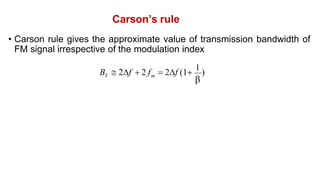
• Carson rule gives the approximate value of transmission bandwidth of
FM signal irrespective of the modulation index

B  2f  2 f  2f (1
1
)
T m
Transmission bandwidth of FM signals
Bandwidth in WBFM:
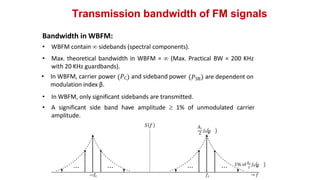
• WBFM contain  sidebands (spectral components).
• Max. theoretical bandwidth in WBFM =  (Max. Practical BW = 200 KHz
with 20 KHz guardbands).
• In WBFM, carrier power 𝑃C and sideband power
modulation index β.
𝑃SB are dependent on
• In WBFM, only significant sidebands are transmitted.
• A significant side band have amplitude  1% of unmodulated carrier
amplitude.
⋯
⋯
𝐴c
2
𝐽0 β
2
1% of Ac
𝐽0 β
𝑓c
—𝑓c
⋯
⋯
→ 𝑓
𝑆 𝑓
Universal curve for evaluating the 1% bandwidth of FM wave
•Carlson’s rule is simple to use, but it does not always provide a good estimate
of the bandwidth
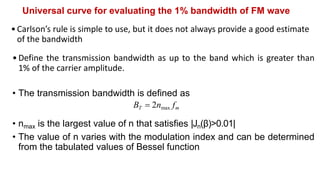
•Define the transmission bandwidth as up to the band which is greater than
1% of the carrier amplitude.
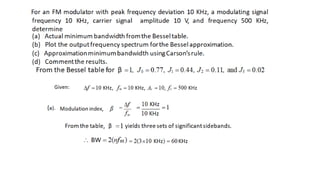
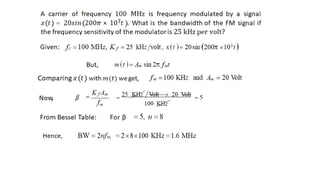
• The transmission bandwidth is defined as
BT  2nmax fm
• nmax is the largest value of n that satisfies |Jn(β)>0.01|
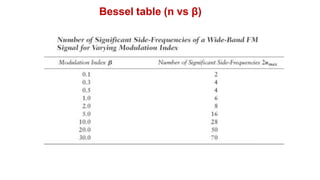
• The value of n varies with the modulation index and can be determined
from the tabulated values of Bessel function
Universal curve for evaluating the 1% bandwidth of FM wave
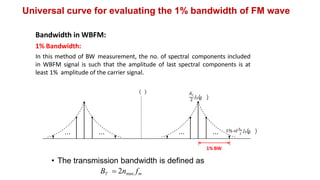
Bandwidth in WBFM:
1% Bandwidth:
In this method of BW measurement, the no. of spectral components included
in WBFM signal is such that the amplitude of last spectral components is at
least 1% amplitude of the carrier signal.
⋯
⋯
𝐴c
2
𝐽0 β
2
1% of Ac
𝐽0 β
⋯
⋯
1% BW
• The transmission bandwidth is defined as
BT  2nmax fm
Universal curve for evaluating the 1% bandwidth of FM wave
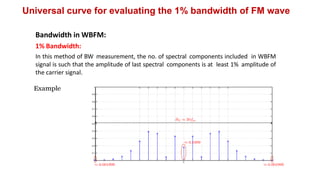
Bandwidth in WBFM:
1% Bandwidth:
In this method of BW measurement, the no. of spectral components included in WBFM
signal is such that the amplitude of last spectral components is at least 1% amplitude of
the carrier signal.
Bessel table (n vs β)
Universal curve for evaluating the 1% bandwidth of FM wave
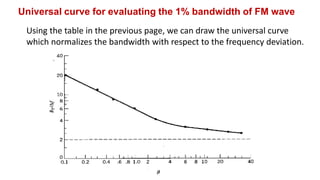
Using the table in the previous page, we can draw the universal curve
which normalizes the bandwidth with respect to the frequency deviation.
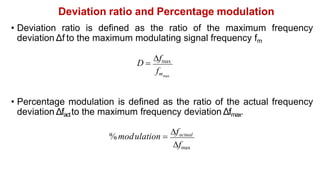
Deviation ratio and Percentage modulation
max
• Deviation ratio is defined as the ratio of the maximum frequency
deviation Δf to the maximum modulating signal frequency fm
D 
fmax
fm
• Percentage modulation is defined as the ratio of the actual frequency
deviation Δfactto the maximum frequency deviation Δfmax.
%modulation 
factual
fmax
Problems
• (a). Determine the peak frequency deviation and modulation index for
the FM modulator with a deviation sensitivity 5 KHz/V and a modulating
signal Vm(t)=2cos(2πХ2000t)
• (b). Determine the peak phase deviation and modulation index for the
FM modulator with a deviation sensitivity 2.5 rad/V and a modulating
signal Vm(t)=2cos(2πХ2000t)
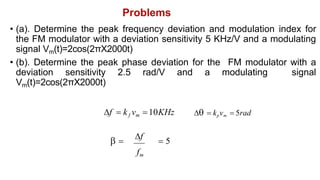
Problems
• (a). Determine the peak frequency deviation and modulation index for
the FM modulator with a deviation sensitivity 5 KHz/V and a modulating
signal Vm(t)=2cos(2πХ2000t)
• (b). Determine the peak phase deviation for the FM modulator with a
deviation sensitivity 2.5 rad/V and a modulating signal
Vm(t)=2cos(2πХ2000t)
f  kf vm 10KHz
 
f
 5
fm
  kpvm  5rad
Problems
• An FM wave is represented by the equation
6 4
VFM (t) 10sin[810 t  6sin310 t]
• Calculate the modulating frequency, carrier frequency, modulation index,
frequency deviation
Problems
• An FM wave is represented by the equation
6 4
VFM (t) 10sin[810 t  6sin310 t]
• Calculate the modulating frequency, carrier frequency, modulation index,
frequency deviation
• Comparing with the standard FM equation
VFM (t)  Ac cos[2fct   sin 2fmt]
fm  4.77KHz
fc 1.27MHz
  6
f  28.62KHz
Problems
• A sinusoidal modulating waveform of amplitude 5 V and a frequency of 2
KHz is applied to FM generator, which has a frequency sensitivity of 40
Hz/volt. Calculate the frequency deviation, modulation index, and
bandwidth.
Problems
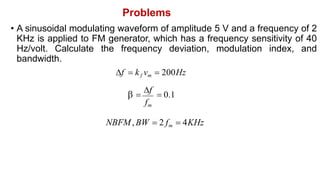
• A sinusoidal modulating waveform of amplitude 5 V and a frequency of 2
KHz is applied to FM generator, which has a frequency sensitivity of 40
Hz/volt. Calculate the frequency deviation, modulation index, and
bandwidth.
f  kf vm  200Hz
 
f
 0.1
fm
NBFM, BW  2 fm  4KHz
Problems
• An FM wave is represented by the equation
VFM (t)  20cos[8 106 t 9sin 2 103 t]
• Calculate the frequency deviation, bandwidth and power
Problems
2R
• An FM wave is represented by the equation
VFM (t)  20cos[8 106 t 9sin 2 103 t]
• Calculate the frequency deviation, bandwidth and the average power
f  fm  9KHz
BW  2(f  fm )  20KHz
V 2
P  c
 200W
Problems
• In India, the maximum value of frequency deviation is fixed at 75 KHz for
commercial FM broadcasting by radio. If we take modulating frequency
is 15 KHz, which is typically the maximum audio frequency of interest in
FM transmission, find the deviation ratio and compare the bandwidth
obtained using Carson rule and universal curve method.
Problems
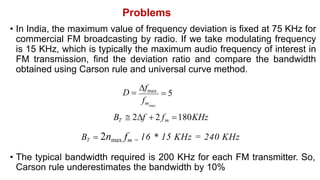
• In India, the maximum value of frequency deviation is fixed at 75 KHz for
commercial FM broadcasting by radio. If we take modulating frequency
is 15 KHz, which is typically the maximum audio frequency of interest in
FM transmission, find the deviation ratio and compare the bandwidth
obtained using Carson rule and universal curve method.
BT  2f  2 fm 180KHz
BT  2nmax fm = 16 * 15 KHz = 240 KHz
• The typical bandwidth required is 200 KHz for each FM transmitter. So,
Carson rule underestimates the bandwidth by 10%
 5
max
fm
D 
fmax
Bessel table (n vs β)
13 Transmission_bandwidth_of_FM_signals.pdf

13 Transmission_bandwidth_of_FM_signals.pdf

  • 1.
    Transmission bandwidth ofFM signals • Theoretically, an FM signal consists of infinite number of side frequencies so the bandwidth required to transmit such signals is infinite • Practically, the FM signal is limited to finite number of side frequencies with specified amount of distortion
  • 2.
    Carson’s rule • Carsonrule gives the approximate value of transmission bandwidth of FM signal irrespective of the modulation index  B  2f  2 f  2f (1 1 ) T m
  • 3.
    Transmission bandwidth ofFM signals Bandwidth in WBFM: • WBFM contain  sidebands (spectral components). • Max. theoretical bandwidth in WBFM =  (Max. Practical BW = 200 KHz with 20 KHz guardbands). • In WBFM, carrier power 𝑃C and sideband power modulation index β. 𝑃SB are dependent on • In WBFM, only significant sidebands are transmitted. • A significant side band have amplitude  1% of unmodulated carrier amplitude. ⋯ ⋯ 𝐴c 2 𝐽0 β 2 1% of Ac 𝐽0 β 𝑓c —𝑓c ⋯ ⋯ → 𝑓 𝑆 𝑓
  • 4.
    Universal curve forevaluating the 1% bandwidth of FM wave •Carlson’s rule is simple to use, but it does not always provide a good estimate of the bandwidth •Define the transmission bandwidth as up to the band which is greater than 1% of the carrier amplitude. • The transmission bandwidth is defined as BT  2nmax fm • nmax is the largest value of n that satisfies |Jn(β)>0.01| • The value of n varies with the modulation index and can be determined from the tabulated values of Bessel function
  • 5.
    Universal curve forevaluating the 1% bandwidth of FM wave Bandwidth in WBFM: 1% Bandwidth: In this method of BW measurement, the no. of spectral components included in WBFM signal is such that the amplitude of last spectral components is at least 1% amplitude of the carrier signal. ⋯ ⋯ 𝐴c 2 𝐽0 β 2 1% of Ac 𝐽0 β ⋯ ⋯ 1% BW • The transmission bandwidth is defined as BT  2nmax fm
  • 6.
    Universal curve forevaluating the 1% bandwidth of FM wave Bandwidth in WBFM: 1% Bandwidth: In this method of BW measurement, the no. of spectral components included in WBFM signal is such that the amplitude of last spectral components is at least 1% amplitude of the carrier signal.
  • 7.
  • 8.
    Universal curve forevaluating the 1% bandwidth of FM wave Using the table in the previous page, we can draw the universal curve which normalizes the bandwidth with respect to the frequency deviation.
  • 9.
    Deviation ratio andPercentage modulation max • Deviation ratio is defined as the ratio of the maximum frequency deviation Δf to the maximum modulating signal frequency fm D  fmax fm • Percentage modulation is defined as the ratio of the actual frequency deviation Δfactto the maximum frequency deviation Δfmax. %modulation  factual fmax
  • 10.
    Problems • (a). Determinethe peak frequency deviation and modulation index for the FM modulator with a deviation sensitivity 5 KHz/V and a modulating signal Vm(t)=2cos(2πХ2000t) • (b). Determine the peak phase deviation and modulation index for the FM modulator with a deviation sensitivity 2.5 rad/V and a modulating signal Vm(t)=2cos(2πХ2000t)
  • 11.
    Problems • (a). Determinethe peak frequency deviation and modulation index for the FM modulator with a deviation sensitivity 5 KHz/V and a modulating signal Vm(t)=2cos(2πХ2000t) • (b). Determine the peak phase deviation for the FM modulator with a deviation sensitivity 2.5 rad/V and a modulating signal Vm(t)=2cos(2πХ2000t) f  kf vm 10KHz   f  5 fm   kpvm  5rad
  • 12.
    Problems • An FMwave is represented by the equation 6 4 VFM (t) 10sin[810 t  6sin310 t] • Calculate the modulating frequency, carrier frequency, modulation index, frequency deviation
  • 13.
    Problems • An FMwave is represented by the equation 6 4 VFM (t) 10sin[810 t  6sin310 t] • Calculate the modulating frequency, carrier frequency, modulation index, frequency deviation • Comparing with the standard FM equation VFM (t)  Ac cos[2fct   sin 2fmt] fm  4.77KHz fc 1.27MHz   6 f  28.62KHz
  • 14.
    Problems • A sinusoidalmodulating waveform of amplitude 5 V and a frequency of 2 KHz is applied to FM generator, which has a frequency sensitivity of 40 Hz/volt. Calculate the frequency deviation, modulation index, and bandwidth.
  • 15.
    Problems • A sinusoidalmodulating waveform of amplitude 5 V and a frequency of 2 KHz is applied to FM generator, which has a frequency sensitivity of 40 Hz/volt. Calculate the frequency deviation, modulation index, and bandwidth. f  kf vm  200Hz   f  0.1 fm NBFM, BW  2 fm  4KHz
  • 16.
    Problems • An FMwave is represented by the equation VFM (t)  20cos[8 106 t 9sin 2 103 t] • Calculate the frequency deviation, bandwidth and power
  • 17.
    Problems 2R • An FMwave is represented by the equation VFM (t)  20cos[8 106 t 9sin 2 103 t] • Calculate the frequency deviation, bandwidth and the average power f  fm  9KHz BW  2(f  fm )  20KHz V 2 P  c  200W
  • 18.
    Problems • In India,the maximum value of frequency deviation is fixed at 75 KHz for commercial FM broadcasting by radio. If we take modulating frequency is 15 KHz, which is typically the maximum audio frequency of interest in FM transmission, find the deviation ratio and compare the bandwidth obtained using Carson rule and universal curve method.
  • 19.
    Problems • In India,the maximum value of frequency deviation is fixed at 75 KHz for commercial FM broadcasting by radio. If we take modulating frequency is 15 KHz, which is typically the maximum audio frequency of interest in FM transmission, find the deviation ratio and compare the bandwidth obtained using Carson rule and universal curve method. BT  2f  2 fm 180KHz BT  2nmax fm = 16 * 15 KHz = 240 KHz • The typical bandwidth required is 200 KHz for each FM transmitter. So, Carson rule underestimates the bandwidth by 10%  5 max fm D  fmax
  • 24.