Angle (Exponential) Modulation
A Historical Note
2
Prepared By: Mohsin Yousuf, FAST NU, LHR
 The constant search for techniques that lower static noise
in the communication lead to the exploring of angle
modulation.
 Noise power is proportional to modulated signal
bandwidth (sidebands) and it was thought that FM
(Frequency Modulation), where the carrier frequency is
varied in proportion to the message 𝑚(𝑡), thus
 𝐴 cos 𝜔𝑐(𝑡) becomes 𝐴 cos[𝜔𝑐 + 𝑘𝑚(𝑡)], where 𝑘 is an
arbitrary constant.
 The bandwidth for peak 𝑚𝑝 would be 2𝑘𝑚𝑝 centered at 𝜔𝑐.
So, by selecting a small 𝑘, we can reduce the bandwidth as
we please.
 However, the experimental results were not as expected.
Concept of Instantaneous Frequency
3
Prepared By: Mohsin Yousuf, FAST NU, LHR
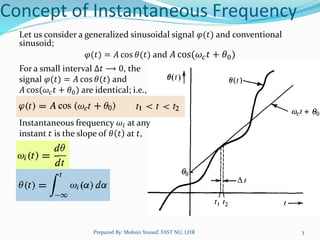
Let us consider a generalized sinusoidal signal 𝜑(𝑡) and conventional
sinusoid;
𝜑(𝑡) = 𝐴 cos 𝜃(𝑡) and 𝐴 cos(𝜔𝑐𝑡 + 𝜃0)
For a small interval ∆𝑡 ⟶ 0, the
signal 𝜑(𝑡) = 𝐴 cos 𝜃(𝑡) and
𝐴 cos(𝜔𝑐𝑡 + 𝜃0) are identical; i.e.,
Instantaneous frequency 𝜔𝑖 at any
instant 𝑡 is the slope of 𝜃 𝑡 at 𝑡,
Concept of Instantaneous Frequency
4
Prepared By: Mohsin Yousuf, FAST NU, LHR
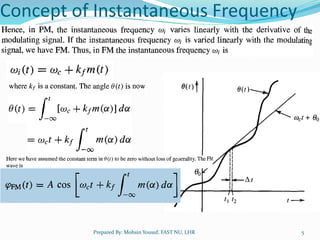
Concept of Instantaneous Frequency
5
Prepared By: Mohsin Yousuf, FAST NU, LHR
Generalized Concept of Angle Modulation
6
Prepared By: Mohsin Yousuf, FAST NU, LHR
Generalized Concept of Angle Modulation
7
Prepared By: Mohsin Yousuf, FAST NU, LHR
Generalized Concept of Angle Modulation
8
Prepared By: Mohsin Yousuf, FAST NU, LHR
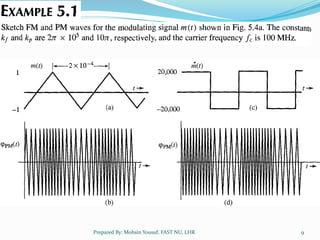
Prepared By: Mohsin Yousuf, FAST NU, LHR 9
Prepared By: Mohsin Yousuf, FAST NU, LHR 10
FSK PSK
Prepared By: Mohsin Yousuf, FAST NU, LHR 11
PSK
Prepared By: Mohsin Yousuf, FAST NU, LHR 12
PSK
When 𝑚(𝑡) is a digital signal, 𝜑𝑃𝑀(𝑡) shows a phase discontinuity where 𝑚 𝑡 has a jump
discontinuity. In such cases 𝑘𝑝𝑚 𝑡 must be restricted to a range (−𝜋, 𝜋) in order to avoid
ambiguity in demodulation. Because a phase 𝜑0 + 2𝑛𝜋 is indistinguishable from the phase
𝜑0 in the demodulator. In addition, 𝑘𝑝 should be small enough to restrict phase change.
Prepared By: Mohsin Yousuf, FAST NU, LHR 13
PSK
FSK
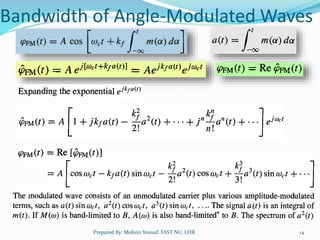
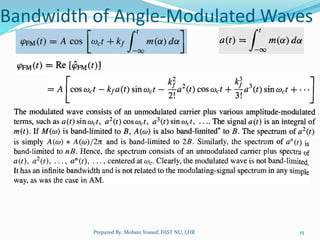
Bandwidth of Angle-Modulated Waves
Prepared By: Mohsin Yousuf, FAST NU, LHR 14
Bandwidth of Angle-Modulated Waves
Prepared By: Mohsin Yousuf, FAST NU, LHR 15
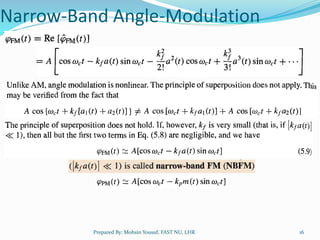
Narrow-Band Angle-Modulation
Prepared By: Mohsin Yousuf, FAST NU, LHR 16
Narrow-Band PM & FM wave generation
Prepared By: Mohsin Yousuf, FAST NU, LHR 17
Wide-band FM (WBFM): The Fallacy Exposed
Prepared By: Mohsin Yousuf, FAST NU, LHR 18
If 𝑘𝑓𝑎(𝑡) ≪ 1 is not satisfied, we can not ignore the higher-order terms.
Wide-band FM (WBFM): The Fallacy Exposed
Prepared By: Mohsin Yousuf, FAST NU, LHR 19
Max Freq: 𝜔𝑐 + 𝑘𝑓𝑚𝑝 + 4𝜋𝐵
Min Freq: 𝜔𝑐 − 𝑘𝑓𝑚𝑝 − 4𝜋𝐵
Spectrum BW: 2𝑘𝑓𝑚𝑝 + 8𝜋𝐵
Wide-band FM (WBFM): The Fallacy Exposed
Prepared By: Mohsin Yousuf, FAST NU, LHR 20
Spectrum BW: 2𝑘𝑓𝑚𝑝 + 8𝜋𝐵
The deviation of the carrier frequency is ∆𝜔 = ±𝑘𝑓𝑚𝑝
Carrier frequency deviation in Hertz is ∆𝑓 =
𝑘𝑓𝑚𝑝
2𝜋
The estimated bandwidth (in Hz) can be expressed as:
𝐵𝐹𝑀 =
1
2𝜋
2𝑘𝑓𝑚𝑝 + 8𝜋𝐵
= 2 ∆𝑓 + 2𝐵
Carson′
s Rule: 2 ∆𝑓 + 𝐵
= 2
𝑘𝑓𝑚𝑝
2𝜋
+ 𝐵
Deviation Ratio: 𝛽 =
∆𝑓
𝐵
𝐵𝐹𝑀 = 2𝐵(𝛽 + 1)
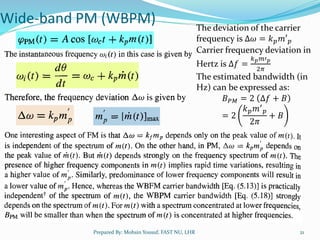
Wide-band PM (WBPM)
Prepared By: Mohsin Yousuf, FAST NU, LHR 21
The deviation of the carrier
frequency is ∆𝜔 = 𝑘𝑝𝑚′𝑝
Carrier frequency deviation in
Hertz is ∆𝑓 =
𝑘𝑝𝑚′𝑝
2𝜋
The estimated bandwidth (in
Hz) can be expressed as:
𝐵𝑃𝑀 = 2 ∆𝑓 + 𝐵
= 2
𝑘𝑝𝑚′
𝑝
2𝜋
+ 𝐵
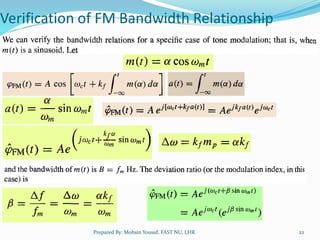
Verification of FM Bandwidth Relationship
Prepared By: Mohsin Yousuf, FAST NU, LHR 22
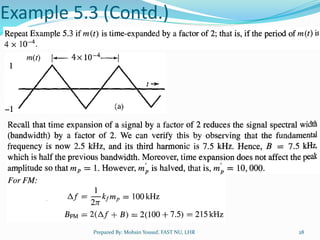
Example 5.3
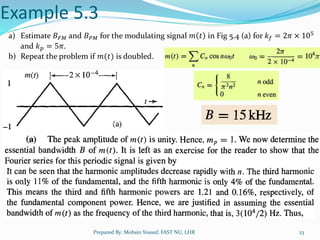
Prepared By: Mohsin Yousuf, FAST NU, LHR 23
a) Estimate 𝐵𝐹𝑀 and 𝐵𝑃𝑀 for the modulating signal 𝑚 𝑡 in Fig 5.4 (a) for 𝑘𝑓 = 2𝜋 × 105
and 𝑘𝑝 = 5𝜋.
b) Repeat the problem if 𝑚(𝑡) is doubled.
Example 5.3 (Contd.)
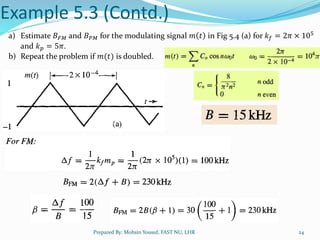
Prepared By: Mohsin Yousuf, FAST NU, LHR 24
a) Estimate 𝐵𝐹𝑀 and 𝐵𝑃𝑀 for the modulating signal 𝑚 𝑡 in Fig 5.4 (a) for 𝑘𝑓 = 2𝜋 × 105
and 𝑘𝑝 = 5𝜋.
b) Repeat the problem if 𝑚(𝑡) is doubled.
Example 5.3 (Contd.)
Prepared By: Mohsin Yousuf, FAST NU, LHR 25
a) Estimate 𝐵𝐹𝑀 and 𝐵𝑃𝑀 for the modulating signal 𝑚 𝑡 in Fig 5.4 (a) for 𝑘𝑓 = 2𝜋 × 105
and 𝑘𝑝 = 5𝜋.
b) Repeat the problem if 𝑚(𝑡) is doubled.
Example 5.3 (Contd.)
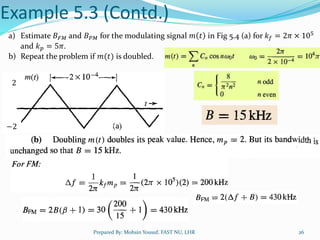
Prepared By: Mohsin Yousuf, FAST NU, LHR 26
a) Estimate 𝐵𝐹𝑀 and 𝐵𝑃𝑀 for the modulating signal 𝑚 𝑡 in Fig 5.4 (a) for 𝑘𝑓 = 2𝜋 × 105
and 𝑘𝑝 = 5𝜋.
b) Repeat the problem if 𝑚(𝑡) is doubled.
2
−2
Example 5.3 (Contd.)
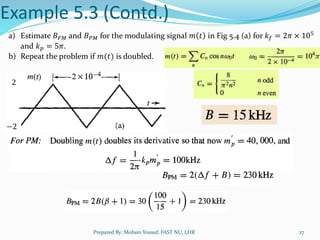
Prepared By: Mohsin Yousuf, FAST NU, LHR 27
a) Estimate 𝐵𝐹𝑀 and 𝐵𝑃𝑀 for the modulating signal 𝑚 𝑡 in Fig 5.4 (a) for 𝑘𝑓 = 2𝜋 × 105
and 𝑘𝑝 = 5𝜋.
b) Repeat the problem if 𝑚(𝑡) is doubled.
2
−2
Example 5.3 (Contd.)
Prepared By: Mohsin Yousuf, FAST NU, LHR 28
4
Example 5.3 (Contd.)
Prepared By: Mohsin Yousuf, FAST NU, LHR 29
4
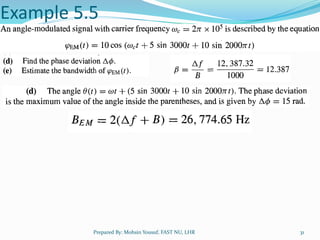
Example 5.5
Prepared By: Mohsin Yousuf, FAST NU, LHR 30
Example 5.5
Prepared By: Mohsin Yousuf, FAST NU, LHR 31

Chapter 5 Angle Modulation (Part 1).pptx

  • 1.
  • 2.
    A Historical Note 2 PreparedBy: Mohsin Yousuf, FAST NU, LHR  The constant search for techniques that lower static noise in the communication lead to the exploring of angle modulation.  Noise power is proportional to modulated signal bandwidth (sidebands) and it was thought that FM (Frequency Modulation), where the carrier frequency is varied in proportion to the message 𝑚(𝑡), thus  𝐴 cos 𝜔𝑐(𝑡) becomes 𝐴 cos[𝜔𝑐 + 𝑘𝑚(𝑡)], where 𝑘 is an arbitrary constant.  The bandwidth for peak 𝑚𝑝 would be 2𝑘𝑚𝑝 centered at 𝜔𝑐. So, by selecting a small 𝑘, we can reduce the bandwidth as we please.  However, the experimental results were not as expected.
  • 3.
    Concept of InstantaneousFrequency 3 Prepared By: Mohsin Yousuf, FAST NU, LHR Let us consider a generalized sinusoidal signal 𝜑(𝑡) and conventional sinusoid; 𝜑(𝑡) = 𝐴 cos 𝜃(𝑡) and 𝐴 cos(𝜔𝑐𝑡 + 𝜃0) For a small interval ∆𝑡 ⟶ 0, the signal 𝜑(𝑡) = 𝐴 cos 𝜃(𝑡) and 𝐴 cos(𝜔𝑐𝑡 + 𝜃0) are identical; i.e., Instantaneous frequency 𝜔𝑖 at any instant 𝑡 is the slope of 𝜃 𝑡 at 𝑡,
  • 4.
    Concept of InstantaneousFrequency 4 Prepared By: Mohsin Yousuf, FAST NU, LHR
  • 5.
    Concept of InstantaneousFrequency 5 Prepared By: Mohsin Yousuf, FAST NU, LHR
  • 6.
    Generalized Concept ofAngle Modulation 6 Prepared By: Mohsin Yousuf, FAST NU, LHR
  • 7.
    Generalized Concept ofAngle Modulation 7 Prepared By: Mohsin Yousuf, FAST NU, LHR
  • 8.
    Generalized Concept ofAngle Modulation 8 Prepared By: Mohsin Yousuf, FAST NU, LHR
  • 9.
    Prepared By: MohsinYousuf, FAST NU, LHR 9
  • 10.
    Prepared By: MohsinYousuf, FAST NU, LHR 10 FSK PSK
  • 11.
    Prepared By: MohsinYousuf, FAST NU, LHR 11 PSK
  • 12.
    Prepared By: MohsinYousuf, FAST NU, LHR 12 PSK When 𝑚(𝑡) is a digital signal, 𝜑𝑃𝑀(𝑡) shows a phase discontinuity where 𝑚 𝑡 has a jump discontinuity. In such cases 𝑘𝑝𝑚 𝑡 must be restricted to a range (−𝜋, 𝜋) in order to avoid ambiguity in demodulation. Because a phase 𝜑0 + 2𝑛𝜋 is indistinguishable from the phase 𝜑0 in the demodulator. In addition, 𝑘𝑝 should be small enough to restrict phase change.
  • 13.
    Prepared By: MohsinYousuf, FAST NU, LHR 13 PSK FSK
  • 14.
    Bandwidth of Angle-ModulatedWaves Prepared By: Mohsin Yousuf, FAST NU, LHR 14
  • 15.
    Bandwidth of Angle-ModulatedWaves Prepared By: Mohsin Yousuf, FAST NU, LHR 15
  • 16.
    Narrow-Band Angle-Modulation Prepared By:Mohsin Yousuf, FAST NU, LHR 16
  • 17.
    Narrow-Band PM &FM wave generation Prepared By: Mohsin Yousuf, FAST NU, LHR 17
  • 18.
    Wide-band FM (WBFM):The Fallacy Exposed Prepared By: Mohsin Yousuf, FAST NU, LHR 18 If 𝑘𝑓𝑎(𝑡) ≪ 1 is not satisfied, we can not ignore the higher-order terms.
  • 19.
    Wide-band FM (WBFM):The Fallacy Exposed Prepared By: Mohsin Yousuf, FAST NU, LHR 19 Max Freq: 𝜔𝑐 + 𝑘𝑓𝑚𝑝 + 4𝜋𝐵 Min Freq: 𝜔𝑐 − 𝑘𝑓𝑚𝑝 − 4𝜋𝐵 Spectrum BW: 2𝑘𝑓𝑚𝑝 + 8𝜋𝐵
  • 20.
    Wide-band FM (WBFM):The Fallacy Exposed Prepared By: Mohsin Yousuf, FAST NU, LHR 20 Spectrum BW: 2𝑘𝑓𝑚𝑝 + 8𝜋𝐵 The deviation of the carrier frequency is ∆𝜔 = ±𝑘𝑓𝑚𝑝 Carrier frequency deviation in Hertz is ∆𝑓 = 𝑘𝑓𝑚𝑝 2𝜋 The estimated bandwidth (in Hz) can be expressed as: 𝐵𝐹𝑀 = 1 2𝜋 2𝑘𝑓𝑚𝑝 + 8𝜋𝐵 = 2 ∆𝑓 + 2𝐵 Carson′ s Rule: 2 ∆𝑓 + 𝐵 = 2 𝑘𝑓𝑚𝑝 2𝜋 + 𝐵 Deviation Ratio: 𝛽 = ∆𝑓 𝐵 𝐵𝐹𝑀 = 2𝐵(𝛽 + 1)
  • 21.
    Wide-band PM (WBPM) PreparedBy: Mohsin Yousuf, FAST NU, LHR 21 The deviation of the carrier frequency is ∆𝜔 = 𝑘𝑝𝑚′𝑝 Carrier frequency deviation in Hertz is ∆𝑓 = 𝑘𝑝𝑚′𝑝 2𝜋 The estimated bandwidth (in Hz) can be expressed as: 𝐵𝑃𝑀 = 2 ∆𝑓 + 𝐵 = 2 𝑘𝑝𝑚′ 𝑝 2𝜋 + 𝐵
  • 22.
    Verification of FMBandwidth Relationship Prepared By: Mohsin Yousuf, FAST NU, LHR 22
  • 23.
    Example 5.3 Prepared By:Mohsin Yousuf, FAST NU, LHR 23 a) Estimate 𝐵𝐹𝑀 and 𝐵𝑃𝑀 for the modulating signal 𝑚 𝑡 in Fig 5.4 (a) for 𝑘𝑓 = 2𝜋 × 105 and 𝑘𝑝 = 5𝜋. b) Repeat the problem if 𝑚(𝑡) is doubled.
  • 24.
    Example 5.3 (Contd.) PreparedBy: Mohsin Yousuf, FAST NU, LHR 24 a) Estimate 𝐵𝐹𝑀 and 𝐵𝑃𝑀 for the modulating signal 𝑚 𝑡 in Fig 5.4 (a) for 𝑘𝑓 = 2𝜋 × 105 and 𝑘𝑝 = 5𝜋. b) Repeat the problem if 𝑚(𝑡) is doubled.
  • 25.
    Example 5.3 (Contd.) PreparedBy: Mohsin Yousuf, FAST NU, LHR 25 a) Estimate 𝐵𝐹𝑀 and 𝐵𝑃𝑀 for the modulating signal 𝑚 𝑡 in Fig 5.4 (a) for 𝑘𝑓 = 2𝜋 × 105 and 𝑘𝑝 = 5𝜋. b) Repeat the problem if 𝑚(𝑡) is doubled.
  • 26.
    Example 5.3 (Contd.) PreparedBy: Mohsin Yousuf, FAST NU, LHR 26 a) Estimate 𝐵𝐹𝑀 and 𝐵𝑃𝑀 for the modulating signal 𝑚 𝑡 in Fig 5.4 (a) for 𝑘𝑓 = 2𝜋 × 105 and 𝑘𝑝 = 5𝜋. b) Repeat the problem if 𝑚(𝑡) is doubled. 2 −2
  • 27.
    Example 5.3 (Contd.) PreparedBy: Mohsin Yousuf, FAST NU, LHR 27 a) Estimate 𝐵𝐹𝑀 and 𝐵𝑃𝑀 for the modulating signal 𝑚 𝑡 in Fig 5.4 (a) for 𝑘𝑓 = 2𝜋 × 105 and 𝑘𝑝 = 5𝜋. b) Repeat the problem if 𝑚(𝑡) is doubled. 2 −2
  • 28.
    Example 5.3 (Contd.) PreparedBy: Mohsin Yousuf, FAST NU, LHR 28 4
  • 29.
    Example 5.3 (Contd.) PreparedBy: Mohsin Yousuf, FAST NU, LHR 29 4
  • 30.
    Example 5.5 Prepared By:Mohsin Yousuf, FAST NU, LHR 30
  • 31.
    Example 5.5 Prepared By:Mohsin Yousuf, FAST NU, LHR 31