FISH AGGREGATING
DEVICES(FADs)
Ashish sahu
INTRODUCTION
• structures facilitate attraction and aggregation of fish
• Mediterranean , Southeast Asia and the western and central Pacific Ocean
(WCPO) -FADs for the first time...
• The fishers nicknamed the FAD as “Fish Bank”.
WHAT ARE FADs?
• Permanent, semi-permanent or temporary structure made of any material
used to lure fish
• Drifting or anchored buoys or rafts that attract and aggregate fish
• Easier to find and catch
• Principle- thigmotropism
• Either drifting or anchored
OBJECTIVES
• to enhance biological productivity and fisheries resources,
• to rehabilitate and conserve marine habitats that have been adversely affected
by fishing activities
• to generate the recovery, conservation and increase the fisheries resources
FLOATING OBJECTS AGGREGATES
FISH BECAUSE,
• they provide a refuge from predators
• a meeting place for schooling companions
• a place of orientation
• a substrate for species undergoing a change from pelagic to other
modes of existence
• a feeding place
• they duplicate natural aggregators such as Sargassum seaweed.
Various Hypotheses Of Fish Aggregating
Devices
• Tuna aggregation theories
• Forage base hypothesis
• Predator avoidance
• FADs aggregate prey items for the tunas
• Meeting point hypothesis
• The ecological trap hypothesis
ADVANTAGES
• Biological productivity in the coastal waters.
• Rehabilitate and conserve the depleting stocks.
• Increases the catch rate with a reduction in the cost of production.
• Reducing the scouting time.
• Enhances the fishery resources.
• Enhances the income and standard of living
DESIGN
• Drifting FADs are not attached to the bottom -can be natural objects such as
logs or man-made.
• Moored FADs occupy a fixed location ,attach to the sea bottom using a weight
such as a concrete block.
• A rope made of floating synthetics such as polypropylene attaches to the
mooring and in turn attaches to a buoy.
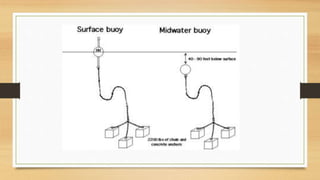
• The buoy can float at the surface (lasting 3–4 years) or lie subsurface (mid water
FAD) to avoid detection and surface hazards such as weather and ship traffic.
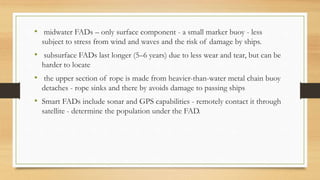
• midwater FADs – only surface component - a small marker buoy - less
subject to stress from wind and waves and the risk of damage by ships.
• subsurface FADs last longer (5–6 years) due to less wear and tear, but can be
harder to locate
• the upper section of rope is made from heavier-than-water metal chain buoy
detaches - rope sinks and there by avoids damage to passing ships
• Smart FADs include sonar and GPS capabilities - remotely contact it through
satellite - determine the population under the FAD.
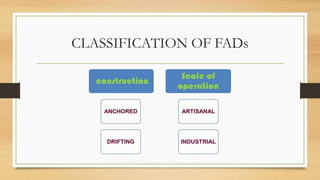
CLASSIFICATION OF FADs
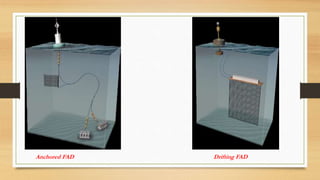
ANCHORED FADs
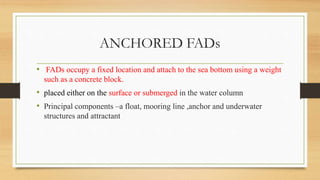
• FADs occupy a fixed location and attach to the sea bottom using a weight
such as a concrete block.
• placed either on the surface or submerged in the water column
• Principal components –a float, mooring line ,anchor and underwater
structures and attractant
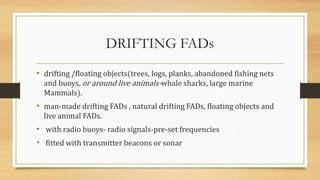
DRIFTING FADs
• drifting /floating objects(trees, logs, planks, abandoned fishing nets
and buoys, or around live animals-whale sharks, large marine
Mammals).
• man-made drifting FADs , natural drifting FADs, floating objects and
live animal FADs.
• with radio buoys- radio signals-pre-set frequencies
• fitted with transmitter beacons or sonar
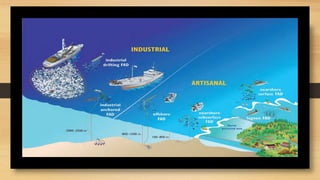
Anchored FAD Drifting FAD
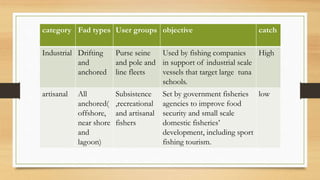
category Fad types User groups objective catch
Industrial Drifting
and
anchored
Purse seine
and pole and

line fleets
Used by fishing companies
in support of industrial scale
vessels that target large tuna
schools.
High
artisanal All
anchored(
offshore,
near shore
and
lagoon)
Subsistence
,recreational
and artisanal
fishers
Set by government fisheries
agencies to improve food
security and small scale
domestic fisheries’
development, including sport
fishing tourism.
low
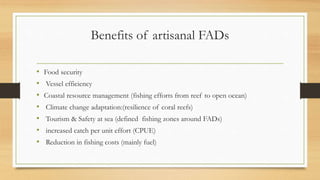
Benefits of artisanal FADs
• Food security
• Vessel efficiency
• Coastal resource management (fishing efforts from reef to open ocean)
• Climate change adaptation:(resilience of coral reefs)
• Tourism & Safety at sea (defined fishing zones around FADs)
• increased catch per unit effort (CPUE)
• Reduction in fishing costs (mainly fuel)
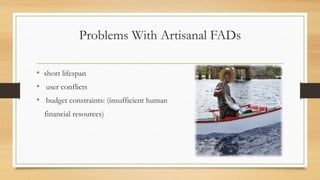
Problems With Artisanal FADs
• short lifespan
• user conflicts
• budget constraints: (insufficient human
financial resources)
Benefits Of Industrial FADs
• Increased catch rate
• Efficiency.
• Domestic development.
• Distribution of effort and license revenue( to some EEZs where fishing on
non-FAD schools is inefficient.
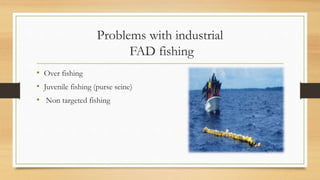
Problems with industrial
FAD fishing
• Over fishing
• Juvenile fishing (purse seine)
• Non targeted fishing
SITE SELECTION CRITERIA FOR
INSTALLATION OF FAD
• firm seabed with sandy bottom & areas with a gentle sloping sea floor than a
steep drop-off
• free from strong currents & should be accessible to fishermen.
• should have adequate water quality
• selected area should be away from navigational routes .
• reasonable depth of water (750 to 1500 m for offshore FADs and 200 to 400 m
for inshore FADs),distance between two FADs (usually 10 - 12 nm apart).
tions For Anchored FAD Sites
• away from the coast, reefs, reserves or whale sanctuaries so as not to interfere
with natural fish aggregations.
• 4–5nm from the shore or reefs & 10–12 nm apart,
• water depth -100 and 1500m
• currents-stronger near narrow passes and around points-area should be avoided.
• shipping lanes, submarine communications cables, underwater pipelines, and any
other submarine structures can be avoided.
• permit to install from the competent authorities and a detailed survey initiated.
MATERIAL SELECTION FOR FAD
• Should be durable & long lasting
• Should be cheap & easily available
• Should not have toxic content
• Ease of handling & transportation
CONSTRUCTION
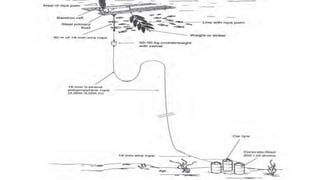
• Anchored FAD - principal components: an upper mooring, a lower mooring,
and a catenary curve.
• The main cost-in the mooring line - the deeper the FAD site, the greater the
cost.
• Braided mooring rope is undoubtedly stronger than three-strand rope & not
having the propensity to twist,but cost 2 - 3times.
• Other factors -type of buoy and the type and size of anchor.
• radar reflectors, solar panels, GPS homing transmitters and echo
sounder
• Concrete and grapnel anchors - expensive
• Steel and cement readily available ,have to be transported great distances
or imported
• Abandoned machinery parts- complete removal of oil, fluids or any
other toxic materials
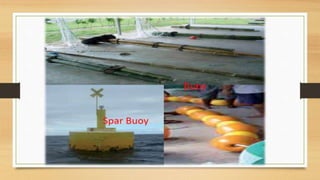
BUOYS
• FAD buoys usually have some sort of flag, light, or radar reflector or a
combination of all.
• Lights, radar reflectors, electronic devices such as solar panels, GPS homing
transmitters, and echo sounders =cost of buoy.
• Some are more sophisticated with solar panels to charge batteries for the lights
echo sounders and sensors (to monitor SST), transmit this data to a vessel or
land station.
• Anchored FADs can also be equipped with a locator beacon.
MOORING ROPE
• entire length of mooring or anchor line - about 120 percent of the depth of
water(20%-scope & 100%-mooring line).
• scope-creating additional jerking forces on the mooring line
• avoid anchored FAD loss-have too much scope on the surface or on the
bottom, the principle of the catenary.
• chain in the upper mooring - anchored spar buoy FADs-counterweight -spar
upright and reduce theft and vandalism.
ANCHOR SYSTEM
• keep the FADs in its proper location
• FAD anchors -concrete blocks , discarded machinery such as forklift
counterweights , oil drums filled with steel tyre rims and concrete , or
grapnel anchors made from steel pipe and rebar.
• Concrete block anchors and rebar grapnel anchors can be expensive to
fabricate.
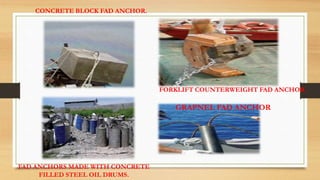
CONCRETE BLOCK FAD ANCHOR.
FORKLIFT COUNTERWEIGHT FAD ANCHOR.
FAD ANCHORS MADE WITH CONCRETE
FILLED STEEL OIL DRUMS.
GRAPNEL FAD ANCHOR
AGGREGATORS
• aggregators-attached to the buoy
• or the upper mooring line.
• of old rope, discarded fishing net,
• plastic strapping, mussel rope,
• coconut & nipa frond, mangrove leaves, rubber tyres.
• any material (bio-degradable material - prefers) aggregate fish by increasing the surface
area for marine growth
• Plastic straps-most effective material for appendages-durable, inexpensive, present
minimal drag on FADs system and simple to attach to the mooring line.
FAD DEPLOYMENT
1. Buoy first method
• Safest method
• deploy the buoy at the site and then steam in a big circle(circumference =
length of mooring), .
• As the vessel- to the original site -all of the mooring rope - in the water
• then anchor is connected to the mooring and deployed.
2. Straight line method.
• buoy is deployed at a distance away from the actual anchored FAD site equal to
¾ of the length of the mooring.
• The vessel then steams toward the site- paying out the mooring rope.
• It passes over the site continuing to pay out the remaining ¼th of mooring rope.
• Then the anchor is connected to the mooring rope and deployed.
• The drag of the mooring and buoy should pull the anchor to the chosen
anchored FAD site, much like a pendulum.
MAINTENANCE
• upper mooring -most damage and wear and tear occurs.
• most vulnerable parts -steel components –shackles & swivels.
• buoy and top end of the upper mooring should be hauled onto the
boat for inspection and repair.
• buoy, flag, radar reflector, and any lights or electronic devices -
serviced at this time.
Risks And Threats For & By Anchored FAD
• Over exploitation
• Anchored FADs in wrong place-disturb delicate ecosystems.
• FADs too close together-increased investment coast
• marine debris:-Anchored FADs break from their moorings
• short life span
• pollute beaches and reefs and the open seas
• ghost fishing
• alteration of the benthic environment
• creating a hazard to navigation
• introduction of synthetic materials into the marine food web
• additional clean-up cost
• both anchored FADs and drifting FADs can be a hazard to
shipping and boats, particularly at night.
• conflict between users creates anchored FAD losses and in the
long term can undermine the benefits.
REFERENCE
• Journal of aquatic biology and fisheries :Srinivasa Gopal, T.K.and Leela
Edwin
• Anchored fish aggregating devices for artisanal fisheries in south and
southeast Asia:benefits and risks :Steve Beverly,Don Griffiths and Robert
Lee
THANK YOU

Fish aggrigrating devices(fad)

  • 1.
  • 2.
    INTRODUCTION • structures facilitateattraction and aggregation of fish • Mediterranean , Southeast Asia and the western and central Pacific Ocean (WCPO) -FADs for the first time... • The fishers nicknamed the FAD as “Fish Bank”.
  • 3.
    WHAT ARE FADs? •Permanent, semi-permanent or temporary structure made of any material used to lure fish • Drifting or anchored buoys or rafts that attract and aggregate fish • Easier to find and catch • Principle- thigmotropism • Either drifting or anchored
  • 4.
    OBJECTIVES • to enhancebiological productivity and fisheries resources, • to rehabilitate and conserve marine habitats that have been adversely affected by fishing activities • to generate the recovery, conservation and increase the fisheries resources
  • 5.
    FLOATING OBJECTS AGGREGATES FISHBECAUSE, • they provide a refuge from predators • a meeting place for schooling companions • a place of orientation • a substrate for species undergoing a change from pelagic to other modes of existence • a feeding place • they duplicate natural aggregators such as Sargassum seaweed.
  • 6.
    Various Hypotheses OfFish Aggregating Devices • Tuna aggregation theories • Forage base hypothesis • Predator avoidance • FADs aggregate prey items for the tunas • Meeting point hypothesis • The ecological trap hypothesis
  • 7.
    ADVANTAGES • Biological productivityin the coastal waters. • Rehabilitate and conserve the depleting stocks. • Increases the catch rate with a reduction in the cost of production. • Reducing the scouting time. • Enhances the fishery resources. • Enhances the income and standard of living
  • 8.
    DESIGN • Drifting FADsare not attached to the bottom -can be natural objects such as logs or man-made. • Moored FADs occupy a fixed location ,attach to the sea bottom using a weight such as a concrete block. • A rope made of floating synthetics such as polypropylene attaches to the mooring and in turn attaches to a buoy. • The buoy can float at the surface (lasting 3–4 years) or lie subsurface (mid water FAD) to avoid detection and surface hazards such as weather and ship traffic.
  • 9.
    • midwater FADs– only surface component - a small marker buoy - less subject to stress from wind and waves and the risk of damage by ships. • subsurface FADs last longer (5–6 years) due to less wear and tear, but can be harder to locate • the upper section of rope is made from heavier-than-water metal chain buoy detaches - rope sinks and there by avoids damage to passing ships • Smart FADs include sonar and GPS capabilities - remotely contact it through satellite - determine the population under the FAD.
  • 11.
  • 12.
    ANCHORED FADs • FADsoccupy a fixed location and attach to the sea bottom using a weight such as a concrete block. • placed either on the surface or submerged in the water column • Principal components –a float, mooring line ,anchor and underwater structures and attractant
  • 13.
    DRIFTING FADs • drifting/floating objects(trees, logs, planks, abandoned fishing nets and buoys, or around live animals-whale sharks, large marine Mammals). • man-made drifting FADs , natural drifting FADs, floating objects and live animal FADs. • with radio buoys- radio signals-pre-set frequencies • fitted with transmitter beacons or sonar
  • 14.
  • 15.
    category Fad typesUser groups objective catch Industrial Drifting and anchored Purse seine and pole and line fleets Used by fishing companies in support of industrial scale vessels that target large tuna schools. High artisanal All anchored( offshore, near shore and lagoon) Subsistence ,recreational and artisanal fishers Set by government fisheries agencies to improve food security and small scale domestic fisheries’ development, including sport fishing tourism. low
  • 16.
    Benefits of artisanalFADs • Food security • Vessel efficiency • Coastal resource management (fishing efforts from reef to open ocean) • Climate change adaptation:(resilience of coral reefs) • Tourism & Safety at sea (defined fishing zones around FADs) • increased catch per unit effort (CPUE) • Reduction in fishing costs (mainly fuel)
  • 17.
    Problems With ArtisanalFADs • short lifespan • user conflicts • budget constraints: (insufficient human financial resources)
  • 18.
    Benefits Of IndustrialFADs • Increased catch rate • Efficiency. • Domestic development. • Distribution of effort and license revenue( to some EEZs where fishing on non-FAD schools is inefficient.
  • 19.
    Problems with industrial FADfishing • Over fishing • Juvenile fishing (purse seine) • Non targeted fishing
  • 21.
    SITE SELECTION CRITERIAFOR INSTALLATION OF FAD • firm seabed with sandy bottom & areas with a gentle sloping sea floor than a steep drop-off • free from strong currents & should be accessible to fishermen. • should have adequate water quality • selected area should be away from navigational routes . • reasonable depth of water (750 to 1500 m for offshore FADs and 200 to 400 m for inshore FADs),distance between two FADs (usually 10 - 12 nm apart).
  • 22.
    tions For AnchoredFAD Sites • away from the coast, reefs, reserves or whale sanctuaries so as not to interfere with natural fish aggregations. • 4–5nm from the shore or reefs & 10–12 nm apart, • water depth -100 and 1500m • currents-stronger near narrow passes and around points-area should be avoided. • shipping lanes, submarine communications cables, underwater pipelines, and any other submarine structures can be avoided. • permit to install from the competent authorities and a detailed survey initiated.
  • 23.
    MATERIAL SELECTION FORFAD • Should be durable & long lasting • Should be cheap & easily available • Should not have toxic content • Ease of handling & transportation
  • 24.
    CONSTRUCTION • Anchored FAD- principal components: an upper mooring, a lower mooring, and a catenary curve. • The main cost-in the mooring line - the deeper the FAD site, the greater the cost. • Braided mooring rope is undoubtedly stronger than three-strand rope & not having the propensity to twist,but cost 2 - 3times. • Other factors -type of buoy and the type and size of anchor.
  • 25.
    • radar reflectors,solar panels, GPS homing transmitters and echo sounder • Concrete and grapnel anchors - expensive • Steel and cement readily available ,have to be transported great distances or imported • Abandoned machinery parts- complete removal of oil, fluids or any other toxic materials
  • 26.
    BUOYS • FAD buoysusually have some sort of flag, light, or radar reflector or a combination of all. • Lights, radar reflectors, electronic devices such as solar panels, GPS homing transmitters, and echo sounders =cost of buoy. • Some are more sophisticated with solar panels to charge batteries for the lights echo sounders and sensors (to monitor SST), transmit this data to a vessel or land station. • Anchored FADs can also be equipped with a locator beacon.
  • 28.
    MOORING ROPE • entirelength of mooring or anchor line - about 120 percent of the depth of water(20%-scope & 100%-mooring line). • scope-creating additional jerking forces on the mooring line • avoid anchored FAD loss-have too much scope on the surface or on the bottom, the principle of the catenary. • chain in the upper mooring - anchored spar buoy FADs-counterweight -spar upright and reduce theft and vandalism.
  • 30.
    ANCHOR SYSTEM • keepthe FADs in its proper location • FAD anchors -concrete blocks , discarded machinery such as forklift counterweights , oil drums filled with steel tyre rims and concrete , or grapnel anchors made from steel pipe and rebar. • Concrete block anchors and rebar grapnel anchors can be expensive to fabricate.
  • 31.
    CONCRETE BLOCK FADANCHOR. FORKLIFT COUNTERWEIGHT FAD ANCHOR. FAD ANCHORS MADE WITH CONCRETE FILLED STEEL OIL DRUMS. GRAPNEL FAD ANCHOR
  • 32.
    AGGREGATORS • aggregators-attached tothe buoy • or the upper mooring line. • of old rope, discarded fishing net, • plastic strapping, mussel rope, • coconut & nipa frond, mangrove leaves, rubber tyres. • any material (bio-degradable material - prefers) aggregate fish by increasing the surface area for marine growth • Plastic straps-most effective material for appendages-durable, inexpensive, present minimal drag on FADs system and simple to attach to the mooring line.
  • 33.
    FAD DEPLOYMENT 1. Buoyfirst method • Safest method • deploy the buoy at the site and then steam in a big circle(circumference = length of mooring), . • As the vessel- to the original site -all of the mooring rope - in the water • then anchor is connected to the mooring and deployed.
  • 34.
    2. Straight linemethod. • buoy is deployed at a distance away from the actual anchored FAD site equal to ¾ of the length of the mooring. • The vessel then steams toward the site- paying out the mooring rope. • It passes over the site continuing to pay out the remaining ¼th of mooring rope. • Then the anchor is connected to the mooring rope and deployed. • The drag of the mooring and buoy should pull the anchor to the chosen anchored FAD site, much like a pendulum.
  • 35.
    MAINTENANCE • upper mooring-most damage and wear and tear occurs. • most vulnerable parts -steel components –shackles & swivels. • buoy and top end of the upper mooring should be hauled onto the boat for inspection and repair. • buoy, flag, radar reflector, and any lights or electronic devices - serviced at this time.
  • 36.
    Risks And ThreatsFor & By Anchored FAD • Over exploitation • Anchored FADs in wrong place-disturb delicate ecosystems. • FADs too close together-increased investment coast • marine debris:-Anchored FADs break from their moorings • short life span • pollute beaches and reefs and the open seas
  • 37.
    • ghost fishing •alteration of the benthic environment • creating a hazard to navigation • introduction of synthetic materials into the marine food web • additional clean-up cost • both anchored FADs and drifting FADs can be a hazard to shipping and boats, particularly at night. • conflict between users creates anchored FAD losses and in the long term can undermine the benefits.
  • 38.
    REFERENCE • Journal ofaquatic biology and fisheries :Srinivasa Gopal, T.K.and Leela Edwin • Anchored fish aggregating devices for artisanal fisheries in south and southeast Asia:benefits and risks :Steve Beverly,Don Griffiths and Robert Lee
  • 39.