PRINCIPLE 4 :
LEVEL OUT THE WORKLOAD
(HEIJUNKA)
MET MMS (Operations)
Neha Jagare (60)
Saurabh Kothawade (78)
Omkar Sawant(141)
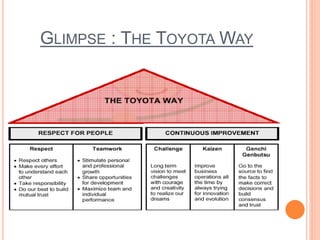
GLIMPSE : THE TOYOTA WAY
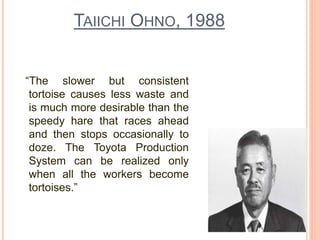
TAIICHI OHNO, 1988
“The slower but consistent
tortoise causes less waste and
is much more desirable than the
speedy hare that races ahead
and then stops occasionally to
doze. The Toyota Production
System can be realized only
when all the workers become
tortoises.”
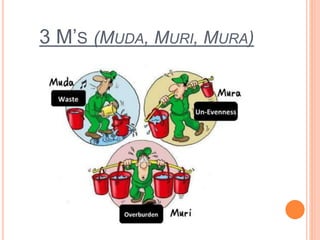
3 M’S (MUDA, MURI, MURA)
LEVEL OUT THE WORKLOAD:
HEIJUNKA
Heijunka is a system of production-leveling that
produces the right product mix as demanded by
the customer by making optimal utilization of the
available capacity
WHAT HEIJUNKA DOES?
 Stabilizes production volume and variety by
consolidating total number of customer orders
 Spreads out the production in an even manner
through-out the day
 Ensures high order fulfillment rate
 Ensures internal production is balanced
 Established capacity is not over or under-utilized
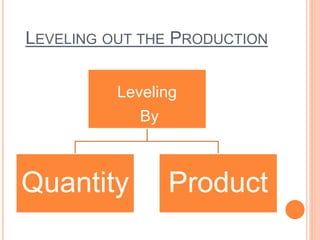
LEVELING OUT THE PRODUCTION
Leveling
By
Quantity Product
WHY IMPLEMENT HEIJUNKA
 Many companies wants to produce what customers
want and when they want
 They follow build-to-order approach
 However customer orders creates uneven
production schedule becomes uneven
 This eventually leads to large amount of inventory ,
hidden problems and poorer quality
 And here arises the need for creating balanced lean
workflow “Heijunka”
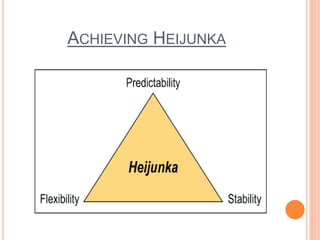
ACHIEVING HEIJUNKA
HOW DOES HEIJUNKA WORK
TRADITIONAL PRODUCTION
(UNLEVELED)
DRAWBACKS
TRADITIONAL PRODUCTION (UNLEVELED)
 Customers do not buy products predictably
 There is risk of unsold goods
 The use of resources is unbalanced
 Placing an uneven demand on upstream
processes
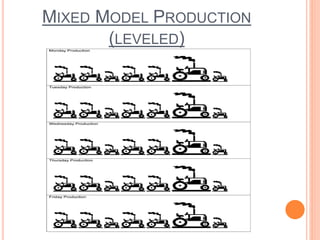
MIXED MODEL PRODUCTION
(LEVELED)
BENEFITS
MIXED MODEL PRODUCTION (LEVELED)
 Flexibility to make what customer wants when
they want it
 Reduced risk of unsold goods
 Balanced use of Labor and Machines
 Smoothed demand on upstream process and the
plant’s suppliers
CHALLENGES OF HEIJUNKA
 Requires major tool redesign to gain flexibility
 Large inventory of finished goods
 Requires a predictable environment as well as
timely-accurate data to implement
 Proper co-ordination with the customer to project
better future demand
 High degree of discipline within the workforce
 Thought out work standards must be followed all
the times
 As there is little operator leeway it can result to
resistance due to lack of flexibility
CHALLENGES OF HEIJUNKA
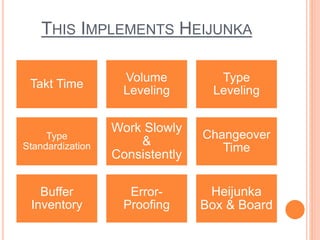
THIS IMPLEMENTS HEIJUNKA
Takt Time
Volume
Leveling
Type
Leveling
Type
Standardization
Work Slowly
&
Consistently
Changeover
Time
Buffer
Inventory
Error-
Proofing
Heijunka
Box & Board
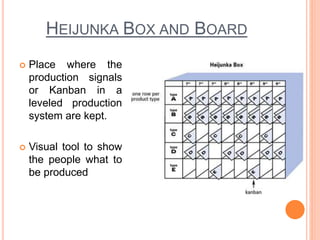
HEIJUNKA BOX AND BOARD
 Place where the
production signals
or Kanban in a
leveled production
system are kept.
 Visual tool to show
the people what to
be produced
LEVELING THE SCHEDULE–
INVENTORY’S ROLE
Heijunka builds inventory to safeguard against
fluctuations. It categorizes inventory into :
Build-to-
Order
inventory
Seasonal
inventory
buffer
Safety
Stock
Buffer Stock
“BUILD TO ORDER”
YET
HEIJUNKA
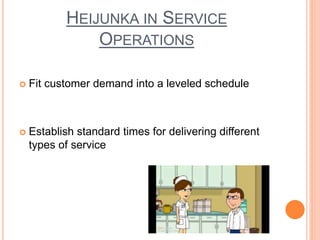
HEIJUNKA IN SERVICE
OPERATIONS
 Fit customer demand into a leveled schedule
 Establish standard times for delivering different
types of service
JUST IN TIME VS. HEIJUNKA
JIT
 Meet customer demand
upon request
 Reduce finished goods
Inventory
 Unpredictable work
schedules
 Overtime occasionally
Heijunka
 Meet customer demand
in total over a given
period of level production
 Finished goods inventory
to make up for short
periods of higher
demands
 Predictable work
schedules
 Overtime savings
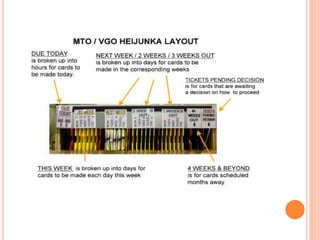
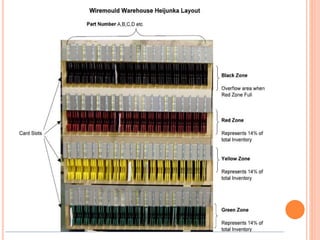
CASE STUDY: 1
Wiremold
CASE STUDY: 2
Building Aluminum Gutters
on a
Level Production Schedule
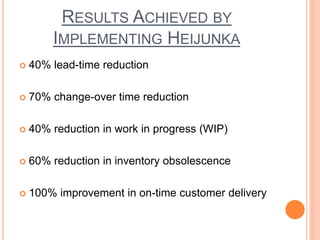
RESULTS ACHIEVED BY
IMPLEMENTING HEIJUNKA
 40% lead-time reduction
 70% change-over time reduction
 40% reduction in work in progress (WIP)
 60% reduction in inventory obsolescence
 100% improvement in on-time customer delivery
CONCLUSION
Heijunka is fundamental to eliminating
mura, which is fundamental to
eliminating muri and muda
CASE STUDY: 1
EZDK Steel Plant (Egypt)
APPLICATION OF HEIJUNKA
IMPLEMENTING HEIJUNKA USING
‘PULL’

Principle 4 heijunka

  • 1.
    PRINCIPLE 4 : LEVELOUT THE WORKLOAD (HEIJUNKA) MET MMS (Operations) Neha Jagare (60) Saurabh Kothawade (78) Omkar Sawant(141)
  • 2.
    GLIMPSE : THETOYOTA WAY
  • 3.
    TAIICHI OHNO, 1988 “Theslower but consistent tortoise causes less waste and is much more desirable than the speedy hare that races ahead and then stops occasionally to doze. The Toyota Production System can be realized only when all the workers become tortoises.”
  • 4.
    3 M’S (MUDA,MURI, MURA)
  • 5.
    LEVEL OUT THEWORKLOAD: HEIJUNKA Heijunka is a system of production-leveling that produces the right product mix as demanded by the customer by making optimal utilization of the available capacity
  • 6.
    WHAT HEIJUNKA DOES? Stabilizes production volume and variety by consolidating total number of customer orders  Spreads out the production in an even manner through-out the day  Ensures high order fulfillment rate  Ensures internal production is balanced  Established capacity is not over or under-utilized
  • 7.
    LEVELING OUT THEPRODUCTION Leveling By Quantity Product
  • 8.
    WHY IMPLEMENT HEIJUNKA Many companies wants to produce what customers want and when they want  They follow build-to-order approach  However customer orders creates uneven production schedule becomes uneven  This eventually leads to large amount of inventory , hidden problems and poorer quality  And here arises the need for creating balanced lean workflow “Heijunka”
  • 9.
  • 10.
  • 11.
  • 12.
    DRAWBACKS TRADITIONAL PRODUCTION (UNLEVELED) Customers do not buy products predictably  There is risk of unsold goods  The use of resources is unbalanced  Placing an uneven demand on upstream processes
  • 13.
  • 14.
    BENEFITS MIXED MODEL PRODUCTION(LEVELED)  Flexibility to make what customer wants when they want it  Reduced risk of unsold goods  Balanced use of Labor and Machines  Smoothed demand on upstream process and the plant’s suppliers
  • 15.
    CHALLENGES OF HEIJUNKA Requires major tool redesign to gain flexibility  Large inventory of finished goods  Requires a predictable environment as well as timely-accurate data to implement  Proper co-ordination with the customer to project better future demand
  • 16.
     High degreeof discipline within the workforce  Thought out work standards must be followed all the times  As there is little operator leeway it can result to resistance due to lack of flexibility CHALLENGES OF HEIJUNKA
  • 17.
    THIS IMPLEMENTS HEIJUNKA TaktTime Volume Leveling Type Leveling Type Standardization Work Slowly & Consistently Changeover Time Buffer Inventory Error- Proofing Heijunka Box & Board
  • 18.
    HEIJUNKA BOX ANDBOARD  Place where the production signals or Kanban in a leveled production system are kept.  Visual tool to show the people what to be produced
  • 19.
    LEVELING THE SCHEDULE– INVENTORY’SROLE Heijunka builds inventory to safeguard against fluctuations. It categorizes inventory into : Build-to- Order inventory Seasonal inventory buffer Safety Stock Buffer Stock
  • 20.
  • 21.
    HEIJUNKA IN SERVICE OPERATIONS Fit customer demand into a leveled schedule  Establish standard times for delivering different types of service
  • 22.
    JUST IN TIMEVS. HEIJUNKA JIT  Meet customer demand upon request  Reduce finished goods Inventory  Unpredictable work schedules  Overtime occasionally Heijunka  Meet customer demand in total over a given period of level production  Finished goods inventory to make up for short periods of higher demands  Predictable work schedules  Overtime savings
  • 23.
  • 26.
    CASE STUDY: 2 BuildingAluminum Gutters on a Level Production Schedule
  • 27.
    RESULTS ACHIEVED BY IMPLEMENTINGHEIJUNKA  40% lead-time reduction  70% change-over time reduction  40% reduction in work in progress (WIP)  60% reduction in inventory obsolescence  100% improvement in on-time customer delivery
  • 28.
    CONCLUSION Heijunka is fundamentalto eliminating mura, which is fundamental to eliminating muri and muda
  • 31.
    CASE STUDY: 1 EZDKSteel Plant (Egypt)
  • 32.
  • 33.