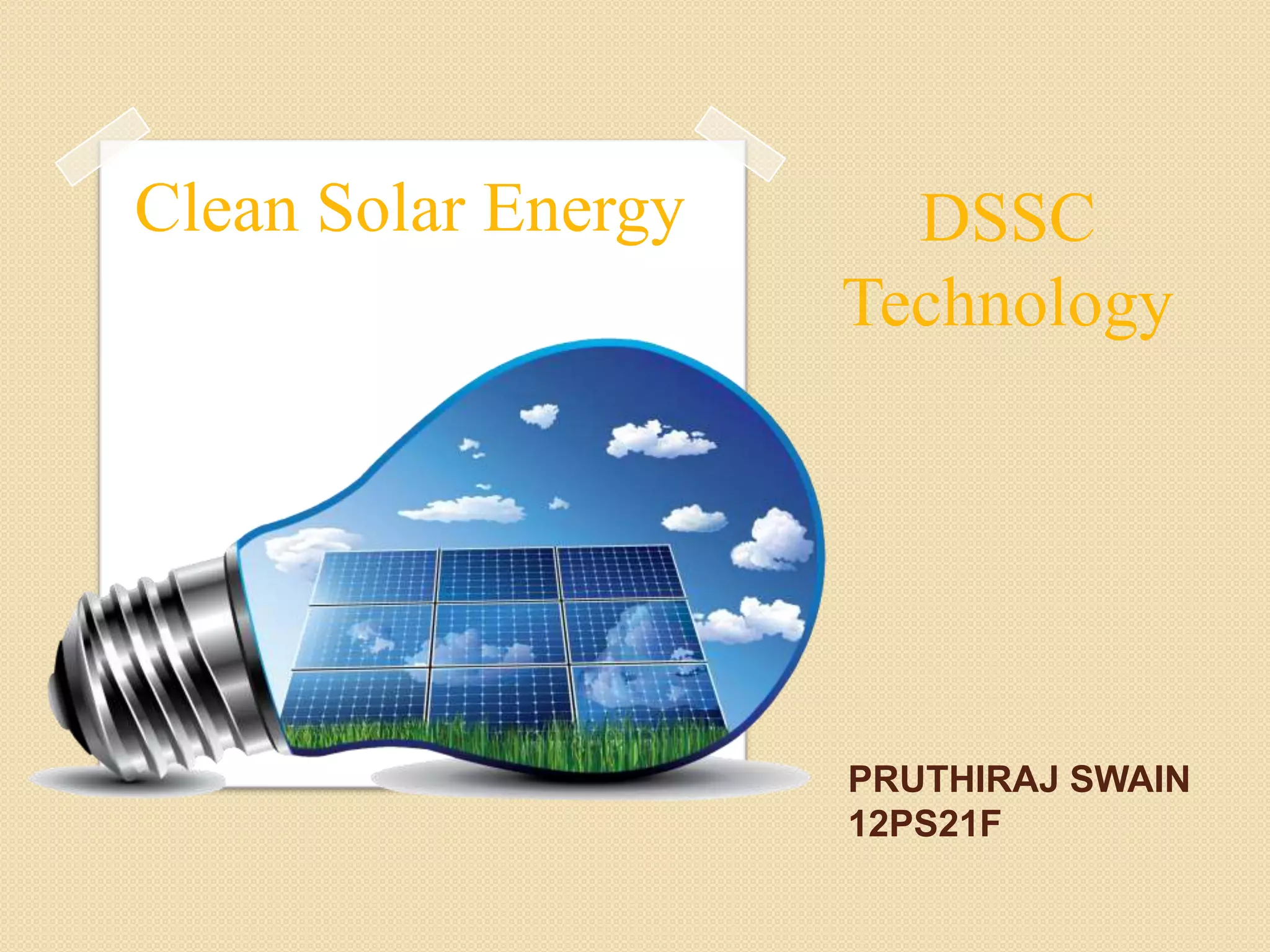
Clean Solar Energy     DSSC
                     Technology


                     PRUTHIRAJ SWAIN
                     12PS21F
Outline

   Introduction(Present Scenario in India)
   Background on Solar Light
   Types of Solar cell
   How a Silicon-Based Solar Cell Works
   How a Dye-Sensitized Cell Works
   Comparison
   Summary
Introduction :
   Energy-starved India is becoming a vibrant market for renewable energy.
    This bodes well for a country that has often seen its industrial and
    economic growth inhibited by a truncated supply of conventional power.
 Currently faces energy shortage of 8 % & a peak demand shortage of
  11.6 %.
 In order to sustain a growth rate of 8 %, it is estimated that the power
  generation capacity in India would have to increase to 306 GW in the
  next 10 years which is 1.7 times current levels.

   Grid-connected renewable power accounts for as much as 20.2 GW – or
    11% – of India's 182.3 GW of installed power capacity.

    ◦ The majority share (55% or 99.8 GW ) – by coal-based thermal power.
    ◦ Gas-fired thermal power, (10% or 17.7 GW),
    ◦ Hydropower (21% or 38.7 GW) and nuclear 2.6% with 4780 MW.

    ◦ India just had 2.12 megawatts of grid-connected solar generation
      capacity
   Under the 11th Five Year Plan (ended March 2012), Only 52 GW of the
    78.6 GW originally envisaged has been added,.
   The 10th Plan (2002-07) only saw a meagre 21.2 GW capacity added,
    against a target of 41.1 GW.
   The 12th Plan (2012-17) now aims for a capacity addition of 103.3 GW
    which includes commensurate transmission and distribution capacities.


   Clean energy investments in India reached a record US$10.3bn in 2011, up
    52% from the US$6.8bn invested in 2010 .This was the highest growth
    figure of any significant economy in the world, with the country accounting
    for 4% of global investments in clean energy. The large growth was driven
    by a 7-fold increase in funding for grid-connected solar projects.


   Solar photovoltaic (PV) power plants totalling over 180 MW were set up in
    the country and off-grid installations of over 50 MW were completed as
    well.
What is Solar Energy?
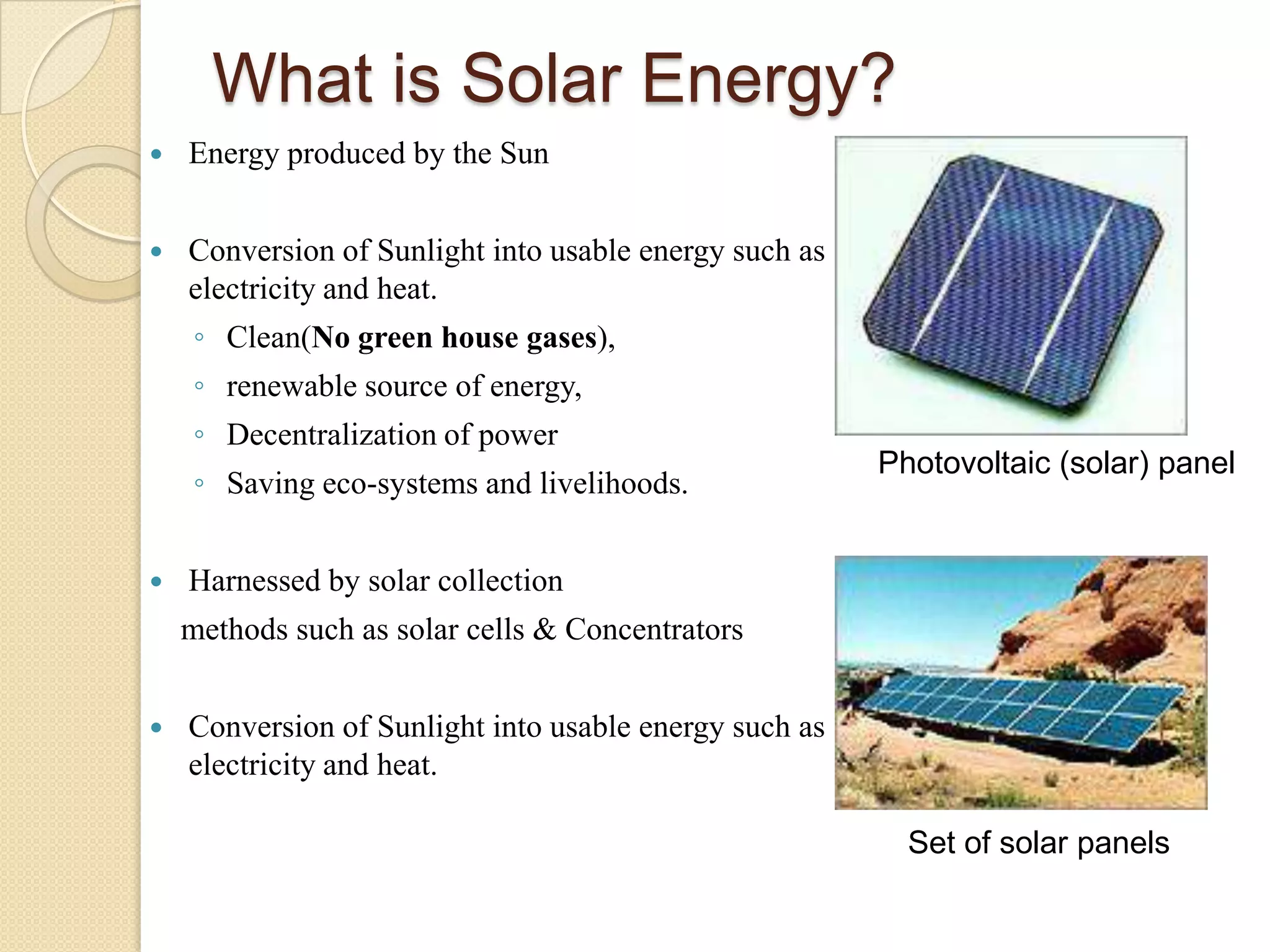
   Energy produced by the Sun


   Conversion of Sunlight into usable energy such as
    electricity and heat.
    ◦ Clean(No green house gases),
    ◦ renewable source of energy,
    ◦ Decentralization of power
                                                        Photovoltaic (solar) panel
    ◦ Saving eco-systems and livelihoods.


   Harnessed by solar collection
    methods such as solar cells & Concentrators


   Conversion of Sunlight into usable energy such as
    electricity and heat.

                                                          Set of solar panels
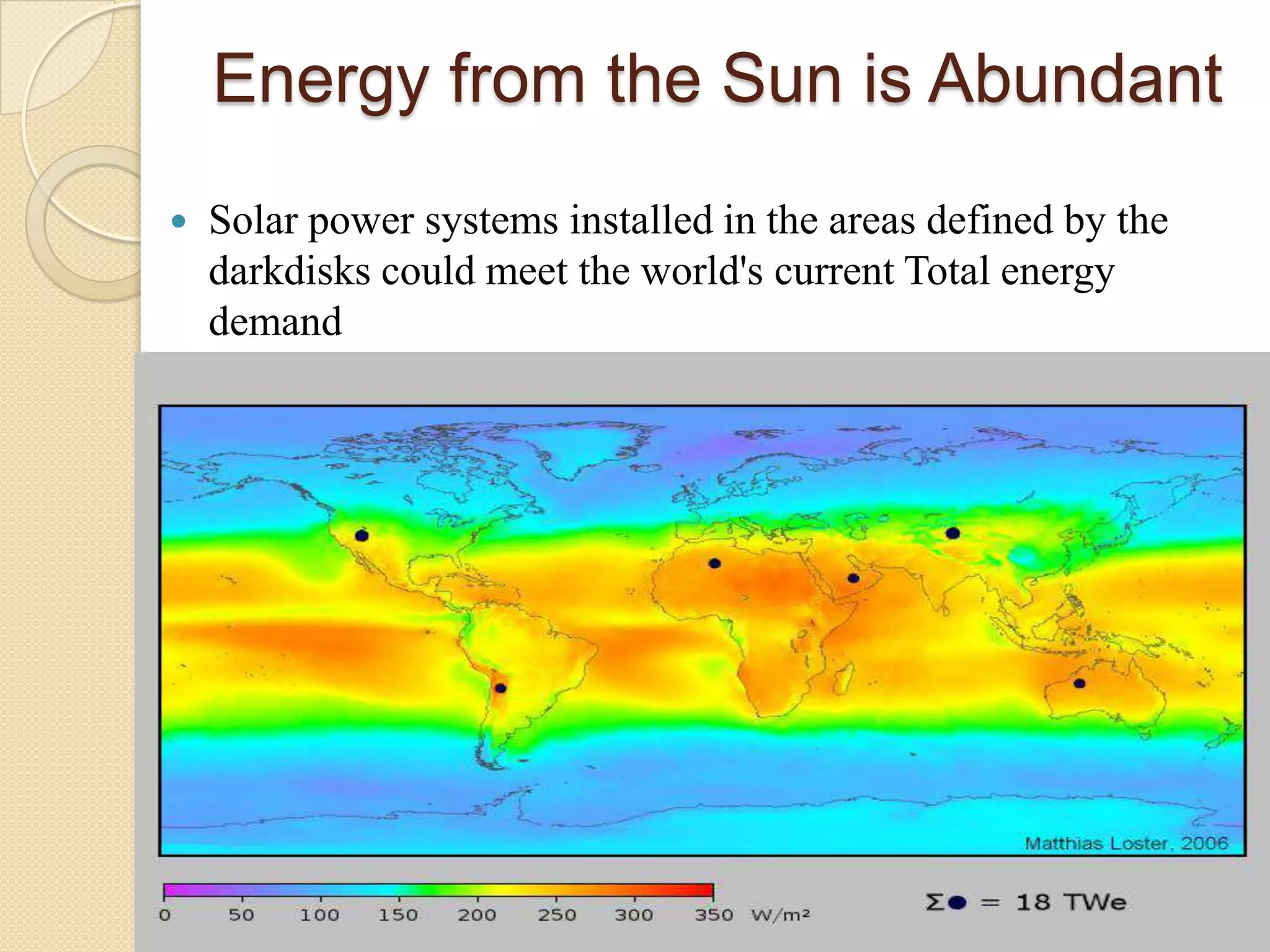
Energy from the Sun is Abundant
   Solar power systems installed in the areas defined by the
    darkdisks could meet the world's current Total energy
    demand
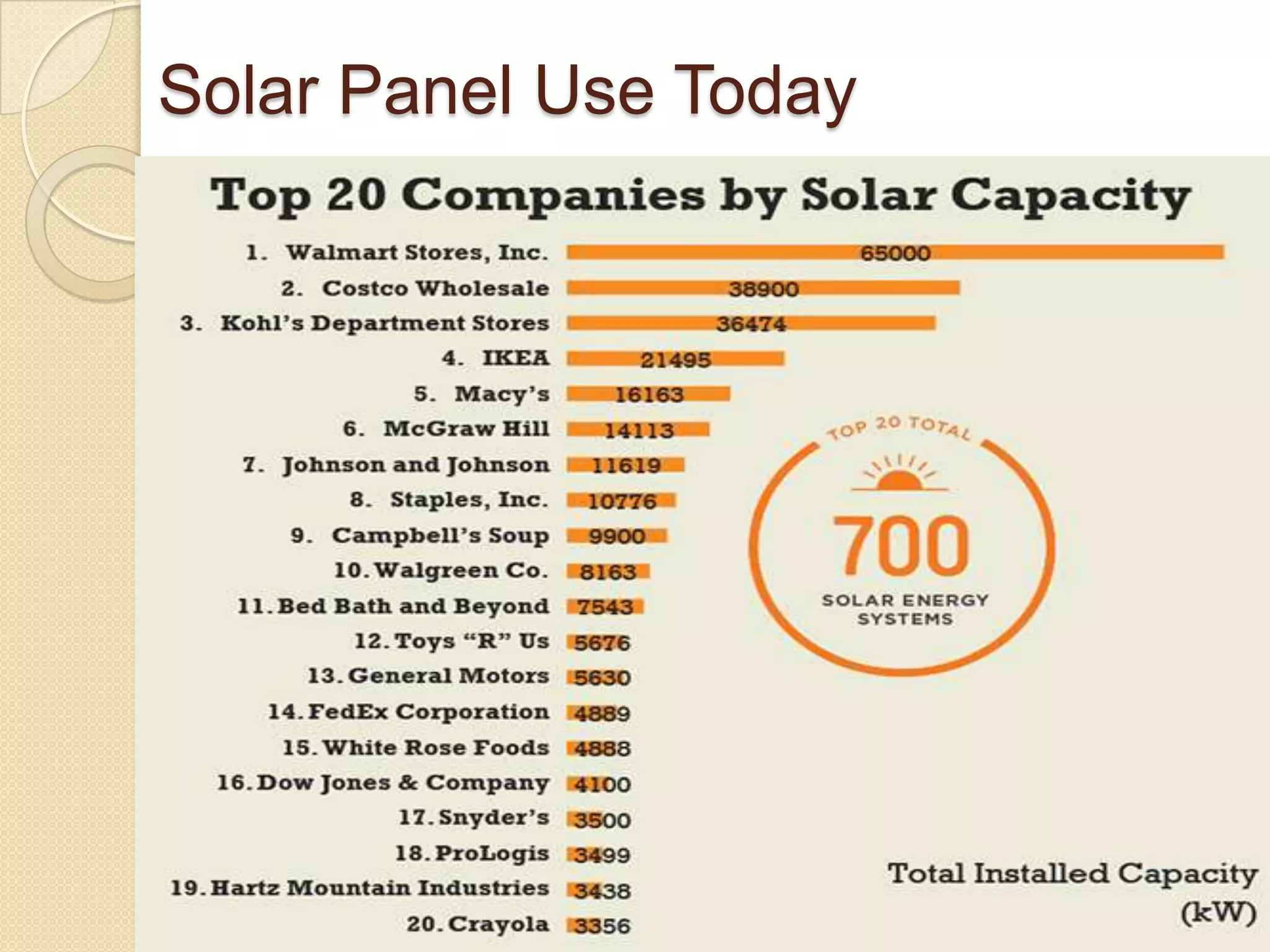
Solar Panel Use Today


                             Solar panels being tested on
                             WalMart store

 Solar panels on Microsoft
 building
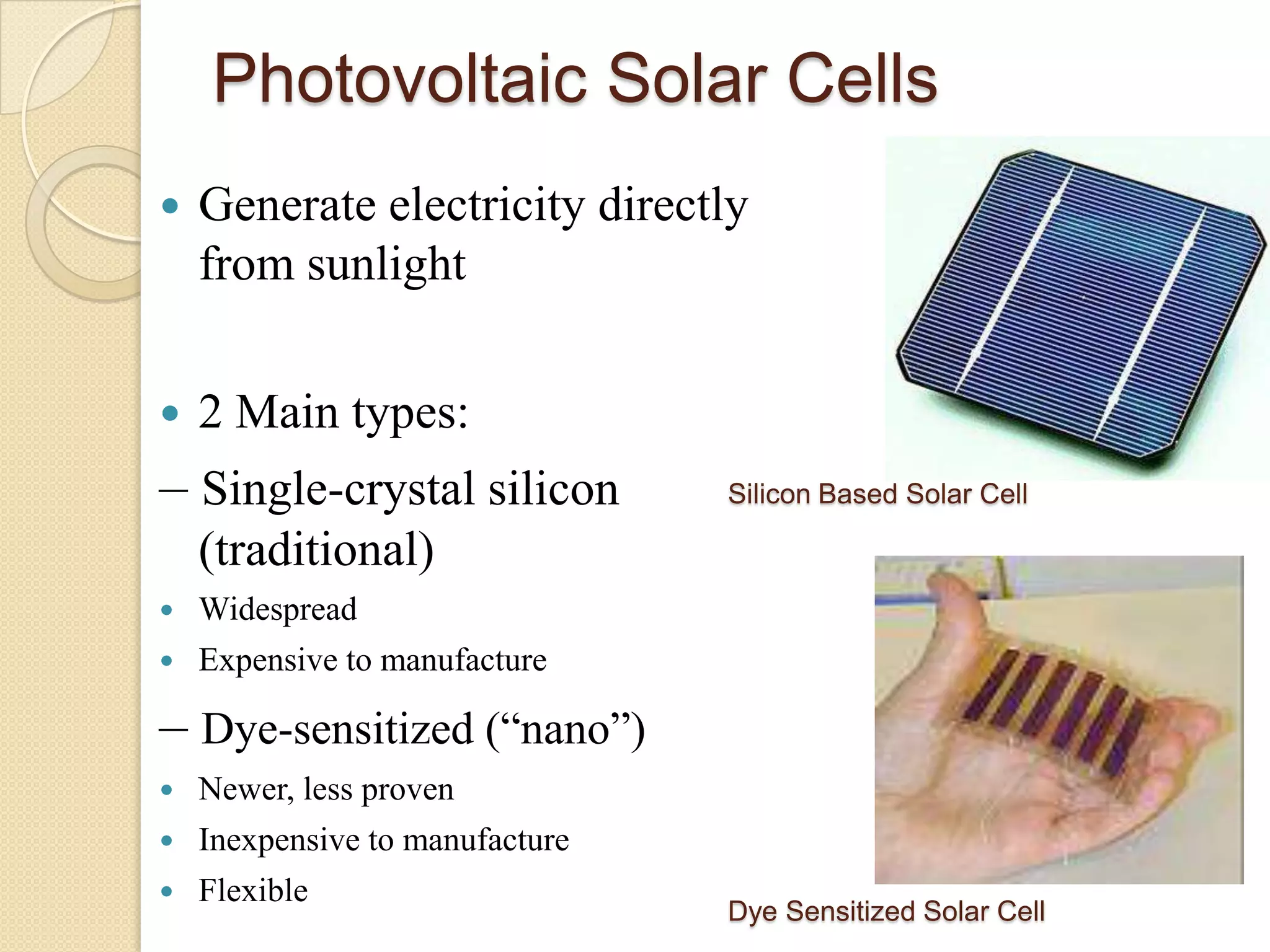
Photovoltaic Solar Cells
   Generate electricity directly
    from sunlight


   2 Main types:
– Single-crystal silicon         Silicon Based Solar Cell

    (traditional)
   Widespread
   Expensive to manufacture

– Dye-sensitized (“nano”)
   Newer, less proven
   Inexpensive to manufacture
   Flexible
                                 Dye Sensitized Solar Cell
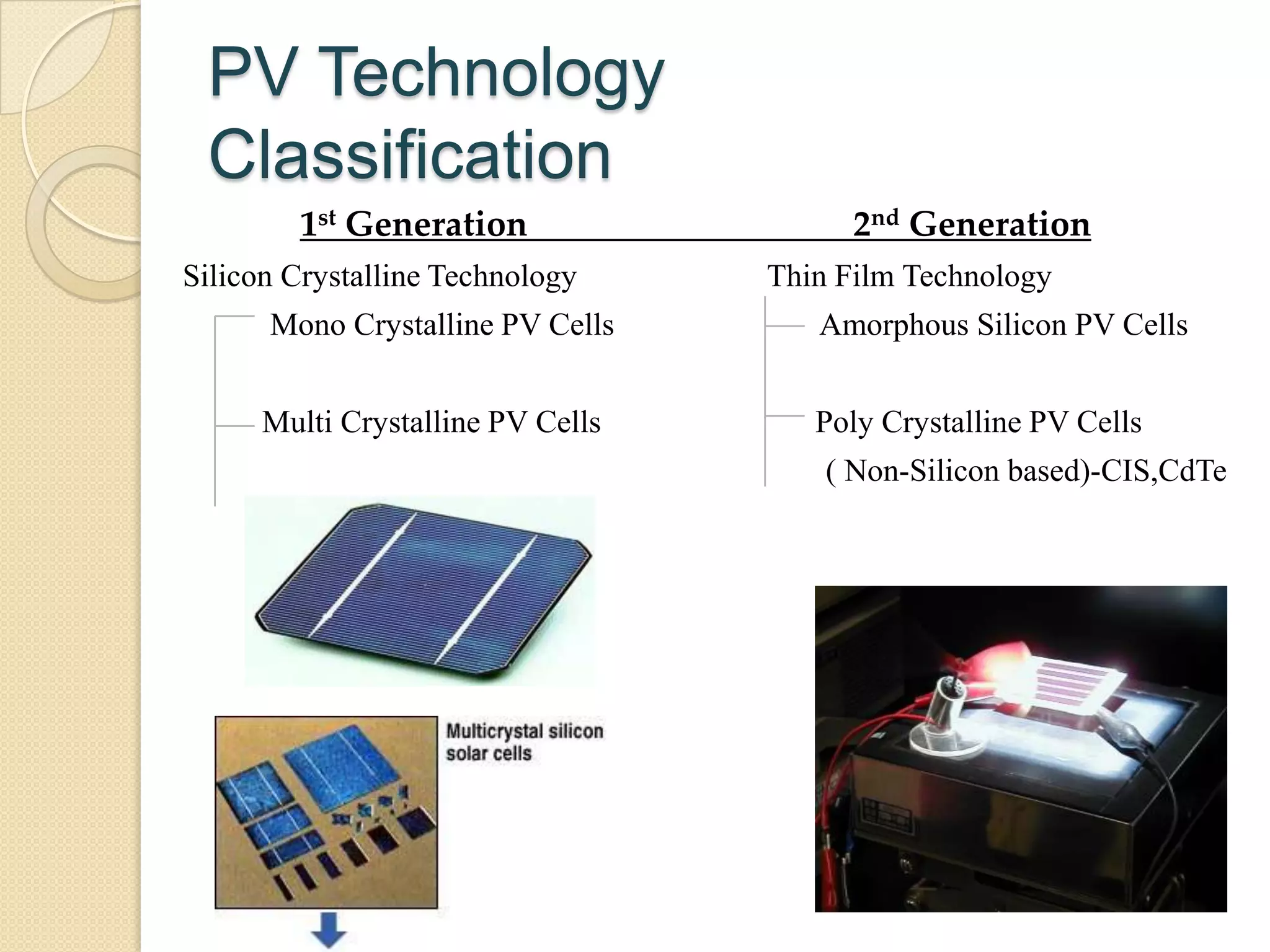
PV Technology
 Classification
        1st Generation                   2nd Generation
Silicon Crystalline Technology     Thin Film Technology
      Mono Crystalline PV Cells       Amorphous Silicon PV Cells


      Multi Crystalline PV Cells      Poly Crystalline PV Cells
                                       ( Non-Silicon based)-CIS,CdTe
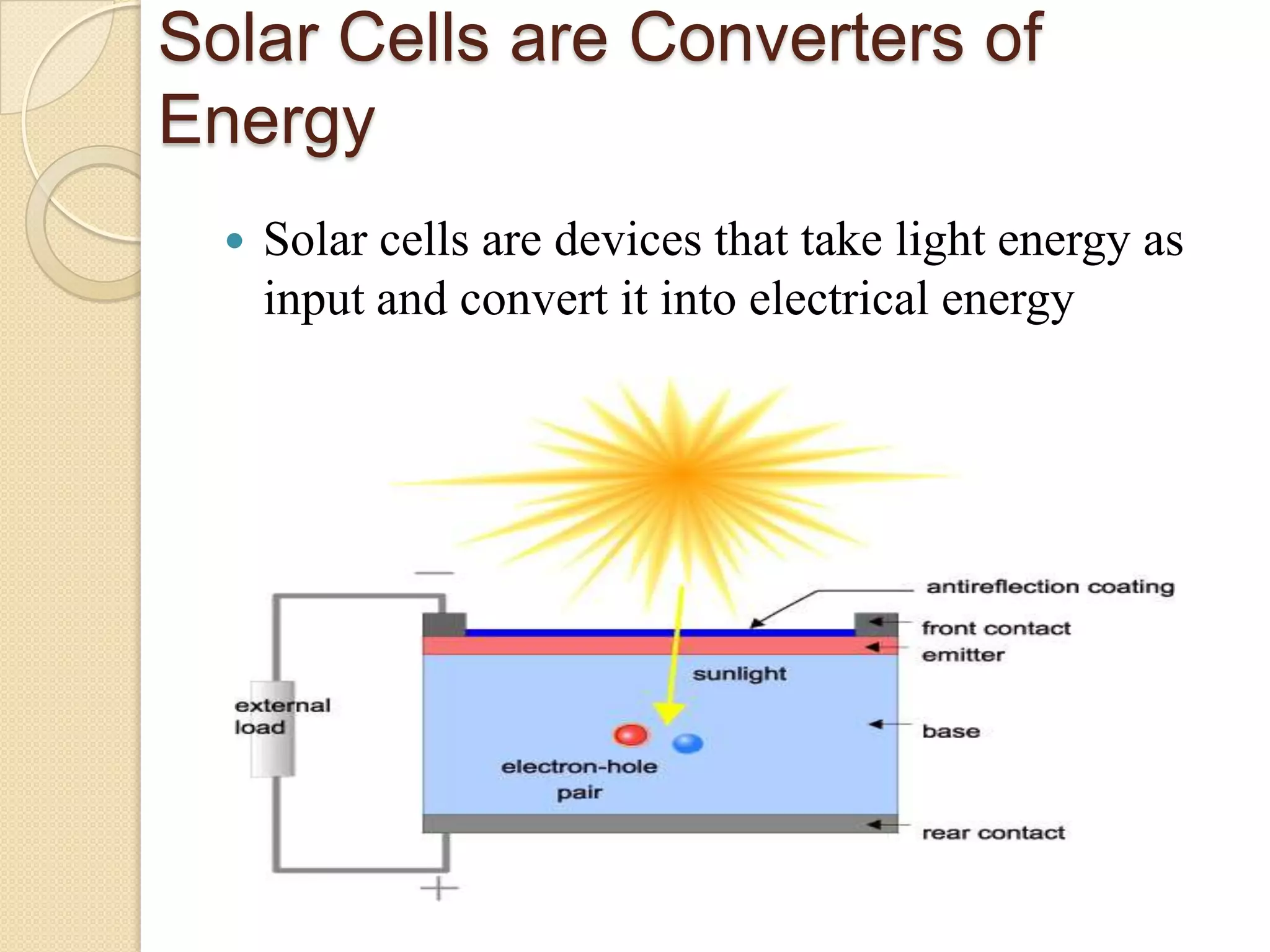
Solar Cells are Converters of
Energy
     Solar cells are devices that take light energy as
      input and convert it into electrical energy
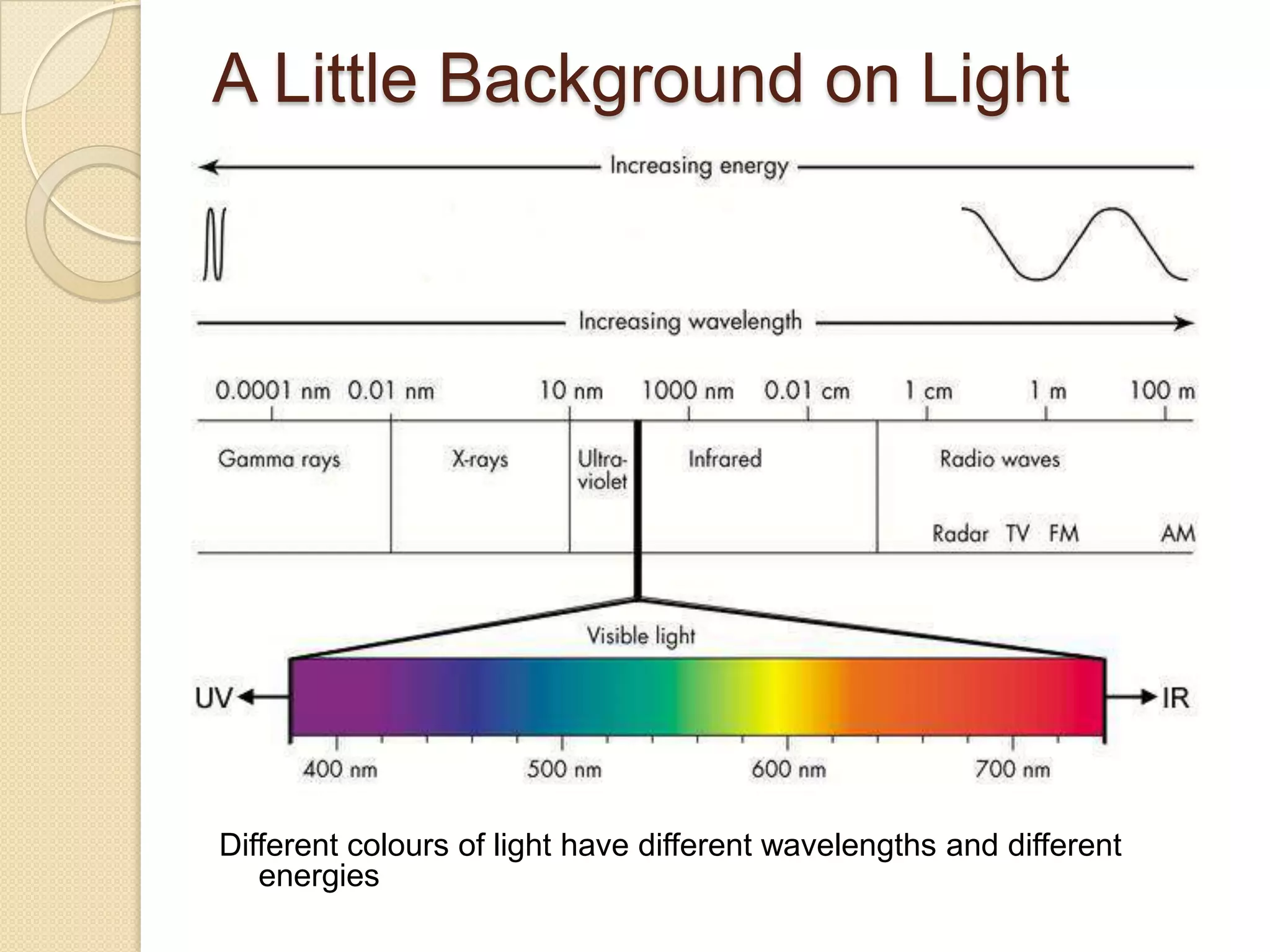
A Little Background on Light


Different colours of light have different wavelengths and different
   energies
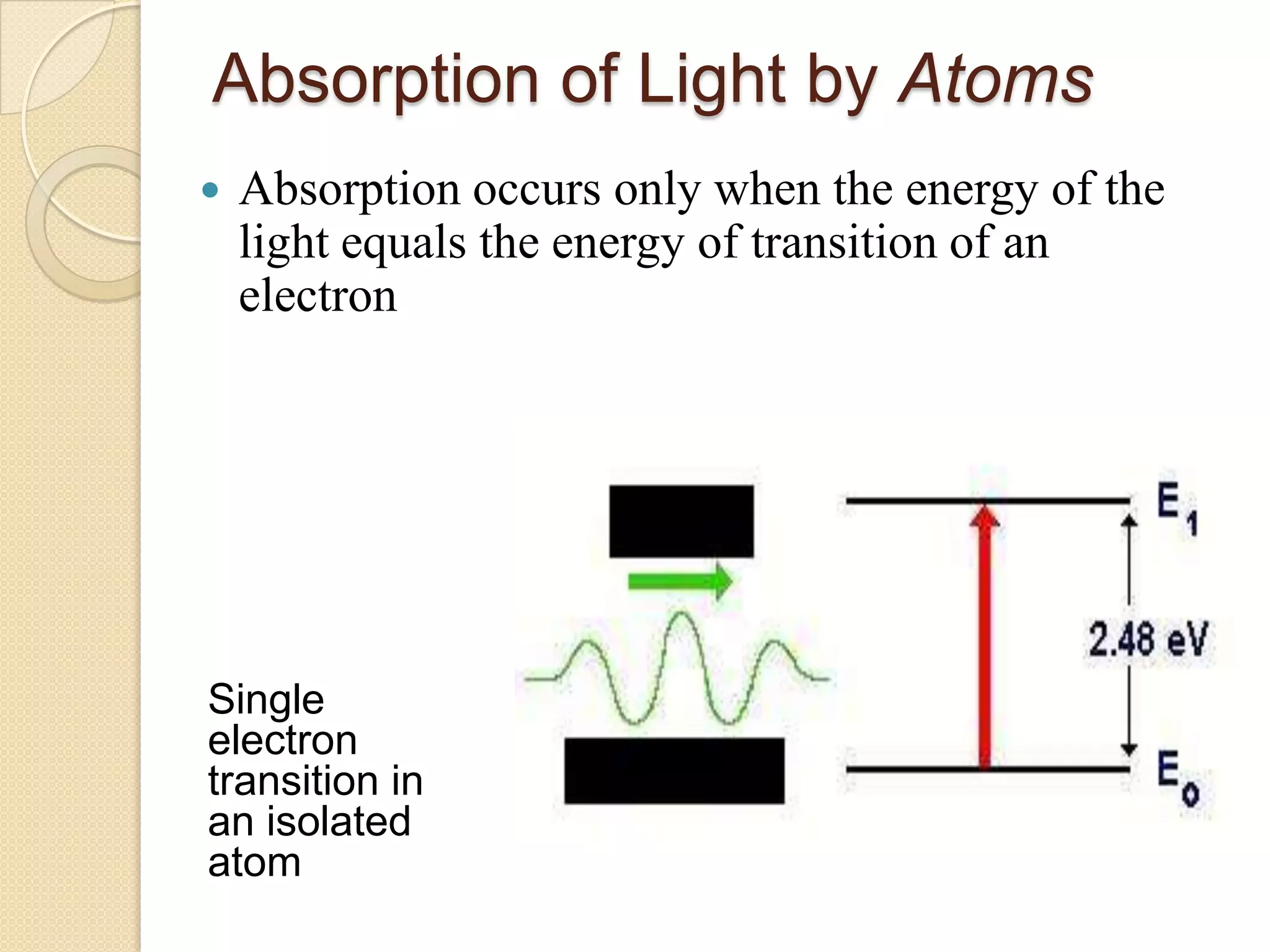
Absorption of Light by Atoms
   Absorption occurs only when the energy of the
    light equals the energy of transition of an
    electron


Single
electron
transition in
an isolated
atom
Absorption of Light by Ionic
Compounds
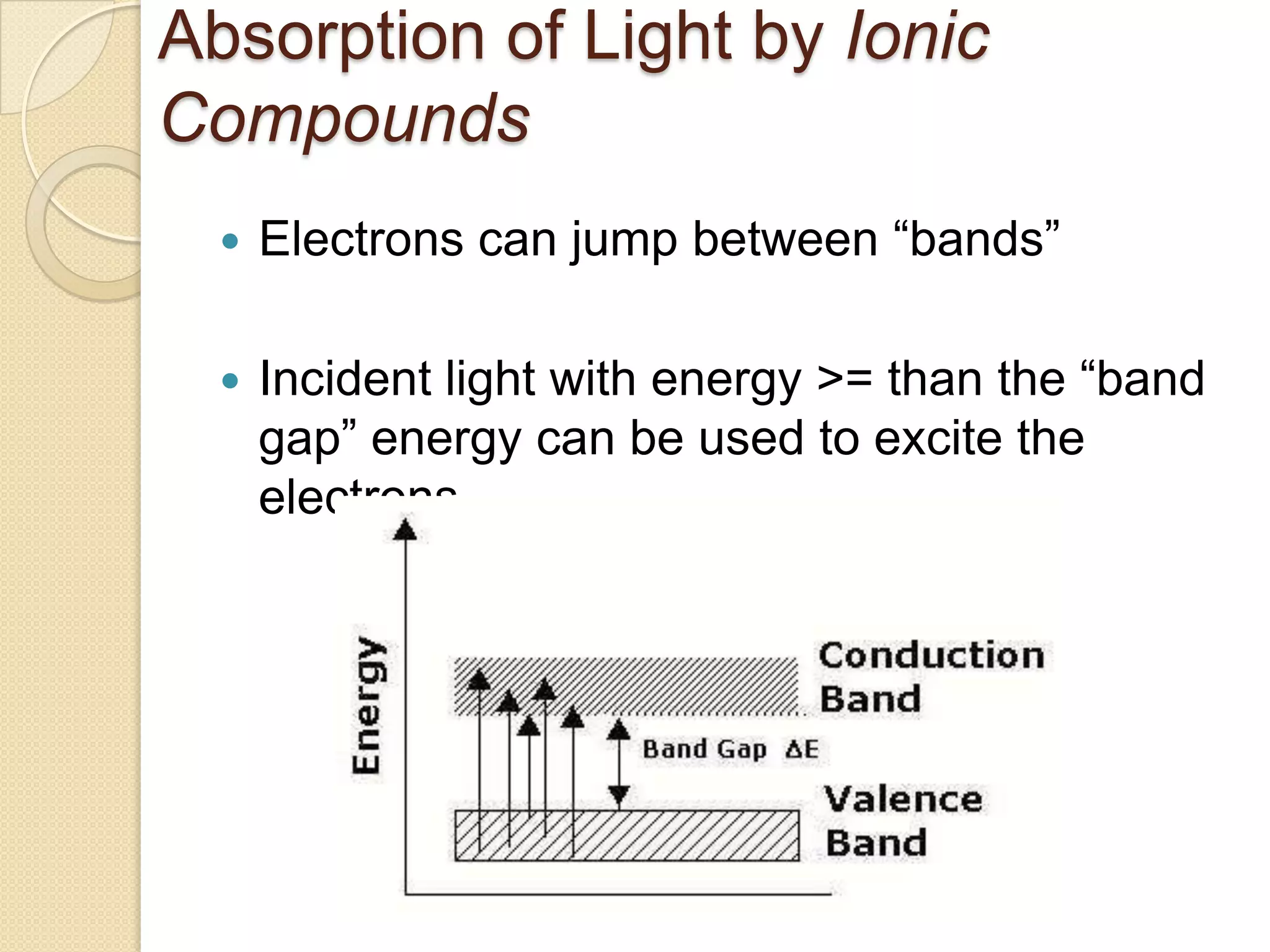
     Electrons can jump between “bands”

     Incident light with energy >= than the “band
      gap” energy can be used to excite the
      electrons
So What Does this Mean for Solar
Cells ?
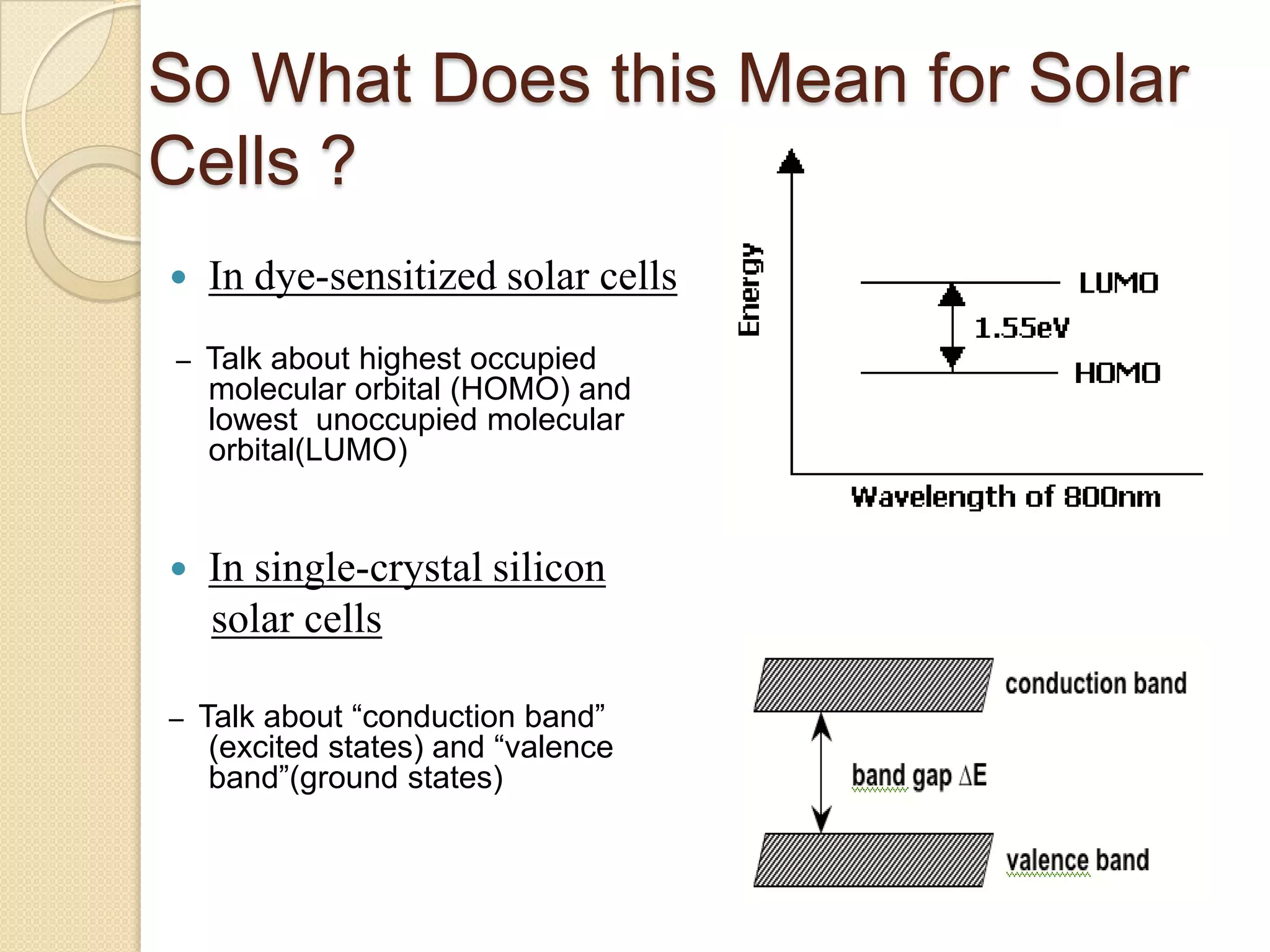
   In dye-sensitized solar cells
– Talk about highest occupied
    molecular orbital (HOMO) and
    lowest unoccupied molecular
    orbital(LUMO)


   In single-crystal silicon
    solar cells

– Talk about “conduction band”
    (excited states) and “valence
    band”(ground states)
How a Silicon-Based Solar Cell
Works
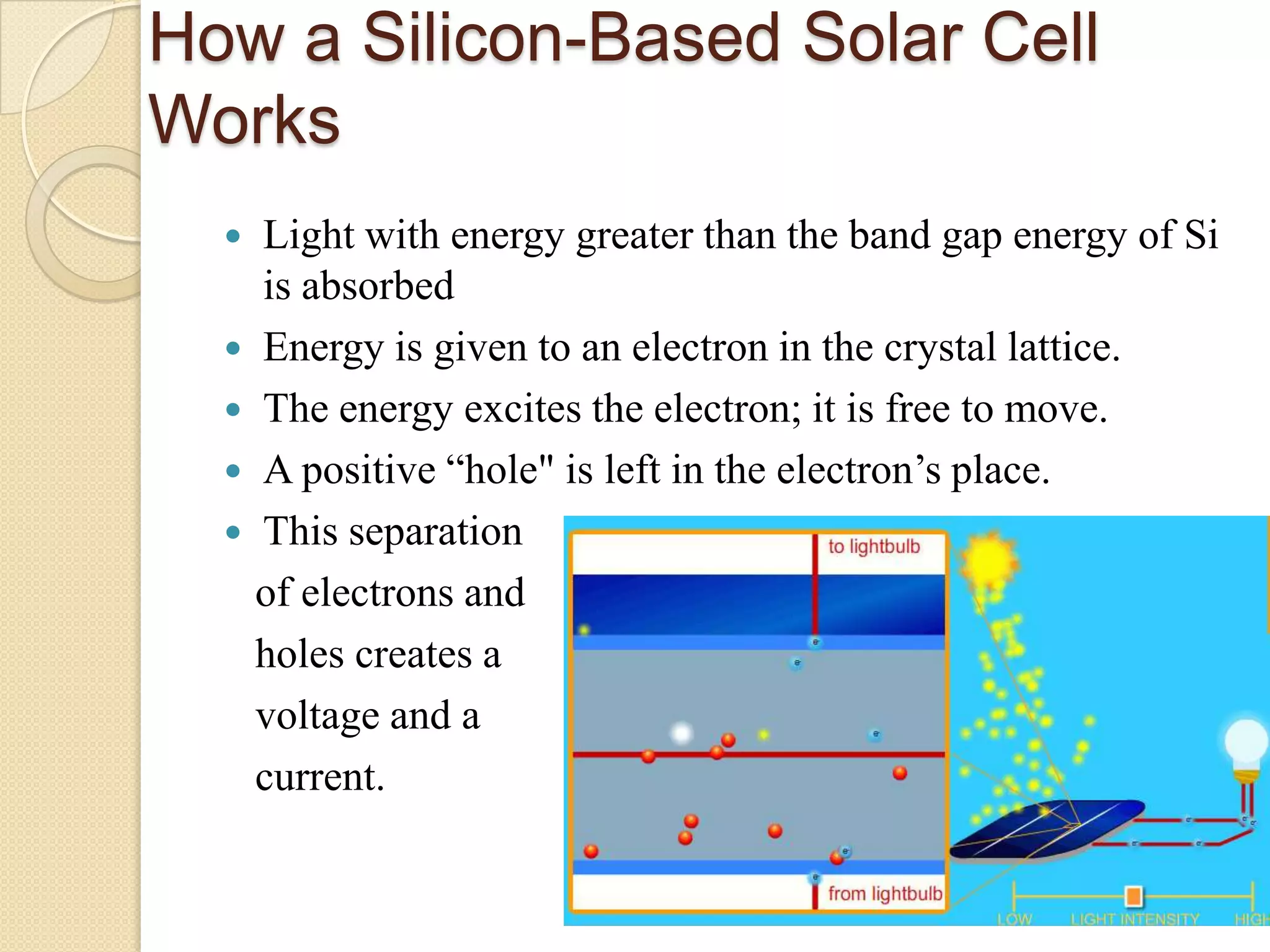
   Light with energy greater than the band gap energy of Si
    is absorbed
   Energy is given to an electron in the crystal lattice.
   The energy excites the electron; it is free to move.
   A positive “hole" is left in the electron’s place.
   This separation
    of electrons and
    holes creates a
    voltage and a
    current.
Silicon-Based Solar Cell
Attributes
   Expensive
    – Made in high vacuum at high heat
    – High manufacturing costs
 Need TLC
  – Fragile, rigid, thick
 Long return on investment
  – Takes 4 years to produce energy savings
     equivalent to cost of production
How a Dye-Sensitized Cell
    Works
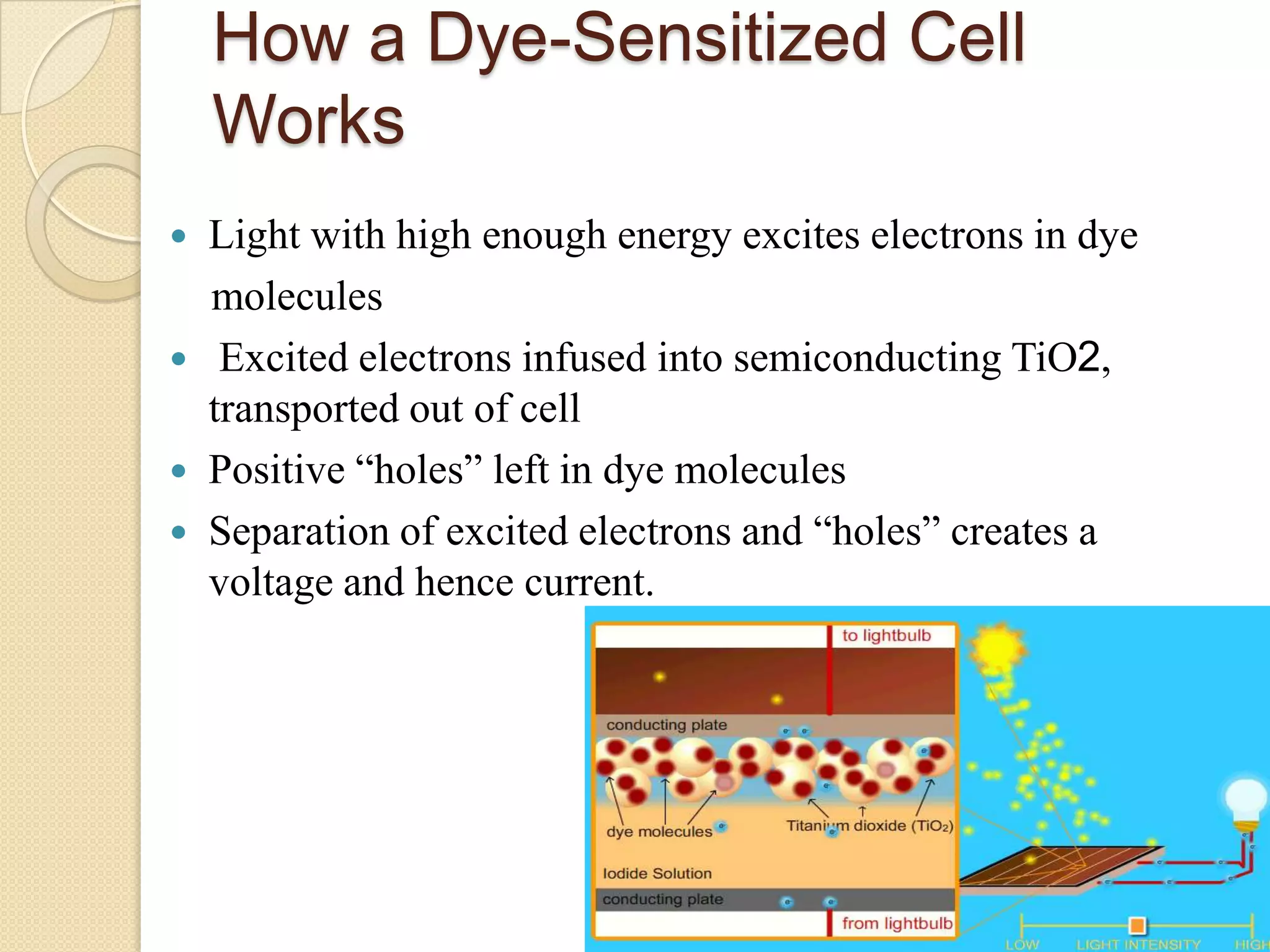
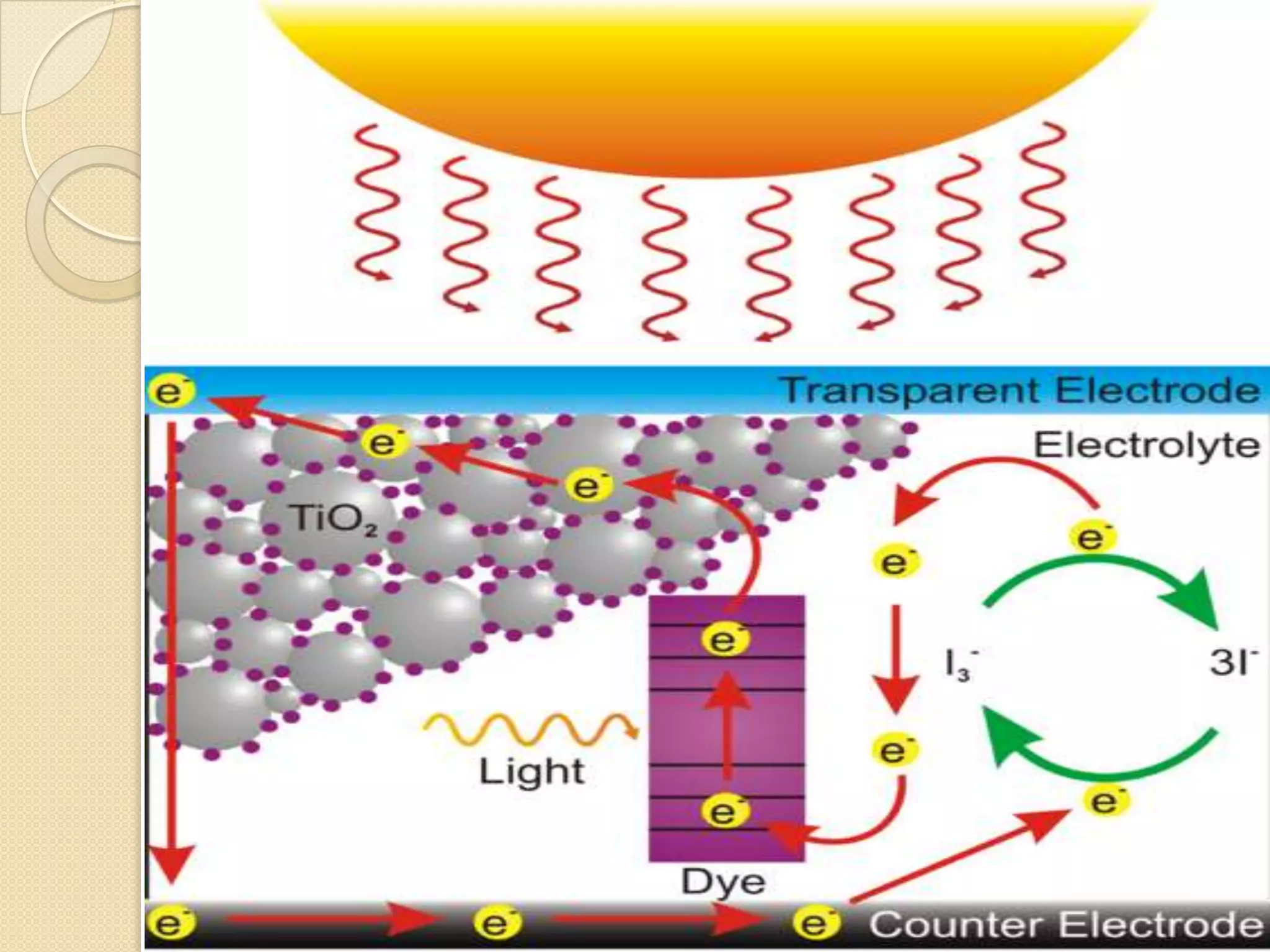
   Light with high enough energy excites electrons in dye
    molecules
    Excited electrons infused into semiconducting TiO2,
    transported out of cell
   Positive “holes” left in dye molecules
   Separation of excited electrons and “holes” creates a
    voltage and hence current.
Dye-Sensitized Solar Cells

   Relatively inexpensive
    – Made in non-vacuum setting mainly at room temperature
    – Relatively simple manufacturing process

   Need little TLC
    – Thin, lightweight, flexible

   Short return on investment
    – Takes approx 3 months to produce energy savings
    equivalent to cost of production
Dye-Sensitized and Silicon-based
Solar Cells Compared
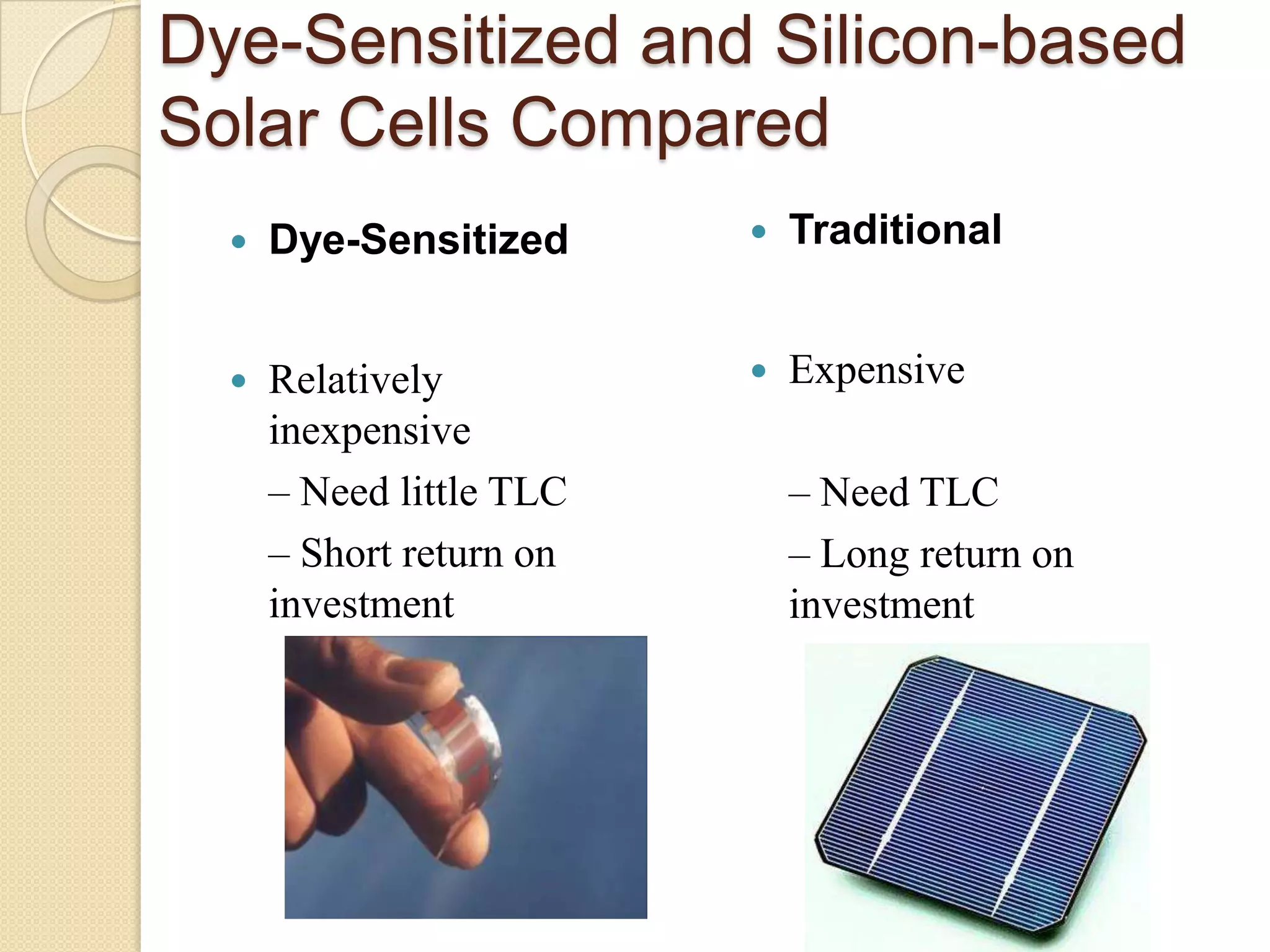
     Dye-Sensitized         Traditional


     Relatively             Expensive
      inexpensive
      – Need little TLC       – Need TLC
      – Short return on       – Long return on
      investment              investment
Summary
 The DSSC has a number of attractive
  features.
 Although its conversion efficiency is less than
  the best thin-film cells, in theory
  its price/performance ratio should be good
  enough to allow them to compete with fossil
  fuel electrical generation by achieving grid
  parity.
 North-western University researchers
  announced a solution to a primary problem of
  DSSCs, short useful life of the device.. The
  current efficiency is about half that of silicon
  cells, but the cells are lightweight and
  potentially of much lower cost to produce.
Further Reading
Konarka Technologies (Graetzel cells) http://www.konarkatech.com/
PV Power Resource Site               http://www.pvpower.com/
US DOE Photovoltaics                 http://www.eere.energy.gov/pv/
Key Center for Photovoltaic Engineering
                                     http://www.pv.unsw.edu.au/
National Center for Photovoltaics    http://www.nrel.gov/ncpv/
 Thank You!!!
(for patient hearing)

Solar Energy-DSSC technology

  • 1.
    Clean Solar Energy DSSC Technology PRUTHIRAJ SWAIN 12PS21F
  • 2.
    Outline  Introduction(Present Scenario in India)  Background on Solar Light  Types of Solar cell  How a Silicon-Based Solar Cell Works  How a Dye-Sensitized Cell Works  Comparison  Summary
  • 3.
    Introduction :  Energy-starved India is becoming a vibrant market for renewable energy. This bodes well for a country that has often seen its industrial and economic growth inhibited by a truncated supply of conventional power.  Currently faces energy shortage of 8 % & a peak demand shortage of 11.6 %.  In order to sustain a growth rate of 8 %, it is estimated that the power generation capacity in India would have to increase to 306 GW in the next 10 years which is 1.7 times current levels.  Grid-connected renewable power accounts for as much as 20.2 GW – or 11% – of India's 182.3 GW of installed power capacity. ◦ The majority share (55% or 99.8 GW ) – by coal-based thermal power. ◦ Gas-fired thermal power, (10% or 17.7 GW), ◦ Hydropower (21% or 38.7 GW) and nuclear 2.6% with 4780 MW. ◦ India just had 2.12 megawatts of grid-connected solar generation capacity
  • 4.
    Under the 11th Five Year Plan (ended March 2012), Only 52 GW of the 78.6 GW originally envisaged has been added,.  The 10th Plan (2002-07) only saw a meagre 21.2 GW capacity added, against a target of 41.1 GW.  The 12th Plan (2012-17) now aims for a capacity addition of 103.3 GW which includes commensurate transmission and distribution capacities.  Clean energy investments in India reached a record US$10.3bn in 2011, up 52% from the US$6.8bn invested in 2010 .This was the highest growth figure of any significant economy in the world, with the country accounting for 4% of global investments in clean energy. The large growth was driven by a 7-fold increase in funding for grid-connected solar projects.  Solar photovoltaic (PV) power plants totalling over 180 MW were set up in the country and off-grid installations of over 50 MW were completed as well.
  • 5.
    What is SolarEnergy?  Energy produced by the Sun  Conversion of Sunlight into usable energy such as electricity and heat. ◦ Clean(No green house gases), ◦ renewable source of energy, ◦ Decentralization of power Photovoltaic (solar) panel ◦ Saving eco-systems and livelihoods.  Harnessed by solar collection methods such as solar cells & Concentrators  Conversion of Sunlight into usable energy such as electricity and heat. Set of solar panels
  • 6.
    Energy from theSun is Abundant  Solar power systems installed in the areas defined by the darkdisks could meet the world's current Total energy demand
  • 7.
    Solar Panel UseToday Solar panels being tested on WalMart store Solar panels on Microsoft building
  • 8.
    Photovoltaic Solar Cells  Generate electricity directly from sunlight  2 Main types: – Single-crystal silicon Silicon Based Solar Cell (traditional)  Widespread  Expensive to manufacture – Dye-sensitized (“nano”)  Newer, less proven  Inexpensive to manufacture  Flexible Dye Sensitized Solar Cell
  • 9.
    PV Technology Classification 1st Generation 2nd Generation Silicon Crystalline Technology Thin Film Technology Mono Crystalline PV Cells Amorphous Silicon PV Cells Multi Crystalline PV Cells Poly Crystalline PV Cells ( Non-Silicon based)-CIS,CdTe
  • 10.
    Solar Cells areConverters of Energy  Solar cells are devices that take light energy as input and convert it into electrical energy
  • 11.
    A Little Backgroundon Light Different colours of light have different wavelengths and different energies
  • 12.
    Absorption of Lightby Atoms  Absorption occurs only when the energy of the light equals the energy of transition of an electron Single electron transition in an isolated atom
  • 13.
    Absorption of Lightby Ionic Compounds  Electrons can jump between “bands”  Incident light with energy >= than the “band gap” energy can be used to excite the electrons
  • 14.
    So What Doesthis Mean for Solar Cells ?  In dye-sensitized solar cells – Talk about highest occupied molecular orbital (HOMO) and lowest unoccupied molecular orbital(LUMO)  In single-crystal silicon solar cells – Talk about “conduction band” (excited states) and “valence band”(ground states)
  • 15.
    How a Silicon-BasedSolar Cell Works  Light with energy greater than the band gap energy of Si is absorbed  Energy is given to an electron in the crystal lattice.  The energy excites the electron; it is free to move.  A positive “hole" is left in the electron’s place.  This separation of electrons and holes creates a voltage and a current.
  • 16.
    Silicon-Based Solar Cell Attributes  Expensive – Made in high vacuum at high heat – High manufacturing costs  Need TLC – Fragile, rigid, thick  Long return on investment – Takes 4 years to produce energy savings equivalent to cost of production
  • 17.
    How a Dye-SensitizedCell Works  Light with high enough energy excites electrons in dye molecules  Excited electrons infused into semiconducting TiO2, transported out of cell  Positive “holes” left in dye molecules  Separation of excited electrons and “holes” creates a voltage and hence current.
  • 19.
    Dye-Sensitized Solar Cells  Relatively inexpensive – Made in non-vacuum setting mainly at room temperature – Relatively simple manufacturing process  Need little TLC – Thin, lightweight, flexible  Short return on investment – Takes approx 3 months to produce energy savings equivalent to cost of production
  • 20.
    Dye-Sensitized and Silicon-based SolarCells Compared  Dye-Sensitized  Traditional  Relatively  Expensive inexpensive – Need little TLC – Need TLC – Short return on – Long return on investment investment
  • 21.
    Summary  The DSSChas a number of attractive features.  Although its conversion efficiency is less than the best thin-film cells, in theory its price/performance ratio should be good enough to allow them to compete with fossil fuel electrical generation by achieving grid parity.  North-western University researchers announced a solution to a primary problem of DSSCs, short useful life of the device.. The current efficiency is about half that of silicon cells, but the cells are lightweight and potentially of much lower cost to produce.
  • 22.
    Further Reading Konarka Technologies(Graetzel cells) http://www.konarkatech.com/ PV Power Resource Site http://www.pvpower.com/ US DOE Photovoltaics http://www.eere.energy.gov/pv/ Key Center for Photovoltaic Engineering http://www.pv.unsw.edu.au/ National Center for Photovoltaics http://www.nrel.gov/ncpv/
  • 23.
     Thank You!!! (forpatient hearing)