The impact of nanoscale science on solar energy production
 Created by
      darshana
      patel
     brp – english,
      prantij (s.k.)


2
What is solar energy?
• Energy produced by       Photovoltaic (solar)
                                 panel
  the sun
• Clean, renewable
  source of energy
• Harnessed by solar
  collection methods
  such as solar cells
• Converted into usable
  energy such as
  electricity                                     Sun and electrical
                                                    power lines
                          Set of solar panels

3
energy from the sun is
           abundant
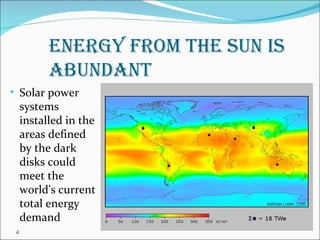
• Solar power
     systems
     installed in the
     areas defined
     by the dark
     disks could
     meet the
     world's current
     total energy
     demand
 4
Current u.s. energy
    demand
                  • The US consumes
                    ~25% of the world’s
                    energy, but has only
                    4.5% of its
                    population
          20 TW   • Solar cells would
                    need to cover an area
                    comparable to the
                    size of Texas to meet
                    US energy demand
                    today
5
projeCted u.s. energy
demand in 2050 •
                 To meet projected
                 U.S. demand in
                 2050, solar cells
                 would need to
                 cover
         20 TW
                 approximately one
                 third of the U.S.
                  180,000 TW
                  of sunlight
                  hit the earth
                  every day
6
solar panel use today
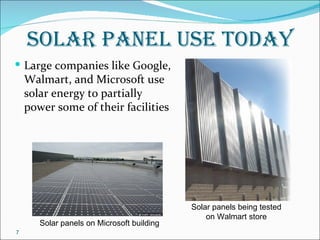
 Large companies like Google,
    Walmart, and Microsoft use
    solar energy to partially
    power some of their facilities


                                            Solar panels being tested
                                                on Walmart store
       Solar panels on Microsoft building
7
photovoltaiC solar Cells
• Generate electricity directly
  from sunlight
• 2 Main types:                       Silicon-based
                                         solar cell
    – Single-crystal silicon
     (traditional)
      •   Widespread
      •   Expensive to manufacture
    – Dye-sensitized (“nano”)
      • Newer, less proven
                                     Dye-sensitized
      • Inexpensive to manufacture
                                       solar cell
      • Flexible


8
solar Cells are Converters of
           energy…
                        • Solar cells are devices that
                           take light energy as input
                           and convert it into
      Light energy
                           electrical energy

                          Electrical energy
                       (carried through wires)

 Solar cell -
converts light
  energy to
  electricity


  9
…but not all energy is
        Converted
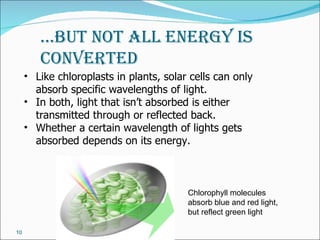
     • Like chloroplasts in plants, solar cells can only
       absorb specific wavelengths of light.
     • In both, light that isn’t absorbed is either
       transmitted through or reflected back.
     • Whether a certain wavelength of lights gets
       absorbed depends on its energy.


                                         Chlorophyll molecules
                                         absorb blue and red light,
                                         but reflect green light

10
a little baCkground on light


• Different colors of light have different wavelengths and
     different energies
11
absorption of light
     by atoms
• Absorption occurs only when the energy of
  the light equals the energy of transition of
  an electron

                            Light
      Single electron
      transition in an
      isolated atom


12
absorption of light by
     moleCules
  Molecules have
   multiple atoms bonded
   together
  More energy states in
   molecules than atoms
  More electron “jumps”      Smallest ∆E possible
   possible - light with a
   range of frequencies are
   absorbed


13
absorption of light by ioniC
     Compounds
• Electrons can jump
  between “bands”
• Incident light with
  energy ≥ than the
  “band gap” energy
  can be used to
  excite the electrons


14
so What does this mean for solar
         Cells?
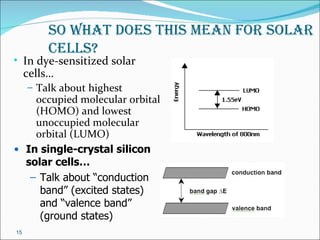
• In dye-sensitized solar
     cells…
     – Talk about highest
    occupied molecular orbital
    (HOMO) and lowest
    unoccupied molecular
    orbital (LUMO)
• In single-crystal silicon
  solar cells…
   – Talk about “conduction
     band” (excited states)
     and “valence band”
     (ground states)
15
a Closer look at solar Cells
• How do traditional,
  silicon-based solar                     Silicon-based
  cells and newer, dye-                   solar cell

  sensitized solar cells
  work?
• What are the
  advantages and
  disadvantages of
  each type of cell?
                        Dye-sensitized
                             solar cell


16
hoW a siliCon-based solar
     Cell Works
• Light with energy greater than the band gap energy
  of Si is absorbed
• Energy is given to an electron in the crystal lattice
• The energy excites the electron; it is free to move
 • A positive “hole”
   is left in the
   electron’s place
 • This separation of
   electrons and holes
   creates a voltage
   and a current

17
siliCon-based solar Cell
     attributes
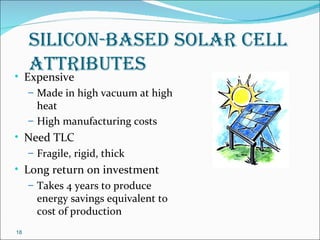
• Expensive
   – Made in high vacuum at high
     heat
   – High manufacturing costs
• Need TLC
   – Fragile, rigid, thick
• Long return on investment
     – Takes 4 years to produce
      energy savings equivalent to
      cost of production
18
hoW a dye-sensitized Cell
 Works
• Light with high enough energy excites electrons in
  dye molecules
• Excited electrons
  infused into
  semiconducting TiO2,
  transported out of cell
• Positive “holes” left in
  dye molecules
• Separation of excited
  electrons and “holes”
  creates a voltage
19
dye-sensitized solar Cells
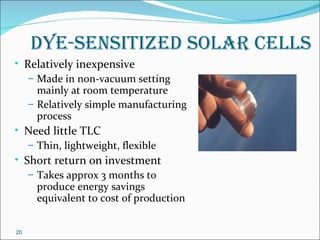
• Relatively inexpensive
   – Made in non-vacuum setting
     mainly at room temperature
   – Relatively simple manufacturing
     process
• Need little TLC
   – Thin, lightweight, flexible
• Short return on investment
   – Takes approx 3 months to
     produce energy savings
     equivalent to cost of production


20
dye-sensitized and siliCon-
based solar Cells Compared
      Dye-Sensitized      • Traditional
        Relatively           – Expensive
         inexpensive          – Need TLC
        Need little TLC
                              – Long return on
        Short return on        investment
         investment


21
solar eleCtriC poWer plants
• Harness solar power to
  generate electricity
• Main types:
     – Solar thermal energy
       •   Has mirrored surface that         Array of mirrored solar collectors at
           reflects sunlight to heat up         FPL Energy site in California
           liquid to make steam to
           generate electricity
     – Photovoltaic
       •   Uses photovoltaic cells that
           absorb direct sunlight (as
           discussed previously)

22                                    Concentrated solar collector (parabolic)
solar heating systems
• Direct heating of fluid; no conversion to electricity
• Components
   – solar thermal
     collectors
   – fluid system to move
     heat (not electricity)
   – reservoir to stock
     heat for later use
• Common uses                   Example system with water heated by
                                solar collector and used to supplement
   – Heat water for home                   hot water radiator
     or pool
23
Wind energy is solar energy
 Wind is driven by solar
  heating
 Largest and fastest growing
  solar energy conversion
  system


       Wind “farm” in
                                Wind turbines
24
        California
25

Solar slide show

  • 1.
    The impact ofnanoscale science on solar energy production
  • 2.
     Created by darshana patel  brp – english, prantij (s.k.) 2
  • 3.
    What is solarenergy? • Energy produced by Photovoltaic (solar) panel the sun • Clean, renewable source of energy • Harnessed by solar collection methods such as solar cells • Converted into usable energy such as electricity Sun and electrical power lines Set of solar panels 3
  • 4.
    energy from thesun is abundant • Solar power systems installed in the areas defined by the dark disks could meet the world's current total energy demand 4
  • 5.
    Current u.s. energy demand • The US consumes ~25% of the world’s energy, but has only 4.5% of its population 20 TW • Solar cells would need to cover an area comparable to the size of Texas to meet US energy demand today 5
  • 6.
    projeCted u.s. energy demandin 2050 • To meet projected U.S. demand in 2050, solar cells would need to cover 20 TW approximately one third of the U.S. 180,000 TW of sunlight hit the earth every day 6
  • 7.
    solar panel usetoday  Large companies like Google, Walmart, and Microsoft use solar energy to partially power some of their facilities Solar panels being tested on Walmart store Solar panels on Microsoft building 7
  • 8.
    photovoltaiC solar Cells •Generate electricity directly from sunlight • 2 Main types: Silicon-based solar cell – Single-crystal silicon (traditional) • Widespread • Expensive to manufacture – Dye-sensitized (“nano”) • Newer, less proven Dye-sensitized • Inexpensive to manufacture solar cell • Flexible 8
  • 9.
    solar Cells areConverters of energy… • Solar cells are devices that take light energy as input and convert it into Light energy electrical energy Electrical energy (carried through wires) Solar cell - converts light energy to electricity 9
  • 10.
    …but not allenergy is Converted • Like chloroplasts in plants, solar cells can only absorb specific wavelengths of light. • In both, light that isn’t absorbed is either transmitted through or reflected back. • Whether a certain wavelength of lights gets absorbed depends on its energy. Chlorophyll molecules absorb blue and red light, but reflect green light 10
  • 11.
    a little baCkgroundon light • Different colors of light have different wavelengths and different energies 11
  • 12.
    absorption of light by atoms • Absorption occurs only when the energy of the light equals the energy of transition of an electron Light Single electron transition in an isolated atom 12
  • 13.
    absorption of lightby moleCules  Molecules have multiple atoms bonded together  More energy states in molecules than atoms  More electron “jumps” Smallest ∆E possible possible - light with a range of frequencies are absorbed 13
  • 14.
    absorption of lightby ioniC Compounds • Electrons can jump between “bands” • Incident light with energy ≥ than the “band gap” energy can be used to excite the electrons 14
  • 15.
    so What doesthis mean for solar Cells? • In dye-sensitized solar cells… – Talk about highest occupied molecular orbital (HOMO) and lowest unoccupied molecular orbital (LUMO) • In single-crystal silicon solar cells… – Talk about “conduction band” (excited states) and “valence band” (ground states) 15
  • 16.
    a Closer lookat solar Cells • How do traditional, silicon-based solar Silicon-based cells and newer, dye- solar cell sensitized solar cells work? • What are the advantages and disadvantages of each type of cell? Dye-sensitized solar cell 16
  • 17.
    hoW a siliCon-basedsolar Cell Works • Light with energy greater than the band gap energy of Si is absorbed • Energy is given to an electron in the crystal lattice • The energy excites the electron; it is free to move • A positive “hole” is left in the electron’s place • This separation of electrons and holes creates a voltage and a current 17
  • 18.
    siliCon-based solar Cell attributes • Expensive – Made in high vacuum at high heat – High manufacturing costs • Need TLC – Fragile, rigid, thick • Long return on investment – Takes 4 years to produce energy savings equivalent to cost of production 18
  • 19.
    hoW a dye-sensitizedCell Works • Light with high enough energy excites electrons in dye molecules • Excited electrons infused into semiconducting TiO2, transported out of cell • Positive “holes” left in dye molecules • Separation of excited electrons and “holes” creates a voltage 19
  • 20.
    dye-sensitized solar Cells •Relatively inexpensive – Made in non-vacuum setting mainly at room temperature – Relatively simple manufacturing process • Need little TLC – Thin, lightweight, flexible • Short return on investment – Takes approx 3 months to produce energy savings equivalent to cost of production 20
  • 21.
    dye-sensitized and siliCon- basedsolar Cells Compared  Dye-Sensitized • Traditional  Relatively – Expensive inexpensive – Need TLC  Need little TLC – Long return on  Short return on investment investment 21
  • 22.
    solar eleCtriC poWerplants • Harness solar power to generate electricity • Main types: – Solar thermal energy • Has mirrored surface that Array of mirrored solar collectors at reflects sunlight to heat up FPL Energy site in California liquid to make steam to generate electricity – Photovoltaic • Uses photovoltaic cells that absorb direct sunlight (as discussed previously) 22 Concentrated solar collector (parabolic)
  • 23.
    solar heating systems •Direct heating of fluid; no conversion to electricity • Components – solar thermal collectors – fluid system to move heat (not electricity) – reservoir to stock heat for later use • Common uses Example system with water heated by solar collector and used to supplement – Heat water for home hot water radiator or pool 23
  • 24.
    Wind energy issolar energy  Wind is driven by solar heating  Largest and fastest growing solar energy conversion system Wind “farm” in Wind turbines 24 California
  • 25.

Editor's Notes

  • #11 Reduce text and add an image. Put in active Absorbed + reflected + transmitted = 1
  • #12 This image will be revised by Alyssa.