Peritonitis
Dr Amos kiweewa
PRESENTER: Unung Kingsley Joseph
Anatomy and Physiology
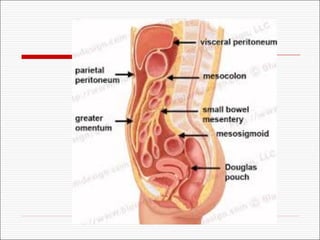
The peritoneum is a thick, double
layer of serous membrane in the
abdominal cavity
The area of the peritoneum is around
2 square meters
Anatomy and Physiology
All organs are divided on 3 groups:
1) Intraperitoneal
2) Mesoperitoneal
3) Extraperitoneal
Anatomy and Physiology
Peritoneum tissue
is a typical connective tissue;
is covered by polygonal mesothelium;
has a very good blood supply.
Anatomy and Physiology
The parietal peritoneum is innervated
by the sensitive somatic nerves
The pain as a result of the parietal
peritoneum irritation is localized
(somatic pain)
The pelvic peritoneum has no somatic
innervations
Anatomy and Physiology
The visceral peritoneum has vegetative
(parasympathic and sympathic)
innervations
The pain as a result of the visceral
peritoneum irritation is not localized
Definition
Peritonitis is an inflammation of the
peritoneum
Aetiology
o Vary according to age, gender and ge
ography.
o 3 most common causes of generalize
d peritonitis in low-income countries a
re probably
1. appendicitis,
2. perforated duodenal ulcer
3. and typhoid perforations, in no par
ticular order.
Aetiology
o In a study of Nigerian children 50% o
f patients had typhoid perforation.
o In women, the complications of pelvic
inflammatory disease predominate.
o Abdominal trauma resulting in intesti
nal injury is also a significant cause of
peritonitis, particularly in low-income
countries.
Aetiology
o In the West appendicitis remains the
most common cause of peritonitis, foll
owed by colonic perforation, usually a
s a result of diverticulitis.
Aetiology
o Iatrogenic causes, resulting from failu
re of intestinal anastomosis and inadv
ertent bowel injuries, need to kept in
mind.
o Certain clinical conditions, primary pe
ritonitis and appendicitis, are more co
mmon in children. Intra-abdominal inf
ection has its own features in the elde
rly.
Classification
Peritonitis is traditionally classified as:
o primary
o secondary
o tertiary.
o The form most commonly encountered by surg
eons is secondary peritonitis resulting from per
foration of a hollow viscus or other abdominal
pathology. Primary peritonitis results from spon
taneous bacterial infection of the peritoneum, a
lone or in association with peritoneal dialysis
Classification
o Tertiary peritonitis is characterized by
a class of very ill patients in whom se
condary peritonitis fails to resolve
despite what appear to be appropr
iate measures and is associated wi
th multi-organ failure.
Secondary peritonitis
o Commonest for surgeon
o Source control, reduction in bacterial
contamination and prevention of its r
ecurrence are the hallmarks of surgic
al treatment.
Primary peritonitis
o occur in children, patients with hepat
ic cirrhosis (usually alcohol) or the ne
phritic syndrome and ascites, in patie
nts on peritoneal dialysis and in HIV/
AIDS.
o Operation is unnecessary for SBP.
o Gram-negative aerobes were the mo
st common infecting agent, followed b
y streptococcus.
Primary peritonitis
o In patients with cirrhosis and ascites,
SBP may be prevalent in as many as
7-30% of patients.
o The pathophysiology appears to be ba
cterial translocation outside the bowel
lumen into extra-intestinal sites.
o E.coli and other gram-negative ba
cilli predominate..
Primary peritonitis
o The mortality varies in these patients
from 10-40% and over 50% of survivi
ng patients will have a recurrence.
o Therefore prophylactic antibiotics, Se
ptra or norfloxacin, should be prescrib
ed to all survivors to achieve selective
gut decontamination
Primary peritonitis
o Patients present with fever, abdomina
l pain, tenderness and often signs of
hepatic decompensation. Diagnosis is
confirmed by the presence of PMNL>2
50/mm³. The condition is a reflection
of serious hepatic failure and initial su
rvivors have a 2 year mortality rate of
50% in the absence of liver transplant
ation.
Primary peritonitis
o In patients undergoing peritoneal dial
ysis peritonitis remains one of the ma
jor complications.
o Gram positive organisms predominate
.
o Treatment consists of instilling antibio
tics into the dialysate.
Tuberculus peritonitis
o tuberculosis, which might be consider
ed a special case of primary peritoniti
s, represents a common extra-pulmo
nary manifestation of tuberculosis.
o It is associated with HIV infection.
o The disease has an insidious onset a
nd should be suspected in any case of
unexplained ascites.
T/peritonitis
o Abdominal pain, fever, weight loss an
d tenderness are the common present
ing features.
o The indolent nature of the process sh
ould assist in distinguishing it from ot
her forms of primary and secondary p
eritonitis.
o Analysis of ascitic fluid shows predom
inance of lymphocytes on gram stain.
T/peritonitis
o The highest sensitivity and specificity
is found with adenosine deaminase
ADA measurement.
o Laparoscopy is recommended as the
diagnostic procedure of choice in that
it allows inspection and biopsy of the
peritoneum.
o Treatment is pharmacologic.
Acute abd in HIV
o Presentation with acute abdominal pain occurs
in 12-48% of HIV patients.
o In the absence of anti-retroviral therapy over 5
0% of these have HIV-related pathology.
o These are, most commonly, cytomegalovirus
(CMV) gastroenteritis, followed by lympho
mas, Kaposi sarcoma and TB peritonitis.
Acute abd in HIV
o Specific HIV-related conditions include: primary
peritonitis, spontaneous bowel perforation, mes
enteric thrombosis, colitis (in adults), necrotizi
ng enterocolitis (in infants), acalculous cholecy
stitis and intra-peritoneal rupture of splenic or
hepatic abscess.
o Operation in HIV patients, particularly in the a
bsence of anti-retroviral therapy, is associated
with elevated morbidity and mortality rates.
o This mandates careful evaluation and avoidanc
e of unnecessary operation. Where diagnosis is
obscure, laparoscopy has been advised.
Classification
I Bacterial peritonitis
a) staphylococcus
b) streptococcus
c) proteus
d) enterococcus
II Sterile peritonitis
a) caused by bile
b) caused by pancreatic enzymes
Classification
1. Serous peritonitis
2. Fibrinous peritonitis
3. Fibrinopurulent peritonitis
4. Purulent peritonitis
5. Hemorrhagic peritonitis
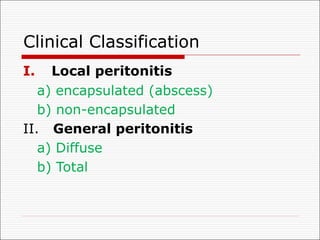
Clinical Classification
I. Local peritonitis
a) encapsulated (abscess)
b) non-encapsulated
II. General peritonitis
a) Diffuse
b) Total
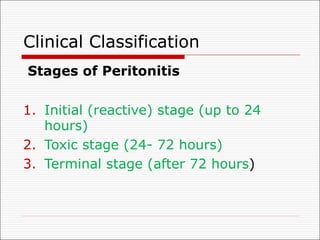
Clinical Classification
Stages of Peritonitis
1. Initial (reactive) stage (up to 24
hours)
2. Toxic stage (24- 72 hours)
3. Terminal stage (after 72 hours)
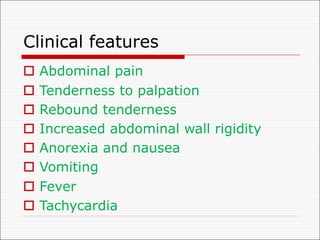
Clinical features
o Abdominal pain
o Tenderness to palpation
o Rebound tenderness
o Increased abdominal wall rigidity
o Anorexia and nausea
o Vomiting
o Fever
o Tachycardia
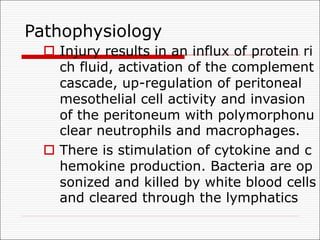
Pathophysiology
o Injury results in an influx of protein ri
ch fluid, activation of the complement
cascade, up-regulation of peritoneal
mesothelial cell activity and invasion
of the peritoneum with polymorphonu
clear neutrophils and macrophages.
o There is stimulation of cytokine and c
hemokine production. Bacteria are op
sonized and killed by white blood cells
and cleared through the lymphatics
Pathophy
opreoperative physiological d
erangement, the surgical cle
arance of the infectious focu
s and the response to treat
ment are established progno
stic factors
Pathophy
o The pathogenesis of intra-abdominal infections
is determined by bacterial factors which influen
ce the transition from contamination to infectio
n.
o Bacterial stimuli, especially endotoxin, lead to
an almost uniform activation response which is
triggered by reaction of mesothelial cells and in
terspersed peritoneal macrophages and which
also involves plasmatic systems, endothelial cel
ls and extra- and intravascular leukocytes.
pathophy
o The local consequences of this activat
ion are the transmigration of granuloc
ytes from peritoneal capillaries to the
mesothelial surface and a dilatation of
peritoneal blood vessels resulting in e
nhanced permeability, peritoneal ede
ma and lastly the formation of protein
-rich peritoneal exudate.
Pathophy
o Intra-abdominal adjuvants such as bil
e, talc, barium and the local host resp
onse are additionally important
pathphy
o The first line of defense is clearance o
f noxious agents via the lymphatics of
the parietal peritoneum, diaphragm a
nd omentum. The formation of fibrin
acts to wall off the infection and is as
sociated with abscess formation.
pathophy
The response to intra-abdominal
infection depends on 5 key factors:
o inoculum size
o virulence of the contaminating organi
sms
o the presences of adjuvants within the
peritoneal cavity
o adequacy of local, regional, and syste
mic host defenses
o the adequacy of initial treatment.
Pathophy
o The specific microbial characteristics of
different regions of the gut determine th
e types of infecting organisms found wit
h specific diseases.
o Secondary peritonitis typically results in
polymicrobial infections with gram-negat
ive aerobes and anaerobes.
o Inflammation within the peritoneal cavit
y evokes a series of secondary changes
that produce the clinical syndrome of pe
ritonitis
pathophy
o The acute inflammatory process withi
n the abdomen results in sympathetic
activation, and suppression of intestin
al peristalsis, or ileus. Fluid absorptio
n through the wall of the bowel is imp
aired, and significant amounts of tissu
e fluid may be sequestered within the
lumen of the gut, resulting in systemi
c hypovolemia.
Diagnosis
o History and physical examination is of
paramount importance.
o Hx usually associated with abrupt ons
et of abd pain often localized at first t
hen generalized
o Some cases like perforated diverticulit
is,pain remains in the one quandrant.
Diagnosis cont
o A careful history often suggests the s
ource of the problem.
o Subsequently confirmed on physical e
xamination and investigations.
o Physical exam findings depend on aeti
ology, duration and whether localsed
or generalized.
Imaging Inx
o Depends on the differential diagnosis
from the hx and examination.
o X rays
o Abdominal ultrasound
o CT scan
Lab Analyses
o Leukocytosis or leukocytopenia
o Dehydration and acidosis
o Peritoneal fluid analysis
o Serum electrolytes
o Hb gping & xmatching
Treatment
o Antibiotic therapy
o Correction of existing serum
electrolytes disturbances
o Correction of coagulation abnormalities
o Surgery
Surgery
o To eliminate the source of
contamination
o To reduce the bacterial contamination
o To prevent further complications and
sepsis
Thank you

12.Peritonitis.pdf

  • 1.
  • 2.
    Anatomy and Physiology Theperitoneum is a thick, double layer of serous membrane in the abdominal cavity The area of the peritoneum is around 2 square meters
  • 4.
    Anatomy and Physiology Allorgans are divided on 3 groups: 1) Intraperitoneal 2) Mesoperitoneal 3) Extraperitoneal
  • 5.
    Anatomy and Physiology Peritoneumtissue is a typical connective tissue; is covered by polygonal mesothelium; has a very good blood supply.
  • 6.
    Anatomy and Physiology Theparietal peritoneum is innervated by the sensitive somatic nerves The pain as a result of the parietal peritoneum irritation is localized (somatic pain) The pelvic peritoneum has no somatic innervations
  • 7.
    Anatomy and Physiology Thevisceral peritoneum has vegetative (parasympathic and sympathic) innervations The pain as a result of the visceral peritoneum irritation is not localized
  • 8.
    Definition Peritonitis is aninflammation of the peritoneum
  • 9.
    Aetiology o Vary accordingto age, gender and ge ography. o 3 most common causes of generalize d peritonitis in low-income countries a re probably 1. appendicitis, 2. perforated duodenal ulcer 3. and typhoid perforations, in no par ticular order.
  • 10.
    Aetiology o In astudy of Nigerian children 50% o f patients had typhoid perforation. o In women, the complications of pelvic inflammatory disease predominate. o Abdominal trauma resulting in intesti nal injury is also a significant cause of peritonitis, particularly in low-income countries.
  • 11.
    Aetiology o In theWest appendicitis remains the most common cause of peritonitis, foll owed by colonic perforation, usually a s a result of diverticulitis.
  • 12.
    Aetiology o Iatrogenic causes,resulting from failu re of intestinal anastomosis and inadv ertent bowel injuries, need to kept in mind. o Certain clinical conditions, primary pe ritonitis and appendicitis, are more co mmon in children. Intra-abdominal inf ection has its own features in the elde rly.
  • 13.
    Classification Peritonitis is traditionallyclassified as: o primary o secondary o tertiary. o The form most commonly encountered by surg eons is secondary peritonitis resulting from per foration of a hollow viscus or other abdominal pathology. Primary peritonitis results from spon taneous bacterial infection of the peritoneum, a lone or in association with peritoneal dialysis
  • 14.
    Classification o Tertiary peritonitisis characterized by a class of very ill patients in whom se condary peritonitis fails to resolve despite what appear to be appropr iate measures and is associated wi th multi-organ failure.
  • 15.
    Secondary peritonitis o Commonestfor surgeon o Source control, reduction in bacterial contamination and prevention of its r ecurrence are the hallmarks of surgic al treatment.
  • 16.
    Primary peritonitis o occurin children, patients with hepat ic cirrhosis (usually alcohol) or the ne phritic syndrome and ascites, in patie nts on peritoneal dialysis and in HIV/ AIDS. o Operation is unnecessary for SBP. o Gram-negative aerobes were the mo st common infecting agent, followed b y streptococcus.
  • 17.
    Primary peritonitis o Inpatients with cirrhosis and ascites, SBP may be prevalent in as many as 7-30% of patients. o The pathophysiology appears to be ba cterial translocation outside the bowel lumen into extra-intestinal sites. o E.coli and other gram-negative ba cilli predominate..
  • 18.
    Primary peritonitis o Themortality varies in these patients from 10-40% and over 50% of survivi ng patients will have a recurrence. o Therefore prophylactic antibiotics, Se ptra or norfloxacin, should be prescrib ed to all survivors to achieve selective gut decontamination
  • 19.
    Primary peritonitis o Patientspresent with fever, abdomina l pain, tenderness and often signs of hepatic decompensation. Diagnosis is confirmed by the presence of PMNL>2 50/mm³. The condition is a reflection of serious hepatic failure and initial su rvivors have a 2 year mortality rate of 50% in the absence of liver transplant ation.
  • 20.
    Primary peritonitis o Inpatients undergoing peritoneal dial ysis peritonitis remains one of the ma jor complications. o Gram positive organisms predominate . o Treatment consists of instilling antibio tics into the dialysate.
  • 21.
    Tuberculus peritonitis o tuberculosis,which might be consider ed a special case of primary peritoniti s, represents a common extra-pulmo nary manifestation of tuberculosis. o It is associated with HIV infection. o The disease has an insidious onset a nd should be suspected in any case of unexplained ascites.
  • 22.
    T/peritonitis o Abdominal pain,fever, weight loss an d tenderness are the common present ing features. o The indolent nature of the process sh ould assist in distinguishing it from ot her forms of primary and secondary p eritonitis. o Analysis of ascitic fluid shows predom inance of lymphocytes on gram stain.
  • 23.
    T/peritonitis o The highestsensitivity and specificity is found with adenosine deaminase ADA measurement. o Laparoscopy is recommended as the diagnostic procedure of choice in that it allows inspection and biopsy of the peritoneum. o Treatment is pharmacologic.
  • 24.
    Acute abd inHIV o Presentation with acute abdominal pain occurs in 12-48% of HIV patients. o In the absence of anti-retroviral therapy over 5 0% of these have HIV-related pathology. o These are, most commonly, cytomegalovirus (CMV) gastroenteritis, followed by lympho mas, Kaposi sarcoma and TB peritonitis.
  • 25.
    Acute abd inHIV o Specific HIV-related conditions include: primary peritonitis, spontaneous bowel perforation, mes enteric thrombosis, colitis (in adults), necrotizi ng enterocolitis (in infants), acalculous cholecy stitis and intra-peritoneal rupture of splenic or hepatic abscess. o Operation in HIV patients, particularly in the a bsence of anti-retroviral therapy, is associated with elevated morbidity and mortality rates. o This mandates careful evaluation and avoidanc e of unnecessary operation. Where diagnosis is obscure, laparoscopy has been advised.
  • 26.
    Classification I Bacterial peritonitis a)staphylococcus b) streptococcus c) proteus d) enterococcus II Sterile peritonitis a) caused by bile b) caused by pancreatic enzymes
  • 27.
    Classification 1. Serous peritonitis 2.Fibrinous peritonitis 3. Fibrinopurulent peritonitis 4. Purulent peritonitis 5. Hemorrhagic peritonitis
  • 28.
    Clinical Classification I. Localperitonitis a) encapsulated (abscess) b) non-encapsulated II. General peritonitis a) Diffuse b) Total
  • 29.
    Clinical Classification Stages ofPeritonitis 1. Initial (reactive) stage (up to 24 hours) 2. Toxic stage (24- 72 hours) 3. Terminal stage (after 72 hours)
  • 30.
    Clinical features o Abdominalpain o Tenderness to palpation o Rebound tenderness o Increased abdominal wall rigidity o Anorexia and nausea o Vomiting o Fever o Tachycardia
  • 31.
    Pathophysiology o Injury resultsin an influx of protein ri ch fluid, activation of the complement cascade, up-regulation of peritoneal mesothelial cell activity and invasion of the peritoneum with polymorphonu clear neutrophils and macrophages. o There is stimulation of cytokine and c hemokine production. Bacteria are op sonized and killed by white blood cells and cleared through the lymphatics
  • 32.
    Pathophy opreoperative physiological d erangement,the surgical cle arance of the infectious focu s and the response to treat ment are established progno stic factors
  • 33.
    Pathophy o The pathogenesisof intra-abdominal infections is determined by bacterial factors which influen ce the transition from contamination to infectio n. o Bacterial stimuli, especially endotoxin, lead to an almost uniform activation response which is triggered by reaction of mesothelial cells and in terspersed peritoneal macrophages and which also involves plasmatic systems, endothelial cel ls and extra- and intravascular leukocytes.
  • 34.
    pathophy o The localconsequences of this activat ion are the transmigration of granuloc ytes from peritoneal capillaries to the mesothelial surface and a dilatation of peritoneal blood vessels resulting in e nhanced permeability, peritoneal ede ma and lastly the formation of protein -rich peritoneal exudate.
  • 35.
    Pathophy o Intra-abdominal adjuvantssuch as bil e, talc, barium and the local host resp onse are additionally important
  • 36.
    pathphy o The firstline of defense is clearance o f noxious agents via the lymphatics of the parietal peritoneum, diaphragm a nd omentum. The formation of fibrin acts to wall off the infection and is as sociated with abscess formation.
  • 37.
    pathophy The response tointra-abdominal infection depends on 5 key factors: o inoculum size o virulence of the contaminating organi sms o the presences of adjuvants within the peritoneal cavity o adequacy of local, regional, and syste mic host defenses o the adequacy of initial treatment.
  • 38.
    Pathophy o The specificmicrobial characteristics of different regions of the gut determine th e types of infecting organisms found wit h specific diseases. o Secondary peritonitis typically results in polymicrobial infections with gram-negat ive aerobes and anaerobes. o Inflammation within the peritoneal cavit y evokes a series of secondary changes that produce the clinical syndrome of pe ritonitis
  • 39.
    pathophy o The acuteinflammatory process withi n the abdomen results in sympathetic activation, and suppression of intestin al peristalsis, or ileus. Fluid absorptio n through the wall of the bowel is imp aired, and significant amounts of tissu e fluid may be sequestered within the lumen of the gut, resulting in systemi c hypovolemia.
  • 40.
    Diagnosis o History andphysical examination is of paramount importance. o Hx usually associated with abrupt ons et of abd pain often localized at first t hen generalized o Some cases like perforated diverticulit is,pain remains in the one quandrant.
  • 41.
    Diagnosis cont o Acareful history often suggests the s ource of the problem. o Subsequently confirmed on physical e xamination and investigations. o Physical exam findings depend on aeti ology, duration and whether localsed or generalized.
  • 42.
    Imaging Inx o Dependson the differential diagnosis from the hx and examination. o X rays o Abdominal ultrasound o CT scan
  • 43.
    Lab Analyses o Leukocytosisor leukocytopenia o Dehydration and acidosis o Peritoneal fluid analysis o Serum electrolytes o Hb gping & xmatching
  • 44.
    Treatment o Antibiotic therapy oCorrection of existing serum electrolytes disturbances o Correction of coagulation abnormalities o Surgery
  • 45.
    Surgery o To eliminatethe source of contamination o To reduce the bacterial contamination o To prevent further complications and sepsis
  • 46.