+
PERITONITIS
IS…
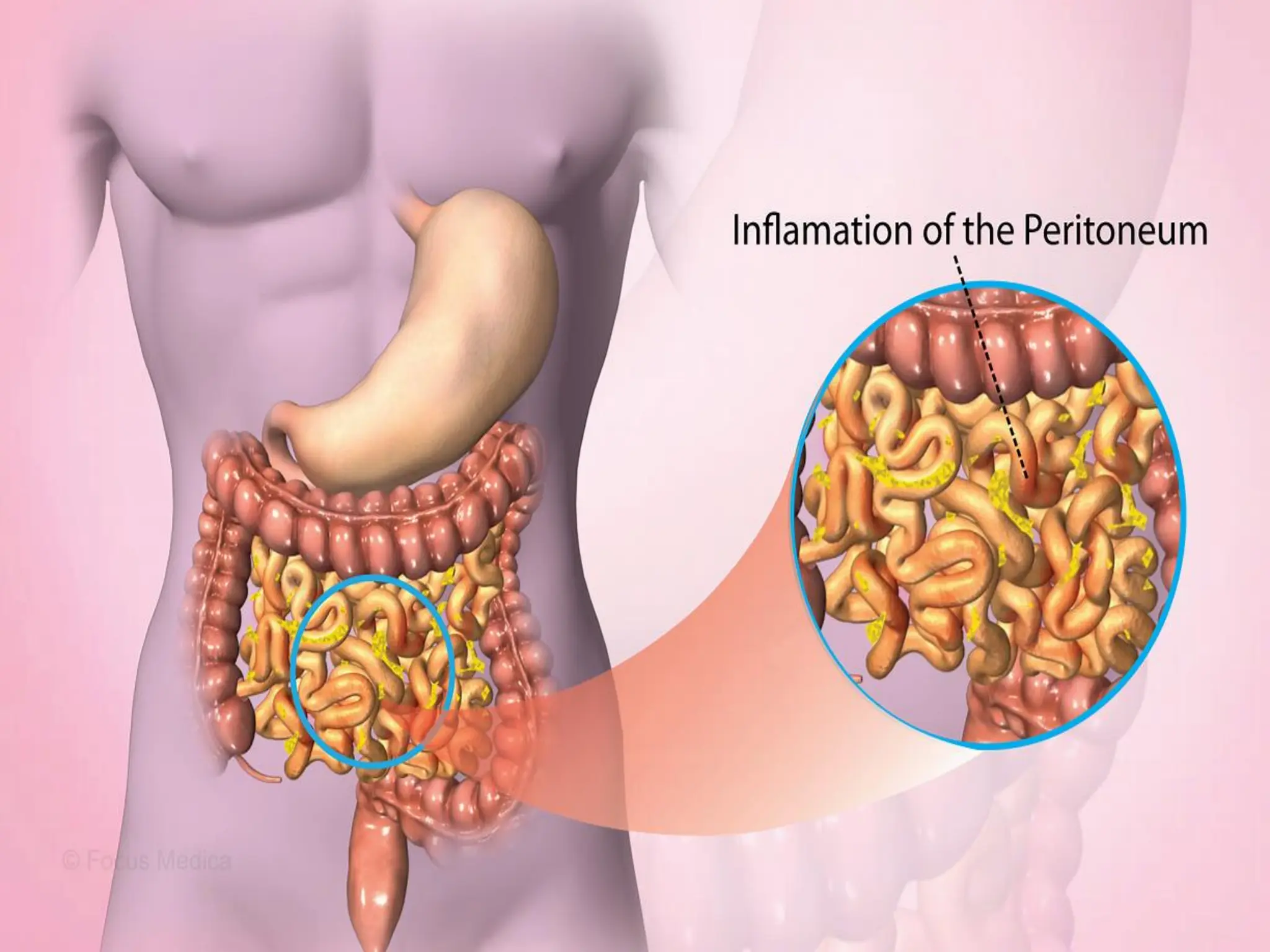
Inflammation of
the peritoneum
+
PERITONEUM
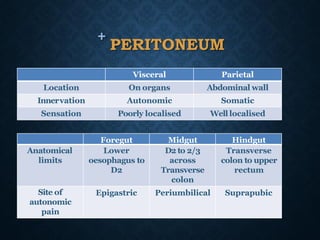
Visceral Parietal
Location On organs Abdominal wall
Innervation Autonomic Somatic
Sensation Poorly localised Well localised
Foregut Midgut Hindgut
Anatomical
limits
Lower
oesophagus to
D2
D2 to 2/3
across
Transverse
colon
Transverse
colon to upper
rectum
Site of
autonomic
pain
Epigastric Periumbilical Suprapubic
+
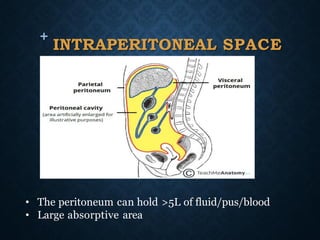
INTRAPERITONEAL SPACE
• The peritoneum can hold >5L of fluid/pus/blood
• Large absorptive area
+
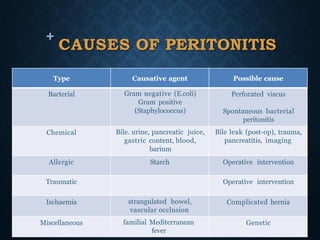
CAUSES OF PERITONITIS
Type Causative agent Possible cause
Bacterial Gram negative (E.coli)
Gram positive
(Staphylococcus)
Perforated viscus
Spontaneous bacterial
peritonitis
Chemical Bile. urine, pancreatic juice,
gastric content, blood,
barium
Bile leak (post-op), trauma,
pancreatitis, imaging
Allergic Starch Operative intervention
Traumatic Operative intervention
Ischaemia strangulated bowel,
vascular occlusion
Complicated hernia
Miscellaneous familial Mediterranean
fever
Genetic
+
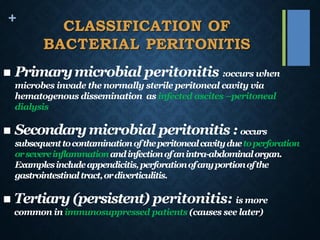
CLASSIFICATION OF
BACTERIAL PERITONITIS
◼ Primarymicrobial peritonitis :occurs when
microbes invade the normally sterile peritoneal cavity via
hematogenous dissemination as infected ascites –peritoneal
dialysis
◼ Secondarymicrobial peritonitis : occurs
subsequenttocontaminationoftheperitonealcavityduetoperforation
orsevereinflammationandinfectionofanintra-abdominalorgan.
Examplesincludeappendicitis,perforationofanyportionofthe
gastrointestinaltract,ordiverticulitis.
◼ Tertiary (persistent) peritonitis: is more
common in immunosuppressed patients (causes see later)
+
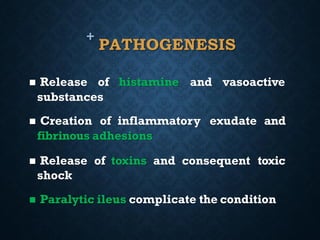
PATHOGENESIS
◼ Release of histamine and vasoactive
substances
◼ Creation of inflammatory exudate and
fibrinous adhesions
◼ Release of toxins and consequent toxic
shock
◼ Paralytic ileus complicate the condition
+
PATHOLOGICAL TYPES
◼ Localised peritonitis
◼ Anatomical
◼ Pathological
◼ Diffuse (generalised) peritonitis
◼ Speed of peritoneal contamination(failure of localization)
◼ Stimulation of peristalsis(food or even water)
◼ The virulence of the infecting organism
◼ Youngchildren havea small omentum
◼ Disruption of localised collections(appendix mass or pericolic abscess)
◼ Deficient naturalresistance
+
CLINICAL FEATURES
Localised peritonitis
◼ Localised guarding
◼ Rebound tenderness
◼ Rigidity
◼ The pain is referred to the C5 dermatome(sub
phernic)
◼ Pelvic peritonitis; rectal or vaginal
examination marked tenderness
+
DIFFUSE (GENERALISED)
PERITONITIS
EARLY
◼ Abdominal pain is severe and made worse by
moving or breathing; experienced at the site of the
spreads outwards from this
original lesion and
point.
◼ The patient usually lies still. Tenderness and
generalised guarding are found on palpation.
◼ Infrequent bowel sounds may still be heard but
they cease with the onset of paralytic ileus.
◼ Pulse and temperature rise in accord with degree of
inflammation and infection.
+
DIFFUSE (GENERALISED)
PERITONITIS
LATE
◼ Generalised rigidity
◼ Distension and absent bowel sounds
◼ Circulatory failure ensues, with cold, clammy
extremities
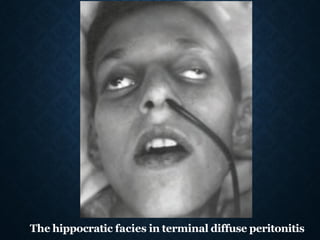
◼ Sunken eyes, dry tongue, thready (irregular)
pulse, and drawn and anxious face (hippocratic
facies)
◼ The patient finally lapses into unconsciousness
The hippocratic facies in terminal diffuse peritonitis
+
INVESTIGATIONS
Blood
◼ Urea and electrolytes
◼ Full blood count for white cell count
(WCC)
◼ Serum amylase
◼ Group and compatibility
+
INVESTIGATIONS
Imaging
◼Erect chest radiograph
◼CT
◼Ultrasonography
◼Peritoneal diagnostic aspiration
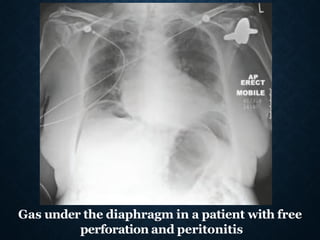
Gas under the diaphragm in a patient with free
perforation and peritonitis
+
MANAGEMENT
General care of the patient
◼ Correction of fluid loss and circulating
volume
◼ Urinary catheterisation ± gastro-
intestinal decompression(NG tube)
◼ Antibiotic therapy
◼ Analgesia
+
MANAGEMENT
• Specific treatment of the cause
◼Non-surgical treatment is preferred
◼Surgery is directed to removing (or
diverting) the cause and subsequent
adequate peritoneal lavage ± drainage
◼The whole peritoneal cavity be explored
and mopped. The use of a large volume
of saline (typically 3 litres) containing
dissolved antiseptic or antibiotic
+
COMPLICATIONS
complications of
Systemic
peritonitis
◼Septic shock
◼Systemic inflammatory response
syndrome
◼Multi-organ dysfunction syndrome
◼Death
+ ABDOMINAL
COMPLICATIONS OF
PERITONITIS
◼ Paralytic ileus
◼ Residual or recurrent
abscess/inflammatory mass
◼ Portal pyaemia/liver abscess
◼ Adhesional small bowel
obstruction
+ SPECIAL FORMS OF PERITONITIS
operations/
Bile peritonitis
◼ Perforated gall bladder
◼ Post-cholecystectomy
◼ Following other
procedures:
◼Blunt or penetrating hepatobiliary or
duodenal trauma
+ SPECIAL FORMS OF PERITONITIS
Tuberculous peritonitis
◼ Acute (may be clinically indistinguishable from
acute bacterial peritonitis) and chronic forms
◼ Abdominal pain, sweats, malaise and weight
loss
◼ Ascites common, may be loculated
◼ Caseating peritoneal nodules – distinguish from
metastatic carcinoma and fat necrosis of
pancreatitis
◼ Intestinal obstruction may respond to anti-
tuberculous treatment without surgery
+ SPECIAL FORMS OF PERITONITIS
Familial Mediterranean fever (periodic
peritonitis)
◼ Comes in attacks
◼ Recurrentwith remissions and
exacerbations
◼ Plus pain in the thorax and joints
◼ Familial Female more,children more
◼ +ve appendectomy
◼ Colchicine therapy
+ SPECIAL FORMS OF PERITONITIS
INTRAPERITONEAL ABSCESS
Symptoms
◼ Malaise, lethargy – failure to recover from
surgery as expected
◼ Anorexia and weight loss
◼ Sweats ± rigors
◼ Abdominal/pelvic pain
◼ Symptomsfrom local irritation
+ SPECIAL FORMS OF PERITONITIS
Signs
◼Increased temperatureand pulse ±
swinging pyrexia
◼Localised abdominal tenderness ±
mass (including on pelvic exam)
+
TERTIARY PERITONITIS IS MAINLY:
A. Postoperative complication of
delayed diagnosis of secondary
peritonitis
poly
B. Residual intraperitoneal abscess
C. Wrong management of
traumatized patient
D. Usually occurred in ascetic patents
with hepatorenal impairment
+
IN
SUMMARY
❑Peritonitis is a very common serious
surgical emergency
❑Early effective Treatment is the cornerstone
❑Treatment underlying cause and
complications
Peritonitis.pdfvjvhicghgcfdruvxseery87r4

Peritonitis.pdfvjvhicghgcfdruvxseery87r4

  • 2.
  • 3.
    + PERITONEUM Visceral Parietal Location Onorgans Abdominal wall Innervation Autonomic Somatic Sensation Poorly localised Well localised Foregut Midgut Hindgut Anatomical limits Lower oesophagus to D2 D2 to 2/3 across Transverse colon Transverse colon to upper rectum Site of autonomic pain Epigastric Periumbilical Suprapubic
  • 4.
    + INTRAPERITONEAL SPACE • Theperitoneum can hold >5L of fluid/pus/blood • Large absorptive area
  • 5.
    + CAUSES OF PERITONITIS TypeCausative agent Possible cause Bacterial Gram negative (E.coli) Gram positive (Staphylococcus) Perforated viscus Spontaneous bacterial peritonitis Chemical Bile. urine, pancreatic juice, gastric content, blood, barium Bile leak (post-op), trauma, pancreatitis, imaging Allergic Starch Operative intervention Traumatic Operative intervention Ischaemia strangulated bowel, vascular occlusion Complicated hernia Miscellaneous familial Mediterranean fever Genetic
  • 6.
    + CLASSIFICATION OF BACTERIAL PERITONITIS ◼Primarymicrobial peritonitis :occurs when microbes invade the normally sterile peritoneal cavity via hematogenous dissemination as infected ascites –peritoneal dialysis ◼ Secondarymicrobial peritonitis : occurs subsequenttocontaminationoftheperitonealcavityduetoperforation orsevereinflammationandinfectionofanintra-abdominalorgan. Examplesincludeappendicitis,perforationofanyportionofthe gastrointestinaltract,ordiverticulitis. ◼ Tertiary (persistent) peritonitis: is more common in immunosuppressed patients (causes see later)
  • 7.
    + PATHOGENESIS ◼ Release ofhistamine and vasoactive substances ◼ Creation of inflammatory exudate and fibrinous adhesions ◼ Release of toxins and consequent toxic shock ◼ Paralytic ileus complicate the condition
  • 9.
    + PATHOLOGICAL TYPES ◼ Localisedperitonitis ◼ Anatomical ◼ Pathological ◼ Diffuse (generalised) peritonitis ◼ Speed of peritoneal contamination(failure of localization) ◼ Stimulation of peristalsis(food or even water) ◼ The virulence of the infecting organism ◼ Youngchildren havea small omentum ◼ Disruption of localised collections(appendix mass or pericolic abscess) ◼ Deficient naturalresistance
  • 10.
    + CLINICAL FEATURES Localised peritonitis ◼Localised guarding ◼ Rebound tenderness ◼ Rigidity ◼ The pain is referred to the C5 dermatome(sub phernic) ◼ Pelvic peritonitis; rectal or vaginal examination marked tenderness
  • 11.
    + DIFFUSE (GENERALISED) PERITONITIS EARLY ◼ Abdominalpain is severe and made worse by moving or breathing; experienced at the site of the spreads outwards from this original lesion and point. ◼ The patient usually lies still. Tenderness and generalised guarding are found on palpation. ◼ Infrequent bowel sounds may still be heard but they cease with the onset of paralytic ileus. ◼ Pulse and temperature rise in accord with degree of inflammation and infection.
  • 12.
    + DIFFUSE (GENERALISED) PERITONITIS LATE ◼ Generalisedrigidity ◼ Distension and absent bowel sounds ◼ Circulatory failure ensues, with cold, clammy extremities ◼ Sunken eyes, dry tongue, thready (irregular) pulse, and drawn and anxious face (hippocratic facies) ◼ The patient finally lapses into unconsciousness
  • 13.
    The hippocratic faciesin terminal diffuse peritonitis
  • 14.
    + INVESTIGATIONS Blood ◼ Urea andelectrolytes ◼ Full blood count for white cell count (WCC) ◼ Serum amylase ◼ Group and compatibility
  • 15.
  • 16.
    Gas under thediaphragm in a patient with free perforation and peritonitis
  • 17.
    + MANAGEMENT General care ofthe patient ◼ Correction of fluid loss and circulating volume ◼ Urinary catheterisation ± gastro- intestinal decompression(NG tube) ◼ Antibiotic therapy ◼ Analgesia
  • 18.
    + MANAGEMENT • Specific treatmentof the cause ◼Non-surgical treatment is preferred ◼Surgery is directed to removing (or diverting) the cause and subsequent adequate peritoneal lavage ± drainage ◼The whole peritoneal cavity be explored and mopped. The use of a large volume of saline (typically 3 litres) containing dissolved antiseptic or antibiotic
  • 19.
    + COMPLICATIONS complications of Systemic peritonitis ◼Septic shock ◼Systemicinflammatory response syndrome ◼Multi-organ dysfunction syndrome ◼Death
  • 20.
    + ABDOMINAL COMPLICATIONS OF PERITONITIS ◼Paralytic ileus ◼ Residual or recurrent abscess/inflammatory mass ◼ Portal pyaemia/liver abscess ◼ Adhesional small bowel obstruction
  • 21.
    + SPECIAL FORMSOF PERITONITIS operations/ Bile peritonitis ◼ Perforated gall bladder ◼ Post-cholecystectomy ◼ Following other procedures: ◼Blunt or penetrating hepatobiliary or duodenal trauma
  • 22.
    + SPECIAL FORMSOF PERITONITIS Tuberculous peritonitis ◼ Acute (may be clinically indistinguishable from acute bacterial peritonitis) and chronic forms ◼ Abdominal pain, sweats, malaise and weight loss ◼ Ascites common, may be loculated ◼ Caseating peritoneal nodules – distinguish from metastatic carcinoma and fat necrosis of pancreatitis ◼ Intestinal obstruction may respond to anti- tuberculous treatment without surgery
  • 23.
    + SPECIAL FORMSOF PERITONITIS Familial Mediterranean fever (periodic peritonitis) ◼ Comes in attacks ◼ Recurrentwith remissions and exacerbations ◼ Plus pain in the thorax and joints ◼ Familial Female more,children more ◼ +ve appendectomy ◼ Colchicine therapy
  • 24.
    + SPECIAL FORMSOF PERITONITIS INTRAPERITONEAL ABSCESS Symptoms ◼ Malaise, lethargy – failure to recover from surgery as expected ◼ Anorexia and weight loss ◼ Sweats ± rigors ◼ Abdominal/pelvic pain ◼ Symptomsfrom local irritation
  • 25.
    + SPECIAL FORMSOF PERITONITIS Signs ◼Increased temperatureand pulse ± swinging pyrexia ◼Localised abdominal tenderness ± mass (including on pelvic exam)
  • 26.
    + TERTIARY PERITONITIS ISMAINLY: A. Postoperative complication of delayed diagnosis of secondary peritonitis poly B. Residual intraperitoneal abscess C. Wrong management of traumatized patient D. Usually occurred in ascetic patents with hepatorenal impairment
  • 27.
    + IN SUMMARY ❑Peritonitis is avery common serious surgical emergency ❑Early effective Treatment is the cornerstone ❑Treatment underlying cause and complications