Orach Walter MBChB 3.
Cancer of the stomach
outline
 Anatomy/introduction
 Epidemiology
 Etiology/Risk Factors
 Pathology
 Clinical Presentation
 Preoperative Evaluation
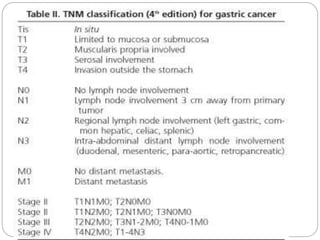
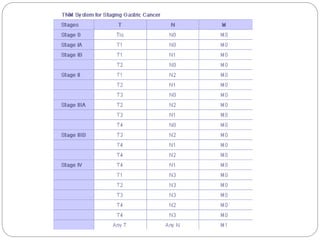
 Staging
 Treatment
 Outcomes
 Follow up
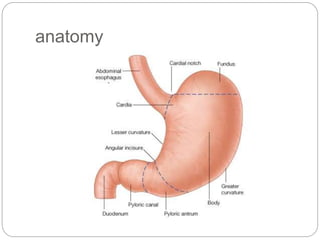
anatomy
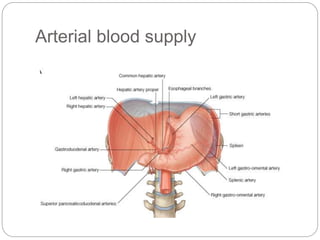
Arterial blood supply
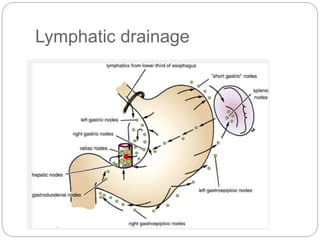
Lymphatic drainage
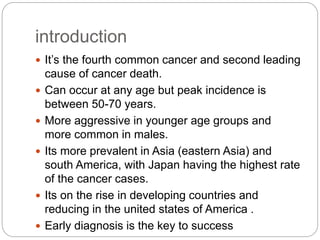
introduction
 It’s the fourth common cancer and second leading
cause of cancer death.
 Can occur at any age but peak incidence is
between 50-70 years.
 More aggressive in younger age groups and
more common in males.
 Its more prevalent in Asia (eastern Asia) and
south America, with Japan having the highest rate
of the cancer cases.
 Its on the rise in developing countries and
reducing in the united states of America .
 Early diagnosis is the key to success
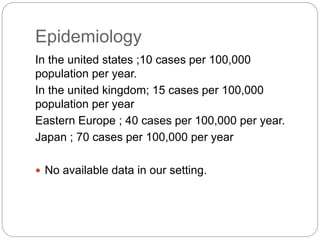
In the united states ;10 cases per 100,000
population per year.
In the united kingdom; 15 cases per 100,000
population per year
Eastern Europe ; 40 cases per 100,000 per year.
Japan ; 70 cases per 100,000 per year
 No available data in our setting.
Epidemiology
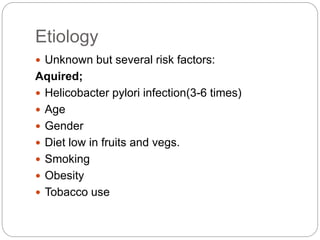
Etiology
 Unknown but several risk factors:
Aquired;
 Helicobacter pylori infection(3-6 times)
 Age
 Gender
 Diet low in fruits and vegs.
 Smoking
 Obesity
 Tobacco use
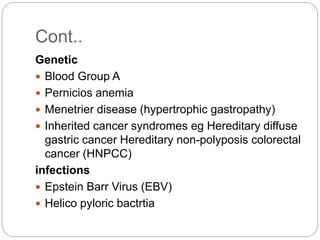
Genetic
 Blood Group A
 Pernicios anemia
 Menetrier disease (hypertrophic gastropathy)
 Inherited cancer syndromes eg Hereditary diffuse
gastric cancer Hereditary non-polyposis colorectal
cancer (HNPCC)
infections
 Epstein Barr Virus (EBV)
 Helico pyloric bactrtia
Cont..
Cont..
others
 Familial history
 Previous surgery
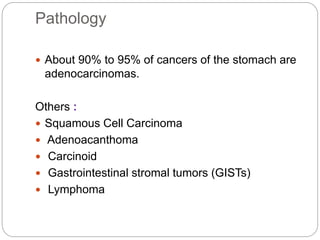
Pathology
 About 90% to 95% of cancers of the stomach are
adenocarcinomas.
Others :
 Squamous Cell Carcinoma
 Adenoacanthoma
 Carcinoid
 Gastrointestinal stromal tumors (GISTs)
 Lymphoma
Spread
 Lymphatic
 Blood(Liver commonest)
 Transperitoneal
 Direct
Clinical presentation
 Early cancer of the stomach does not cause signs
and symptoms thus making it difficult to diagnose.
 1 in 5 are diagnosed early in the USA.
 Depends on the stage of the disease at the time
of presentation. In our setting, patients present
very late.
Clinical presentation
They include:
 Weight loss and reduced appetite
 Epigatric pain
 Vomiting
 Abdominal mass
 Dysphagia
 Jaundice
 Ascites
 Troisier’s sign
Clinical presentation
 Blummer shelf (recto-vesicle metastases)
 Anaemia and cachexia
 Haematemesis/melaena
 Peritonitis(perforation)
 Metastases to the umbilicus(Sister Joseph’s
nodules)
 Krukenberg tumors
 Cutaneous metastases
Investigations
Endoscopy
 Esophagogastroduodenoscopy /
Imaging
 Barium meal
 EUS(endoscopy ultrasound)
 CT scan
 MRI
 PET(Positron emission tomography)
 Chest X-Ray
Investigations
Other investigations ..
 Complete Blood Count
 Liver Functional Tests
 Renal Functional test
 Grouping and X-matching
Management
 Location of the tumor
 Resectable Vs Non resectable
 Curative Vs Non curative surgery
 Lymph node clearance
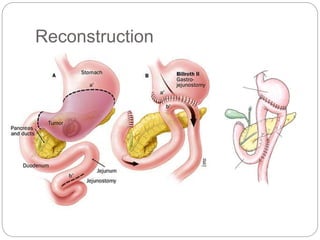
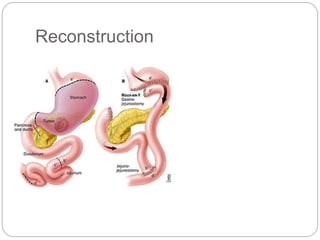
 Reconstructive surgery
Goals of management
 Correction of anemia
 Correction of nutritional status
 Fluid and electrolyte correction
 Prophylactic antibiotics
 Cardiac and respiratory status monitering
Surgical Treatment
 Absence of distant metastases
 Resection margin w/ neg. microscopic
margins
 Gastric tumors char. by extensive
intramural spread
 Line of resection at least 6 cm from the
tumor mass to decrease recurrence at
anastomosis
 App surgery based on location / pattern
of spread
Surgical treatment
Resectable Vs unresectable
 Unresectable cancers can’t be removed
completely.
 This might be because the tumor has
grown too far into nearby organs or
lymph nodes, it has grown too close to
major blood vessels, it has spread to
distant parts of the body, or the person
is not healthy enough for surgery.
Surgical treatment
 Cardia / proximal ~ 35-50% of gastric
adenocarcinomas
 Proximal
 More advanced at presentation
 Curative resection is rare
 Total gastrectomy or proximal gastric resection
Proximal / Cardia
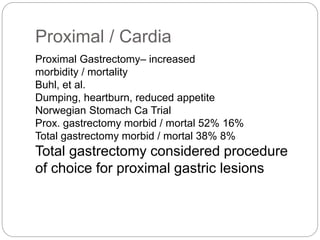
Proximal Gastrectomy– increased
morbidity / mortality
Buhl, et al.
Dumping, heartburn, reduced appetite
Norwegian Stomach Ca Trial
Prox. gastrectomy morbid / mortal 52% 16%
Total gastrectomy morbid / mortal 38% 8%
Total gastrectomy considered procedure
of choice for proximal gastric lesions
Distal tumors
 Account for ~ 35 % of all gastric cancers
 No 5-year survival difference between
subtotal vs total gastrectomy
 Subtotal appropriate if negative margins
 Recurrence vs nonrecurrence depends on
margin of 3.5 cm vs 6.5 cm
Endoscopic mucosal resection
 This operation is not done as much in
the United States as it is in Japan and
some other countries, where stomach
cancer is often detected early during
screening.
 If you are going to have this surgery, it
should be at a center that has
experience with this technique.
Lymphadenectomy
 Conventional Western lymph node
dissection during therapeutic
gastrectomy for cancer of the stomach
includes removal of the perigastric
(mostly N1) nodes only and has been
referred to as D1 lymph node dissection.
Lymphadenectomy
 In 1960s the Japanese surgeons first
introduced the extended
lymphadenectomy procedure (D2),
during which in addition the (N2) lymph
nodes around the coeliac axis, the left
gastric artery, the common hepatic
artery and the splenic artery as well as
those at the splenic hilus were removed
Lymphadenectomy
 Some also advocated the removal of
(N3) nodes around the upper abdominal
aorta (D3 lymphadenectomy), based on
the fact that 20–30% of patients with
non-early gastric cancer (>T1) have
micrometastases in those para-aortic
lymph nodes.
 Hence, D3 resection also included
nodes surrounding the superior
mesenteric artery, at the posterior
aspect of the pancreas head as well as
Lymphadenectomy
During the last years, some have
advocated removal of all para-aortic
lymph nodes, which was previously
referred to as D2+ or D4
lymphadenectomy
Lymphadenectomy
Extended Lymphadenectomy is Controversial
Japanese system
D1 – group 1 LN
D2 – groups 1 & 2
D3 – D2 plus para-aortic LN
To remove station 10 & 11 LN – splenectomy
D2 resection – partial pancreatectomy
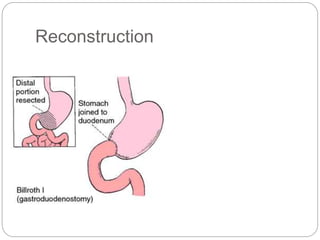
Reconstruction
Reconstruction
Reconstruction
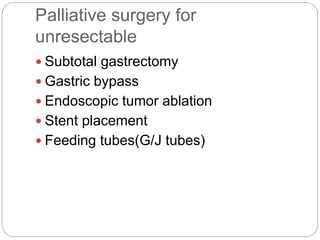
Palliative surgery for
unresectable
 Subtotal gastrectomy
 Gastric bypass
 Endoscopic tumor ablation
 Stent placement
 Feeding tubes(G/J tubes)
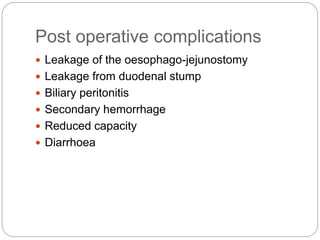
Post operative complications
 Leakage of the oesophago-jejunostomy
 Leakage from duodenal stump
 Biliary peritonitis
 Secondary hemorrhage
 Reduced capacity
 Diarrhoea
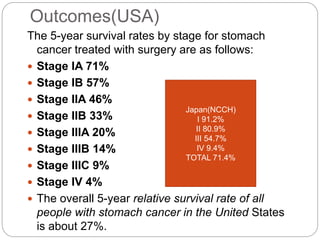
Outcomes(USA)
The 5-year survival rates by stage for stomach
cancer treated with surgery are as follows:
 Stage IA 71%
 Stage IB 57%
 Stage IIA 46%
 Stage IIB 33%
 Stage IIIA 20%
 Stage IIIB 14%
 Stage IIIC 9%
 Stage IV 4%
 The overall 5-year relative survival rate of all
people with stomach cancer in the United States
is about 27%.
Japan(NCCH)
I 91.2%
II 80.9%
III 54.7%
IV 9.4%
TOTAL 71.4%
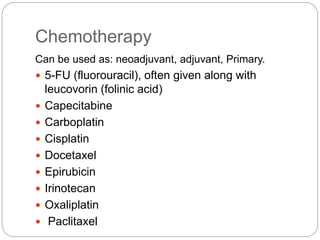
Chemotherapy
Can be used as: neoadjuvant, adjuvant, Primary.
 5-FU (fluorouracil), often given along with
leucovorin (folinic acid)
 Capecitabine
 Carboplatin
 Cisplatin
 Docetaxel
 Epirubicin
 Irinotecan
 Oxaliplatin
 Paclitaxel
Chemotherapy
Common chemo combinations include:
 ECF (epirubicin, cisplatin, and 5-FU),which may
be given before and after surgery
 Docetaxel or paclitaxel plus either 5-FU or
capecitabine, combined with radiation as
treatment before surgery
 Cisplatin plus either 5-FU or capecitabine,
combined with radiation as treatment before
surgery
 Paclitaxel and carboplatin, combined with
radiation as treatment before surgery
Targeted therapies
Trastuzumab
 About 1 out of 5 of stomach cancers has too
much of a growth-promoting protein called
HER2/neu (or just HER2) on the surface of the
cancer cells.
 Tumors with increased levels of HER2 are called
HER2-positive.

ca stomach.ppt

  • 1.
    Orach Walter MBChB3. Cancer of the stomach
  • 2.
    outline  Anatomy/introduction  Epidemiology Etiology/Risk Factors  Pathology  Clinical Presentation  Preoperative Evaluation  Staging  Treatment  Outcomes  Follow up
  • 3.
  • 4.
  • 5.
  • 6.
    introduction  It’s thefourth common cancer and second leading cause of cancer death.  Can occur at any age but peak incidence is between 50-70 years.  More aggressive in younger age groups and more common in males.  Its more prevalent in Asia (eastern Asia) and south America, with Japan having the highest rate of the cancer cases.  Its on the rise in developing countries and reducing in the united states of America .  Early diagnosis is the key to success
  • 7.
    In the unitedstates ;10 cases per 100,000 population per year. In the united kingdom; 15 cases per 100,000 population per year Eastern Europe ; 40 cases per 100,000 per year. Japan ; 70 cases per 100,000 per year  No available data in our setting. Epidemiology
  • 8.
    Etiology  Unknown butseveral risk factors: Aquired;  Helicobacter pylori infection(3-6 times)  Age  Gender  Diet low in fruits and vegs.  Smoking  Obesity  Tobacco use
  • 9.
    Genetic  Blood GroupA  Pernicios anemia  Menetrier disease (hypertrophic gastropathy)  Inherited cancer syndromes eg Hereditary diffuse gastric cancer Hereditary non-polyposis colorectal cancer (HNPCC) infections  Epstein Barr Virus (EBV)  Helico pyloric bactrtia Cont..
  • 10.
  • 11.
    Pathology  About 90%to 95% of cancers of the stomach are adenocarcinomas. Others :  Squamous Cell Carcinoma  Adenoacanthoma  Carcinoid  Gastrointestinal stromal tumors (GISTs)  Lymphoma
  • 12.
    Spread  Lymphatic  Blood(Livercommonest)  Transperitoneal  Direct
  • 13.
    Clinical presentation  Earlycancer of the stomach does not cause signs and symptoms thus making it difficult to diagnose.  1 in 5 are diagnosed early in the USA.  Depends on the stage of the disease at the time of presentation. In our setting, patients present very late.
  • 14.
    Clinical presentation They include: Weight loss and reduced appetite  Epigatric pain  Vomiting  Abdominal mass  Dysphagia  Jaundice  Ascites  Troisier’s sign
  • 15.
    Clinical presentation  Blummershelf (recto-vesicle metastases)  Anaemia and cachexia  Haematemesis/melaena  Peritonitis(perforation)  Metastases to the umbilicus(Sister Joseph’s nodules)  Krukenberg tumors  Cutaneous metastases
  • 16.
    Investigations Endoscopy  Esophagogastroduodenoscopy / Imaging Barium meal  EUS(endoscopy ultrasound)  CT scan  MRI  PET(Positron emission tomography)  Chest X-Ray
  • 17.
    Investigations Other investigations .. Complete Blood Count  Liver Functional Tests  Renal Functional test  Grouping and X-matching
  • 20.
    Management  Location ofthe tumor  Resectable Vs Non resectable  Curative Vs Non curative surgery  Lymph node clearance  Reconstructive surgery
  • 21.
    Goals of management Correction of anemia  Correction of nutritional status  Fluid and electrolyte correction  Prophylactic antibiotics  Cardiac and respiratory status monitering
  • 22.
    Surgical Treatment  Absenceof distant metastases  Resection margin w/ neg. microscopic margins  Gastric tumors char. by extensive intramural spread  Line of resection at least 6 cm from the tumor mass to decrease recurrence at anastomosis  App surgery based on location / pattern of spread
  • 23.
    Surgical treatment Resectable Vsunresectable  Unresectable cancers can’t be removed completely.  This might be because the tumor has grown too far into nearby organs or lymph nodes, it has grown too close to major blood vessels, it has spread to distant parts of the body, or the person is not healthy enough for surgery.
  • 24.
    Surgical treatment  Cardia/ proximal ~ 35-50% of gastric adenocarcinomas  Proximal  More advanced at presentation  Curative resection is rare  Total gastrectomy or proximal gastric resection
  • 25.
    Proximal / Cardia ProximalGastrectomy– increased morbidity / mortality Buhl, et al. Dumping, heartburn, reduced appetite Norwegian Stomach Ca Trial Prox. gastrectomy morbid / mortal 52% 16% Total gastrectomy morbid / mortal 38% 8% Total gastrectomy considered procedure of choice for proximal gastric lesions
  • 26.
    Distal tumors  Accountfor ~ 35 % of all gastric cancers  No 5-year survival difference between subtotal vs total gastrectomy  Subtotal appropriate if negative margins  Recurrence vs nonrecurrence depends on margin of 3.5 cm vs 6.5 cm
  • 27.
    Endoscopic mucosal resection This operation is not done as much in the United States as it is in Japan and some other countries, where stomach cancer is often detected early during screening.  If you are going to have this surgery, it should be at a center that has experience with this technique.
  • 28.
    Lymphadenectomy  Conventional Westernlymph node dissection during therapeutic gastrectomy for cancer of the stomach includes removal of the perigastric (mostly N1) nodes only and has been referred to as D1 lymph node dissection.
  • 29.
    Lymphadenectomy  In 1960sthe Japanese surgeons first introduced the extended lymphadenectomy procedure (D2), during which in addition the (N2) lymph nodes around the coeliac axis, the left gastric artery, the common hepatic artery and the splenic artery as well as those at the splenic hilus were removed
  • 30.
    Lymphadenectomy  Some alsoadvocated the removal of (N3) nodes around the upper abdominal aorta (D3 lymphadenectomy), based on the fact that 20–30% of patients with non-early gastric cancer (>T1) have micrometastases in those para-aortic lymph nodes.  Hence, D3 resection also included nodes surrounding the superior mesenteric artery, at the posterior aspect of the pancreas head as well as
  • 31.
    Lymphadenectomy During the lastyears, some have advocated removal of all para-aortic lymph nodes, which was previously referred to as D2+ or D4 lymphadenectomy
  • 32.
    Lymphadenectomy Extended Lymphadenectomy isControversial Japanese system D1 – group 1 LN D2 – groups 1 & 2 D3 – D2 plus para-aortic LN To remove station 10 & 11 LN – splenectomy D2 resection – partial pancreatectomy
  • 33.
  • 34.
  • 35.
  • 36.
    Palliative surgery for unresectable Subtotal gastrectomy  Gastric bypass  Endoscopic tumor ablation  Stent placement  Feeding tubes(G/J tubes)
  • 37.
    Post operative complications Leakage of the oesophago-jejunostomy  Leakage from duodenal stump  Biliary peritonitis  Secondary hemorrhage  Reduced capacity  Diarrhoea
  • 38.
    Outcomes(USA) The 5-year survivalrates by stage for stomach cancer treated with surgery are as follows:  Stage IA 71%  Stage IB 57%  Stage IIA 46%  Stage IIB 33%  Stage IIIA 20%  Stage IIIB 14%  Stage IIIC 9%  Stage IV 4%  The overall 5-year relative survival rate of all people with stomach cancer in the United States is about 27%. Japan(NCCH) I 91.2% II 80.9% III 54.7% IV 9.4% TOTAL 71.4%
  • 39.
    Chemotherapy Can be usedas: neoadjuvant, adjuvant, Primary.  5-FU (fluorouracil), often given along with leucovorin (folinic acid)  Capecitabine  Carboplatin  Cisplatin  Docetaxel  Epirubicin  Irinotecan  Oxaliplatin  Paclitaxel
  • 40.
    Chemotherapy Common chemo combinationsinclude:  ECF (epirubicin, cisplatin, and 5-FU),which may be given before and after surgery  Docetaxel or paclitaxel plus either 5-FU or capecitabine, combined with radiation as treatment before surgery  Cisplatin plus either 5-FU or capecitabine, combined with radiation as treatment before surgery  Paclitaxel and carboplatin, combined with radiation as treatment before surgery
  • 41.
    Targeted therapies Trastuzumab  About1 out of 5 of stomach cancers has too much of a growth-promoting protein called HER2/neu (or just HER2) on the surface of the cancer cells.  Tumors with increased levels of HER2 are called HER2-positive.