LIGHT
By: Metta
Introduction
   Light is a form of energy and also a form of
    electromagnetic radiation.
   Luminous objects are objects that radiates.
   Most luminous objects release light together with a large
    amount of heat.
   Non-luminous objects can only be seen if they are
    reflecting light from a luminous source.

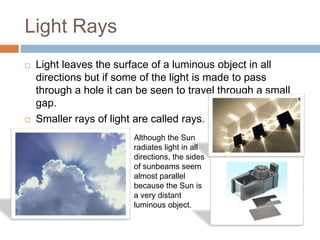
                      Luminous object:
                      Stars

                                Non-Luminous
                                object: Moon
Light Rays
   Light leaves the surface of a luminous object in all
    directions but if some of the light is made to pass
    through a hole it can be seen to travel through a small
    gap.
   Smaller rays of light are called rays.
                         Although the Sun
                         radiates light in all
                         directions, the sides
                         of sunbeams seem
                         almost parallel
                         because the Sun is
                         a very distant
                         luminous object.
Classifying non-luminous
  objects
     Non-luminous materials can be classified as
      transparent, translucent or opaque.
     Transparent materials let light pass through it.
     Translucent materials let some of the light pass through
      but many light rays are scattered.
     Opaque materials do not let light pass through it.


Transparent           Translucent         Opaque
Shadows
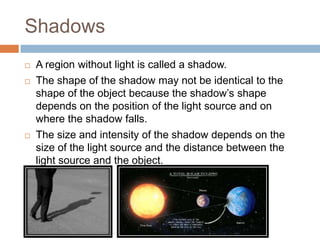
   A region without light is called a shadow.
   The shape of the shadow may not be identical to the
    shape of the object because the shadow’s shape
    depends on the position of the light source and on
    where the shadow falls.
   The size and intensity of the shadow depends on the
    size of the light source and the distance between the
    light source and the object.
Reflecting Light
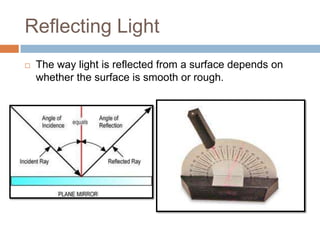
   The way light is reflected from a surface depends on
    whether the surface is smooth or rough.
Reflecting Light
   The angle of reflection is equal to the angle of incidence
    on glass, still water and polished metal.
   When the reflected light reaches your eyes you see an
    image.
Reflecting Light
   There are two kinds of images that can be formed with
    light: real images and virtual images.
   Real images are images such as those produced on a
    cinema screen by biconvex lenses.
Reflecting Light
   Virtual images cannot be projected onto a surface but
    only appear to exist, such as those in a plane mirror or
    other smooth, shiny surface.
   The virtual image of yourself is the same size as you
    are, and is at the same distance from the mirror’s
    surface as you are but behind the mirror instead in front
    of it.
   Your image in the mirror is the wrong way
    around, because your left shoulder will appear to be
    your right shoulder.
Reflecting Light
   Two plane mirrors my be used to give a person
    at the back of a crowd a view of an event.
   This device is called a periscope.
Reflecting Light
   Most objects have rough surfaces.
   When light rays strike any rough surfaces the rays are
    scattered in different directions.
Passing light through transparent
materials
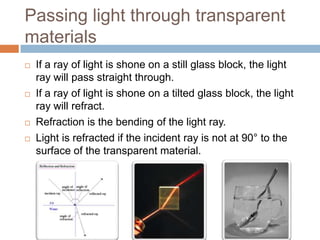
   If a ray of light is shone on a still glass block, the light
    ray will pass straight through.
   If a ray of light is shone on a tilted glass block, the light
    ray will refract.
   Refraction is the bending of the light ray.
   Light is refracted if the incident ray is not at 90° to the
    surface of the transparent material.
The Prism
   A triangular prism is a glass or plastic block with a
    triangular cross-section.
   Light behaves as if it travels in waves. The white light
    from the sun contains light of different wavelengths
    which give different colored light.
   When they pass through a prism the light waves of
    different wavelengths at slightly different speeds and are
    spread out to form the colors of the spectrum.
The Rainbow
   A rainbow is produced by the refraction and reflection of
    the Sun’s light through the water drops.
Color-Absorbing and Reflecting
Colors
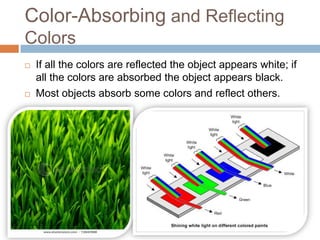
   If all the colors are reflected the object appears white; if
    all the colors are absorbed the object appears black.
   Most objects absorb some colors and reflect others.
Color-Filtering Colors
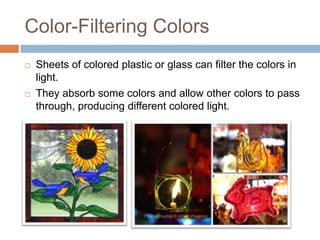
   Sheets of colored plastic or glass can filter the colors in
    light.
   They absorb some colors and allow other colors to pass
    through, producing different colored light.
Color-Combining Colors
   All the colors can be made from different combinations
    of just three colors.
   They are called the primary colors of light:
    red, green, and blue.
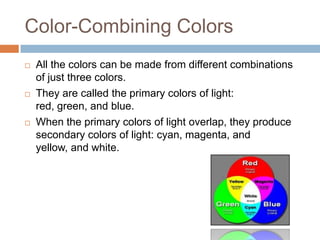
   When the primary colors of light overlap, they produce
    secondary colors of light: cyan, magenta, and
    yellow, and white.
Thank You for Your Attention!

Light

  • 1.
  • 2.
    Introduction  Light is a form of energy and also a form of electromagnetic radiation.  Luminous objects are objects that radiates.  Most luminous objects release light together with a large amount of heat.  Non-luminous objects can only be seen if they are reflecting light from a luminous source. Luminous object: Stars Non-Luminous object: Moon
  • 3.
    Light Rays  Light leaves the surface of a luminous object in all directions but if some of the light is made to pass through a hole it can be seen to travel through a small gap.  Smaller rays of light are called rays. Although the Sun radiates light in all directions, the sides of sunbeams seem almost parallel because the Sun is a very distant luminous object.
  • 4.
    Classifying non-luminous objects  Non-luminous materials can be classified as transparent, translucent or opaque.  Transparent materials let light pass through it.  Translucent materials let some of the light pass through but many light rays are scattered.  Opaque materials do not let light pass through it. Transparent Translucent Opaque
  • 5.
    Shadows  A region without light is called a shadow.  The shape of the shadow may not be identical to the shape of the object because the shadow’s shape depends on the position of the light source and on where the shadow falls.  The size and intensity of the shadow depends on the size of the light source and the distance between the light source and the object.
  • 6.
    Reflecting Light  The way light is reflected from a surface depends on whether the surface is smooth or rough.
  • 7.
    Reflecting Light  The angle of reflection is equal to the angle of incidence on glass, still water and polished metal.  When the reflected light reaches your eyes you see an image.
  • 8.
    Reflecting Light  There are two kinds of images that can be formed with light: real images and virtual images.  Real images are images such as those produced on a cinema screen by biconvex lenses.
  • 9.
    Reflecting Light  Virtual images cannot be projected onto a surface but only appear to exist, such as those in a plane mirror or other smooth, shiny surface.  The virtual image of yourself is the same size as you are, and is at the same distance from the mirror’s surface as you are but behind the mirror instead in front of it.  Your image in the mirror is the wrong way around, because your left shoulder will appear to be your right shoulder.
  • 10.
    Reflecting Light  Two plane mirrors my be used to give a person at the back of a crowd a view of an event.  This device is called a periscope.
  • 11.
    Reflecting Light  Most objects have rough surfaces.  When light rays strike any rough surfaces the rays are scattered in different directions.
  • 12.
    Passing light throughtransparent materials  If a ray of light is shone on a still glass block, the light ray will pass straight through.  If a ray of light is shone on a tilted glass block, the light ray will refract.  Refraction is the bending of the light ray.  Light is refracted if the incident ray is not at 90° to the surface of the transparent material.
  • 13.
    The Prism  A triangular prism is a glass or plastic block with a triangular cross-section.  Light behaves as if it travels in waves. The white light from the sun contains light of different wavelengths which give different colored light.  When they pass through a prism the light waves of different wavelengths at slightly different speeds and are spread out to form the colors of the spectrum.
  • 14.
    The Rainbow  A rainbow is produced by the refraction and reflection of the Sun’s light through the water drops.
  • 15.
    Color-Absorbing and Reflecting Colors  If all the colors are reflected the object appears white; if all the colors are absorbed the object appears black.  Most objects absorb some colors and reflect others.
  • 16.
    Color-Filtering Colors  Sheets of colored plastic or glass can filter the colors in light.  They absorb some colors and allow other colors to pass through, producing different colored light.
  • 17.
    Color-Combining Colors  All the colors can be made from different combinations of just three colors.  They are called the primary colors of light: red, green, and blue.  When the primary colors of light overlap, they produce secondary colors of light: cyan, magenta, and yellow, and white.
  • 18.
    Thank You forYour Attention!