1 
Welcome to CHEM 1101 
Instructor: Dr. Muhannad Amer 
Office Location: 44 staff Bldng
2 
• Beyond the chemistry theory of this class 
taking this class will enable you to: 
•Apply knowledge to solve new problems. 
• Analyze information you have gathered. 
• Work with and delegate responsibility to others. 
• Have confidence in yourself and your work. 
• Be organized in your thoughts and actions. 
• Ask and answer questions.
3 
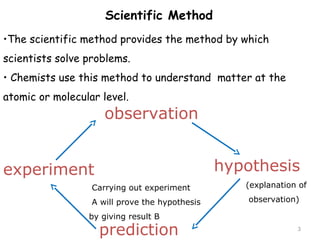
•The scientific method provides the method by which 
scientists solve problems. 
• Chemists use this method to understand matter at the 
atomic or molecular level. 
observation 
hypothesis 
prediction 
experiment 
Scientific Method 
(explanation of 
observation) 
Carrying out experiment 
A will prove the hypothesis 
by giving result B
4 
TThheeoorryy 
• WWhheenn ccoonnssiisstteennccyy iiss oobbttaaiinneedd,, 
hhyyppootthheesseess bbeeccoommee aa tthheeoorryy 
• Typically a fact of nature, often a math 
constant/number and unit. 
– Law of Conservation of Mass— “In a chemical 
reaction matter is neither created nor destroyed.” 
– Speed of Light, E = mc2, Dalton’s Gas Law, 
Universal Gas Constant, etc…
5 
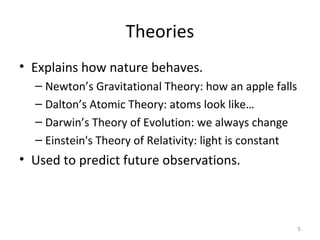
Theories 
• Explains how nature behaves. 
– Newton’s Gravitational Theory: how an apple falls 
– Dalton’s Atomic Theory: atoms look like… 
– Darwin’s Theory of Evolution: we always change 
– Einstein's Theory of Relativity: light is constant 
• Used to predict future observations.
6 
6 
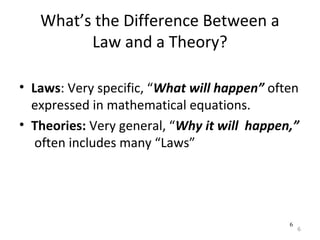
What’s the Difference Between a 
Law and a Theory? 
• Laws: Very specific, “What will happen” often 
expressed in mathematical equations. 
• Theories: Very general, “Why it will happen,” 
often includes many “Laws”
7 
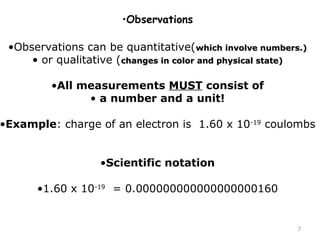
•Observations 
•Observations can be quantitative(wwhhiicchh iinnvvoollvvee nnuummbbeerrss..)) 
• or qualitative (cchhaannggeess iinn ccoolloorr aanndd pphhyyssiiccaall ssttaattee)) 
•All measurements MUST consist of 
• a number and a unit! 
•Example: charge of an electron is 1.60 x 10⁻¹⁹ coulombs 
•Scientific notation 
•1.60 x 10-19 = 0.000000000000000000160
8 
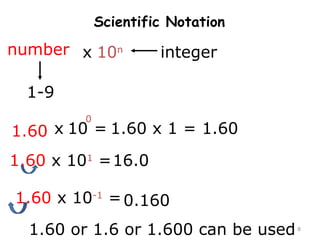
Scientific Notation 
number x 10n 
1-9 
integer 
0 
1.60 x 10 = 1.60 x 1 = 1.60 
1.60 x 101 = 16.0 
1.60 x 10-1 = 0.160 
1.60 or 1.6 or 1.600 can be used
9 
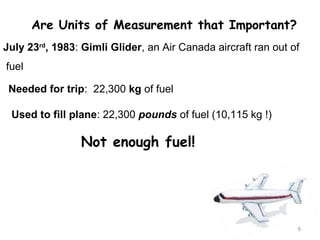
Are Units of Measurement that Important? 
July 23rd, 1983: Gimli Glider, an Air Canada aircraft ran out of 
fuel 
Needed for trip: 22,300 kg of fuel 
Used to fill plane: 22,300 pounds of fuel (10,115 kg !) 
Not enough fuel!
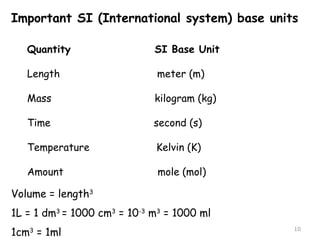
Important SI (International system) base units 
10 
Quantity SI Base Unit 
Length meter (m) 
Mass kilogram (kg) 
Time second (s) 
Temperature Kelvin (K) 
Amount mole (mol) 
Volume = length3 
1L = 1 dm3 = 1000 cm3 = 10-3 m3 = 1000 ml 
1cm3 = 1ml
11 
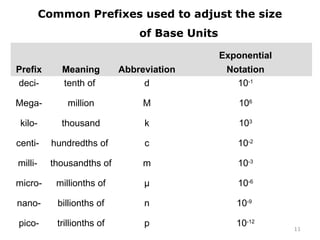
Common Prefixes used to adjust the size 
of Base Units 
Prefix Meaning Abbreviation 
Exponential 
Notation 
deci- tenth of d 10-1 
Mega- million M 106 
kilo- thousand k 103 
centi- hundredths of c 10-2 
milli- thousandths of m 10-3 
micro- millionths of μ 10-6 
nano- billionths of n 10-9 
pico- trillionths of p 10-12
12 
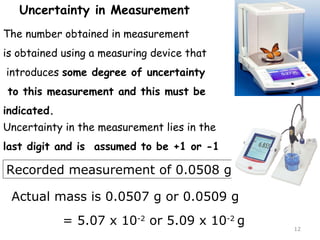
Uncertainty in Measurement 
The number obtained in measurement 
is obtained using a measuring device that 
introduces some degree of uncertainty 
to this measurement and this must be 
indicated. 
Uncertainty in the measurement lies in the 
last digit and is assumed to be +1 or -1 
Recorded measurement of 0.0508 g 
Actual mass is 0.0507 g or 0.0509 g 
= 5.07 x 10⁻² or 5.09 x 10⁻² g
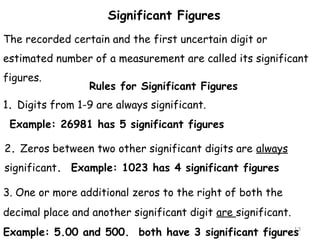
The recorded certain and the first uncertain digit or 
estimated number of a measurement are called its significant 
figures. 
13 
Significant Figures 
Rules for Significant Figures 
1. Digits from 1-9 are always significant. 
Example: 26981 has 5 significant figures 
2. Zeros between two other significant digits are always 
significant. Example: 1023 has 4 significant figures 
3. One or more additional zeros to the right of both the 
decimal place and another significant digit are significant. 
Example: 5.00 and 500. both have 3 significant figures
14 
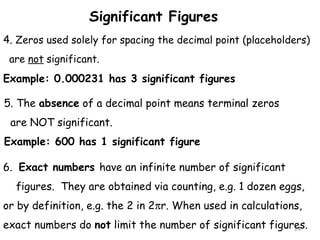
Significant Figures 
4. Zeros used solely for spacing the decimal point (placeholders) 
are not significant. 
Example: 0.000231 has 3 significant figures 
5. The absence of a decimal point means terminal zeros 
are NOT significant. 
Example: 600 has 1 significant figure 
6. Exact numbers have an infinite number of significant 
figures. They are obtained via counting, e.g. 1 dozen eggs, 
or by definition, e.g. the 2 in 2pr. When used in calculations, 
exact numbers do not limit the number of significant figures.
15 
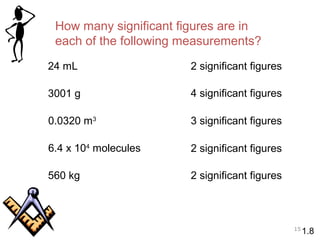
How many significant figures are in 
each of the following measurements? 
24 mL 2 significant figures 
3001 g 4 significant figures 
0.0320 m3 3 significant figures 
6.4 x 10⁴ molecules 2 significant figures 
560 kg 2 significant figures 
1.8
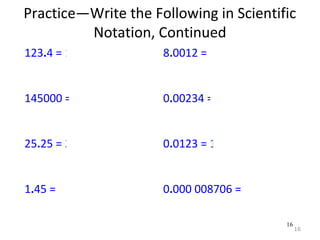
Practice—Write the Following in Scientific 
16 
16 
Notation, Continued 
123.4 = 1.234 x 10² 
145000 = 1.45 x 10⁵ 
25.25 = 2.525 x 101 
1.45 = 1.45 x 100 
8.0012 = 8.0012 x 100 
0.00234 = 2.34 x 10⁻³ 
0.0123 = 1.23 x 10⁻² 
0.000 008706 = 8.706 x 10⁻⁶
17 
Tro's "Introductory Chemistry", 
Chapter 2 
17 
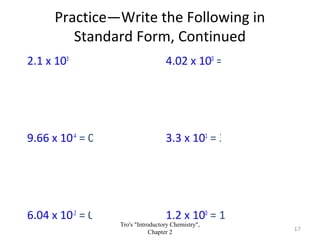
Practice—Write the Following in 
Standard Form, Continued 
2.1 x 103 = 2100 
9.66 x 10-4 = 0.000966 
6.04 x 10-2 = 0.0604 
4.02 x 100 = 4.02 
3.3 x 101 = 33 
1.2 x 100 = 1.2
18 
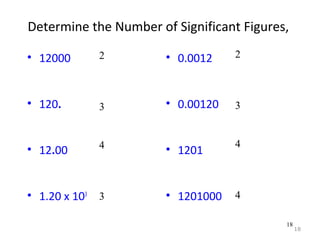
Determine the Number of Significant Figures, 
• 12000 
18 
• 120. 
• 12.00 
• 1.20 x 10³ 
• 0.0012 
• 0.00120 
• 1201 
• 1201000 
2 
3 
4 
3 
2 
3 
4 
4
19 
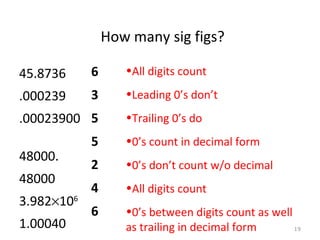
How man y sig figs? 
45.8736 
.000239 
.00023900 
48000. 
48000 
3.982´106 
1.00040 
6 
3 
5 
5 
2 
4 
6 
•All digits count 
•Leading 0’s don’t 
•Trailing 0’s do 
•0’s count in decimal form 
•0’s don’t count w/o decimal 
•All digits count 
•0’s between digits count as well 
as trailing in decimal form
20 
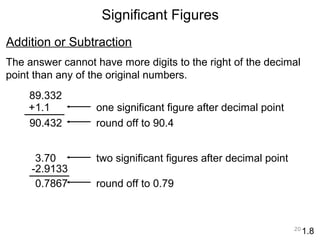
Significant Figures 
1.8 
Addition or Subtraction 
The answer cannot have more digits to the right of the decimal 
point than any of the original numbers. 
89.332 
+1.1 
90.432 round off to 90.4 
one significant figure after decimal point 
3.70 
-2.9133 
0.7867 
two significant figures after decimal point 
round off to 0.79
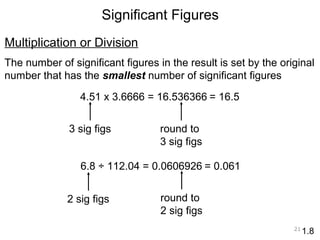
Multiplication or Division 
The number of significant figures in the result is set by the original 
number that has the smallest number of significant figures 
21 
Significant Figures 
1.8 
4.51 x 3.6666 = 16.536366 = 16.5 
3 sig figs round to 
3 sig figs 
6.8 ÷ 112.04 = 0.0606926 
2 sig figs round to 
2 sig figs 
= 0.061
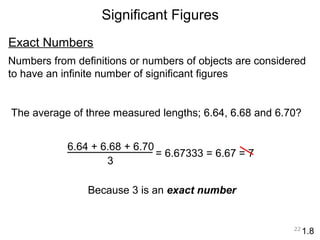
Exact Numbers 
Numbers from definitions or numbers of objects are considered 
to have an infinite number of significant figures 
22 
Significant Figures 
1.8 
The average of three measured lengths; 6.64, 6.68 and 6.70? 
6.64 + 6.68 + 6.70 
3 
= 6.67333 = 6.67 
Because 3 is an exact number 
= 7
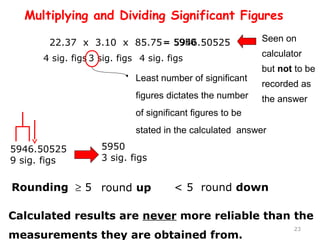
= 5946.50525 Seen on 
calculator 
but not to be 
recorded as 
the answer 
23 
Multiplying and Dividing Significant Figures 
22.37 x 3.10 x 85.75 
4 sig. figs 3 sig. figs 4 sig. figs 
5950 
Least number of significant 
figures dictates the number 
of significant figures to be 
stated in the calculated answer 
5946.50525 
9 sig. figs 
5950 
3 sig. figs 
Rounding ³ 5 round up < 5 round down 
Calculated results are never more reliable than the 
measurements they are obtained from.
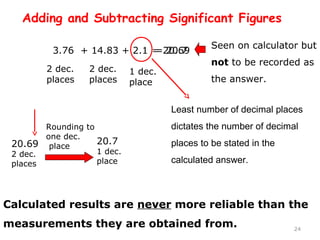
= 20.69 Seen on calculator but 
24 
Adding and Subtracting Significant Figures 
3.76 + 14.83 + 2.1 
2 dec. 
2 dec. 
places 
places 
1 dec. 
place 
not to be recorded as 
the answer. 
Least number of decimal places 
dictates the number of decimal 
places to be stated in the 
calculated answer. 
20.69 
2 dec. 
places 
20.7 
1 dec. 
place 
= 20.7 
Rounding to 
one dec. 
place 
Calculated results are never more reliable than the 
measurements they are obtained from.
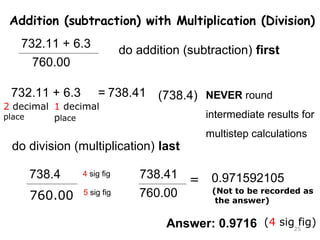
Addition (subtraction) with Multiplication (Division) 
732.11 + 6.3 
(Not to be recorded as 
the answer) 
25 
760.00 
do addition (subtraction) first 
732.11 + 6.3 = 
2 decimal 
place 
1 decimal 
place 
738.41 NEVER round 
intermediate results for 
multistep calculations 
(738.4) 
do division (multiplication) last 
738.4 
760.00 
4 sig fig 
5 sig fig 
738.41 
760.00 
= 0.971592105 
Answer: 0.9716 (4 sig fig)
26 
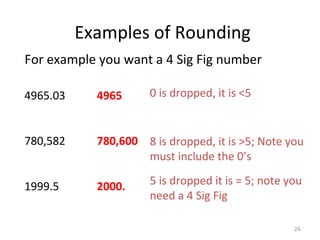
Examples of Rounding 
For example you want a 4 Sig Fig number 
4965.03 
780,582 
1999.5 
0 is dropped, it is <5 
8 is dropped, it is >5; Note you 
must include the 0’s 
5 is dropped it is = 5; note you 
need a 4 Sig Fig 
4965 
780,600 
2000.
27 
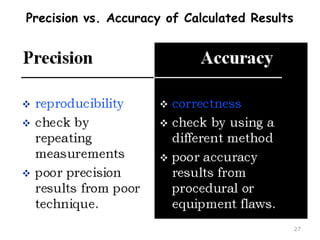
Precision vs. Accuracy of Calculated Results
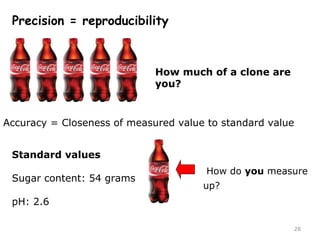
Accuracy = Closeness of measured value to standard value 
28 
Precision = reproducibility 
How much of a clone are 
you? 
Standard values 
Sugar content: 54 grams 
pH: 2.6 
How do you measure 
up?
29 
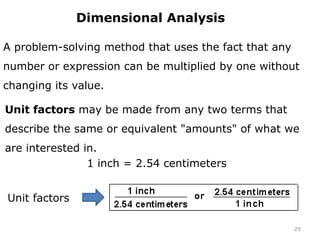
Dimensional Analysis 
A problem-solving method that uses the fact that any 
number or expression can be multiplied by one without 
changing its value. 
Unit factors may be made from any two terms that 
describe the same or equivalent "amounts" of what we 
are interested in. 
1 inch = 2.54 centimeters 
Unit factors
30 
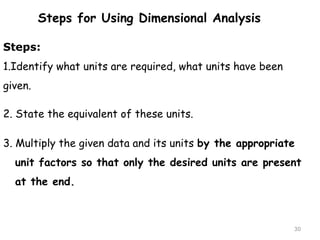
Steps for Using Dimensional Analysis 
Steps: 
1.Identify what units are required, what units have been 
given. 
2. State the equivalent of these units. 
3. Multiply the given data and its units by the appropriate 
unit factors so that only the desired units are present 
at the end.
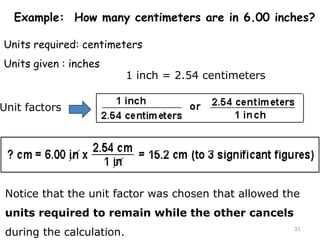
Example: How many centimeters are in 6.00 inches? 
Units required: centimeters 
Units given : inches 
Notice that the unit factor was chosen that allowed the 
units required to remain while the other cancels 
during the calculation. 
31 
1 inch = 2.54 centimeters 
Unit factors
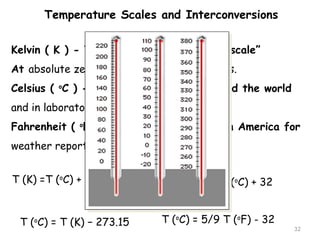
Kelvin ( K ) - The “Absolute temperature scale” 
At absolute zero and only has positive values. 
Celsius ( oC ) - Commonly used scale around the world 
and in laboratories. 
Fahrenheit ( oF ) - Commonly used scale in America for 
weather reports. 
32 
Temperature Scales and Interconversions 
T (K) =T (oC) + 273.15 
T (oC) = T (K) − 273.15 
T (oF) = 9/5 T (oC) + 32 
T (oC) = 5/9 T (oF) - 32
33 
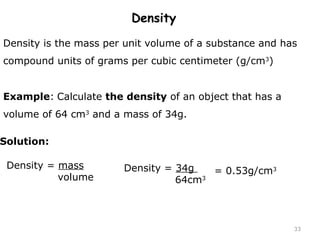
Density 
Density is the mass per unit volume of a substance and has 
compound units of grams per cubic centimeter (g/cm3) 
Example: Calculate the density of an object that has a 
volume of 64 cm3 and a mass of 34g. 
Density = mass 
volume 
Solution: 
Density = 34g 
64cm3 
= 0.53g/cm3
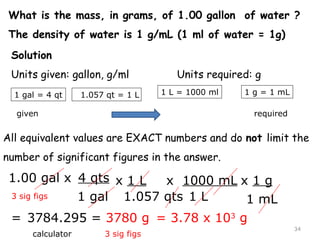
What is the mass, in grams, of 1.00 gallon of water ? 
The density of water is 1 g/mL (1 ml of water = 1g) 
1.057 qt = 1 L 
given required 
All equivalent values are EXACT numbers and do not limit the 
number of significant figures in the answer. 
34 
Solution 
Units given: gallon, g/ml Units required: g 
1 gal = 4 qt 
1.00 gal x 
= 
4 qts 
1 gal 
1 L = 1000 ml 1 g = 1 mL 
x 1 L 
1.057 qts 
x 1000 mL 
1 L 
x 1 g 
3 sig figs 1 mL 
3784.295 = 3.78 x 10³ g 
calculator 
= 3780 g 
3 sig figs
35 
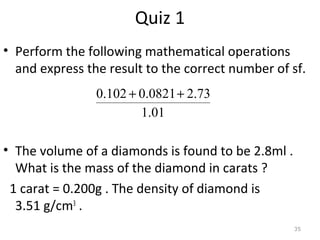
Quiz 1 
• Perform the following mathematical operations 
and express the result to the correct number of sf. 
0.102 + 0.0821+ 2.73 
1.01 
• The volume of a diamonds is found to be 2.8ml . 
What is the mass of the diamond in carats ? 
1 carat = 0.200g . The density of diamond is 
3.51 g/cm3 .

general chemistry ch1

  • 1.
    1 Welcome toCHEM 1101 Instructor: Dr. Muhannad Amer Office Location: 44 staff Bldng
  • 2.
    2 • Beyondthe chemistry theory of this class taking this class will enable you to: •Apply knowledge to solve new problems. • Analyze information you have gathered. • Work with and delegate responsibility to others. • Have confidence in yourself and your work. • Be organized in your thoughts and actions. • Ask and answer questions.
  • 3.
    3 •The scientificmethod provides the method by which scientists solve problems. • Chemists use this method to understand matter at the atomic or molecular level. observation hypothesis prediction experiment Scientific Method (explanation of observation) Carrying out experiment A will prove the hypothesis by giving result B
  • 4.
    4 TThheeoorryy •WWhheenn ccoonnssiisstteennccyy iiss oobbttaaiinneedd,, hhyyppootthheesseess bbeeccoommee aa tthheeoorryy • Typically a fact of nature, often a math constant/number and unit. – Law of Conservation of Mass— “In a chemical reaction matter is neither created nor destroyed.” – Speed of Light, E = mc2, Dalton’s Gas Law, Universal Gas Constant, etc…
  • 5.
    5 Theories •Explains how nature behaves. – Newton’s Gravitational Theory: how an apple falls – Dalton’s Atomic Theory: atoms look like… – Darwin’s Theory of Evolution: we always change – Einstein's Theory of Relativity: light is constant • Used to predict future observations.
  • 6.
    6 6 What’sthe Difference Between a Law and a Theory? • Laws: Very specific, “What will happen” often expressed in mathematical equations. • Theories: Very general, “Why it will happen,” often includes many “Laws”
  • 7.
    7 •Observations •Observationscan be quantitative(wwhhiicchh iinnvvoollvvee nnuummbbeerrss..)) • or qualitative (cchhaannggeess iinn ccoolloorr aanndd pphhyyssiiccaall ssttaattee)) •All measurements MUST consist of • a number and a unit! •Example: charge of an electron is 1.60 x 10⁻¹⁹ coulombs •Scientific notation •1.60 x 10-19 = 0.000000000000000000160
  • 8.
    8 Scientific Notation number x 10n 1-9 integer 0 1.60 x 10 = 1.60 x 1 = 1.60 1.60 x 101 = 16.0 1.60 x 10-1 = 0.160 1.60 or 1.6 or 1.600 can be used
  • 9.
    9 Are Unitsof Measurement that Important? July 23rd, 1983: Gimli Glider, an Air Canada aircraft ran out of fuel Needed for trip: 22,300 kg of fuel Used to fill plane: 22,300 pounds of fuel (10,115 kg !) Not enough fuel!
  • 10.
    Important SI (Internationalsystem) base units 10 Quantity SI Base Unit Length meter (m) Mass kilogram (kg) Time second (s) Temperature Kelvin (K) Amount mole (mol) Volume = length3 1L = 1 dm3 = 1000 cm3 = 10-3 m3 = 1000 ml 1cm3 = 1ml
  • 11.
    11 Common Prefixesused to adjust the size of Base Units Prefix Meaning Abbreviation Exponential Notation deci- tenth of d 10-1 Mega- million M 106 kilo- thousand k 103 centi- hundredths of c 10-2 milli- thousandths of m 10-3 micro- millionths of μ 10-6 nano- billionths of n 10-9 pico- trillionths of p 10-12
  • 12.
    12 Uncertainty inMeasurement The number obtained in measurement is obtained using a measuring device that introduces some degree of uncertainty to this measurement and this must be indicated. Uncertainty in the measurement lies in the last digit and is assumed to be +1 or -1 Recorded measurement of 0.0508 g Actual mass is 0.0507 g or 0.0509 g = 5.07 x 10⁻² or 5.09 x 10⁻² g
  • 13.
    The recorded certainand the first uncertain digit or estimated number of a measurement are called its significant figures. 13 Significant Figures Rules for Significant Figures 1. Digits from 1-9 are always significant. Example: 26981 has 5 significant figures 2. Zeros between two other significant digits are always significant. Example: 1023 has 4 significant figures 3. One or more additional zeros to the right of both the decimal place and another significant digit are significant. Example: 5.00 and 500. both have 3 significant figures
  • 14.
    14 Significant Figures 4. Zeros used solely for spacing the decimal point (placeholders) are not significant. Example: 0.000231 has 3 significant figures 5. The absence of a decimal point means terminal zeros are NOT significant. Example: 600 has 1 significant figure 6. Exact numbers have an infinite number of significant figures. They are obtained via counting, e.g. 1 dozen eggs, or by definition, e.g. the 2 in 2pr. When used in calculations, exact numbers do not limit the number of significant figures.
  • 15.
    15 How manysignificant figures are in each of the following measurements? 24 mL 2 significant figures 3001 g 4 significant figures 0.0320 m3 3 significant figures 6.4 x 10⁴ molecules 2 significant figures 560 kg 2 significant figures 1.8
  • 16.
    Practice—Write the Followingin Scientific 16 16 Notation, Continued 123.4 = 1.234 x 10² 145000 = 1.45 x 10⁵ 25.25 = 2.525 x 101 1.45 = 1.45 x 100 8.0012 = 8.0012 x 100 0.00234 = 2.34 x 10⁻³ 0.0123 = 1.23 x 10⁻² 0.000 008706 = 8.706 x 10⁻⁶
  • 17.
    17 Tro's "IntroductoryChemistry", Chapter 2 17 Practice—Write the Following in Standard Form, Continued 2.1 x 103 = 2100 9.66 x 10-4 = 0.000966 6.04 x 10-2 = 0.0604 4.02 x 100 = 4.02 3.3 x 101 = 33 1.2 x 100 = 1.2
  • 18.
    18 Determine theNumber of Significant Figures, • 12000 18 • 120. • 12.00 • 1.20 x 10³ • 0.0012 • 0.00120 • 1201 • 1201000 2 3 4 3 2 3 4 4
  • 19.
    19 How many sig figs? 45.8736 .000239 .00023900 48000. 48000 3.982´106 1.00040 6 3 5 5 2 4 6 •All digits count •Leading 0’s don’t •Trailing 0’s do •0’s count in decimal form •0’s don’t count w/o decimal •All digits count •0’s between digits count as well as trailing in decimal form
  • 20.
    20 Significant Figures 1.8 Addition or Subtraction The answer cannot have more digits to the right of the decimal point than any of the original numbers. 89.332 +1.1 90.432 round off to 90.4 one significant figure after decimal point 3.70 -2.9133 0.7867 two significant figures after decimal point round off to 0.79
  • 21.
    Multiplication or Division The number of significant figures in the result is set by the original number that has the smallest number of significant figures 21 Significant Figures 1.8 4.51 x 3.6666 = 16.536366 = 16.5 3 sig figs round to 3 sig figs 6.8 ÷ 112.04 = 0.0606926 2 sig figs round to 2 sig figs = 0.061
  • 22.
    Exact Numbers Numbersfrom definitions or numbers of objects are considered to have an infinite number of significant figures 22 Significant Figures 1.8 The average of three measured lengths; 6.64, 6.68 and 6.70? 6.64 + 6.68 + 6.70 3 = 6.67333 = 6.67 Because 3 is an exact number = 7
  • 23.
    = 5946.50525 Seenon calculator but not to be recorded as the answer 23 Multiplying and Dividing Significant Figures 22.37 x 3.10 x 85.75 4 sig. figs 3 sig. figs 4 sig. figs 5950 Least number of significant figures dictates the number of significant figures to be stated in the calculated answer 5946.50525 9 sig. figs 5950 3 sig. figs Rounding ³ 5 round up < 5 round down Calculated results are never more reliable than the measurements they are obtained from.
  • 24.
    = 20.69 Seenon calculator but 24 Adding and Subtracting Significant Figures 3.76 + 14.83 + 2.1 2 dec. 2 dec. places places 1 dec. place not to be recorded as the answer. Least number of decimal places dictates the number of decimal places to be stated in the calculated answer. 20.69 2 dec. places 20.7 1 dec. place = 20.7 Rounding to one dec. place Calculated results are never more reliable than the measurements they are obtained from.
  • 25.
    Addition (subtraction) withMultiplication (Division) 732.11 + 6.3 (Not to be recorded as the answer) 25 760.00 do addition (subtraction) first 732.11 + 6.3 = 2 decimal place 1 decimal place 738.41 NEVER round intermediate results for multistep calculations (738.4) do division (multiplication) last 738.4 760.00 4 sig fig 5 sig fig 738.41 760.00 = 0.971592105 Answer: 0.9716 (4 sig fig)
  • 26.
    26 Examples ofRounding For example you want a 4 Sig Fig number 4965.03 780,582 1999.5 0 is dropped, it is <5 8 is dropped, it is >5; Note you must include the 0’s 5 is dropped it is = 5; note you need a 4 Sig Fig 4965 780,600 2000.
  • 27.
    27 Precision vs.Accuracy of Calculated Results
  • 28.
    Accuracy = Closenessof measured value to standard value 28 Precision = reproducibility How much of a clone are you? Standard values Sugar content: 54 grams pH: 2.6 How do you measure up?
  • 29.
    29 Dimensional Analysis A problem-solving method that uses the fact that any number or expression can be multiplied by one without changing its value. Unit factors may be made from any two terms that describe the same or equivalent "amounts" of what we are interested in. 1 inch = 2.54 centimeters Unit factors
  • 30.
    30 Steps forUsing Dimensional Analysis Steps: 1.Identify what units are required, what units have been given. 2. State the equivalent of these units. 3. Multiply the given data and its units by the appropriate unit factors so that only the desired units are present at the end.
  • 31.
    Example: How manycentimeters are in 6.00 inches? Units required: centimeters Units given : inches Notice that the unit factor was chosen that allowed the units required to remain while the other cancels during the calculation. 31 1 inch = 2.54 centimeters Unit factors
  • 32.
    Kelvin ( K) - The “Absolute temperature scale” At absolute zero and only has positive values. Celsius ( oC ) - Commonly used scale around the world and in laboratories. Fahrenheit ( oF ) - Commonly used scale in America for weather reports. 32 Temperature Scales and Interconversions T (K) =T (oC) + 273.15 T (oC) = T (K) − 273.15 T (oF) = 9/5 T (oC) + 32 T (oC) = 5/9 T (oF) - 32
  • 33.
    33 Density Densityis the mass per unit volume of a substance and has compound units of grams per cubic centimeter (g/cm3) Example: Calculate the density of an object that has a volume of 64 cm3 and a mass of 34g. Density = mass volume Solution: Density = 34g 64cm3 = 0.53g/cm3
  • 34.
    What is themass, in grams, of 1.00 gallon of water ? The density of water is 1 g/mL (1 ml of water = 1g) 1.057 qt = 1 L given required All equivalent values are EXACT numbers and do not limit the number of significant figures in the answer. 34 Solution Units given: gallon, g/ml Units required: g 1 gal = 4 qt 1.00 gal x = 4 qts 1 gal 1 L = 1000 ml 1 g = 1 mL x 1 L 1.057 qts x 1000 mL 1 L x 1 g 3 sig figs 1 mL 3784.295 = 3.78 x 10³ g calculator = 3780 g 3 sig figs
  • 35.
    35 Quiz 1 • Perform the following mathematical operations and express the result to the correct number of sf. 0.102 + 0.0821+ 2.73 1.01 • The volume of a diamonds is found to be 2.8ml . What is the mass of the diamond in carats ? 1 carat = 0.200g . The density of diamond is 3.51 g/cm3 .

Editor's Notes

  • #2 Welcome to CHEM 1101 Instructor: Dr. Muhannad Amer
  • #3 Beyond the chemistry theory of this class taking this class will enable you to: Apply knowledge to solve new problems. Analyze information you have gathered. Work with and delegate responsibility to others. Have confidence in yourself and your work. Be organized in your thoughts and actions. Ask and answer questions.
  • #4 Scientific Method The scientific method provides the method by which scientists solve problems. Chemists use this method to understand matter at the atomic or molecular level. observation→ hypothesis(explanation of observation) → prediction(Carrying out experiment A will prove the hypothesis by giving result B → experiment
  • #8 Observations Observations can be quantitative or qualitative. Measurement of physical phenomenon All measurements MUST consist of a number and a unit! Example: charge of an electron is 1.60 x 10⁻¹⁹ coulombs Scientific notation 1.60 x 10-19 = 0.000000000000000000160
  • #10 It is essential that conversions between units of measurement be performed as it facilitates proper communication. For example, in 1983 an Air Canada aircraft was filled with the incorrect amount of fuel because the units for the amount of fuel required for the trip was stated. The assumption was made that the amount given was in pounds but kilograms of fuel was what was required. This seemingly small error almost led to an air disaster as the plane was filled with too little fuel. Units must be stated when stating a measurement and if the units provided are either unfamiliar or unused by the institution, the measurement must be converted to its equivalent quantity having those units.
  • #30 The process of unit conversion is facilitated using dimensional analysis. Unit factors are utilized in this process and made from any two equivalent units. For example……..
  • #31 Listed are the steps required to perform conversions between equivalent units
  • #32 Let’s do an example. Please notice that the unit factor selected is always the ine that allows the required units to be obtained while the units given cancel.
  • #34 Density is defined as the mass per unit volume of a substance and this measurement of course has units, These are stated as grams per cubic centimeter or grams per milliliter. To calculate density the mass of an object is divided by its volume as shown in this example.
  • #35 Let’s take a look at an example where dimensional analysis is used with units of density. We approach the problem as before, identifying the units required and those that were given. The next step requires stating a series of equivalent units that successfully allow gallons to be converted into milliliters. Notice other units of volume have to be introduced and these are quarts and liters. It is important to note that the numbers mentioned in the equivalent units statement are exact numbers and thus do not limit the number of sig figs when performing calculations of this kind. To make things easy, list the equivalent units statement from units given to those required . This will greatly assist in the selection of the correct unit factors to use. Grams are required and by selecting unit factors that allow the units of grams to remain while others cancel and we obtain the answer shown here but as we stated before the measurement with the least number of significant figs*as this problem involves multiplication) dictates the number of significant figures that ar to be stated in the answer and in this case this is three and so we get the answer 3780g which is 3.78 x 10⁻³ using scientific notation