The Demographic Transition 
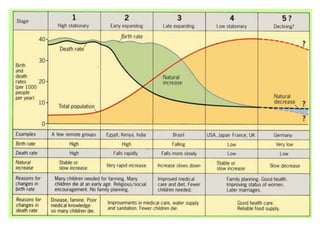
To be able to explain the DTM and 
explain why countries are in different 
stages.
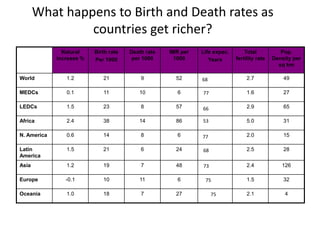
What happens to Birth and Death rates as 
countries get richer? 
Natural 
increase % 
Birth rate 
Per 1000 
Death rate 
per 1000 
IMR per 
1000 
Life expec. 
Years 
Total 
fertility rate 
Pop. 
Density per 
sq km 
World 1.2 21 9 52 2.7 49 
68 
MEDCs 0.1 11 10 6 1.6 27 
77 
LEDCs 1.5 23 8 57 2.9 65 
66 
53 
Africa 2.4 38 14 86 5.0 31 
N. America 0.6 14 8 6 2.0 15 
Latin 
America 
77 
1.5 21 6 24 2.5 28 
68 
Asia 1.2 19 7 48 2.4 126 
73 
Europe -0.1 10 11 6 1.5 32 
75 
Oceania 1.0 18 7 27 2.1 4 
75
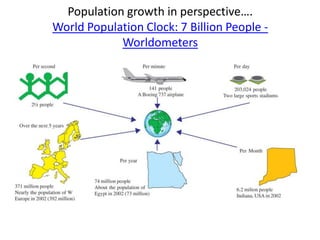
Population growth in perspective…. 
World Population Clock: 7 Billion People - 
Worldometers
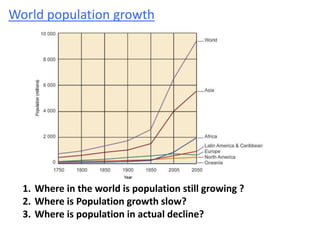
World population growth 
1. Where in the world is population still growing ? 
2. Where is Population growth slow? 
3. Where is population in actual decline?
The Demographic Transition
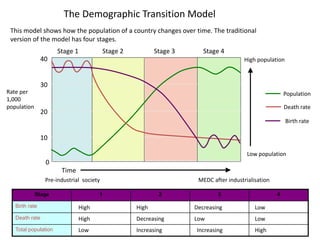
The Demographic Transition Model 
This model shows how the population of a country changes over time. The traditional 
version of the model has four stages. 
High population 
Low population 
40 
30 
20 
10 
0 
Pre-industrial society MEDC after industrialisation 
Rate per 
1,000 
population 
Stage 1 Stage 2 Stage 3 Stage 4 
Time 
Population 
Death rate 
Birth rate 
Stage 1 2 3 4 
Birth rate 
Death rate 
Total population 
High 
High 
High Decreasing 
Increasing High 
Decreasing 
Low 
Low 
Low 
Low Increasing
65 
15 
Age 
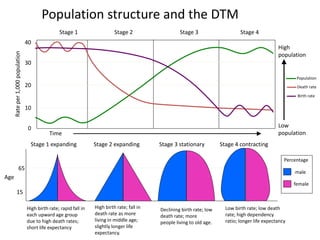
Population structure and the DTM 
40 
30 
20 
10 
0 
Rate per 1,000 population 
High 
population 
Population 
Death rate 
Birth rate 
Low 
population 
Stage 1 Stage 2 Stage 3 Stage 4 
Time 
Stage 1 expanding Stage 2 expanding Stage 3 stationary Stage 4 contracting 
High birth rate; rapid fall in 
each upward age group 
due to high death rates; 
short life expectancy 
High birth rate; fall in 
death rate as more 
living in middle age; 
slightly longer life 
expectancy. 
Declining birth rate; low 
death rate; more 
people living to old age. 
Percentage 
Low birth rate; low death 
rate; high dependency 
ratio; longer life expectancy 
male 
female
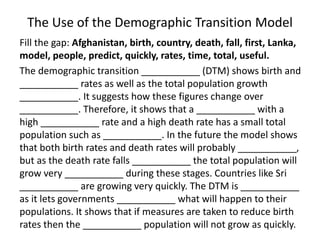
The Use of the Demographic Transition Model 
Fill the gap: Afghanistan, birth, country, death, fall, first, Lanka, 
model, people, predict, quickly, rates, time, total, useful. 
The demographic transition ___________ (DTM) shows birth and 
___________ rates as well as the total population growth 
___________. It suggests how these figures change over 
___________. Therefore, it shows that a ___________ with a 
high ___________ rate and a high death rate has a small total 
population such as ___________. In the future the model shows 
that both birth rates and death rates will probably ___________, 
but as the death rate falls ___________ the total population will 
grow very ___________ during these stages. Countries like Sri 
___________ are growing very quickly. The DTM is ___________ 
as it lets governments ___________ what will happen to their 
populations. It shows that if measures are taken to reduce birth 
rates then the ___________ population will not grow as quickly.
The fifth stage of the DTM 
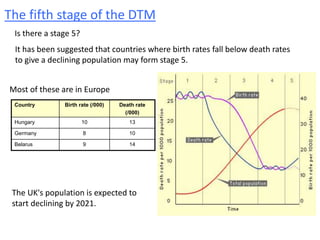
Is there a stage 5? 
It has been suggested that countries where birth rates fall below death rates 
to give a declining population may form stage 5. 
Most of these are in Europe 
Country Birth rate (/000) Death rate 
(/000) 
Hungary 10 13 
Germany 8 10 
Belarus 9 14 
The UK's population is expected to 
start declining by 2021.
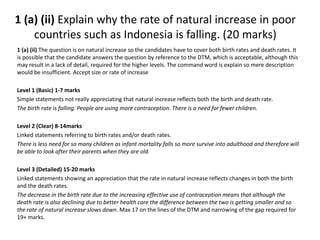
1 (a) (ii) Explain why the rate of natural increase in poor countries such as 
Indonesia is falling. (20 marks) 
1 (a) (ii) The question is on natural increase so the candidates have to cover both birth rates and death rates. It is 
possible that the candidate answers the question by reference to the DTM, which is acceptable, although this may result 
in a lack of detail, required for the higher levels. The command word is explain so mere description would be 
insufficient. Accept size or rate of increase 
1 (a) (ii) Explain why the rate of natural increase in poor countries such as 
Indonesia is falling. (20 marks) 
1 (a) (ii) The question is on natural increase so the candidates have to cover both birth rates and death rates. It is 
possible that the candidate answers the question by reference to the DTM, which is acceptable, although this may result 
in a lack of detail, required for the higher levels. The command word is explain so mere description would be 
insufficient. Accept size or rate of increase 
1 (a) (ii) Explain why the rate of natural increase in poor countries such as 
Indonesia is falling. (20 marks) 
1 (a) (ii) The question is on natural increase so the candidates have to cover both birth rates and death rates. It is 
possible that the candidate answers the question by reference to the DTM, which is acceptable, although this may result 
in a lack of detail, required for the higher levels. The command word is explain so mere description would be 
insufficient. Accept size or rate of increase
1 (a) (ii) Explain why the rate of natural increase in poor 
countries such as Indonesia is falling. (20 marks) 
1 (a) (ii) The question is on natural increase so the candidates have to cover both birth rates and death rates. It 
is possible that the candidate answers the question by reference to the DTM, which is acceptable, although this 
may result in a lack of detail, required for the higher levels. The command word is explain so mere description 
would be insufficient. Accept size or rate of increase 
Level 1 (Basic) 1-7 marks 
Simple statements not really appreciating that natural increase reflects both the birth and death rate. 
The birth rate is falling. People are using more contraception. There is a need for fewer children. 
Level 2 (Clear) 8-14marks 
Linked statements referring to birth rates and/or death rates. 
There is less need for so many children as infant mortality falls so more survive into adulthood and therefore will 
be able to look after their parents when they are old. 
Level 3 (Detailed) 15-20 marks 
Linked statements showing an appreciation that the rate in natural increase reflects changes in both the birth 
and the death rates. 
The decrease in the birth rate due to the increasing effective use of contraception means that although the 
death rate is also declining due to better health care the difference between the two is getting smaller and so 
the rate of natural increase slows down. Max 17 on the lines of the DTM and narrowing of the gap required for 
19+ marks.
12 matu the demographic transition

12 matu the demographic transition

  • 1.
    The Demographic Transition To be able to explain the DTM and explain why countries are in different stages.
  • 2.
    What happens toBirth and Death rates as countries get richer? Natural increase % Birth rate Per 1000 Death rate per 1000 IMR per 1000 Life expec. Years Total fertility rate Pop. Density per sq km World 1.2 21 9 52 2.7 49 68 MEDCs 0.1 11 10 6 1.6 27 77 LEDCs 1.5 23 8 57 2.9 65 66 53 Africa 2.4 38 14 86 5.0 31 N. America 0.6 14 8 6 2.0 15 Latin America 77 1.5 21 6 24 2.5 28 68 Asia 1.2 19 7 48 2.4 126 73 Europe -0.1 10 11 6 1.5 32 75 Oceania 1.0 18 7 27 2.1 4 75
  • 3.
    Population growth inperspective…. World Population Clock: 7 Billion People - Worldometers
  • 4.
    World population growth 1. Where in the world is population still growing ? 2. Where is Population growth slow? 3. Where is population in actual decline?
  • 5.
  • 6.
    The Demographic TransitionModel This model shows how the population of a country changes over time. The traditional version of the model has four stages. High population Low population 40 30 20 10 0 Pre-industrial society MEDC after industrialisation Rate per 1,000 population Stage 1 Stage 2 Stage 3 Stage 4 Time Population Death rate Birth rate Stage 1 2 3 4 Birth rate Death rate Total population High High High Decreasing Increasing High Decreasing Low Low Low Low Increasing
  • 7.
    65 15 Age Population structure and the DTM 40 30 20 10 0 Rate per 1,000 population High population Population Death rate Birth rate Low population Stage 1 Stage 2 Stage 3 Stage 4 Time Stage 1 expanding Stage 2 expanding Stage 3 stationary Stage 4 contracting High birth rate; rapid fall in each upward age group due to high death rates; short life expectancy High birth rate; fall in death rate as more living in middle age; slightly longer life expectancy. Declining birth rate; low death rate; more people living to old age. Percentage Low birth rate; low death rate; high dependency ratio; longer life expectancy male female
  • 8.
    The Use ofthe Demographic Transition Model Fill the gap: Afghanistan, birth, country, death, fall, first, Lanka, model, people, predict, quickly, rates, time, total, useful. The demographic transition ___________ (DTM) shows birth and ___________ rates as well as the total population growth ___________. It suggests how these figures change over ___________. Therefore, it shows that a ___________ with a high ___________ rate and a high death rate has a small total population such as ___________. In the future the model shows that both birth rates and death rates will probably ___________, but as the death rate falls ___________ the total population will grow very ___________ during these stages. Countries like Sri ___________ are growing very quickly. The DTM is ___________ as it lets governments ___________ what will happen to their populations. It shows that if measures are taken to reduce birth rates then the ___________ population will not grow as quickly.
  • 9.
    The fifth stageof the DTM Is there a stage 5? It has been suggested that countries where birth rates fall below death rates to give a declining population may form stage 5. Most of these are in Europe Country Birth rate (/000) Death rate (/000) Hungary 10 13 Germany 8 10 Belarus 9 14 The UK's population is expected to start declining by 2021.
  • 12.
    1 (a) (ii)Explain why the rate of natural increase in poor countries such as Indonesia is falling. (20 marks) 1 (a) (ii) The question is on natural increase so the candidates have to cover both birth rates and death rates. It is possible that the candidate answers the question by reference to the DTM, which is acceptable, although this may result in a lack of detail, required for the higher levels. The command word is explain so mere description would be insufficient. Accept size or rate of increase 1 (a) (ii) Explain why the rate of natural increase in poor countries such as Indonesia is falling. (20 marks) 1 (a) (ii) The question is on natural increase so the candidates have to cover both birth rates and death rates. It is possible that the candidate answers the question by reference to the DTM, which is acceptable, although this may result in a lack of detail, required for the higher levels. The command word is explain so mere description would be insufficient. Accept size or rate of increase 1 (a) (ii) Explain why the rate of natural increase in poor countries such as Indonesia is falling. (20 marks) 1 (a) (ii) The question is on natural increase so the candidates have to cover both birth rates and death rates. It is possible that the candidate answers the question by reference to the DTM, which is acceptable, although this may result in a lack of detail, required for the higher levels. The command word is explain so mere description would be insufficient. Accept size or rate of increase
  • 13.
    1 (a) (ii)Explain why the rate of natural increase in poor countries such as Indonesia is falling. (20 marks) 1 (a) (ii) The question is on natural increase so the candidates have to cover both birth rates and death rates. It is possible that the candidate answers the question by reference to the DTM, which is acceptable, although this may result in a lack of detail, required for the higher levels. The command word is explain so mere description would be insufficient. Accept size or rate of increase Level 1 (Basic) 1-7 marks Simple statements not really appreciating that natural increase reflects both the birth and death rate. The birth rate is falling. People are using more contraception. There is a need for fewer children. Level 2 (Clear) 8-14marks Linked statements referring to birth rates and/or death rates. There is less need for so many children as infant mortality falls so more survive into adulthood and therefore will be able to look after their parents when they are old. Level 3 (Detailed) 15-20 marks Linked statements showing an appreciation that the rate in natural increase reflects changes in both the birth and the death rates. The decrease in the birth rate due to the increasing effective use of contraception means that although the death rate is also declining due to better health care the difference between the two is getting smaller and so the rate of natural increase slows down. Max 17 on the lines of the DTM and narrowing of the gap required for 19+ marks.