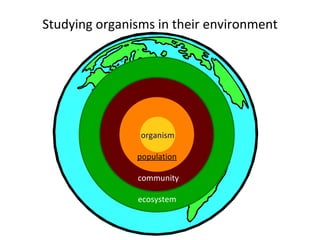
Studying organisms in their environment biosphere ecosystem community population organism
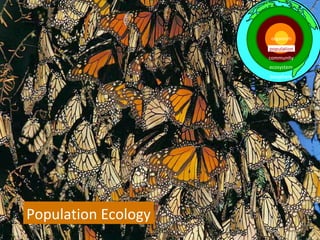
Population Ecology population ecosystem community biosphere organism
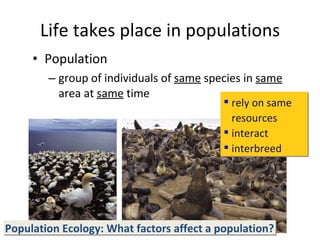
Life takes place in populations Population group of individuals of  same  species in  same  area at  same  time rely on same resources interact interbreed Population Ecology: What factors affect a population?
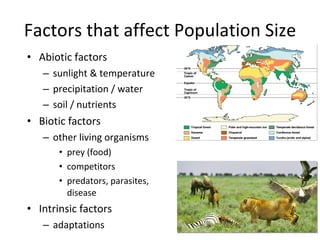
Abiotic factors sunlight & temperature precipitation / water soil / nutrients Biotic factors other living organisms prey (food) competitors predators, parasites,  disease Intrinsic factors adaptations Factors that affect Population Size
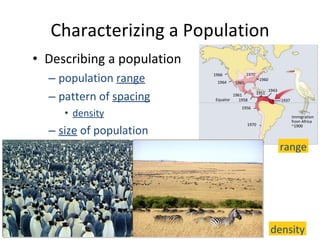
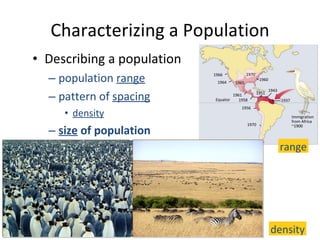
Characterizing a Population Describing a population population  range pattern of  spacing density size  of population range density 1937 1943 1951 1958 1961 1960 1965 1964 1966 1970 1970 1956 Immigration from Africa ~1900 Equator
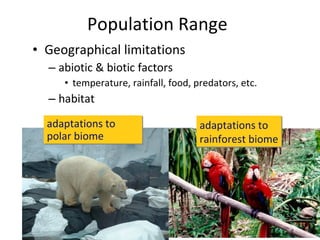
Population Range Geographical limitations abiotic & biotic factors temperature, rainfall, food, predators, etc. habitat adaptations to polar biome adaptations to rainforest biome
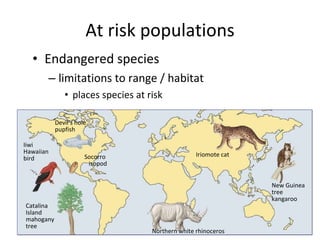
At risk populations Endangered species limitations to range / habitat places species at risk Socorro  isopod Devil’s hole pupfish Iriomote cat Northern white rhinoceros New Guinea tree  kangaroo Iiwi Hawaiian bird Catalina  Island mahogany tree
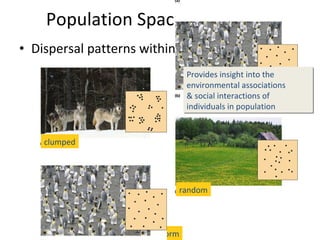
Population Spacing (Density) Dispersal patterns within a population uniform random clumped Provides insight into the environmental associations  & social interactions of individuals in population
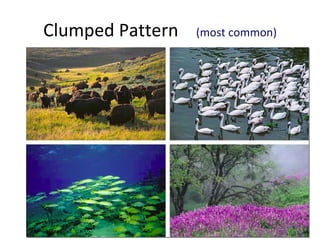
Clumped Pattern  (most common)
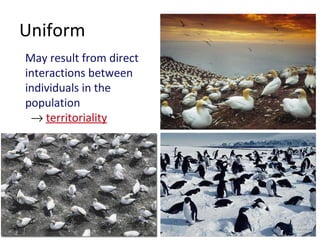
Uniform Clumped patterns May result from direct interactions between individuals in the population    territoriality
Characterizing a Population Describing a population population  range pattern of  spacing density size  of population range density 1937 1943 1951 1958 1961 1960 1965 1964 1966 1970 1970 1956 Immigration from Africa ~1900 Equator
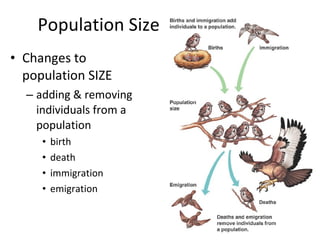
Population Size Changes to population SIZE adding & removing individuals from a population birth death immigration emigration
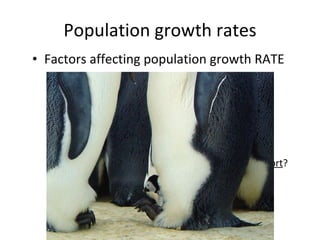
Population growth rates Factors affecting population growth RATE sex ratio how many females vs. males? generation time at what age do females reproduce? age structure how many females at reproductive age in  cohort ?
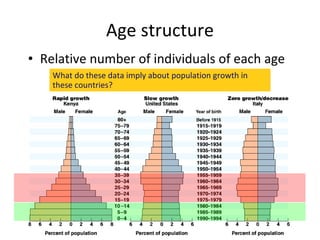
Age structure Relative number of individuals of each age What do these data imply about population growth in these countries?
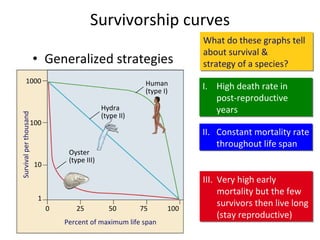
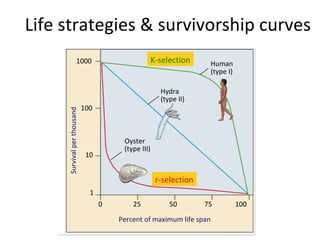
Survivorship curves Generalized strategies What do these graphs tell about survival &  strategy of a species? I. High death rate in post-reproductive years II. Constant mortality rate throughout life span III. Very high early mortality but the few survivors then live long (stay reproductive) 0 25 1000 100 Human (type I) Hydra (type II) Oyster (type III) 10 1 50 Percent of maximum life span 100 75 Survival per thousand
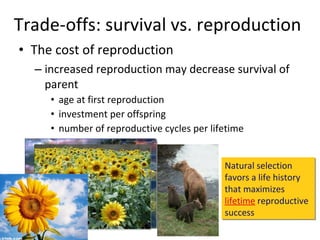
Trade-offs: survival vs. reproduction The cost of reproduction increased reproduction may decrease survival of parent age at first reproduction  investment per offspring number of reproductive cycles per lifetime Natural selection favors a life history that maximizes  lifetime  reproductive success
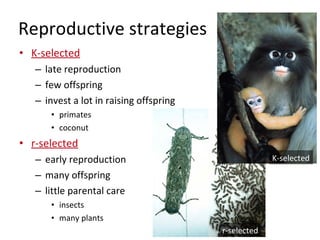
Reproductive strategies K-selected late reproduction few offspring invest a lot in raising offspring primates coconut r-selected early reproduction many offspring little parental care insects many plants K-selected r-selected
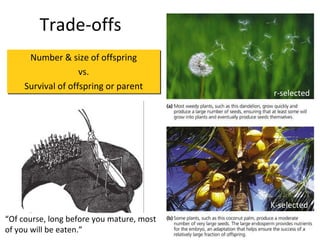
Trade-offs Number & size of offspring vs. Survival of offspring or parent r-selected K-selected “ Of course, long before you mature, most of you will be eaten.”
Life strategies & survivorship curves K-selection r-selection 0 25 1000 100 Human (type I) Hydra (type II) Oyster (type III) 10 1 50 Percent of maximum life span 100 75 Survival per thousand
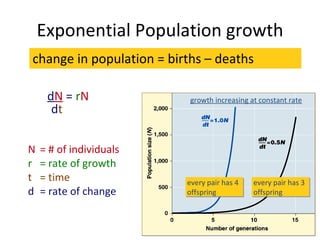
Exponential Population growth change in population = births – deaths d N  =  r N d t N = # of individuals r = rate of growth t = time d = rate of change growth increasing at constant rate every pair has 4 offspring every pair has 3 offspring
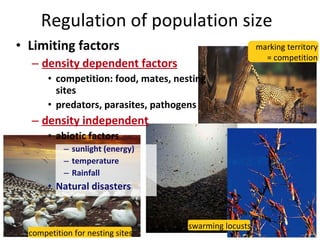
Regulation of population size Limiting factors density dependent factors competition: food, mates, nesting sites predators, parasites, pathogens density independent abiotic factors sunlight (energy) temperature Rainfall Natural disasters swarming locusts marking territory = competition competition for nesting sites
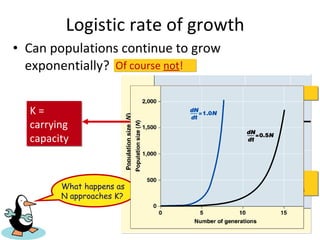
Logistic rate of growth Can populations continue to grow exponentially? K = carrying capacity Of course  not ! effect of  natural controls no natural controls What happens as  N approaches K ?
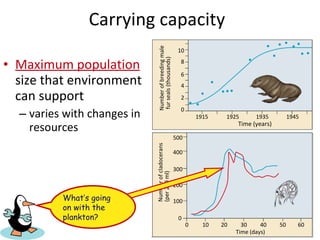
Maximum population  size that environment can support  varies with changes in resources Carrying capacity What’s going  on with the  plankton? 500 400 300 200 100 0 20 0 10 30 50 40 60 Time (days) Number of cladocerans (per 200 ml) Time (years) 1915 1925 1935 1945 10 8 6 4 2 0 Number of breeding male fur seals (thousands)
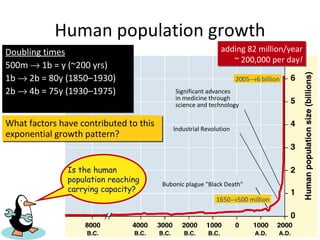
Human population growth What factors have contributed to this exponential growth pattern?  1650  500 million 2005  6 billion Bubonic plague "Black Death" adding 82 million/year ~ 200,000 per day ! Doubling times 500m    1b = y (~200 yrs) 1b    2b = 80y (1850–1930) 2b    4b = 75y (1930–1975)  Is the human  population reaching carrying capacity? Industrial Revolution Significant advances in medicine through science and technology
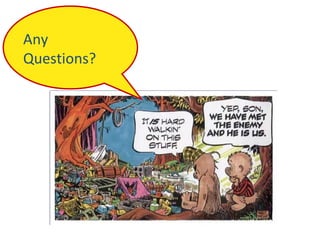
Any Questions?

Population Ecology

  • 1.
    Studying organisms intheir environment biosphere ecosystem community population organism
  • 2.
    Population Ecology populationecosystem community biosphere organism
  • 3.
    Life takes placein populations Population group of individuals of same species in same area at same time rely on same resources interact interbreed Population Ecology: What factors affect a population?
  • 4.
    Abiotic factors sunlight& temperature precipitation / water soil / nutrients Biotic factors other living organisms prey (food) competitors predators, parasites, disease Intrinsic factors adaptations Factors that affect Population Size
  • 5.
    Characterizing a PopulationDescribing a population population range pattern of spacing density size of population range density 1937 1943 1951 1958 1961 1960 1965 1964 1966 1970 1970 1956 Immigration from Africa ~1900 Equator
  • 6.
    Population Range Geographicallimitations abiotic & biotic factors temperature, rainfall, food, predators, etc. habitat adaptations to polar biome adaptations to rainforest biome
  • 7.
    At risk populationsEndangered species limitations to range / habitat places species at risk Socorro isopod Devil’s hole pupfish Iriomote cat Northern white rhinoceros New Guinea tree kangaroo Iiwi Hawaiian bird Catalina Island mahogany tree
  • 8.
    Population Spacing (Density)Dispersal patterns within a population uniform random clumped Provides insight into the environmental associations & social interactions of individuals in population
  • 9.
    Clumped Pattern (most common)
  • 10.
    Uniform Clumped patternsMay result from direct interactions between individuals in the population  territoriality
  • 11.
    Characterizing a PopulationDescribing a population population range pattern of spacing density size of population range density 1937 1943 1951 1958 1961 1960 1965 1964 1966 1970 1970 1956 Immigration from Africa ~1900 Equator
  • 12.
    Population Size Changesto population SIZE adding & removing individuals from a population birth death immigration emigration
  • 13.
    Population growth ratesFactors affecting population growth RATE sex ratio how many females vs. males? generation time at what age do females reproduce? age structure how many females at reproductive age in cohort ?
  • 14.
    Age structure Relativenumber of individuals of each age What do these data imply about population growth in these countries?
  • 15.
    Survivorship curves Generalizedstrategies What do these graphs tell about survival & strategy of a species? I. High death rate in post-reproductive years II. Constant mortality rate throughout life span III. Very high early mortality but the few survivors then live long (stay reproductive) 0 25 1000 100 Human (type I) Hydra (type II) Oyster (type III) 10 1 50 Percent of maximum life span 100 75 Survival per thousand
  • 16.
    Trade-offs: survival vs.reproduction The cost of reproduction increased reproduction may decrease survival of parent age at first reproduction investment per offspring number of reproductive cycles per lifetime Natural selection favors a life history that maximizes lifetime reproductive success
  • 17.
    Reproductive strategies K-selectedlate reproduction few offspring invest a lot in raising offspring primates coconut r-selected early reproduction many offspring little parental care insects many plants K-selected r-selected
  • 18.
    Trade-offs Number &size of offspring vs. Survival of offspring or parent r-selected K-selected “ Of course, long before you mature, most of you will be eaten.”
  • 19.
    Life strategies &survivorship curves K-selection r-selection 0 25 1000 100 Human (type I) Hydra (type II) Oyster (type III) 10 1 50 Percent of maximum life span 100 75 Survival per thousand
  • 20.
    Exponential Population growthchange in population = births – deaths d N = r N d t N = # of individuals r = rate of growth t = time d = rate of change growth increasing at constant rate every pair has 4 offspring every pair has 3 offspring
  • 21.
    Regulation of populationsize Limiting factors density dependent factors competition: food, mates, nesting sites predators, parasites, pathogens density independent abiotic factors sunlight (energy) temperature Rainfall Natural disasters swarming locusts marking territory = competition competition for nesting sites
  • 22.
    Logistic rate ofgrowth Can populations continue to grow exponentially? K = carrying capacity Of course not ! effect of natural controls no natural controls What happens as N approaches K ?
  • 23.
    Maximum population size that environment can support varies with changes in resources Carrying capacity What’s going on with the plankton? 500 400 300 200 100 0 20 0 10 30 50 40 60 Time (days) Number of cladocerans (per 200 ml) Time (years) 1915 1925 1935 1945 10 8 6 4 2 0 Number of breeding male fur seals (thousands)
  • 24.
    Human population growthWhat factors have contributed to this exponential growth pattern? 1650  500 million 2005  6 billion Bubonic plague "Black Death" adding 82 million/year ~ 200,000 per day ! Doubling times 500m  1b = y (~200 yrs) 1b  2b = 80y (1850–1930) 2b  4b = 75y (1930–1975) Is the human population reaching carrying capacity? Industrial Revolution Significant advances in medicine through science and technology
  • 25.

Editor's Notes

  • #9 Within a population’s geographic range, local densities may vary substantially. Variations in local density are among the most important characteristics that a population ecologist might study, since they provide insight into the environmental associations and social interactions of individuals in the population. Environmental differences—even at a local level—contribute to variation in population density; some habitat patches are simply more suitable for a species than are others. Social interactions between members of the population, which may maintain patterns of spacing between individuals, can also contribute to variation in population density.
  • #10 The most common pattern of dispersion is clumped, with the individuals aggregated in patches. Plants or fungi are often clumped where soil conditions and other environmental factors favor germination and growth. For example, mushrooms may be clumped on a rotting log. Many animals spend much of their time in a particular microenvironment that satisfies their requirements. Forest insects and salamanders, for instance, are frequently clumped under logs, where the humidity tends to be higher than in more exposed areas. Clumping of animals may also be associated with mating behavior. For example, mayflies often swarm in great numbers, a behavior that increases mating chances for these insects, which survive only a day or two as reproductive adults. Group living may also increase the effectiveness of certain predators; for example, a wolf pack is more likely than a single wolf to subdue a large prey animal, such as a moose
  • #11 A uniform, or evenly spaced, pattern of dispersion may result from direct interactions between individuals in the population. For example, some plants secrete chemicals that inhibit the germination and growth of nearby individuals that could compete for resources. Animals often exhibit uniform dispersion as a result of antagonistic social interactions, such as territoriality —the defense of a bounded physical space against encroachment by other individuals. Uniform patterns are not as common in populations as clumped patterns.
  • #16 A Type I curve is flat at the start, reflecting low death rates during early and middle life, then drops steeply as death rates increase among older age groups. Humans and many other large mammals that produce few offspring but provide them with good care often exhibit this kind of curve. In contrast, a Type III curve drops sharply at the start, reflecting very high death rates for the young, but then flattens out as death rates decline for those few individuals that have survived to a certain critical age. This type of curve is usually associated with organisms that produce very large numbers of offspring but provide little or no care, such as long–lived plants, many fishes, and marine invertebrates. An oyster, for example, may release millions of eggs, but most offspring die as larvae from predation or other causes. Those few that survive long enough to attach to a suitable substrate and begin growing a hard shell will probably survive for a relatively long time. Type II curves are intermediate, with a constant death rate over the organism’s life span. This kind of survivorship occurs in Belding’s ground squirrels and some other rodents, various invertebrates, some lizards, and some annual plants.
  • #20 A Type I curve is flat at the start, reflecting low death rates during early and middle life, then drops steeply as death rates increase among older age groups. Humans and many other large mammals that produce few offspring but provide them with good care often exhibit this kind of curve. In contrast, a Type III curve drops sharply at the start, reflecting very high death rates for the young, but then flattens out as death rates decline for those few individuals that have survived to a certain critical age. This type of curve is usually associated with organisms that produce very large numbers of offspring but provide little or no care, such as long–lived plants, many fishes, and marine invertebrates. An oyster, for example, may release millions of eggs, but most offspring die as larvae from predation or other causes. Those few that survive long enough to attach to a suitable substrate and begin growing a hard shell will probably survive for a relatively long time. Type II curves are intermediate, with a constant death rate over the organism’s life span. This kind of survivorship occurs in Belding’s ground squirrels and some other rodents, various invertebrates, some lizards, and some annual plants.
  • #23 Decrease rate of growth as N reaches K
  • #25 The population doubled to 1 billion within the next two centuries, doubled again to 2 billion between 1850 and 1930, and doubled still again by 1975 to more than 4 billion. The global population now numbers over 6 billion people and is increasing by about 73 million each year. The population grows by approximately 201,000 people each day, the equivalent of adding a city the size of Amarillo, Texas, or Madison, Wisconsin. Every week the population increases by the size of San Antonio, Milwaukee, or Indianapolis. It takes only four years for world population growth to add the equivalent of another United States. Population ecologists predict a population of 7.3–8.4 billion people on Earth by the year 2025.