Population Change in England and Wales 1700-2000
Hanel, Germany J. Gathorpe-Hardy What do you think these cartoons are saying?
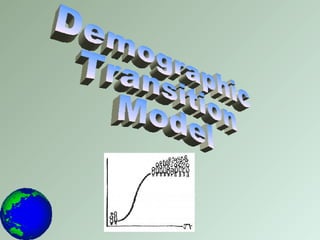
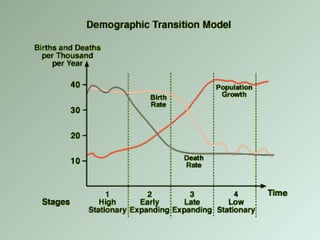
Demographic Transition Model
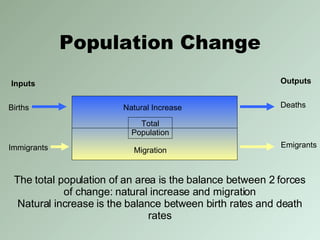
Population Change Births Immigrants Deaths Emigrants Total Population Natural Increase Migration The total population of an area is the balance between 2 forces of change: natural increase and migration Natural increase is the balance between birth rates and death rates Inputs Outputs
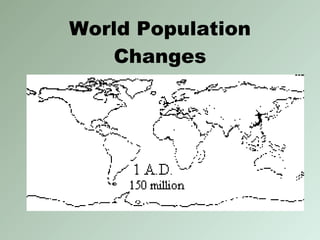
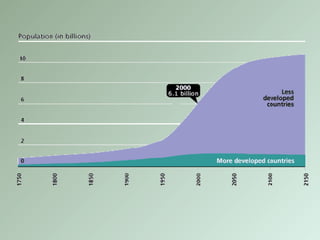
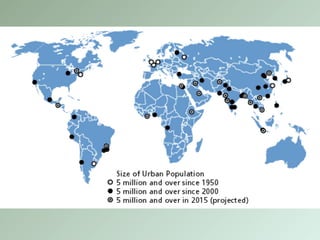
World Population Changes
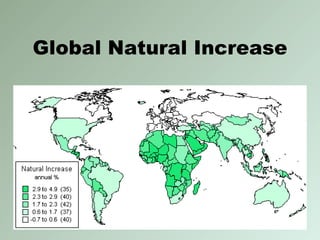
Global Natural Increase
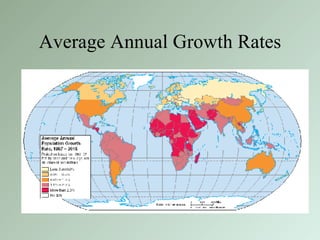
Average Annual Growth Rates
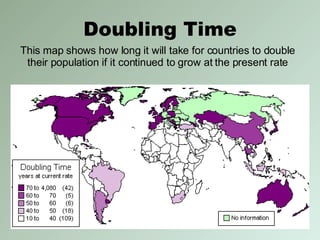
Doubling Time This map shows how long it will take for countries to double their population if it continued to grow at the present rate
 
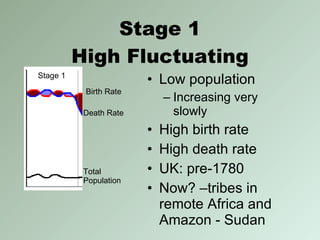
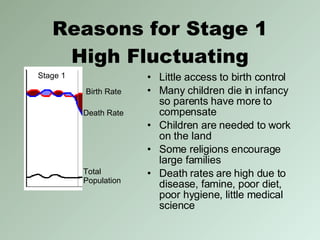
Stage 1 High Fluctuating Low population Increasing very slowly High birth rate High death rate UK: pre-1780 Now? –tribes in remote Africa and Amazon - Sudan Total  Population Birth Rate Death Rate Stage 1
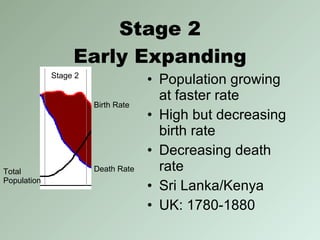
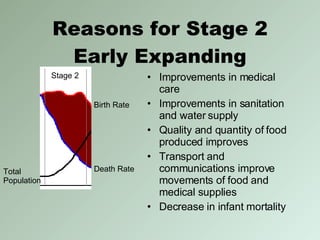
Stage 2 Early Expanding Total  Population Birth Rate Death Rate Stage 2 Population growing at faster rate High but decreasing birth rate Decreasing death rate Sri Lanka/Kenya UK: 1780-1880
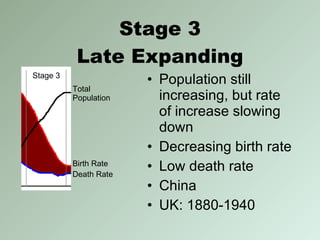
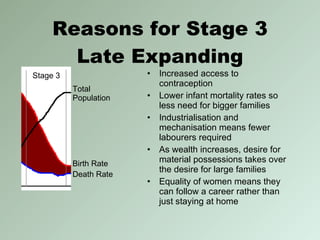
Stage 3 Late Expanding Total  Population Birth Rate Death Rate Stage 3 Population still increasing, but rate of increase slowing down Decreasing birth rate Low death rate China UK: 1880-1940
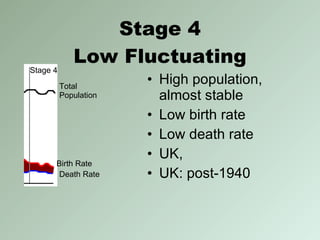
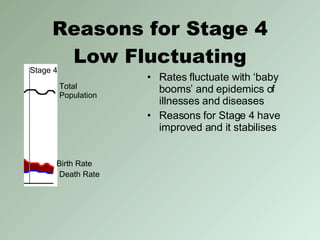
Stage 4 Low Fluctuating Total  Population Birth Rate Death Rate Stage 4 High population, almost stable Low birth rate Low death rate UK,  UK: post-1940
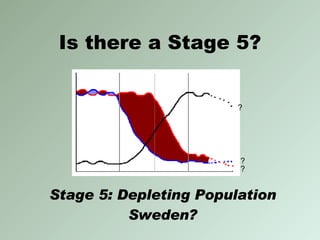
Is there a Stage 5? ? ? ? Stage 5: Depleting Population Sweden?
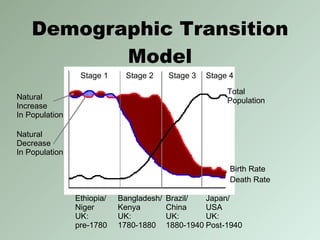
Demographic Transition Model Stage 1 Stage 2 Stage 3 Stage 4 Total  Population Birth Rate Death Rate Ethiopia/ Niger UK:  pre-1780 Natural Increase In Population Natural Decrease In Population Bangladesh/ Kenya UK:  1780-1880 Brazil/ China UK:  1880-1940 Japan/ USA UK:  Post-1940
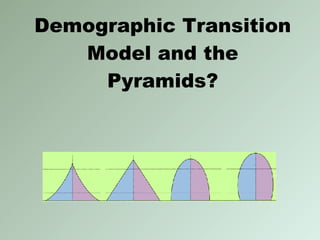
Demographic Transition Model and the Pyramids?
 
Reasons What do you think the reasons are for the changes at each stage?
Reasons for Stage 1 High Fluctuating Little access to birth control Many children die in infancy so parents have more to compensate Children are needed to work on the land Some religions encourage large families Death rates are high due to disease, famine, poor diet, poor hygiene, little medical science Total  Population Birth Rate Death Rate Stage 1
Reasons for Stage 2 Early Expanding Total  Population Birth Rate Death Rate Stage 2 Improvements in medical care Improvements in sanitation and water supply Quality and quantity of food produced improves Transport and communications improve movements of food and medical supplies Decrease in infant mortality
Reasons for Stage 3 Late Expanding Total  Population Birth Rate Death Rate Stage 3 Increased access to contraception Lower infant mortality rates so less need for bigger families Industrialisation and mechanisation means fewer labourers required As wealth increases, desire for material possessions takes over the desire for large families Equality of women means they can follow a career rather than just staying at home
Reasons for Stage 4 Low Fluctuating Total  Population Birth Rate Death Rate Stage 4 Rates fluctuate with ‘baby booms’ and epidemics of illnesses and diseases Reasons for Stage 4 have improved and it stabilises
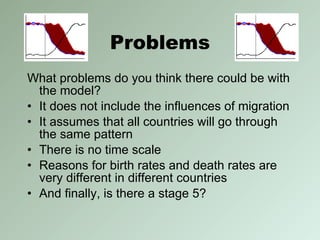
Problems What problems do you think there could be with the model? It does not include the influences of migration It assumes that all countries will go through the same pattern There is no time scale Reasons for birth rates and death rates are very different in different countries And finally, is there a stage 5?
Like all models, the demographic transition model has its limitations. It failed to consider, or to predict, several factors and events: 1 Birth rates in several MEDCs have fallen below death rates (Germany, Sweden). This has caused, for the first time, a population decline which suggests that perhaps the model should have a fifth stage added to it. 2 The model assumes that in time all countries pass through the same four stages. It now seems unlikely, however, that many LEDCs, especially in Africa, will ever become industrialised.
3 The model assumes that the fall in the death rate in Stage 2 was the consequence of industrialisation. Initially, the death rate in many British cities rose, due to the insanitary conditions which resulted from rapid urban growth, and it only began to fall after advances were made in medicine.  The delayed fall in the death rate in many developing countries has been due mainly to their inability to afford medical facilities. In many countries, the fall in the birth rate in Stage 3 has been  less  rapid than the model suggests due to religious and/or political opposition to birth control (Brazil), whereas the fall was much  more  rapid, and came earlier, in China following the government-introduced ‘onechild’ policy. The timescale of the model, especially in several South-east Asian countries such as Hong Kong and Malaysia, is being squashed as they develop at a much faster rate than did the early industrialised countries. Like all models, the demographic transition model has its limitations. It failed to consider, or to predict, several factors and events: (cont..)
4 Countries that grew as a consequence of emigration from Europe (USA, Canada, Australia) did not pass through the early stages of the model.
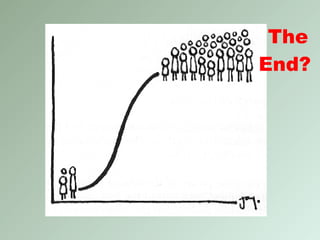
The End?
 
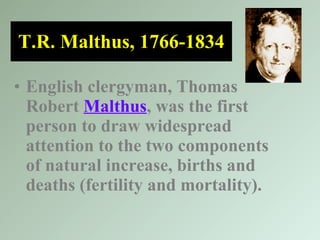
T.R. Malthus, 1766-1834 English clergyman, Thomas Robert  Malthus , was the first person to draw widespread attention to the two components of natural increase, births and deaths (fertility and mortality).
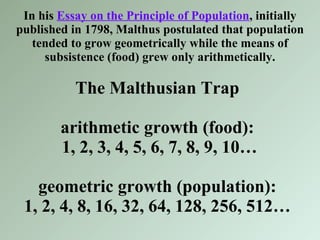
In his  Essay on the Principle of Population , initially published in 1798, Malthus postulated that population tended to grow geometrically while the means of subsistence (food) grew only arithmetically. The Malthusian Trap arithmetic growth (food):  1, 2, 3, 4, 5, 6, 7, 8, 9, 10… geometric growth (population): 1, 2, 4, 8, 16, 32, 64, 128, 256, 512…
Malthus argued that the difference between geometric and arithmetic growth caused a tension between the growth of population and that of the means of subsistence. -- this gap could not persist indefinitely.  Owing to war, disease, hunger, and vice, mortality would serve as a positive check on population growth.
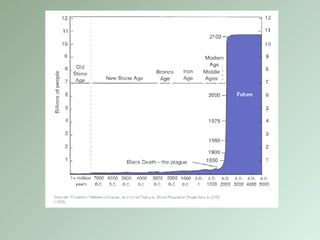
BUT!!! Contrary to Malthus’s prediction, mortality has not yet risen to curb world population growth. < 1 billion people in 1800 6 billion by the end of the 20 th  century
 
 
BBC REPORT – World Population to rise by 40% http://news.bbc.co.uk/1/hi/world/4297169.stm

Demographic Transition

  • 1.
    Population Change inEngland and Wales 1700-2000
  • 2.
    Hanel, Germany J.Gathorpe-Hardy What do you think these cartoons are saying?
  • 3.
  • 4.
    Population Change BirthsImmigrants Deaths Emigrants Total Population Natural Increase Migration The total population of an area is the balance between 2 forces of change: natural increase and migration Natural increase is the balance between birth rates and death rates Inputs Outputs
  • 5.
  • 6.
  • 7.
  • 8.
    Doubling Time Thismap shows how long it will take for countries to double their population if it continued to grow at the present rate
  • 9.
  • 10.
    Stage 1 HighFluctuating Low population Increasing very slowly High birth rate High death rate UK: pre-1780 Now? –tribes in remote Africa and Amazon - Sudan Total Population Birth Rate Death Rate Stage 1
  • 11.
    Stage 2 EarlyExpanding Total Population Birth Rate Death Rate Stage 2 Population growing at faster rate High but decreasing birth rate Decreasing death rate Sri Lanka/Kenya UK: 1780-1880
  • 12.
    Stage 3 LateExpanding Total Population Birth Rate Death Rate Stage 3 Population still increasing, but rate of increase slowing down Decreasing birth rate Low death rate China UK: 1880-1940
  • 13.
    Stage 4 LowFluctuating Total Population Birth Rate Death Rate Stage 4 High population, almost stable Low birth rate Low death rate UK, UK: post-1940
  • 14.
    Is there aStage 5? ? ? ? Stage 5: Depleting Population Sweden?
  • 15.
    Demographic Transition ModelStage 1 Stage 2 Stage 3 Stage 4 Total Population Birth Rate Death Rate Ethiopia/ Niger UK: pre-1780 Natural Increase In Population Natural Decrease In Population Bangladesh/ Kenya UK: 1780-1880 Brazil/ China UK: 1880-1940 Japan/ USA UK: Post-1940
  • 16.
  • 17.
  • 18.
    Reasons What doyou think the reasons are for the changes at each stage?
  • 19.
    Reasons for Stage1 High Fluctuating Little access to birth control Many children die in infancy so parents have more to compensate Children are needed to work on the land Some religions encourage large families Death rates are high due to disease, famine, poor diet, poor hygiene, little medical science Total Population Birth Rate Death Rate Stage 1
  • 20.
    Reasons for Stage2 Early Expanding Total Population Birth Rate Death Rate Stage 2 Improvements in medical care Improvements in sanitation and water supply Quality and quantity of food produced improves Transport and communications improve movements of food and medical supplies Decrease in infant mortality
  • 21.
    Reasons for Stage3 Late Expanding Total Population Birth Rate Death Rate Stage 3 Increased access to contraception Lower infant mortality rates so less need for bigger families Industrialisation and mechanisation means fewer labourers required As wealth increases, desire for material possessions takes over the desire for large families Equality of women means they can follow a career rather than just staying at home
  • 22.
    Reasons for Stage4 Low Fluctuating Total Population Birth Rate Death Rate Stage 4 Rates fluctuate with ‘baby booms’ and epidemics of illnesses and diseases Reasons for Stage 4 have improved and it stabilises
  • 23.
    Problems What problemsdo you think there could be with the model? It does not include the influences of migration It assumes that all countries will go through the same pattern There is no time scale Reasons for birth rates and death rates are very different in different countries And finally, is there a stage 5?
  • 24.
    Like all models,the demographic transition model has its limitations. It failed to consider, or to predict, several factors and events: 1 Birth rates in several MEDCs have fallen below death rates (Germany, Sweden). This has caused, for the first time, a population decline which suggests that perhaps the model should have a fifth stage added to it. 2 The model assumes that in time all countries pass through the same four stages. It now seems unlikely, however, that many LEDCs, especially in Africa, will ever become industrialised.
  • 25.
    3 The modelassumes that the fall in the death rate in Stage 2 was the consequence of industrialisation. Initially, the death rate in many British cities rose, due to the insanitary conditions which resulted from rapid urban growth, and it only began to fall after advances were made in medicine. The delayed fall in the death rate in many developing countries has been due mainly to their inability to afford medical facilities. In many countries, the fall in the birth rate in Stage 3 has been less rapid than the model suggests due to religious and/or political opposition to birth control (Brazil), whereas the fall was much more rapid, and came earlier, in China following the government-introduced ‘onechild’ policy. The timescale of the model, especially in several South-east Asian countries such as Hong Kong and Malaysia, is being squashed as they develop at a much faster rate than did the early industrialised countries. Like all models, the demographic transition model has its limitations. It failed to consider, or to predict, several factors and events: (cont..)
  • 26.
    4 Countries thatgrew as a consequence of emigration from Europe (USA, Canada, Australia) did not pass through the early stages of the model.
  • 27.
  • 28.
  • 29.
    T.R. Malthus, 1766-1834English clergyman, Thomas Robert Malthus , was the first person to draw widespread attention to the two components of natural increase, births and deaths (fertility and mortality).
  • 30.
    In his Essay on the Principle of Population , initially published in 1798, Malthus postulated that population tended to grow geometrically while the means of subsistence (food) grew only arithmetically. The Malthusian Trap arithmetic growth (food): 1, 2, 3, 4, 5, 6, 7, 8, 9, 10… geometric growth (population): 1, 2, 4, 8, 16, 32, 64, 128, 256, 512…
  • 31.
    Malthus argued thatthe difference between geometric and arithmetic growth caused a tension between the growth of population and that of the means of subsistence. -- this gap could not persist indefinitely. Owing to war, disease, hunger, and vice, mortality would serve as a positive check on population growth.
  • 32.
    BUT!!! Contrary toMalthus’s prediction, mortality has not yet risen to curb world population growth. < 1 billion people in 1800 6 billion by the end of the 20 th century
  • 33.
  • 34.
  • 35.
    BBC REPORT –World Population to rise by 40% http://news.bbc.co.uk/1/hi/world/4297169.stm