Internal Equity
Pay Structures
Prepared By
Kindly restrict the use of slides for personal purpose.
Please seek permission to reproduce the same in public forms and presentations.
Manu Melwin Joy
Assistant Professor
Ilahia School of Management Studies
Kerala, India.
Phone – 9744551114
Mail – manu_melwinjoy@yahoo.com
Internal Equity
• The internal equity
method undertakes the
job position in the
organizational hierarchy.
Internal Equity
• The process aims at balancing
the compensation provided
to a job profile in comparison
to the compensation
provided to its senior and
junior level in the hierarchy.
Internal Equity
• “Internal equity exists when
employees in an organization
perceive that they are being
rewarded fairly according to
the relative value of their jobs
within an organization”.
Internal Equity
• Another way of stating this is to say
that a person’s perception of their
responsibilities, rewards and work
conditions is seen as fair or equitable
when compared with those of other
employees in similar positions in the
same organization.
Internal Equity
• An internal equity study can
determine if there is pay
equity between like-
positions and if all roles in
the organization are
governed by the same
compensation guidelines.
Internal Equity
• Usually each role is assigned
a pay range with
corresponding criteria that
outlines how to determine
where an employee should
be placed in the range.
Internal Equity
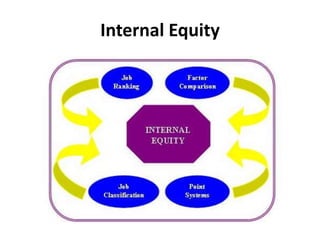
• The fairness is ensured
using job ranking, job
classification, level of
management, level of
status and factor
comparison.
Internal Equity
Example
• An agency may employ a
number of social workers to
work with similar client
groups. By reviewing the
salary of each employee and
comparing it with others in
the same role, you will be
able to determine if internal
equity exists.
Example
• This does not mean that all
employees are paid the
same; it means that they are
paid fairly in relation to
other staff in the same role.
Differences in salary may be
based on education,
experience, years of service,
or responsibility level.
Internal equity -  pay structures - Manu Melwin Joy

Internal equity - pay structures - Manu Melwin Joy

  • 1.
  • 2.
    Prepared By Kindly restrictthe use of slides for personal purpose. Please seek permission to reproduce the same in public forms and presentations. Manu Melwin Joy Assistant Professor Ilahia School of Management Studies Kerala, India. Phone – 9744551114 Mail – manu_melwinjoy@yahoo.com
  • 3.
    Internal Equity • Theinternal equity method undertakes the job position in the organizational hierarchy.
  • 4.
    Internal Equity • Theprocess aims at balancing the compensation provided to a job profile in comparison to the compensation provided to its senior and junior level in the hierarchy.
  • 5.
    Internal Equity • “Internalequity exists when employees in an organization perceive that they are being rewarded fairly according to the relative value of their jobs within an organization”.
  • 6.
    Internal Equity • Anotherway of stating this is to say that a person’s perception of their responsibilities, rewards and work conditions is seen as fair or equitable when compared with those of other employees in similar positions in the same organization.
  • 7.
    Internal Equity • Aninternal equity study can determine if there is pay equity between like- positions and if all roles in the organization are governed by the same compensation guidelines.
  • 8.
    Internal Equity • Usuallyeach role is assigned a pay range with corresponding criteria that outlines how to determine where an employee should be placed in the range.
  • 9.
    Internal Equity • Thefairness is ensured using job ranking, job classification, level of management, level of status and factor comparison.
  • 10.
  • 11.
    Example • An agencymay employ a number of social workers to work with similar client groups. By reviewing the salary of each employee and comparing it with others in the same role, you will be able to determine if internal equity exists.
  • 12.
    Example • This doesnot mean that all employees are paid the same; it means that they are paid fairly in relation to other staff in the same role. Differences in salary may be based on education, experience, years of service, or responsibility level.