TRINITY INSTITUTE OF PROFESSIONAL
STUDIESSector – 9, DwarkaInstitutional Area, New Delhi-75
Affiliated Institution of G.G.S.IP.U, Delhi
BBA
HRM (17202)
Wage Board –
By: RatikaMalhotra
TRINITY INSTITUTE OF PROFESSIONAL STUDIES
Sector – 9, DwarkaInstitutional Area, New Delhi-75
WAGE BOARDS
• Its concept came into existence during the
first five year plan.
• First wage board was setup in 1957 for the
textile industry.
• It helps in determining the wages of workers
in different industries.
• The objective was to resolve wage disputes.
TRINITY INSTITUTE OF PROFESSIONAL STUDIES
Sector – 9, DwarkaInstitutional Area, New Delhi-75
Wage Board Composition:-
• The composition of the wage boards is
Tripartite i.e. it comprises of representatives
from industry, trade unions and the
government.
• It constitutes of an impartial Chairman, 2
other independent members and 2 or 3
representatives of workers and employers
each
TRINITY INSTITUTE OF PROFESSIONAL STUDIES
Sector – 9, DwarkaInstitutional Area, New Delhi-75
NATIONAL LABOUR COMMISSION IN 1969
recommended that wage board should:-
Create a climate for harmonious industrial
relations.
Safeguard the interests of the community
and consumers.
Device standardized wage structures for the
concerned industry.
TRINITY INSTITUTE OF PROFESSIONAL STUDIES
Sector – 9, DwarkaInstitutional Area, New Delhi-75
WAGE BOARD
While determining the wage structure for an
industry following factors are considered:-
• Need-based minimum wage.
• Industry’s capacity to pay.
• Prevailing of Labour.
• Level of national in the economy of the country.
• Requirement of social justice.
• Adjustment of wage differentials in such manner
as to provide incentives for skill formation.
TRINITY INSTITUTE OF PROFESSIONAL STUDIES
Sector – 9, DwarkaInstitutional Area, New Delhi-75
PAY COMMISSIONS
• It is the commission set up by government in order to
determine the pay structure of government
employees [both central and state government]
• Pay commission covers a wide range of employees in
public sector.
• There is difference between method of settlement of
wage disputes available to private sector and public
sector workers. methods such as collective
bargaining, adjudication etc. thus for private sector
workers pay commission was setup.
TRINITY INSTITUTE OF PROFESSIONAL STUDIES
Sector – 9, DwarkaInstitutional Area, New Delhi-75
PAY COMMISSIONS
Pay commissions give recommendations to
government and then government decide
whether:-
• 1. To accept
• 2. To reject
• 3. To modify
TRINITY INSTITUTE OF PROFESSIONAL STUDIES
Sector – 9, DwarkaInstitutional Area, New Delhi-75
PAY COMMISSIONS
• 1ST
PC:- 1947
It stressed that the “living wage” should form the
basis for determining minimum wage, which
should be Rs. 30 for the lowest grade
employees.
• 2nd
PC:- 1957
It visualized dearness as a desire to protect the
real wages. minimum wage should be Rs. 300.
TRINITY INSTITUTE OF PROFESSIONAL STUDIES
Sector – 9, DwarkaInstitutional Area, New Delhi-75
PAY COMMISSIONS
• 3rd
PC:- 1973
It stressed on reduction of prevailling numerous
pay scales. It fixed the minimum wage to be
Rs. 185.
• 4th
PC:- 1983
It was specially asked to examine the variety of
allowances and benefits in kind. And suggest
their rationalisation and simplification .
TRINITY INSTITUTE OF PROFESSIONAL STUDIES
Sector – 9, DwarkaInstitutional Area, New Delhi-75
PAY COMMISSIONS
• 5TH
PC:- 1994
Made 99 recommendations, some of which are:-
Increase of lower level employees by 20 to 40 % and
that of senior level by almost 130 %.
Reduction in hiring, abolishing currently vacant posts,
and restructuring government departments.
six days a week instead of five
No. of gazatted holidays reduced to 3 from 17
Maternity leave be increased to 135 days
Retirement age to be made 60 yrs.
TRINITY INSTITUTE OF PROFESSIONAL STUDIES
Sector – 9, DwarkaInstitutional Area, New Delhi-75
PAY COMMISSIONS
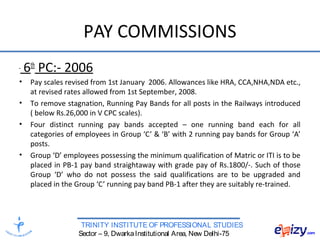
6th
PC:- 2006
• Pay scales revised from 1st January 2006. Allowances like HRA, CCA,NHA,NDA etc.,
at revised rates allowed from 1st September, 2008.
• To remove stagnation, Running Pay Bands for all posts in the Railways introduced
( below Rs.26,000 in V CPC scales).
• Four distinct running pay bands accepted – one running band each for all
categories of employees in Group ‘C’ & ‘B’ with 2 running pay bands for Group ‘A’
posts.
• Group ‘D’ employees possessing the minimum qualification of Matric or ITI is to be
placed in PB-1 pay band straightaway with grade pay of Rs.1800/-. Such of those
Group ‘D’ who do not possess the said qualifications are to be upgraded and
placed in the Group ‘C’ running pay band PB-1 after they are suitably re-trained.
TRINITY INSTITUTE OF PROFESSIONAL STUDIES
Sector – 9, DwarkaInstitutional Area, New Delhi-75
PAY COMMISSIONS
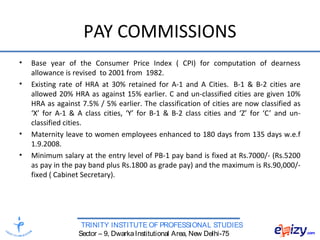
• Base year of the Consumer Price Index ( CPI) for computation of dearness
allowance is revised to 2001 from 1982.
• Existing rate of HRA at 30% retained for A-1 and A Cities. B-1 & B-2 cities are
allowed 20% HRA as against 15% earlier. C and un-classified cities are given 10%
HRA as against 7.5% / 5% earlier. The classification of cities are now classified as
‘X’ for A-1 & A class cities, ‘Y’ for B-1 & B-2 class cities and ‘Z’ for ‘C’ and un-
classified cities.
• Maternity leave to women employees enhanced to 180 days from 135 days w.e.f
1.9.2008.
• Minimum salary at the entry level of PB-1 pay band is fixed at Rs.7000/- (Rs.5200
as pay in the pay band plus Rs.1800 as grade pay) and the maximum is Rs.90,000/-
fixed ( Cabinet Secretary).

WAGE BOARD

  • 1.
    TRINITY INSTITUTE OFPROFESSIONAL STUDIESSector – 9, DwarkaInstitutional Area, New Delhi-75 Affiliated Institution of G.G.S.IP.U, Delhi BBA HRM (17202) Wage Board – By: RatikaMalhotra
  • 2.
    TRINITY INSTITUTE OFPROFESSIONAL STUDIES Sector – 9, DwarkaInstitutional Area, New Delhi-75 WAGE BOARDS • Its concept came into existence during the first five year plan. • First wage board was setup in 1957 for the textile industry. • It helps in determining the wages of workers in different industries. • The objective was to resolve wage disputes.
  • 3.
    TRINITY INSTITUTE OFPROFESSIONAL STUDIES Sector – 9, DwarkaInstitutional Area, New Delhi-75 Wage Board Composition:- • The composition of the wage boards is Tripartite i.e. it comprises of representatives from industry, trade unions and the government. • It constitutes of an impartial Chairman, 2 other independent members and 2 or 3 representatives of workers and employers each
  • 4.
    TRINITY INSTITUTE OFPROFESSIONAL STUDIES Sector – 9, DwarkaInstitutional Area, New Delhi-75 NATIONAL LABOUR COMMISSION IN 1969 recommended that wage board should:- Create a climate for harmonious industrial relations. Safeguard the interests of the community and consumers. Device standardized wage structures for the concerned industry.
  • 5.
    TRINITY INSTITUTE OFPROFESSIONAL STUDIES Sector – 9, DwarkaInstitutional Area, New Delhi-75 WAGE BOARD While determining the wage structure for an industry following factors are considered:- • Need-based minimum wage. • Industry’s capacity to pay. • Prevailing of Labour. • Level of national in the economy of the country. • Requirement of social justice. • Adjustment of wage differentials in such manner as to provide incentives for skill formation.
  • 6.
    TRINITY INSTITUTE OFPROFESSIONAL STUDIES Sector – 9, DwarkaInstitutional Area, New Delhi-75 PAY COMMISSIONS • It is the commission set up by government in order to determine the pay structure of government employees [both central and state government] • Pay commission covers a wide range of employees in public sector. • There is difference between method of settlement of wage disputes available to private sector and public sector workers. methods such as collective bargaining, adjudication etc. thus for private sector workers pay commission was setup.
  • 7.
    TRINITY INSTITUTE OFPROFESSIONAL STUDIES Sector – 9, DwarkaInstitutional Area, New Delhi-75 PAY COMMISSIONS Pay commissions give recommendations to government and then government decide whether:- • 1. To accept • 2. To reject • 3. To modify
  • 8.
    TRINITY INSTITUTE OFPROFESSIONAL STUDIES Sector – 9, DwarkaInstitutional Area, New Delhi-75 PAY COMMISSIONS • 1ST PC:- 1947 It stressed that the “living wage” should form the basis for determining minimum wage, which should be Rs. 30 for the lowest grade employees. • 2nd PC:- 1957 It visualized dearness as a desire to protect the real wages. minimum wage should be Rs. 300.
  • 9.
    TRINITY INSTITUTE OFPROFESSIONAL STUDIES Sector – 9, DwarkaInstitutional Area, New Delhi-75 PAY COMMISSIONS • 3rd PC:- 1973 It stressed on reduction of prevailling numerous pay scales. It fixed the minimum wage to be Rs. 185. • 4th PC:- 1983 It was specially asked to examine the variety of allowances and benefits in kind. And suggest their rationalisation and simplification .
  • 10.
    TRINITY INSTITUTE OFPROFESSIONAL STUDIES Sector – 9, DwarkaInstitutional Area, New Delhi-75 PAY COMMISSIONS • 5TH PC:- 1994 Made 99 recommendations, some of which are:- Increase of lower level employees by 20 to 40 % and that of senior level by almost 130 %. Reduction in hiring, abolishing currently vacant posts, and restructuring government departments. six days a week instead of five No. of gazatted holidays reduced to 3 from 17 Maternity leave be increased to 135 days Retirement age to be made 60 yrs.
  • 11.
    TRINITY INSTITUTE OFPROFESSIONAL STUDIES Sector – 9, DwarkaInstitutional Area, New Delhi-75 PAY COMMISSIONS 6th PC:- 2006 • Pay scales revised from 1st January 2006. Allowances like HRA, CCA,NHA,NDA etc., at revised rates allowed from 1st September, 2008. • To remove stagnation, Running Pay Bands for all posts in the Railways introduced ( below Rs.26,000 in V CPC scales). • Four distinct running pay bands accepted – one running band each for all categories of employees in Group ‘C’ & ‘B’ with 2 running pay bands for Group ‘A’ posts. • Group ‘D’ employees possessing the minimum qualification of Matric or ITI is to be placed in PB-1 pay band straightaway with grade pay of Rs.1800/-. Such of those Group ‘D’ who do not possess the said qualifications are to be upgraded and placed in the Group ‘C’ running pay band PB-1 after they are suitably re-trained.
  • 12.
    TRINITY INSTITUTE OFPROFESSIONAL STUDIES Sector – 9, DwarkaInstitutional Area, New Delhi-75 PAY COMMISSIONS • Base year of the Consumer Price Index ( CPI) for computation of dearness allowance is revised to 2001 from 1982. • Existing rate of HRA at 30% retained for A-1 and A Cities. B-1 & B-2 cities are allowed 20% HRA as against 15% earlier. C and un-classified cities are given 10% HRA as against 7.5% / 5% earlier. The classification of cities are now classified as ‘X’ for A-1 & A class cities, ‘Y’ for B-1 & B-2 class cities and ‘Z’ for ‘C’ and un- classified cities. • Maternity leave to women employees enhanced to 180 days from 135 days w.e.f 1.9.2008. • Minimum salary at the entry level of PB-1 pay band is fixed at Rs.7000/- (Rs.5200 as pay in the pay band plus Rs.1800 as grade pay) and the maximum is Rs.90,000/- fixed ( Cabinet Secretary).