SDM COLLEGE OF ENGINEERING AND TECHNOLOGY
DEPARTMENT OF MANAGEMENT STUDIES
PRESENTATION ON
Pay-For-Performance Plan
SUBMITTED TO:
SHILPA ARAKERI
(LECTURER,MBA DEPARTMENT)
SUBMITTED BY:
RAHUL V GULAGANJI
(2SD15MBA32)
Designing Pay for performance Plan
Defining Performance:
 It is critical to link compensation to your overall business strategy.
 To do that effectively, you must be able to identify the direction the organization
needs to move and communicate the desired actions to get there.
 Compensation provides a very effective tool for getting employees to move in the
same direction and follow the same path.
Merit Pay
Definition:
Merit pay is an approach to compensation that rewards the higher performing
employees with additional pay or incentive pay. Merit pay has advantages and
disadvantages for the employees and the employer. But, all-in-all, merit pay is
the best way to reward the employees that you most want to keep.
Well Above Above Below Well Below
Average Average Average Average Average
Performance rating 1 2 3 4 5
Merit pay increase 5% 4% 3% 1% 0%
Advantages
These are reasons why you might want to consider merit pay.
• Compensation
• Employee Benefits
• Employee Awards
• Human Resources Software
• Merit pay helps an employer differentiate between the performance of high and
low performing employees and reward the performance of the higher
performers.
Dis-Advantages
• There is no way, with 100% accuracy, to differentiate the performance of
various employees to determine deservers of merit pay.
• The amount of time and energy that organizations invest in an attempt to make
performance measurable for merit pay,.
• Given the limitations of metrics, the ability of the supervisor to communicate to
each employee the value of his or her contribution, and what superior
performance worthy of merit pay entails,
Variable Pay
Definition:
The amount of time and energy that organizations invest in an attempt to make
performance measurable for merit pay, including developing competencies,
measurements, base lines for performance, and so forth, is better spent on
delivering service for customers.
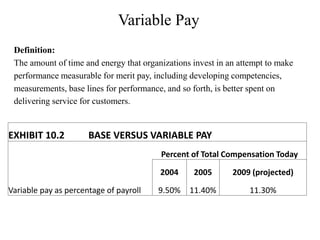
EXHIBIT 10.2 BASE VERSUS VARIABLE PAY
Percent of Total Compensation Today
2004 2005 2009 (projected)
Variable pay as percentage of payroll 9.50% 11.40% 11.30%
The greater interest in variable pay probably can be traced to two trends:
1. The increasing competition from foreign producers forces American firms
to cut costs and/or increase productivity.
2. Today’s fast-paced business environment means that workers must be
willing to adjust what they do and how they do it.
Advantages Of Variable Pay
• In a variable pay scheme, an employee earns rewards additional to his or
her basic pay depending on what he or she has achieved vis-à-vis what he
or she is supposed to achieve. Read on to find out the pros and cons of a
variable pay plan.
• Basic pay is entitlement in return for the time put in by the employee at
work. Variable pay on the other hand anchors to a measurement of
performance such as units produced, customer satisfaction scores,
attendance records, performance evaluation results, profitability, and other
factors, with the employee needing to re-earn the pay each time
Individual Spot Awards/Spot Awards
An immediate recognition to reward an employee for exceptional
performance beyond the prescribed expectation of the employee’s job.
Spot awards are given after the event has been completed, usually without
pre‐determined goals or set performance levels and paid as a one‐time
bonus.
Individual Incentive Plans
Incentive plans are part of an employee's compensation or pay. The incentive
plan gives an employee the opportunity to increase his annual pay based
upon either company performance or individual performance. Incentive plans
are a way for companies to keep employees motivated to perform to the best
of their abilities, thus increasing company profit.
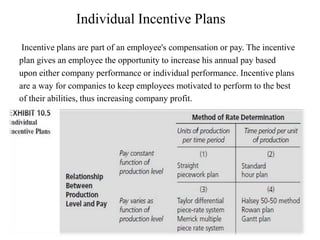
There are four general categories of plan
1. Cell 1
 The most frequently implemented incentive system is a straight
piecework system.
 Rate determination is based on units of production per time period, and
wages vary directly as a function of production level.
 The major advantages of this type of system are that it is easily
understood by workers and, perhaps consequently, is more readily
accepted than some of the other incentive systems.
2. Cell 2
 Two relatively common plans set standards based on time per unit and tie
incentives directly to level of output:
a. Standard hour plan is a generic term for plans setting the incentive
rate based on completion of a task in some expected time period.
b. Bandeaux plan provides a variation on straight piecework and
standard hour plans. It requires division of a task into simple actions
and determination of the time required by an average skilled worker to
complete each action.
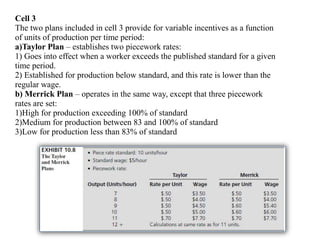
Cell 3
The two plans included in cell 3 provide for variable incentives as a function
of units of production per time period:
a)Taylor Plan – establishes two piecework rates:
1) Goes into effect when a worker exceeds the published standard for a given
time period.
2) Established for production below standard, and this rate is lower than the
regular wage.
b) Merrick Plan – operates in the same way, except that three piecework
rates are set:
1)High for production exceeding 100% of standard
2)Medium for production between 83 and 100% of standard
3)Low for production less than 83% of standard
Individual Incentive Plans
Advantages:
 Substantial impact that raises productivity, lowers production costs,
and increases earnings of workers.
 Less direct supervision is required to maintain reasonable levels of
output than under payment by time.
 In most cases, systems of payments by results, if accompanied by
improved organizational and work measurement, enable labor costs to
be estimated more accurately than under payment by time. This helps
costing and budgetary control.
4. Cell 4
The three plans included in cell 4 provide for variable incentives linked to
a standard expressed as a time period per unit of production:
a. Halsey 50-50 method – derives its name from the shared split
between worker and employer of any savings in direct cost.
b. Rowan Plan – similar to the Halsey plan in that an employer and
employee both share in savings resulting from work completed in
less than standard time.
c. Gantt Plan – differs from both the Halsey and the Rowan plans in
that the standard time for a task is purposely set at a level requiring
high effort to complete.
Individual Incentive Plans
Disadvantages:
 Greater conflict may emerge between employees seeking to maximize
output and managers concerned about deteriorating quality levels.
 Attempts to introduce new technology may be resisted by employees
concerned about the impact on production standards.
 Reduced willingness of employees to suggest new production methods
for fear of subsequent increases in production standards.
 Increased complaints that equipment is poorly maintained, hindering
employee efforts to earn larger incentives.
 Increased turnover among new employees discouraged by the
unwillingness of experienced workers to cooperate in on-the-job
training.
 Elevated levels of mistrust between workers and management.
Group Incentives
The incentive schemes can be applied on a group basis also. Group incentive
schemes are appropriate where jobs are interdependent. It is difficult to
meaningfully measure individual performance and group pressures affect the
performance of the members of the group. The chief group incentive schemes
are discussed here.
Profit-Sharing
The concept of profit-sharing emerged towards the end of the nineteenth
century. Profit-sharing, as the name itself suggests, is sharing of profit of
organization among employees. The International Co-operative Congress”
held in Paris in 1889 considered the issue of profit-sharing and defined it as
“an agreement (formal or informal) freely entered into by which an employee
receives a share fixed in advance of the profits”.
Long Term Incentives
Long term incentives focus on performance beyond the one-year time line
used as the cutoff for short term incentive plans. recent explosive growth in
long-term plans. recent explosive growth in long-term plans appears to be
surprised in part by a desire to motivate long term value creation.
Long-Term Incentives & Their Risk-Reward Tradeoff’s
Level One: Risk/Reward
1)Time-Based Restricted Stock:
2)Performance-accelerated restricted stock:
3)Stock Purchase Plan:
Level Two: Medium Risk/Reward
4)Time-Vested stock option
5)Performance-versed restricted stock
6) Performance-accelerated stock option
Level Three: High Risk/Reward
7)Premium-priced stock option
8)Indexed stock option
9)Performance-vested stock option
Pay For Performance ppt

Pay For Performance ppt

  • 1.
    SDM COLLEGE OFENGINEERING AND TECHNOLOGY DEPARTMENT OF MANAGEMENT STUDIES PRESENTATION ON Pay-For-Performance Plan SUBMITTED TO: SHILPA ARAKERI (LECTURER,MBA DEPARTMENT) SUBMITTED BY: RAHUL V GULAGANJI (2SD15MBA32)
  • 2.
    Designing Pay forperformance Plan Defining Performance:  It is critical to link compensation to your overall business strategy.  To do that effectively, you must be able to identify the direction the organization needs to move and communicate the desired actions to get there.  Compensation provides a very effective tool for getting employees to move in the same direction and follow the same path.
  • 3.
    Merit Pay Definition: Merit payis an approach to compensation that rewards the higher performing employees with additional pay or incentive pay. Merit pay has advantages and disadvantages for the employees and the employer. But, all-in-all, merit pay is the best way to reward the employees that you most want to keep. Well Above Above Below Well Below Average Average Average Average Average Performance rating 1 2 3 4 5 Merit pay increase 5% 4% 3% 1% 0%
  • 4.
    Advantages These are reasonswhy you might want to consider merit pay. • Compensation • Employee Benefits • Employee Awards • Human Resources Software • Merit pay helps an employer differentiate between the performance of high and low performing employees and reward the performance of the higher performers. Dis-Advantages • There is no way, with 100% accuracy, to differentiate the performance of various employees to determine deservers of merit pay. • The amount of time and energy that organizations invest in an attempt to make performance measurable for merit pay,. • Given the limitations of metrics, the ability of the supervisor to communicate to each employee the value of his or her contribution, and what superior performance worthy of merit pay entails,
  • 5.
    Variable Pay Definition: The amountof time and energy that organizations invest in an attempt to make performance measurable for merit pay, including developing competencies, measurements, base lines for performance, and so forth, is better spent on delivering service for customers. EXHIBIT 10.2 BASE VERSUS VARIABLE PAY Percent of Total Compensation Today 2004 2005 2009 (projected) Variable pay as percentage of payroll 9.50% 11.40% 11.30%
  • 6.
    The greater interestin variable pay probably can be traced to two trends: 1. The increasing competition from foreign producers forces American firms to cut costs and/or increase productivity. 2. Today’s fast-paced business environment means that workers must be willing to adjust what they do and how they do it. Advantages Of Variable Pay • In a variable pay scheme, an employee earns rewards additional to his or her basic pay depending on what he or she has achieved vis-à-vis what he or she is supposed to achieve. Read on to find out the pros and cons of a variable pay plan. • Basic pay is entitlement in return for the time put in by the employee at work. Variable pay on the other hand anchors to a measurement of performance such as units produced, customer satisfaction scores, attendance records, performance evaluation results, profitability, and other factors, with the employee needing to re-earn the pay each time
  • 7.
    Individual Spot Awards/SpotAwards An immediate recognition to reward an employee for exceptional performance beyond the prescribed expectation of the employee’s job. Spot awards are given after the event has been completed, usually without pre‐determined goals or set performance levels and paid as a one‐time bonus.
  • 8.
    Individual Incentive Plans Incentiveplans are part of an employee's compensation or pay. The incentive plan gives an employee the opportunity to increase his annual pay based upon either company performance or individual performance. Incentive plans are a way for companies to keep employees motivated to perform to the best of their abilities, thus increasing company profit.
  • 9.
    There are fourgeneral categories of plan 1. Cell 1  The most frequently implemented incentive system is a straight piecework system.  Rate determination is based on units of production per time period, and wages vary directly as a function of production level.  The major advantages of this type of system are that it is easily understood by workers and, perhaps consequently, is more readily accepted than some of the other incentive systems. 2. Cell 2  Two relatively common plans set standards based on time per unit and tie incentives directly to level of output: a. Standard hour plan is a generic term for plans setting the incentive rate based on completion of a task in some expected time period. b. Bandeaux plan provides a variation on straight piecework and standard hour plans. It requires division of a task into simple actions and determination of the time required by an average skilled worker to complete each action.
  • 10.
    Cell 3 The twoplans included in cell 3 provide for variable incentives as a function of units of production per time period: a)Taylor Plan – establishes two piecework rates: 1) Goes into effect when a worker exceeds the published standard for a given time period. 2) Established for production below standard, and this rate is lower than the regular wage. b) Merrick Plan – operates in the same way, except that three piecework rates are set: 1)High for production exceeding 100% of standard 2)Medium for production between 83 and 100% of standard 3)Low for production less than 83% of standard
  • 11.
    Individual Incentive Plans Advantages: Substantial impact that raises productivity, lowers production costs, and increases earnings of workers.  Less direct supervision is required to maintain reasonable levels of output than under payment by time.  In most cases, systems of payments by results, if accompanied by improved organizational and work measurement, enable labor costs to be estimated more accurately than under payment by time. This helps costing and budgetary control.
  • 12.
    4. Cell 4 Thethree plans included in cell 4 provide for variable incentives linked to a standard expressed as a time period per unit of production: a. Halsey 50-50 method – derives its name from the shared split between worker and employer of any savings in direct cost. b. Rowan Plan – similar to the Halsey plan in that an employer and employee both share in savings resulting from work completed in less than standard time. c. Gantt Plan – differs from both the Halsey and the Rowan plans in that the standard time for a task is purposely set at a level requiring high effort to complete.
  • 13.
    Individual Incentive Plans Disadvantages: Greater conflict may emerge between employees seeking to maximize output and managers concerned about deteriorating quality levels.  Attempts to introduce new technology may be resisted by employees concerned about the impact on production standards.  Reduced willingness of employees to suggest new production methods for fear of subsequent increases in production standards.  Increased complaints that equipment is poorly maintained, hindering employee efforts to earn larger incentives.  Increased turnover among new employees discouraged by the unwillingness of experienced workers to cooperate in on-the-job training.  Elevated levels of mistrust between workers and management.
  • 14.
    Group Incentives The incentiveschemes can be applied on a group basis also. Group incentive schemes are appropriate where jobs are interdependent. It is difficult to meaningfully measure individual performance and group pressures affect the performance of the members of the group. The chief group incentive schemes are discussed here. Profit-Sharing The concept of profit-sharing emerged towards the end of the nineteenth century. Profit-sharing, as the name itself suggests, is sharing of profit of organization among employees. The International Co-operative Congress” held in Paris in 1889 considered the issue of profit-sharing and defined it as “an agreement (formal or informal) freely entered into by which an employee receives a share fixed in advance of the profits”.
  • 15.
    Long Term Incentives Longterm incentives focus on performance beyond the one-year time line used as the cutoff for short term incentive plans. recent explosive growth in long-term plans. recent explosive growth in long-term plans appears to be surprised in part by a desire to motivate long term value creation. Long-Term Incentives & Their Risk-Reward Tradeoff’s Level One: Risk/Reward 1)Time-Based Restricted Stock: 2)Performance-accelerated restricted stock: 3)Stock Purchase Plan: Level Two: Medium Risk/Reward 4)Time-Vested stock option 5)Performance-versed restricted stock 6) Performance-accelerated stock option
  • 16.
    Level Three: HighRisk/Reward 7)Premium-priced stock option 8)Indexed stock option 9)Performance-vested stock option