Chapter Eleven
Compensation
System Development
Copyright © Houghton Mifflin Company. All rights reserved. 11–2
Chapter Outline
• Employee Satisfaction and Motivation Issues
in Compensation Design
• Establishing Internal Equity: Job Evaluation
Methods
• Establishing External Equity
• Establishing Individual Equity
• Legal Regulation of Compensation Systems
• Administering Compensation Systems
• The Issue of Comparable Worth
Copyright © Houghton Mifflin Company. All rights reserved. 11–3
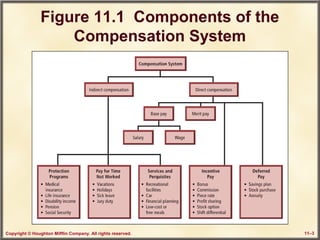
Figure 11.1 Components of the
Compensation System
Copyright © Houghton Mifflin Company. All rights reserved. 11–4
Employee Satisfaction and Motivation
Issues in Compensation Design
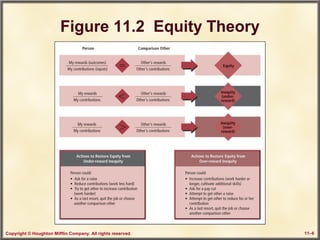
• Equity Theory
• Satisfaction with Pay
• Designing Equitable Compensation
Systems
– Internal Equity
– External Equity
– Individual Equity
Copyright © Houghton Mifflin Company. All rights reserved. 11–5
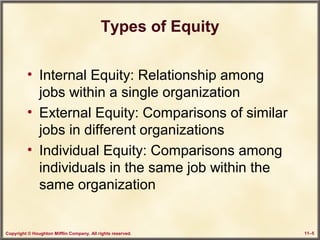
Types of Equity
• Internal Equity: Relationship among
jobs within a single organization
• External Equity: Comparisons of similar
jobs in different organizations
• Individual Equity: Comparisons among
individuals in the same job within the
same organization
Copyright © Houghton Mifflin Company. All rights reserved. 11–6
Figure 11.2 Equity Theory
Copyright © Houghton Mifflin Company. All rights reserved. 11–7
Establishing Internal Equity: Job
Evaluation Methods
• Job Ranking
Copyright © Houghton Mifflin Company. All rights reserved. 11–8
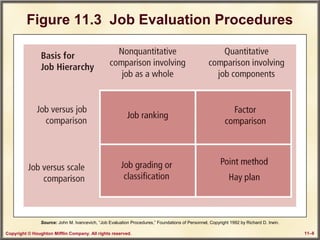
Figure 11.3 Job Evaluation Procedures
Source: John M. Ivancevich, “Job Evaluation Procedures,” Foundations of Personnel, Copyright 1992 by Richard D. Irwin.
Copyright © Houghton Mifflin Company. All rights reserved. 11–9
Establishing Internal Equity: Job
Evaluation Methods (cont’d)
• Job Grading or Classification
• Point Method
– Compensable Factors
Copyright © Houghton Mifflin Company. All rights reserved. 11–10
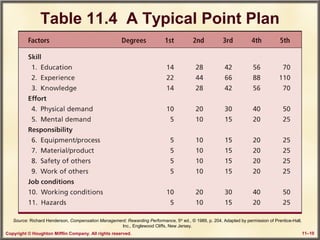
Table 11.4 A Typical Point Plan
Source: Richard Henderson, Compensation Management: Rewarding Performance, 5th
ed., © 1989, p. 204. Adapted by permission of Prentice-Hall,
Inc., Englewood Cliffs, New Jersey.
Copyright © Houghton Mifflin Company. All rights reserved. 11–11
Establishing Internal Equity: Job
Evaluation Methods (cont’d)
• Job Grading or Classification
• Point Method
– Compensable Factors
– Application to Jobs
Copyright © Houghton Mifflin Company. All rights reserved. 11–12
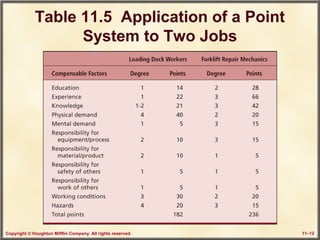
Table 11.5 Application of a Point
System to Two Jobs
Copyright © Houghton Mifflin Company. All rights reserved. 11–13
Establishing Internal Equity: Job
Evaluation Methods (cont’d)
• Job Grading or Classification
• Point Method
– Compensable Factors
– Application to Jobs
– The Hay Plan
Copyright © Houghton Mifflin Company. All rights reserved. 11–14
Hay Factors
• Know-How
• Problem Solving (Mental Activity)
• Accountability
Copyright © Houghton Mifflin Company. All rights reserved. 11–15
Establishing Internal Equity: Job
Evaluation Methods (cont’d)
• Factor Comparison
• Computerized Job Evaluation
• Results of Job Evaluation
• Job Grading or Classification
• Point Method
– Compensable Factors
– Application to Jobs
– The Hay Plan
Copyright © Houghton Mifflin Company. All rights reserved. 11–16
Establishing External Equity
• Wage and Salary Surveys
– Identifying Key Jobs
– Selecting Organizations to Survey
– Collecting Data
• Self-Surveys
• Online Surveys
• Government Surveys
• Interpreting the Data
• Avoiding Antitrust
• Pay Level Policy
– Matching the Competition
– Adapting a Lead Policy
– Following a Lag Approach
Copyright © Houghton Mifflin Company. All rights reserved. 11–17
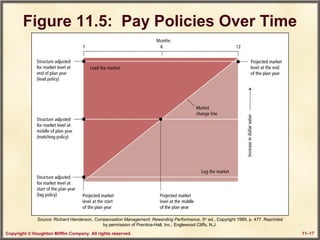
Figure 11.5: Pay Policies Over Time
Source: Richard Henderson, Compensation Management: Rewarding Performance, 5th
ed., Copyright 1989, p. 477. Reprinted
by permission of Prentice-Hall, Inc., Englewood Cliffs, N.J.
Copyright © Houghton Mifflin Company. All rights reserved. 11–18
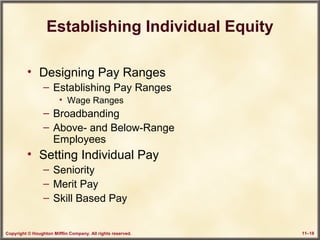
Establishing Individual Equity
• Designing Pay Ranges
– Establishing Pay Ranges
• Wage Ranges
– Broadbanding
– Above- and Below-Range
Employees
• Setting Individual Pay
– Seniority
– Merit Pay
– Skill Based Pay
Copyright © Houghton Mifflin Company. All rights reserved. 11–19
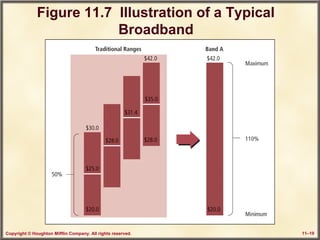
Figure 11.7 Illustration of a Typical
Broadband
Copyright © Houghton Mifflin Company. All rights reserved. 11–20
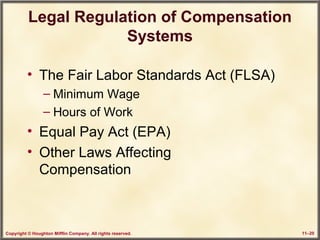
Legal Regulation of Compensation
Systems
• The Fair Labor Standards Act (FLSA)
– Minimum Wage
– Hours of Work
• Equal Pay Act (EPA)
• Other Laws Affecting
Compensation
Copyright © Houghton Mifflin Company. All rights reserved. 11–21
Administering Compensation Systems
• Pay Secrecy
• Employee Participation
• Wage Compression
• Impact of Inflation
• All-Salaried Work Force
• Wage Concessions
Copyright © Houghton Mifflin Company. All rights reserved. 11–22
The Issue of Comparable Worth
• The Earnings Gap
• Legal and Judicial Developments
• Comparable Worth and Job Evaluation
• Alternatives
• Prospects for the Future
Copyright © Houghton Mifflin Company. All rights reserved. 11–23
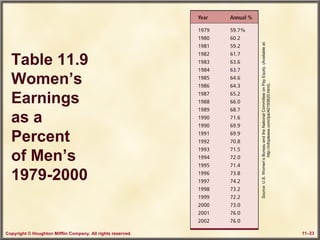
Table 11.9
Women’s
Earnings
as a
Percent
of Men’s
1979-2000
Source:U.S.Women’sBureauandtheNationalCommitteeonPayEquity.(Availableat:
http://infoplease.com/ipa/A0193820.html).
Copyright © Houghton Mifflin Company. All rights reserved. 11–24
Review
• Employee Satisfaction and Motivation Issues
in Compensation Design
• Establishing Internal Equity: Job Evaluation
Methods
• Establishing External Equity
• Establishing Individual Equity
• Legal Regulation of Compensation Systems
• Administering Compensation Systems
• The Issue of Comparable Worth

Hra 310 chapter 11

  • 1.
  • 2.
    Copyright © HoughtonMifflin Company. All rights reserved. 11–2 Chapter Outline • Employee Satisfaction and Motivation Issues in Compensation Design • Establishing Internal Equity: Job Evaluation Methods • Establishing External Equity • Establishing Individual Equity • Legal Regulation of Compensation Systems • Administering Compensation Systems • The Issue of Comparable Worth
  • 3.
    Copyright © HoughtonMifflin Company. All rights reserved. 11–3 Figure 11.1 Components of the Compensation System
  • 4.
    Copyright © HoughtonMifflin Company. All rights reserved. 11–4 Employee Satisfaction and Motivation Issues in Compensation Design • Equity Theory • Satisfaction with Pay • Designing Equitable Compensation Systems – Internal Equity – External Equity – Individual Equity
  • 5.
    Copyright © HoughtonMifflin Company. All rights reserved. 11–5 Types of Equity • Internal Equity: Relationship among jobs within a single organization • External Equity: Comparisons of similar jobs in different organizations • Individual Equity: Comparisons among individuals in the same job within the same organization
  • 6.
    Copyright © HoughtonMifflin Company. All rights reserved. 11–6 Figure 11.2 Equity Theory
  • 7.
    Copyright © HoughtonMifflin Company. All rights reserved. 11–7 Establishing Internal Equity: Job Evaluation Methods • Job Ranking
  • 8.
    Copyright © HoughtonMifflin Company. All rights reserved. 11–8 Figure 11.3 Job Evaluation Procedures Source: John M. Ivancevich, “Job Evaluation Procedures,” Foundations of Personnel, Copyright 1992 by Richard D. Irwin.
  • 9.
    Copyright © HoughtonMifflin Company. All rights reserved. 11–9 Establishing Internal Equity: Job Evaluation Methods (cont’d) • Job Grading or Classification • Point Method – Compensable Factors
  • 10.
    Copyright © HoughtonMifflin Company. All rights reserved. 11–10 Table 11.4 A Typical Point Plan Source: Richard Henderson, Compensation Management: Rewarding Performance, 5th ed., © 1989, p. 204. Adapted by permission of Prentice-Hall, Inc., Englewood Cliffs, New Jersey.
  • 11.
    Copyright © HoughtonMifflin Company. All rights reserved. 11–11 Establishing Internal Equity: Job Evaluation Methods (cont’d) • Job Grading or Classification • Point Method – Compensable Factors – Application to Jobs
  • 12.
    Copyright © HoughtonMifflin Company. All rights reserved. 11–12 Table 11.5 Application of a Point System to Two Jobs
  • 13.
    Copyright © HoughtonMifflin Company. All rights reserved. 11–13 Establishing Internal Equity: Job Evaluation Methods (cont’d) • Job Grading or Classification • Point Method – Compensable Factors – Application to Jobs – The Hay Plan
  • 14.
    Copyright © HoughtonMifflin Company. All rights reserved. 11–14 Hay Factors • Know-How • Problem Solving (Mental Activity) • Accountability
  • 15.
    Copyright © HoughtonMifflin Company. All rights reserved. 11–15 Establishing Internal Equity: Job Evaluation Methods (cont’d) • Factor Comparison • Computerized Job Evaluation • Results of Job Evaluation • Job Grading or Classification • Point Method – Compensable Factors – Application to Jobs – The Hay Plan
  • 16.
    Copyright © HoughtonMifflin Company. All rights reserved. 11–16 Establishing External Equity • Wage and Salary Surveys – Identifying Key Jobs – Selecting Organizations to Survey – Collecting Data • Self-Surveys • Online Surveys • Government Surveys • Interpreting the Data • Avoiding Antitrust • Pay Level Policy – Matching the Competition – Adapting a Lead Policy – Following a Lag Approach
  • 17.
    Copyright © HoughtonMifflin Company. All rights reserved. 11–17 Figure 11.5: Pay Policies Over Time Source: Richard Henderson, Compensation Management: Rewarding Performance, 5th ed., Copyright 1989, p. 477. Reprinted by permission of Prentice-Hall, Inc., Englewood Cliffs, N.J.
  • 18.
    Copyright © HoughtonMifflin Company. All rights reserved. 11–18 Establishing Individual Equity • Designing Pay Ranges – Establishing Pay Ranges • Wage Ranges – Broadbanding – Above- and Below-Range Employees • Setting Individual Pay – Seniority – Merit Pay – Skill Based Pay
  • 19.
    Copyright © HoughtonMifflin Company. All rights reserved. 11–19 Figure 11.7 Illustration of a Typical Broadband
  • 20.
    Copyright © HoughtonMifflin Company. All rights reserved. 11–20 Legal Regulation of Compensation Systems • The Fair Labor Standards Act (FLSA) – Minimum Wage – Hours of Work • Equal Pay Act (EPA) • Other Laws Affecting Compensation
  • 21.
    Copyright © HoughtonMifflin Company. All rights reserved. 11–21 Administering Compensation Systems • Pay Secrecy • Employee Participation • Wage Compression • Impact of Inflation • All-Salaried Work Force • Wage Concessions
  • 22.
    Copyright © HoughtonMifflin Company. All rights reserved. 11–22 The Issue of Comparable Worth • The Earnings Gap • Legal and Judicial Developments • Comparable Worth and Job Evaluation • Alternatives • Prospects for the Future
  • 23.
    Copyright © HoughtonMifflin Company. All rights reserved. 11–23 Table 11.9 Women’s Earnings as a Percent of Men’s 1979-2000 Source:U.S.Women’sBureauandtheNationalCommitteeonPayEquity.(Availableat: http://infoplease.com/ipa/A0193820.html).
  • 24.
    Copyright © HoughtonMifflin Company. All rights reserved. 11–24 Review • Employee Satisfaction and Motivation Issues in Compensation Design • Establishing Internal Equity: Job Evaluation Methods • Establishing External Equity • Establishing Individual Equity • Legal Regulation of Compensation Systems • Administering Compensation Systems • The Issue of Comparable Worth

Editor's Notes

  • #24 Jason, if you need to alter table in order to fit in slide, show 2-year intervals rather than every year.