The 3-P Compensation Concept
Dr. G C Mohanta, BE, MSc(Engg), MBA, PhD(Mgt)
Professor
Al-Qurmoshi Institute of Business Management
Hyderabad
Pay for Position
 Pay for position, Position based pay or Job-based
pay, pays employees for the job to which they are
assigned, regardless of the skills they possess.
 In other words, pay is centered on the job or position
and not on the person.
 Pay for Position is a more traditional pay structure in
which each position is assigned a pay range based on the
job duties and pay is based on education and seniority.
Pay for Position (Contd.)
 Employee compensation is set in broadband based on
qualifications, education, training & experience
 Through broad banding, narrowly structured pay grades
determined through job evaluation, are replaced by
fewer and wider bands
 Employees progress up through broad band if their
performance ratings are good, rather than through steps
based on time in the grade
 It reduces different compensation categories to broad
compensation bands, grouping jobs together by
common characteristic
Pay for Position (Contd.)
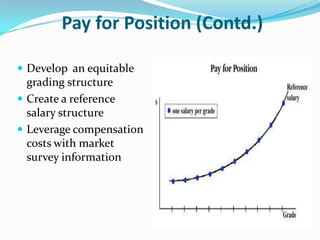
 Develop an equitable
grading structure
 Create a reference
salary structure
 Leverage compensation
costs with market
survey information
Pay for Person
 Pay for Person or Person focused pay or Skill-based
pay or Knowledge-based pay or Competency-based
pay structures link pay to the depth or breadth of the
skills, abilities, competency and knowledge a person
acquires and applies to the work.
 Structures based on skill, pay individuals for all the
skills for which they have been certified regardless of
whether the work they are doing requires all or just a
few of those particular skills.
 The wage is attached to the person.
Pay for Person (Contd.)
 The pay increases are usually tied to three types of skills:
- horizontal skills, which involve a broadening of skills in
terms of the range of tasks
- vertical skills, which involve acquiring skills of a higher
level
- depth skills, which involve a high level of skills in
specialised areas relating to the same job.
 Because skill-based pay encourages and rewards a broad
range of skills, the employee becomes multi-skilled and
more flexible and valuable;
 A job rotation is used to fill in temporary gaps in the
workforce.
Pay for Person (Contd.)
 Pay for person takes into account the demonstrable
characteristics of a person, including knowledge, skills,
competency and behaviors, that enable performance
 Take into consideration the person’s capabilities & experience
in setting a pay level that is both equitable and competitive
 It considers the market demand of a person’s unique skills and
experience
 It also incorporates market based pay approach
Pay for Person (Contd.)
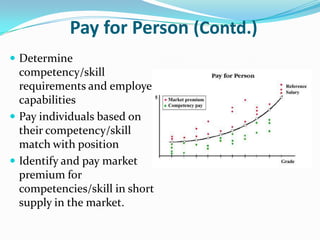
 Determine
competency/skill
requirements and employee
capabilities
 Pay individuals based on
their competency/skill
match with position
 Identify and pay market
premium for
competencies/skill in short
supply in the market.
Pay for Performance
 Pay for Performance, Performance related pay,
Performance-based pay is a financial reward system
for employees where some or all of their monetary
compensation is related to how their performance is
assessed relative to stated criteria.
 The criteria for performance-related pay scheme may
be based on individual, group or organizational
performance, or on a mixture of them.
Pay for Performance (Contd.)
 Individual-based criteria would require –
- individual goal-setting,
- an appropriate performance appraisal system
- individual training to increase job knowledge & skills and
- the individual should have a large measure of control over
his/her own performance.
 Team-based criteria are appropriate where individual
performance is difficult to measure,
 or where there is a need for a corporate culture to
promote team values and cooperation.
Pay for Performance (Contd.)
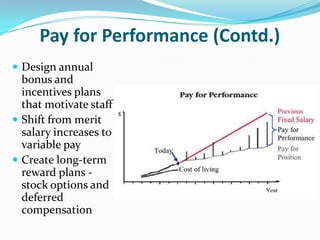
 Design annual
bonus and
incentives plans
that motivate staff
 Shift from merit
salary increases to
variable pay
 Create long-term
reward plans -
stock options and
deferred
compensation

3 p compensation concept

  • 1.
    The 3-P CompensationConcept Dr. G C Mohanta, BE, MSc(Engg), MBA, PhD(Mgt) Professor Al-Qurmoshi Institute of Business Management Hyderabad
  • 2.
    Pay for Position Pay for position, Position based pay or Job-based pay, pays employees for the job to which they are assigned, regardless of the skills they possess.  In other words, pay is centered on the job or position and not on the person.  Pay for Position is a more traditional pay structure in which each position is assigned a pay range based on the job duties and pay is based on education and seniority.
  • 3.
    Pay for Position(Contd.)  Employee compensation is set in broadband based on qualifications, education, training & experience  Through broad banding, narrowly structured pay grades determined through job evaluation, are replaced by fewer and wider bands  Employees progress up through broad band if their performance ratings are good, rather than through steps based on time in the grade  It reduces different compensation categories to broad compensation bands, grouping jobs together by common characteristic
  • 4.
    Pay for Position(Contd.)  Develop an equitable grading structure  Create a reference salary structure  Leverage compensation costs with market survey information
  • 5.
    Pay for Person Pay for Person or Person focused pay or Skill-based pay or Knowledge-based pay or Competency-based pay structures link pay to the depth or breadth of the skills, abilities, competency and knowledge a person acquires and applies to the work.  Structures based on skill, pay individuals for all the skills for which they have been certified regardless of whether the work they are doing requires all or just a few of those particular skills.  The wage is attached to the person.
  • 6.
    Pay for Person(Contd.)  The pay increases are usually tied to three types of skills: - horizontal skills, which involve a broadening of skills in terms of the range of tasks - vertical skills, which involve acquiring skills of a higher level - depth skills, which involve a high level of skills in specialised areas relating to the same job.  Because skill-based pay encourages and rewards a broad range of skills, the employee becomes multi-skilled and more flexible and valuable;  A job rotation is used to fill in temporary gaps in the workforce.
  • 7.
    Pay for Person(Contd.)  Pay for person takes into account the demonstrable characteristics of a person, including knowledge, skills, competency and behaviors, that enable performance  Take into consideration the person’s capabilities & experience in setting a pay level that is both equitable and competitive  It considers the market demand of a person’s unique skills and experience  It also incorporates market based pay approach
  • 8.
    Pay for Person(Contd.)  Determine competency/skill requirements and employee capabilities  Pay individuals based on their competency/skill match with position  Identify and pay market premium for competencies/skill in short supply in the market.
  • 9.
    Pay for Performance Pay for Performance, Performance related pay, Performance-based pay is a financial reward system for employees where some or all of their monetary compensation is related to how their performance is assessed relative to stated criteria.  The criteria for performance-related pay scheme may be based on individual, group or organizational performance, or on a mixture of them.
  • 10.
    Pay for Performance(Contd.)  Individual-based criteria would require – - individual goal-setting, - an appropriate performance appraisal system - individual training to increase job knowledge & skills and - the individual should have a large measure of control over his/her own performance.  Team-based criteria are appropriate where individual performance is difficult to measure,  or where there is a need for a corporate culture to promote team values and cooperation.
  • 11.
    Pay for Performance(Contd.)  Design annual bonus and incentives plans that motivate staff  Shift from merit salary increases to variable pay  Create long-term reward plans - stock options and deferred compensation