Defining Internal
Alignment
1
Internal Alignment
Often called internal equity, refers to the pay relationships among different
jobs/skills/competencies within a single organization.
2
3
Pay Structure
Refers to the array of pay rates for different work or skills within a single
organization.
4
Compensation Strategy: Internal
Alignment
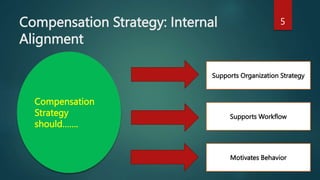
Compensation
Strategy
should…….
Supports Organization Strategy
Supports Workflow
Motivates Behavior
5
Compensation Strategy: Internal
Alignment cont.
 Support Organization Strategy
The organization’s strategy tells us how it plans to achieve its purpose.
Internal structures that are aligned with a strategy help achieve it.
 Supports Workflow
Work flow refers to the process by which goods and services are delivered to
the customer. The pay structure ought to support the efficient flow of that
work and the design of the organization.
 Motivates Behavior
Internal pay structures influence employees’ behaviour. The challenge is to
design the structures so they direct people’s efforts toward organization
objectives.
6
Structures Vary Among Organizations
 An internal pay structure can be defined by:
-Number of levels of work
-Pay differentials between the levels
-Criteria or basis used to determine those levels and differentials
7
Structures Vary Among Organizations cont.
LEVELS
Pay structure is hierarchical in nature, based on:
-Number of levels
-Reporting relationships
8
Exhibit 3.2: Career Bands at GE
Healthcare
9
Structures Vary Among Organizations
cont.
DIFFENTIALS
Pay differences between the levels are called differentials. Differentials should be based on
some measure of the differences in the value of the work to the organization.
10
11
Structures Vary Among Organizations
cont.
CRITERIA: Content and Value
Content – the work performed in a job and how it gets done
-Structure ranks jobs on – skills required, complexity of tasks, problem solving,
and/or responsibility
Value – the worth of the work; its relative contribution to the organization
objectives
-Structure focuses on – relative contribution of these skills, tasks, and
responsibilities to the organization's goals
-Can include external market value
12
Use Value and Exchange Value
 Use value – the value of goods or services an employee produces in a job
 Exchange value – whatever wage the employer and employee agrees on
for a job
Difference between exchange value and use value surfaces when one firm
acquires another
13
Job- and Person-Based Structures
 Job-based structures relies on the work content – tasks, behaviors,
responsibilities
 Person-based structure shifts the focus to the employee
Skills, knowledge, or competencies the employee possesses
Whether or not they are used in the particular job
In reality, both job-and-person-based structures are included
14
Factors Influencing Internal Pay
Structures
 Societal factors
 Economic factors
 Organizational Factors
15
16
STRATEGIC CHOICES IN DESIGNING
INTERNAL STRUCTURES
 Fitting or tailoring the pay structure to be internally aligned involves two
strategic choices
-How tailored to organization design and work flow to make the structure
-How to distribute pay throughout the levels in the structure
17
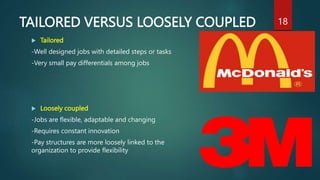
TAILORED VERSUS LOOSELY COUPLED
 Tailored
-Well designed jobs with detailed steps or tasks
-Very small pay differentials among jobs
 Loosely coupled
-Jobs are flexible, adaptable and changing
-Requires constant innovation
-Pay structures are more loosely linked to the
organization to provide flexibility
18
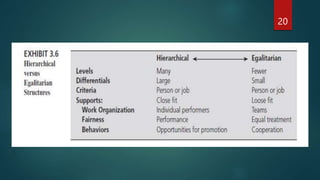
EGALITARIAN VERSUS HIERARCHICAL
 Egalitarian structures send the message that all employees are valued equally
Advantage
Fewer levels and smaller differentials between adjacent levels and between highest- and lowest-paid
workers
Disadvantage
‘Averagism’ brings to light that equal treatment can mean more knowledgeable employees feel
underpaid
 Hierarchical structures send the message that the organization values the differences in work
content, individual skills, and contributions to the organization.
-Multiple levels include detailed descriptions of work done at each level.
-Outlined responsibility for each
19
20
21
22
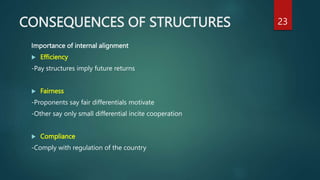
CONSEQUENCES OF STRUCTURES
Importance of internal alignment
 Efficiency
-Pay structures imply future returns
 Fairness
-Proponents say fair differentials motivate
-Other say only small differential incite cooperation
 Compliance
-Comply with regulation of the country
23

Defining Internal Alignment.pptx

  • 1.
  • 2.
    Internal Alignment Often calledinternal equity, refers to the pay relationships among different jobs/skills/competencies within a single organization. 2
  • 3.
  • 4.
    Pay Structure Refers tothe array of pay rates for different work or skills within a single organization. 4
  • 5.
    Compensation Strategy: Internal Alignment Compensation Strategy should……. SupportsOrganization Strategy Supports Workflow Motivates Behavior 5
  • 6.
    Compensation Strategy: Internal Alignmentcont.  Support Organization Strategy The organization’s strategy tells us how it plans to achieve its purpose. Internal structures that are aligned with a strategy help achieve it.  Supports Workflow Work flow refers to the process by which goods and services are delivered to the customer. The pay structure ought to support the efficient flow of that work and the design of the organization.  Motivates Behavior Internal pay structures influence employees’ behaviour. The challenge is to design the structures so they direct people’s efforts toward organization objectives. 6
  • 7.
    Structures Vary AmongOrganizations  An internal pay structure can be defined by: -Number of levels of work -Pay differentials between the levels -Criteria or basis used to determine those levels and differentials 7
  • 8.
    Structures Vary AmongOrganizations cont. LEVELS Pay structure is hierarchical in nature, based on: -Number of levels -Reporting relationships 8
  • 9.
    Exhibit 3.2: CareerBands at GE Healthcare 9
  • 10.
    Structures Vary AmongOrganizations cont. DIFFENTIALS Pay differences between the levels are called differentials. Differentials should be based on some measure of the differences in the value of the work to the organization. 10
  • 11.
  • 12.
    Structures Vary AmongOrganizations cont. CRITERIA: Content and Value Content – the work performed in a job and how it gets done -Structure ranks jobs on – skills required, complexity of tasks, problem solving, and/or responsibility Value – the worth of the work; its relative contribution to the organization objectives -Structure focuses on – relative contribution of these skills, tasks, and responsibilities to the organization's goals -Can include external market value 12
  • 13.
    Use Value andExchange Value  Use value – the value of goods or services an employee produces in a job  Exchange value – whatever wage the employer and employee agrees on for a job Difference between exchange value and use value surfaces when one firm acquires another 13
  • 14.
    Job- and Person-BasedStructures  Job-based structures relies on the work content – tasks, behaviors, responsibilities  Person-based structure shifts the focus to the employee Skills, knowledge, or competencies the employee possesses Whether or not they are used in the particular job In reality, both job-and-person-based structures are included 14
  • 15.
    Factors Influencing InternalPay Structures  Societal factors  Economic factors  Organizational Factors 15
  • 16.
  • 17.
    STRATEGIC CHOICES INDESIGNING INTERNAL STRUCTURES  Fitting or tailoring the pay structure to be internally aligned involves two strategic choices -How tailored to organization design and work flow to make the structure -How to distribute pay throughout the levels in the structure 17
  • 18.
    TAILORED VERSUS LOOSELYCOUPLED  Tailored -Well designed jobs with detailed steps or tasks -Very small pay differentials among jobs  Loosely coupled -Jobs are flexible, adaptable and changing -Requires constant innovation -Pay structures are more loosely linked to the organization to provide flexibility 18
  • 19.
    EGALITARIAN VERSUS HIERARCHICAL Egalitarian structures send the message that all employees are valued equally Advantage Fewer levels and smaller differentials between adjacent levels and between highest- and lowest-paid workers Disadvantage ‘Averagism’ brings to light that equal treatment can mean more knowledgeable employees feel underpaid  Hierarchical structures send the message that the organization values the differences in work content, individual skills, and contributions to the organization. -Multiple levels include detailed descriptions of work done at each level. -Outlined responsibility for each 19
  • 20.
  • 21.
  • 22.
  • 23.
    CONSEQUENCES OF STRUCTURES Importanceof internal alignment  Efficiency -Pay structures imply future returns  Fairness -Proponents say fair differentials motivate -Other say only small differential incite cooperation  Compliance -Comply with regulation of the country 23

Editor's Notes

  • #2 Setting objectives is our first issue in a strategic approach to pay. Our second issue, internal alignment, addresses relationships inside the organization. Internal alignment addresses the logic underlying these relationships. The relationships form a pay structure that should support the organization strategy, support the work flow, and motivate behavior toward organization objectives.     An internally consistent pay structure is one that supports the organization’s internal structure and is perceived as equitable when pay rates for different jobs within the organization are compared, i.e., the array of wage rates for different jobs in the organization is deemed to be fair or equitable.
  • #3 It focuses attention on the importance of designing a pay structure that supports the workflow, is fair to employees, and directs their behaviours toward organizational objectives.
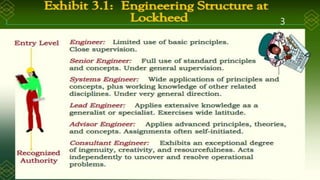
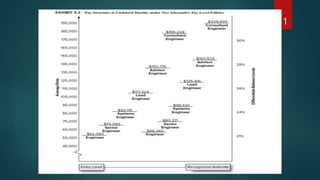
  • #4 Exhibit 3.1 shows a structure for engineering work at a division of Lockheed Martin, the world’s largest defense contractor. The six levels in Lockheed’s structure range from entry to consultant. You can see the relationships in the descriptions of each level. Decisions on how to pay each level create a pay structure.
  • #6 The relationships form a pay structure that should support the organization strategy, support the work flow, and motivate behavior toward organization objectives.
  • #7 1. Supports Organization Strategy - The organization’s strategy tells us how it plans to achieve its purpose. Internal structures that are aligned with a strategy help achieve it. Lockheed decided that six levels of engineering work would support the company’s strategy of researching, designing, and developing advanced technology systems. 2. Supports Workflow - For example, financial service firms in the United States traditionally offer investment advice and products through client centers. At Merrill Lynch, customer associates used to take all calls from clients or new prospects and route them to financial advisors (FAs). If the caller wanted a specific transaction, such as purchasing a stock, mutual fund, or certificate of deposit, the customer associate passed the information on to an FA who was legally certified to make the purchase. 3. Motivates Behavior - Internal pay structures are part of the network of returns discussed in Chapter 1: pay increases for promotions, more challenging work, and greater responsibility as employees move up in the structure. The challenge is to design structures that will engage people to help achieve organization objectives. Merrill Lynch financial advisors work to meet the specific needs of their clients by building long-term relationships. Lockheed engineers work together to share knowledge with each other and with their customers. It will in a well-designed pay structure. The structure ought to make clear the relationship between each job and the organization’s objectives. This is an example of “line-of-sight.” Employees should be able to “see” the links between their work, the work of others, and the organization’s objectives. And the structure ought to be fair to employees. The vineyard owner’s internal pay structure may have been aligned with his business strategy, but the employee dissatisfaction raises concerns about its fairness to employees.
  • #8 An internal pay structure can be defined by (1) the number of levels of work, (2) the pay differentials between the levels, and (3) the criteria or bases used to determine those levels and differentials.
  • #9 Reflect the overall hierarchy of the flow of work in the organization- the number of levels and reporting relationships.
  • #10 One feature of any pay structure is its hierarchical nature: the number of levels and reporting relationships. Some are more hierarchical, with multiple levels; others are compressed, with few levels.7 The stated goal of GE Healthcare is to provide “transformational medical technologies and services that are shaping a new age of patient care.” One of their many product lines is magnetic resonance imaging (MRI). In comparison to Lockheed’s six levels for engineering alone (Exhibit 3.1), GE Healthcare uses five broad levels, described in Exhibit 3.2, to cover all professional and executive work, including engineering. GE Healthcare would probably fit the Lockheed Martin structure into two or three levels.
  • #11 Pay differences between the levels are called differentials. Differentials should be based on some measure of the differences in the value of the work to the organization.
  • #12 The pay differences among levels are referred to as differentials. If we assume that an organization has a compensation budget of a set amount to distribute among its employees, there are a number of ways it can do so. It can divide the budget by the number of employees to give everyone the same amount. The Moosewood Restaurant in Ithaca, New York, adopts this approach. But few organizations in the world are that egalitarian. In most, pay varies among employees.8 Work that requires more knowledge or skills, is performed under unpleasant working conditions, or adds more value is usually paid more.9 Exhibit 3.3 shows the percent differentials traditionally attached to Lockheed Martin’s engineering structure. (Actual pay levels are now somewhat higher for the entire structure.) Northrup Grumman uses a similar six-level engineering structure with similar differentials. One intention of these differentials is to motivate people to strive for promotion to a higher-paying level.
  • #13 Content and Value- content refers to the work performed in a job and how it gets done. Value refers to the worth of the work: its relative based on skills required, complexity of tasks, and/or responsibility. Work content and its value are the most common bases for determining internal structures. Content refers to the work performed in a job and how it gets done (tasks, behaviors, knowledge required, etc.). Value refers to the worth of the work: its relative contribution to the organization objectives. A structure based on content typically ranks jobs on skills required, complexity of tasks, problem solving, and/or responsibility. In contrast, a structure based on the value of the work focuses on the relative contribution of these skills, tasks, and responsibilities to the organization’s goals. While the resulting structures may be the same, there are important differences. In addition to relative contribution, external market value may also be included (i.e., what competitors pay for this job). Or it may include rates agreed upon through collective bargaining, or even legislated rates (minimum wage).
  • #14 Use value reflects the value of goods or services an employee produces in a job. Exchange value is whatever wage the employer and employee agree on for a job The difference between exchange value and use value also surfaces when one firm acquires another. For instance, IBM’s acquisition of PricewaterhouseCoopers (PWC), where consultants were the lifeblood of the company, is a case in point. At the time, IBM was moving from being a computer company to a provider of information technology solutions whose applications were broader than the IT department. PWC consultants could help IBM’s marketing teams engage with clients at a higher organization level. The use value of the PWC consultants within IBM differed from their use value within PWC (how they contributed to IBM or PWC objectives). So, similar marketing jobs in two different companies may be valued differently based on how they contribute to organization objectives. Alternatively, the same work content in the same company (IBM’s software engineers) may have different exchange value based on different geographies.
  • #15 A job-based structure relies on the work content—tasks, behaviors, responsibilities. A person-based structure shifts the focus to the employee: the skills, knowledge, or competencies the employee possesses, whether or not they are used in the employee’s particular job. The engineering structure at Lockheed Martin (Exhibit 3.1) uses the work performed as the criterion. GE Healthcare (Exhibit 3.2) uses the individual employees’ competencies/knowledge required at each level of work. So class, In the real workplace, it is often hard to describe a job without reference to the jobholder’s knowledge and skills. Conversely, it is hard to define a person’s job-related knowledge or competencies without referring to work content. So rather than a job- or person-based structure, reality includes both job and person.
  • #16 Just wage doctrine claims that societal norms, customs and tradition justify pay structures. Present-day manifestation of then just wage doctrine can be seen in debates over minimum wage legislation and comparable worth, which also argue against economic forces as the sole determinant of pay structures. Globalization of economic competition is having a major impact on pay structures. In essence, pay structures are being redesigned to face the new economic realities. The supply and demand for specific skills also influence pay structures. The technology employed is a critical organizational factor influencing the design of pay structures. The organization’s human resource policies are another influence on pay structures. Most organizations use promotions as an incentive to induce employees to apply for higher level positions.
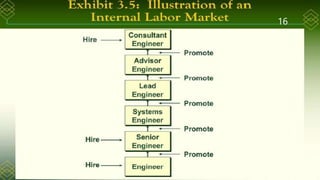
  • #17 Internal Labor Market refers to the rules and procedure that: -Determine the pay for the different jobs within the single organization, and -Allocate employees among those different jobs. In the organization depicted in Exhibit 3.5, individuals are recruited only for entry-level jobs (an engineer would be hired right out of college; a senior engineer would have a few years’ experience). They are later promoted or transferred to other jobs inside the organization. Because the employer competes in the external market for people to fill these entry jobs, their pay must be high enough to attract a pool of qualified applicants. In contrast, pay for jobs filled via transfer and promotions is connected to external market forces, but the connection is less direct. External factors are dominant influences on pay for entry jobs, but the differences for nonentry jobs tend to reflect internal factors.
  • #18 Aligned pay structures support the way the work gets done, fit the organization’s business strategy, and are fair to employees. Greater internal alignment—fit—is more likely to lead to success. Misaligned structures become obstacles. They may still motivate employee behavior, but it may be undesirable behavior. Two strategic choices are involved: how specifically tailored to the organization’s design and work flow to make the structure and (2) how to distribute pay throughout the levels in the structure.
  • #19 A low-cost, customer-focused business strategy such as that followed by McDonald’s or Walmart may be supported by a closely tailored structure. Jobs are well defined with detailed tasks or steps to follow. You can go into a McDonald’s in Cleveland, Prague, or Shanghai and find they all are very similar. Their pay structures are, too. There are seven jobs in each McDonald’s (under supervisors and managers). All are very well defined in order to eliminate variance in how they are performed. Cooking french fries takes nine steps. It seems hard to make a mistake in these jobs.36 It is also hard to be the very best french fryer in the whole company. Differences in pay among jobs are very small. In contrast to McDonald’s, 3M’s business strategy requires constant product innovation and short product-design-to-market cycle times. The 3M competitive environment is turbulent and unpredictable. No steps at all are laid out. 3M engineers may work on several teams developing several products at the same time. 3M’s pay structures are more loosely linked to the organization in order to provide flexibility.
  • #21 Pay structures can range from hierarchical to egalitarian. Exhibit 3.6 clarifies the differences. Egalitarian structures have fewer levels and/or smaller differentials between adjacent levels and between the highest- and lowest-paid workers. This slide clarifies the differences between egalitarian and hierarchical structures. The choice, however, is not either / or. Rather, the differences are a matter of degree. So levels can range from many to few, differentials can be large or small, and the criteria can be based on the job, the person, or some combination of the two.
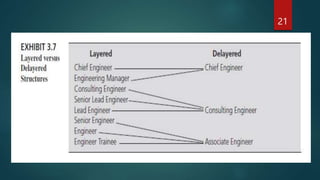
  • #22 Structures can also be said to vary from layered to delayered. In Exhibit 3.7, the layered structure has eight different levels, with relatively small between-level differentials in comparison to the delayered structure, which has only three levels. The layered structure is more hierarchical than the delayered structure and less egalitarian in terms of number of levels; the multiple levels would include detailed descriptions of work done at each level and outline who is responsible for what. Hierarchies send the message that the organization values the differences in work content, individual skills, and contributions to the organization. In the delayered structure, several levels of job titles are removed so that all employees at all levels become responsible for a broader range of tasks but also have greater freedom (with less close supervision) to determine how best to accomplish what is expected of them. The delayered structure is more egalitarian in that it sends the message that all employees are valued equally. Employees are less closely supervised and they are given more autonomy (less close supervision), in hopes of allowing them to exercise independent thought, initiative, and action. The assumption is that more equal treatment will improve employee satisfaction, support cooperation, and therefore affect workers’ performance.
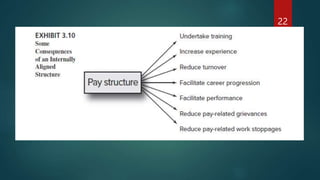
  • #23 Exhibit 3.10 summarizes the potential outcomes or effects attributed to internally aligned structures. The impact of internal structures depends on the context in which they operate.
  • #24 1. Research shows that an aligned structure can lead to better organization performance. If the structure does not motivate employees to help achieve the organization’s objectives, then it is a candidate for redesign. Internal pay structures imply future returns. The size of the differentials between the entry level in the structure and the highest level can encourage employees to remain with the organization, increase their experience and training, cooperate with co-workers, and seek greater responsibility. 2. Writers have long agreed that departures from an acceptable wage structure will occasion turnover, grievances, and diminished motivation. But that is where the agreement ends. One group argues that if fair (i.e., sizable) differentials among jobs are not paid, individuals may harbor ill will toward the employer, resist change, change employment if possible, become depressed, and “lack that zest and enthusiasm which makes for high efficiency and personal satisfaction in work.” Others, including labor unions, argue for only small differentials within pay levels and for similar work, in the belief that more egalitarian structures support cooperation and commitment and improve performance 3. As with any pay decision, internal pay structures must comply with the regulations of the countries in which the organization operates. While the research on internal alignment is very informative, there is still a lot we do not know. What about the appropriate number of levels, the size of the differentials, lie in understanding the factors discussed in this chapter: the organization’s strategic intent, its design and work flow, human capital, and the external conditions, regulations, and customs it faces. We also believe that aligning the pay structure to fit the organization’s conditions is more likely to lead to competitive advantage for the organization and a sense of fair treatment for employees.