
HUMAN RESOURCE
MANAGMENT
TALHA JALAL
BBA 5th5th
TOPIC’S
√ Pay Structure Decision
√ Internal Equity Recognizing Employee Contribution
With Pay
Pay Structure Decision
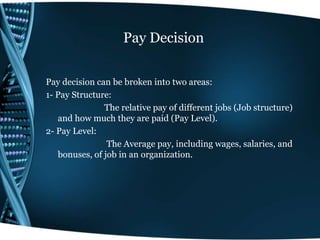
Once employees have done their job and been appraised, they
expect to be paid. Each empoyee’s pay should make sense in terms
of the company’s overall pay plan.
“ How to establish a pay plan ” and how to price the job in your
firm developing pay plan. & why and how organizations attach pay
policies to jobs.
Employer’s Point Of View:
1- Powerful tool for achieveing organaization’s strategic goals.
2- Large Impact on employee behavior & attitude.
3- Powerful tool for retain current employee.
4- Significant Organizational Cost requires for aquiring the
human resource for running operation
What is Pay
Employee’s Point Of View
1- Having good salary for their job satisfaction
2- wages, salaries, and other earning effect thier over all
income & Standard of living.
3- Fairness in pay distribution.
4- Pay is sign status and success.
5- Other bonuses and incentive for the encouragment of their
work.
6- Work with honesty and remain loyall
Pay Decision
Pay decision can be broken into two areas:
1- Pay Structure:
The relative pay of different jobs (Job structure)
and how much they are paid (Pay Level).
2- Pay Level:
The Average pay, including wages, salaries, and
bonuses, of job in an organization.
For Example:
Consider the same two jobs in two different organizations. In
organization 1, job A and B are paid an annual average
compensation of $40000 and $60000 respectively. In organization
2 the pay rates are $45000 and $55000 respectively. Organization 1
and 2 have the same pay level ($50000) but the job structure
(relative rates of Pay) differ. Both pay level and jobs structure are
characteristics of organization and reflect decision about jobs rather
than about individual employees.
Why is the focus on jobs in developing a pay
structure
 Number of employees in an organization increases.
 Take many decision in determining compensation.
 Employees must be required a rate of pay that is acceptable in
terms of external, internal and individual equity and in terms
of employer’s cost.
 Each employee are unique and thus requires some degree of
individualizaed treatment.
 Standarizing the treatment of similar employees (those with
similar jobs) can help greatly to make compensation
administration and decision making more manageable and
more equitable. Thus pay policies are often attached to
particular jobs rather than tailored entirely to individual
employees.
Internal Equity recognizing employee
contribution with pay
Employees often evaluate their pay relative to that of other
employees. Equity theory suggest that people evaluate the
fairness of their situations by comparing them with those
of other peopl e. According to the theory, A person (p) compare
his own ratio of perceived outcomes O (pay, benefits, working
conditions) to perceived inputs (efforts, ability, experience) to the
ratio of comparison other (o) this is called equity theory.
Op/Ip <, >, or = Oo/Io ?
Equity Theory (or Adam’s Equity Theory)
It explains the thought process an employee uses to determine the
fairness of management decision making. The core of equity theory says
that individuals judge the fairness of their treatment based on how others
like them are treated. Employees make social comparisons to others who
are similarly situated in the organization. Said another way, an employee
asks himself the following: Based on what I am giving to this
organization (inputs), am I getting the same rewards (outcomes) as
others are getting who give similar inputs?
Equity theory shows that inequities (perceived or real) harm
employee motivation.
 Reducing one’s own inputs (not work as hard)
 Increasing one’s outcomes (such as by theft)
 Leaving the situation that generates perceived inequity
(leaving the organization or refusing to work or cooperate with
employees who are perceived as overrewarded.
 Go into survival mode (do their job and little more)
 Become resistant (act out on other issues)
 Become overly competitive (focus on reducing the outputs of
others)
Pay Structure
Decision Area
Administrative
Tool
Consequences of
Equity Perceptions
Pay Level
Market pay
surveys
External equity
External employee
movement, labor
costs, employee
attitudes
Job Structure Job evaluation Internal equity
Internal employee
movement, cooperation,
employee attitudes
Pay Structure Concept and consequence
Focus of
Employee Pay
Comparison
THANK YOU

Pay Structure Decision

  • 1.
  • 2.
    TOPIC’S √ Pay StructureDecision √ Internal Equity Recognizing Employee Contribution With Pay
  • 3.
    Pay Structure Decision Onceemployees have done their job and been appraised, they expect to be paid. Each empoyee’s pay should make sense in terms of the company’s overall pay plan. “ How to establish a pay plan ” and how to price the job in your firm developing pay plan. & why and how organizations attach pay policies to jobs.
  • 4.
    Employer’s Point OfView: 1- Powerful tool for achieveing organaization’s strategic goals. 2- Large Impact on employee behavior & attitude. 3- Powerful tool for retain current employee. 4- Significant Organizational Cost requires for aquiring the human resource for running operation What is Pay
  • 5.
    Employee’s Point OfView 1- Having good salary for their job satisfaction 2- wages, salaries, and other earning effect thier over all income & Standard of living. 3- Fairness in pay distribution. 4- Pay is sign status and success. 5- Other bonuses and incentive for the encouragment of their work. 6- Work with honesty and remain loyall
  • 6.
    Pay Decision Pay decisioncan be broken into two areas: 1- Pay Structure: The relative pay of different jobs (Job structure) and how much they are paid (Pay Level). 2- Pay Level: The Average pay, including wages, salaries, and bonuses, of job in an organization.
  • 7.
    For Example: Consider thesame two jobs in two different organizations. In organization 1, job A and B are paid an annual average compensation of $40000 and $60000 respectively. In organization 2 the pay rates are $45000 and $55000 respectively. Organization 1 and 2 have the same pay level ($50000) but the job structure (relative rates of Pay) differ. Both pay level and jobs structure are characteristics of organization and reflect decision about jobs rather than about individual employees.
  • 8.
    Why is thefocus on jobs in developing a pay structure  Number of employees in an organization increases.  Take many decision in determining compensation.  Employees must be required a rate of pay that is acceptable in terms of external, internal and individual equity and in terms of employer’s cost.  Each employee are unique and thus requires some degree of individualizaed treatment.  Standarizing the treatment of similar employees (those with similar jobs) can help greatly to make compensation administration and decision making more manageable and more equitable. Thus pay policies are often attached to particular jobs rather than tailored entirely to individual employees.
  • 9.
    Internal Equity recognizingemployee contribution with pay Employees often evaluate their pay relative to that of other employees. Equity theory suggest that people evaluate the fairness of their situations by comparing them with those of other peopl e. According to the theory, A person (p) compare his own ratio of perceived outcomes O (pay, benefits, working conditions) to perceived inputs (efforts, ability, experience) to the ratio of comparison other (o) this is called equity theory. Op/Ip <, >, or = Oo/Io ?
  • 10.
    Equity Theory (orAdam’s Equity Theory) It explains the thought process an employee uses to determine the fairness of management decision making. The core of equity theory says that individuals judge the fairness of their treatment based on how others like them are treated. Employees make social comparisons to others who are similarly situated in the organization. Said another way, an employee asks himself the following: Based on what I am giving to this organization (inputs), am I getting the same rewards (outcomes) as others are getting who give similar inputs?
  • 11.
    Equity theory showsthat inequities (perceived or real) harm employee motivation.  Reducing one’s own inputs (not work as hard)  Increasing one’s outcomes (such as by theft)  Leaving the situation that generates perceived inequity (leaving the organization or refusing to work or cooperate with employees who are perceived as overrewarded.  Go into survival mode (do their job and little more)  Become resistant (act out on other issues)  Become overly competitive (focus on reducing the outputs of others)
  • 12.
    Pay Structure Decision Area Administrative Tool Consequencesof Equity Perceptions Pay Level Market pay surveys External equity External employee movement, labor costs, employee attitudes Job Structure Job evaluation Internal equity Internal employee movement, cooperation, employee attitudes Pay Structure Concept and consequence Focus of Employee Pay Comparison
  • 13.