Author(s): Louis D’Alecy, 2009

License: Unless otherwise noted, this material is made available under the terms of the
Creative Commons Attribution–Non-commercial–Share Alike 3.0 License:
http://creativecommons.org/licenses/by-nc-sa/3.0/

We have reviewed this material in accordance with U.S. Copyright Law and have tried to maximize your ability to use,
share, and adapt it. The citation key on the following slide provides information about how you may share and adapt this
material.

Copyright holders of content included in this material should contact open.michigan@umich.edu with any questions,
corrections, or clarification regarding the use of content.

For more information about how to cite these materials visit http://open.umich.edu/education/about/terms-of-use.

Any medical information in this material is intended to inform and educate and is not a tool for self-diagnosis or a
replacement for medical evaluation, advice, diagnosis or treatment by a healthcare professional. Please speak to your
physician if you have questions about your medical condition.

Viewer discretion is advised: Some medical content is graphic and may not be suitable for all viewers.
Citation Key
                          for more information see: http://open.umich.edu/wiki/CitationPolicy


Use + Share + Adapt
  { Content the copyright holder, author, or law permits you to use, share and adapt. }
               Public Domain – Government: Works that are produced by the U.S. Government. (USC 17 § 105)
               Public Domain – Expired: Works that are no longer protected due to an expired copyright term.
               Public Domain – Self Dedicated: Works that a copyright holder has dedicated to the public domain.

               Creative Commons – Zero Waiver

               Creative Commons – Attribution License
               Creative Commons – Attribution Share Alike License
               Creative Commons – Attribution Noncommercial License
               Creative Commons – Attribution Noncommercial Share Alike License
               GNU – Free Documentation License

Make Your Own Assessment
  { Content Open.Michigan believes can be used, shared, and adapted because it is ineligible for copyright. }
               Public Domain – Ineligible: Works that are ineligible for copyright protection in the U.S. (USC 17 § 102(b)) *laws in
               your jurisdiction may differ
   { Content Open.Michigan has used under a Fair Use determination. }
               Fair Use: Use of works that is determined to be Fair consistent with the U.S. Copyright Act. (USC 17 § 107) *laws in
               your jurisdiction may differ
               Our determination DOES NOT mean that all uses of this 3rd-party content are Fair Uses and we DO NOT guarantee
               that your use of the content is Fair.
               To use this content you should do your own independent analysis to determine whether or not your use will be Fair.
Respiratory Mechanics II

            M1 – Cardiovascular/Respiratory
                       Sequence
                 Louis D’Alecy, Ph.D.


Fall 2008                                     3
Friday 11/14/08, 9:00
     Mechanics of Ventilation II
                30 slides, 50 minutes
1.   Tidal Volume
2.   Intraplural Pressure
3.   Alveolar Distending Pressure
4.   Lung Compliance
5.   Airway Resistance
6.   Lung volumes (Spirometer)
7.   Functional Residual Capacity
8.   Forced vital capacity
9.   Measurement of airway resistance   4
Tidal Volume (TV)
   -- air volume entering or leaving
        the respiratory system
          in a single breath.
        It adds to, and mixes with,
              alveolar gases.
Contrast with :
Minute ventilation that is total
Ventilation per minute = TV X Rate
                                       5
Tidal Volume & Intraplural (Pip)
           Inspiration               Expiration

  Air                                                                   Air
Entering                                                              Leaving
 Lung                                                                  Lung


Pip   is     -5            -7                            -5                      6
                    Levitzky. Pulmonary Physiology. McGraw-Hill, 2003. 6th ed.
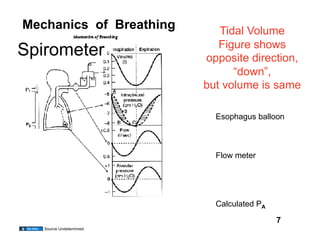
Mechanics of Breathing      Tidal Volume
                            Figure shows
Spirometer               opposite direction,
                               “down”,
                         but volume is same

                           Esophagus balloon


                           Flow meter


                           Calculated PA

                                           7
   Source Undetermined
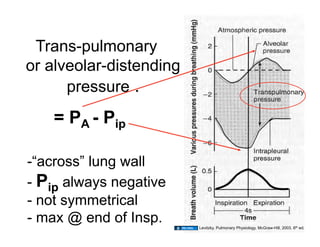
Trans-pulmonary
or alveolar-distending
      pressure .
    = PA - Pip

-“across” lung wall
- Pip always negative
- not symmetrical
- max @ end of Insp.                                               8
                         Levitzky. Pulmonary Physiology. McGraw-Hill, 2003. 6th ed.
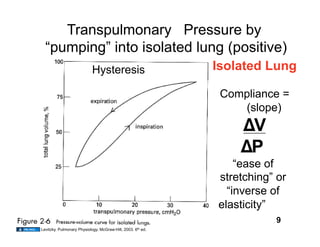
Transpulmonary Pressure by
  “pumping” into isolated lung (positive)
                            Hysteresis                       Isolated Lung

                                                              Compliance =
                                                                 (slope)
                                                                   V
                                                                   P
                                                                 “ease of
                                                             stretching” or
                                                               “inverse of
                                                             elasticity”
                                                                        9
Levitzky. Pulmonary Physiology. McGraw-Hill, 2003. 6th ed.
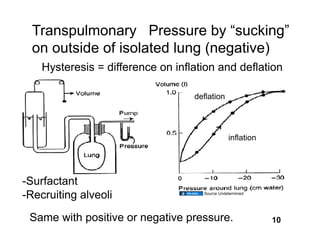
Transpulmonary Pressure by “sucking”
  on outside of isolated lung (negative)
    Hysteresis = difference on inflation and deflation

                                  deflation


                                               inflation


-Surfactant
-Recruiting alveoli                 Source Undetermined


 Same with positive or negative pressure.                 10
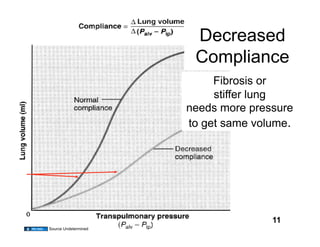
Decreased
                       Compliance
                           Fibrosis or
                           stiffer lung
                      needs more pressure
                      to get same volume.


                                     11
Source Undetermined
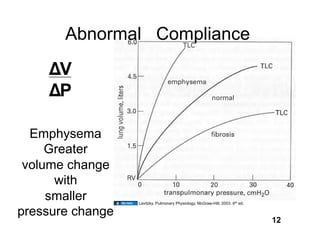
Abnormal Compliance
      V
      P

  Emphysema
     Greater
 volume change
      with
     smaller      Levitzky. Pulmonary Physiology. McGraw-Hill, 2003. 6th ed.

pressure change
                                                                               12
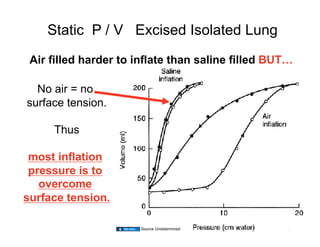
Static P / V Excised Isolated Lung
 Air filled harder to inflate than saline filled BUT…

  No air = no
surface tension.

     Thus

 most inflation
 pressure is to
   overcome
surface tension.
                                              13
                     Source Undetermined
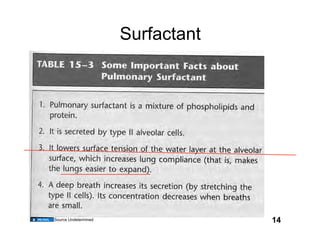
Surfactant


Source Undetermined                14
Infant Respiratory Distress Syndrome

•   No functional pulmonary surfactant
•   Great difficulty inflating lungs
•   If inflated for them -- tend to collapse
•   Very low compliance (very stiff)
•   Strenuous effort needed to breathe
•   Die from complete exhaustion

                                              15
Work of breathing

Work ~ Pressure change X Volume change

Elastic work overcomes:
      recoil of chest wall
      recoil of lung parenchyma
      surface tension of alveoli

Resistive Work overcomes:
     Tissue resistance
     Airway resistance
                                     16
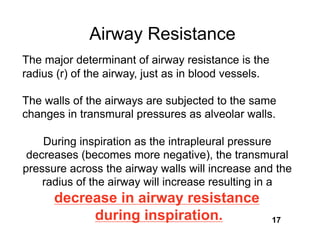
Airway Resistance
The major determinant of airway resistance is the
radius (r) of the airway, just as in blood vessels.

The walls of the airways are subjected to the same
changes in transmural pressures as alveolar walls.

    During inspiration as the intrapleural pressure
 decreases (becomes more negative), the transmural
pressure across the airway walls will increase and the
    radius of the airway will increase resulting in a
      decrease in airway resistance
           during inspiration.                        17
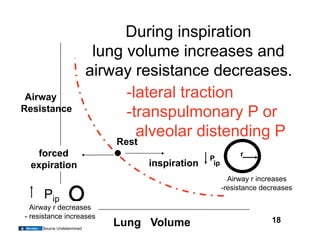
During inspiration
                            lung volume increases and
                           airway resistance decreases.
 Airway                          -lateral traction
Resistance
                                 -transpulmonary P or
                                   alveolar distending P
                               Rest
  forced                                            P
                                                               r
 expiration                           inspiration    ip

                                                            Airway r increases
                                                          -resistance decreases
      Pip
  Airway r decreases
- resistance increases
                              Lung Volume                                18
     Source Undetermined
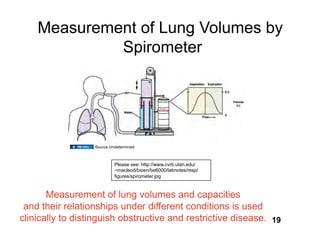
Measurement of Lung Volumes by
             Spirometer


                  Source Undetermined


                           Please see: http://www.cvrti.utah.edu/
                           ~macleod/bioen/be6000/labnotes/resp/
                           figures/spirometer.jpg


       Measurement of lung volumes and capacities
 and their relationships under different conditions is used
clinically to distinguish obstructive and restrictive disease. 19
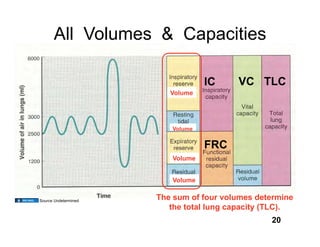
All Volumes & Capacities

                                  IC     VC TLC
                         Volume


                         Volume


                                  FRC
                         Volume


                         Volume


Source Undetermined
                      The sum of four volumes determine
                         the total lung capacity (TLC).
                                                 20
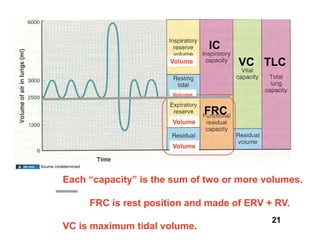
IC
                                      Volume          VC TLC

                                       Volume


                                                FRC
                                       Volume


                                       Volume


Source Undetermined


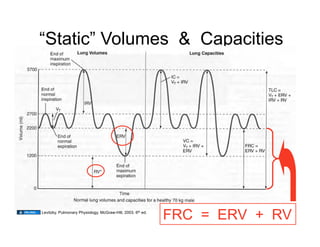
          Each “capacity” is the sum of two or more volumes.

                      FRC is rest position and made of ERV + RV.
                                                            21
          VC is maximum tidal volume.
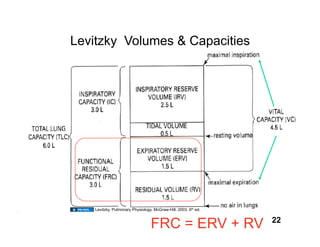
Levitzky Volumes & Capacities


    Levitzky. Pulmonary Physiology. McGraw-Hill, 2003. 6th ed.

                                                                 22
                                  FRC = ERV + RV
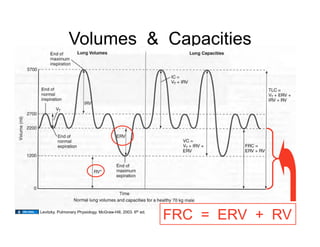
Volumes & Capacities


Levitzky. Pulmonary Physiology. McGraw-Hill, 2003. 6th ed.
                                                             FRC = ERV + RV
                                                                         23
FRC &             RV
  Neither functional residual capacity (FRC)
nor residual volume (RV) can be measured with
              simple spirometer.
          THREE CLINICAL OPTIONS

1) Gas (helium) dilution******* ( poor solubility )
                            ( no metabolism )
                             ( no diffusion )
        2) Nitrogen-Washout Technique
            3)Body plethysmography
                                                24
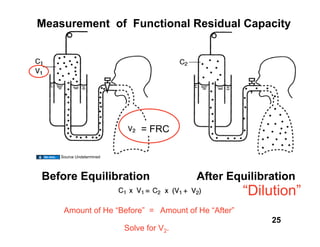
Measurement of Functional Residual Capacity


                              = FRC

    Source Undetermined


Before Equilibration                      After Equilibration
                                                    “Dilution”
     Amount of He “Before” = Amount of He “After”
                                                        25
                          Solve for V2.
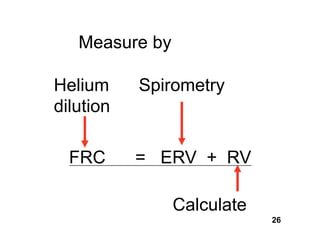
Measure by

Helium     Spirometry
dilution

  FRC      = ERV + RV

                Calculate
                            26
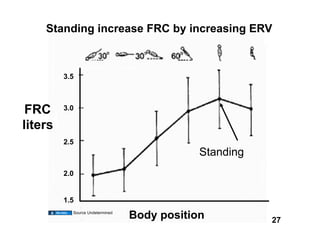
Standing increase FRC by increasing ERV


         3.5


 FRC     3.0

liters
         2.5
                                             Standing
         2.0


         1.5
           Source Undetermined
                                 Body position          27
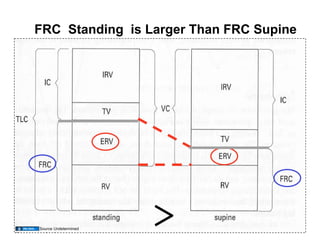
FRC Standing is Larger Than FRC Supine


                                  28
Source Undetermined
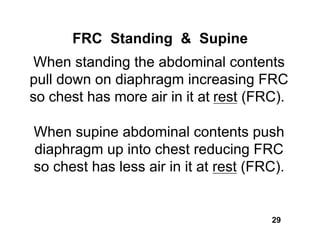
FRC Standing & Supine
 When standing the abdominal contents
pull down on diaphragm increasing FRC
so chest has more air in it at rest (FRC).

When supine abdominal contents push
diaphragm up into chest reducing FRC
so chest has less air in it at rest (FRC).


                                       29
“Static” Volumes & Capacities


Levitzky. Pulmonary Physiology. McGraw-Hill, 2003. 6th ed.
                                                             FRC = ERV + RV
                                                                         30
Airway Resistance 1 (Normal)
Forced expired volume in 1 sec (FEV1) as a
   faction of Forced Vital Capacity (FVC)


                     3.6
                         =
                                        FEV1
                     4.5                                       = 80%
                                        FVC

             Fig 2-21                                                        0.7 s
                                                                         Forced
                                                                        Expiratory
                                                                              31
  Levitzky. Pulmonary Physiology. McGraw-Hill, 2003. 6th ed.           Flow 25-75%
Airway Resistance 2 (Obstruction)
    More resistance so less and slower flow

x
                  3.0
x
                                            FEV1 = 50%
                                            FVC
x


                                                              2.7 s
                                                               Forced
                                                              Expiratory
Levitzky. Pulmonary Physiology. McGraw-Hill, 2003. 6th ed.   Flow 25-75%
                                                                       32
Airway Resistance 3
                    “Rolling Seal Spirometer”


                                                             33
Levitzky. Pulmonary Physiology. McGraw-Hill, 2003. 6th ed.
Additional Source Information
                                  for more information see: http://open.umich.edu/wiki/CitationPolicy

Slide 6: Levitzky. Pulmonary Physiology. McGraw-Hill, 2003. 6th ed.
Slide 7: Source Undetermined
Slide 8: Levitzky. Pulmonary Physiology. McGraw-Hill, 2003. 6th ed.
Slide 9: Levitzky. Pulmonary Physiology. McGraw-Hill, 2003. 6th ed.
Slide 10: Source Undetermined
Slide 11: Source Undetermined
Slide 12: Levitzky. Pulmonary Physiology. McGraw-Hill, 2003. 6th ed.
Slide 13: Source Undetermined
Slide 14: Source Undetermined
Slide 18: Source Undetermined
Slide 19: Source Undetermined, Please see: http://www.cvrti.utah.edu/~macleod/bioen/be6000/labnotes/resp/figures/spirometer.jpg
Slide 20: Source Undetermined
Slide 21: Source Undetermined
Slide 22: Levitzky. Pulmonary Physiology. McGraw-Hill, 2003. 6th ed.
Slide 23: Levitzky. Pulmonary Physiology. McGraw-Hill, 2003. 6th ed.
Slide 25: Source Undetermined
Slide 27: Source Undetermined
Slide 28: Source Undetermined
Slide 30: Levitzky. Pulmonary Physiology. McGraw-Hill, 2003. 6th ed.
Slide 31: Levitzky. Pulmonary Physiology. McGraw-Hill, 2003. 6th ed.
Slide 32: Levitzky. Pulmonary Physiology. McGraw-Hill, 2003. 6th ed.
Slide 33: Levitzky. Pulmonary Physiology. McGraw-Hill, 2003. 6th ed.

11.14.08: Respiratory Mechanics II

  • 1.
    Author(s): Louis D’Alecy,2009 License: Unless otherwise noted, this material is made available under the terms of the Creative Commons Attribution–Non-commercial–Share Alike 3.0 License: http://creativecommons.org/licenses/by-nc-sa/3.0/ We have reviewed this material in accordance with U.S. Copyright Law and have tried to maximize your ability to use, share, and adapt it. The citation key on the following slide provides information about how you may share and adapt this material. Copyright holders of content included in this material should contact open.michigan@umich.edu with any questions, corrections, or clarification regarding the use of content. For more information about how to cite these materials visit http://open.umich.edu/education/about/terms-of-use. Any medical information in this material is intended to inform and educate and is not a tool for self-diagnosis or a replacement for medical evaluation, advice, diagnosis or treatment by a healthcare professional. Please speak to your physician if you have questions about your medical condition. Viewer discretion is advised: Some medical content is graphic and may not be suitable for all viewers.
  • 2.
    Citation Key for more information see: http://open.umich.edu/wiki/CitationPolicy Use + Share + Adapt { Content the copyright holder, author, or law permits you to use, share and adapt. } Public Domain – Government: Works that are produced by the U.S. Government. (USC 17 § 105) Public Domain – Expired: Works that are no longer protected due to an expired copyright term. Public Domain – Self Dedicated: Works that a copyright holder has dedicated to the public domain. Creative Commons – Zero Waiver Creative Commons – Attribution License Creative Commons – Attribution Share Alike License Creative Commons – Attribution Noncommercial License Creative Commons – Attribution Noncommercial Share Alike License GNU – Free Documentation License Make Your Own Assessment { Content Open.Michigan believes can be used, shared, and adapted because it is ineligible for copyright. } Public Domain – Ineligible: Works that are ineligible for copyright protection in the U.S. (USC 17 § 102(b)) *laws in your jurisdiction may differ { Content Open.Michigan has used under a Fair Use determination. } Fair Use: Use of works that is determined to be Fair consistent with the U.S. Copyright Act. (USC 17 § 107) *laws in your jurisdiction may differ Our determination DOES NOT mean that all uses of this 3rd-party content are Fair Uses and we DO NOT guarantee that your use of the content is Fair. To use this content you should do your own independent analysis to determine whether or not your use will be Fair.
  • 3.
    Respiratory Mechanics II M1 – Cardiovascular/Respiratory Sequence Louis D’Alecy, Ph.D. Fall 2008 3
  • 4.
    Friday 11/14/08, 9:00 Mechanics of Ventilation II 30 slides, 50 minutes 1. Tidal Volume 2. Intraplural Pressure 3. Alveolar Distending Pressure 4. Lung Compliance 5. Airway Resistance 6. Lung volumes (Spirometer) 7. Functional Residual Capacity 8. Forced vital capacity 9. Measurement of airway resistance 4
  • 5.
    Tidal Volume (TV) -- air volume entering or leaving the respiratory system in a single breath. It adds to, and mixes with, alveolar gases. Contrast with : Minute ventilation that is total Ventilation per minute = TV X Rate 5
  • 6.
    Tidal Volume &Intraplural (Pip) Inspiration Expiration Air Air Entering Leaving Lung Lung Pip is -5 -7 -5 6 Levitzky. Pulmonary Physiology. McGraw-Hill, 2003. 6th ed.
  • 7.
    Mechanics of Breathing Tidal Volume Figure shows Spirometer opposite direction, “down”, but volume is same Esophagus balloon Flow meter Calculated PA 7 Source Undetermined
  • 8.
    Trans-pulmonary or alveolar-distending pressure . = PA - Pip -“across” lung wall - Pip always negative - not symmetrical - max @ end of Insp. 8 Levitzky. Pulmonary Physiology. McGraw-Hill, 2003. 6th ed.
  • 9.
    Transpulmonary Pressure by “pumping” into isolated lung (positive) Hysteresis Isolated Lung Compliance = (slope) V P “ease of stretching” or “inverse of elasticity” 9 Levitzky. Pulmonary Physiology. McGraw-Hill, 2003. 6th ed.
  • 10.
    Transpulmonary Pressure by“sucking” on outside of isolated lung (negative) Hysteresis = difference on inflation and deflation deflation inflation -Surfactant -Recruiting alveoli Source Undetermined Same with positive or negative pressure. 10
  • 11.
    Decreased Compliance Fibrosis or stiffer lung needs more pressure to get same volume. 11 Source Undetermined
  • 12.
    Abnormal Compliance V P Emphysema Greater volume change with smaller Levitzky. Pulmonary Physiology. McGraw-Hill, 2003. 6th ed. pressure change 12
  • 13.
    Static P /V Excised Isolated Lung Air filled harder to inflate than saline filled BUT… No air = no surface tension. Thus most inflation pressure is to overcome surface tension. 13 Source Undetermined
  • 14.
  • 15.
    Infant Respiratory DistressSyndrome • No functional pulmonary surfactant • Great difficulty inflating lungs • If inflated for them -- tend to collapse • Very low compliance (very stiff) • Strenuous effort needed to breathe • Die from complete exhaustion 15
  • 16.
    Work of breathing Work~ Pressure change X Volume change Elastic work overcomes: recoil of chest wall recoil of lung parenchyma surface tension of alveoli Resistive Work overcomes: Tissue resistance Airway resistance 16
  • 17.
    Airway Resistance The majordeterminant of airway resistance is the radius (r) of the airway, just as in blood vessels. The walls of the airways are subjected to the same changes in transmural pressures as alveolar walls. During inspiration as the intrapleural pressure decreases (becomes more negative), the transmural pressure across the airway walls will increase and the radius of the airway will increase resulting in a decrease in airway resistance during inspiration. 17
  • 18.
    During inspiration lung volume increases and airway resistance decreases. Airway -lateral traction Resistance -transpulmonary P or alveolar distending P Rest forced P r expiration inspiration ip Airway r increases -resistance decreases Pip Airway r decreases - resistance increases Lung Volume 18 Source Undetermined
  • 19.
    Measurement of LungVolumes by Spirometer Source Undetermined Please see: http://www.cvrti.utah.edu/ ~macleod/bioen/be6000/labnotes/resp/ figures/spirometer.jpg Measurement of lung volumes and capacities and their relationships under different conditions is used clinically to distinguish obstructive and restrictive disease. 19
  • 20.
    All Volumes &Capacities IC VC TLC Volume Volume FRC Volume Volume Source Undetermined The sum of four volumes determine the total lung capacity (TLC). 20
  • 21.
    IC Volume VC TLC Volume FRC Volume Volume Source Undetermined Each “capacity” is the sum of two or more volumes. FRC is rest position and made of ERV + RV. 21 VC is maximum tidal volume.
  • 22.
    Levitzky Volumes &Capacities Levitzky. Pulmonary Physiology. McGraw-Hill, 2003. 6th ed. 22 FRC = ERV + RV
  • 23.
    Volumes & Capacities Levitzky.Pulmonary Physiology. McGraw-Hill, 2003. 6th ed. FRC = ERV + RV 23
  • 24.
    FRC & RV Neither functional residual capacity (FRC) nor residual volume (RV) can be measured with simple spirometer. THREE CLINICAL OPTIONS 1) Gas (helium) dilution******* ( poor solubility ) ( no metabolism ) ( no diffusion ) 2) Nitrogen-Washout Technique 3)Body plethysmography 24
  • 25.
    Measurement of FunctionalResidual Capacity = FRC Source Undetermined Before Equilibration After Equilibration “Dilution” Amount of He “Before” = Amount of He “After” 25 Solve for V2.
  • 26.
    Measure by Helium Spirometry dilution FRC = ERV + RV Calculate 26
  • 27.
    Standing increase FRCby increasing ERV 3.5 FRC 3.0 liters 2.5 Standing 2.0 1.5 Source Undetermined Body position 27
  • 28.
    FRC Standing isLarger Than FRC Supine 28 Source Undetermined
  • 29.
    FRC Standing &Supine When standing the abdominal contents pull down on diaphragm increasing FRC so chest has more air in it at rest (FRC). When supine abdominal contents push diaphragm up into chest reducing FRC so chest has less air in it at rest (FRC). 29
  • 30.
    “Static” Volumes &Capacities Levitzky. Pulmonary Physiology. McGraw-Hill, 2003. 6th ed. FRC = ERV + RV 30
  • 31.
    Airway Resistance 1(Normal) Forced expired volume in 1 sec (FEV1) as a faction of Forced Vital Capacity (FVC) 3.6 = FEV1 4.5 = 80% FVC Fig 2-21 0.7 s Forced Expiratory 31 Levitzky. Pulmonary Physiology. McGraw-Hill, 2003. 6th ed. Flow 25-75%
  • 32.
    Airway Resistance 2(Obstruction) More resistance so less and slower flow x 3.0 x FEV1 = 50% FVC x 2.7 s Forced Expiratory Levitzky. Pulmonary Physiology. McGraw-Hill, 2003. 6th ed. Flow 25-75% 32
  • 33.
    Airway Resistance 3 “Rolling Seal Spirometer” 33 Levitzky. Pulmonary Physiology. McGraw-Hill, 2003. 6th ed.
  • 34.
    Additional Source Information for more information see: http://open.umich.edu/wiki/CitationPolicy Slide 6: Levitzky. Pulmonary Physiology. McGraw-Hill, 2003. 6th ed. Slide 7: Source Undetermined Slide 8: Levitzky. Pulmonary Physiology. McGraw-Hill, 2003. 6th ed. Slide 9: Levitzky. Pulmonary Physiology. McGraw-Hill, 2003. 6th ed. Slide 10: Source Undetermined Slide 11: Source Undetermined Slide 12: Levitzky. Pulmonary Physiology. McGraw-Hill, 2003. 6th ed. Slide 13: Source Undetermined Slide 14: Source Undetermined Slide 18: Source Undetermined Slide 19: Source Undetermined, Please see: http://www.cvrti.utah.edu/~macleod/bioen/be6000/labnotes/resp/figures/spirometer.jpg Slide 20: Source Undetermined Slide 21: Source Undetermined Slide 22: Levitzky. Pulmonary Physiology. McGraw-Hill, 2003. 6th ed. Slide 23: Levitzky. Pulmonary Physiology. McGraw-Hill, 2003. 6th ed. Slide 25: Source Undetermined Slide 27: Source Undetermined Slide 28: Source Undetermined Slide 30: Levitzky. Pulmonary Physiology. McGraw-Hill, 2003. 6th ed. Slide 31: Levitzky. Pulmonary Physiology. McGraw-Hill, 2003. 6th ed. Slide 32: Levitzky. Pulmonary Physiology. McGraw-Hill, 2003. 6th ed. Slide 33: Levitzky. Pulmonary Physiology. McGraw-Hill, 2003. 6th ed.