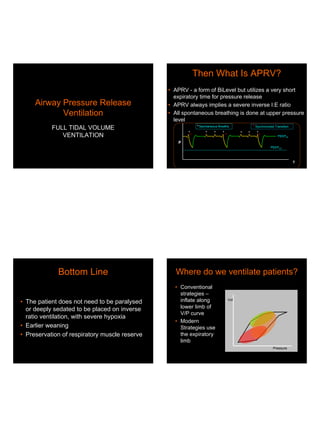
Then What Is APRV?
                                               • APRV - a form of BiLevel but utilizes a very short
                                                 expiratory time for pressure release
     Airway Pressure Release                   • APRV always implies a severe inverse I:E ratio
            Ventilation                        • All spontaneous breathing is done at upper pressure
                                                 level
                                                                                              † Synchronized Transition
           FULL TIDAL VOLUME                               * Spontaneous Breaths
                                                       *        *     *    *†         *   *     *
              VENTILATION                              †                                            †          PEEPHI

                                                   P
                                                                                                          PEEPLO


                                                                                                                          T


             Bottom Line                         Where do we ventilate patients?
                                                 • Conventional
                                                   strategies –
• The patient does not need to be paralysed        inflate along                Vol

  or deeply sedated to be placed on inverse        lower limb of
                                                   V/P curve
  ratio ventilation, with severe hypoxia
                                                 • Modern
• Earlier weaning                                  Strategies use
• Preservation of respiratory muscle reserve       the expiratory
                                                   limb
                                                                                                            Pressure
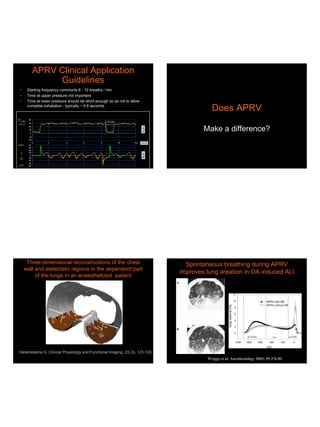
APRV Clinical Application
                    Guidelines
 •      Starting frequency commonly 6 - 10 breaths / min
 •      Time at upper pressure not important
 •      Time at lower pressure should be short enough so as not to allow
        complete exhalation - typically ~ 0.8 seconds
                                                                                         Does APRV
PCIRC    40
                                                      0.8 sec
         30
cmH2O
         20
         10
          0
                                                                                      Make a difference?
          10
         -20
               0    2         4         6         8             10   12s
INSP     80
         60
         40
 .       20
 V
          0
  L      20
 min
         40
         60
EXP     -80


        Three-dimensional reconstructions of the chest                          Spontaneous breathing during APRV
       wall and atelectatic regions in the dependent part
                                                                              improves lung areation in OA induced ALI
            of the lungs in an anaesthetized patient


Hedenstierna G. Clinical Physiology and Functional Imaging 23 (3), 123-129.
                                                                                       Wrigge et al. Anesthesiology 2003; 99:376-84
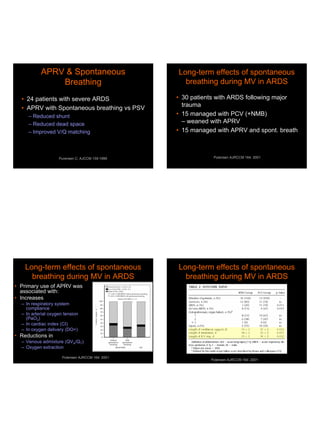
APRV & Spontaneous                     Long-term effects of spontaneous
               Breathing                            breathing during MV in ARDS

  • 24 patients with severe ARDS                  • 30 patients with ARDS following major
                                                    trauma
  • APRV with Spontaneous breathing vs PSV
     – Reduced shunt                              • 15 managed with PCV (+NMB)
     – Reduced dead space                           – weaned with APRV
     – Improved V/Q matching                      • 15 managed with APRV and spont. breath


                    Purensen C, AJCCM 159:1999                Putensen AJRCCM 164: 2001


    Long-term effects of spontaneous              Long-term effects of spontaneous
      breathing during MV in ARDS                   breathing during MV in ARDS
• Primary use of APRV was
  associated with:
• Increases
  – In respiratory system
    compliance
  – In arterial oxygen tension
    (PaO2)
  – In cardiac index (CI)
  – In oxygen delivery (DO=)
• Reductions in
  – Venous admixture (QVA/QT)
  – Oxygen extraction

                      Putensen AJRCCM 164: 2001
                                                             Putensen AJRCCM 164: 2001

APRV aka BiLevel

  • 1.
    Then What IsAPRV? • APRV - a form of BiLevel but utilizes a very short expiratory time for pressure release Airway Pressure Release • APRV always implies a severe inverse I:E ratio Ventilation • All spontaneous breathing is done at upper pressure level † Synchronized Transition FULL TIDAL VOLUME * Spontaneous Breaths * * * *† * * * VENTILATION † † PEEPHI P PEEPLO T Bottom Line Where do we ventilate patients? • Conventional strategies – • The patient does not need to be paralysed inflate along Vol or deeply sedated to be placed on inverse lower limb of V/P curve ratio ventilation, with severe hypoxia • Modern • Earlier weaning Strategies use • Preservation of respiratory muscle reserve the expiratory limb Pressure
  • 2.
    APRV Clinical Application Guidelines • Starting frequency commonly 6 - 10 breaths / min • Time at upper pressure not important • Time at lower pressure should be short enough so as not to allow complete exhalation - typically ~ 0.8 seconds Does APRV PCIRC 40 0.8 sec 30 cmH2O 20 10 0 Make a difference? 10 -20 0 2 4 6 8 10 12s INSP 80 60 40 . 20 V 0 L 20 min 40 60 EXP -80 Three-dimensional reconstructions of the chest Spontaneous breathing during APRV wall and atelectatic regions in the dependent part improves lung areation in OA induced ALI of the lungs in an anaesthetized patient Hedenstierna G. Clinical Physiology and Functional Imaging 23 (3), 123-129. Wrigge et al. Anesthesiology 2003; 99:376-84
  • 3.
    APRV & Spontaneous Long-term effects of spontaneous Breathing breathing during MV in ARDS • 24 patients with severe ARDS • 30 patients with ARDS following major trauma • APRV with Spontaneous breathing vs PSV – Reduced shunt • 15 managed with PCV (+NMB) – Reduced dead space – weaned with APRV – Improved V/Q matching • 15 managed with APRV and spont. breath Purensen C, AJCCM 159:1999 Putensen AJRCCM 164: 2001 Long-term effects of spontaneous Long-term effects of spontaneous breathing during MV in ARDS breathing during MV in ARDS • Primary use of APRV was associated with: • Increases – In respiratory system compliance – In arterial oxygen tension (PaO2) – In cardiac index (CI) – In oxygen delivery (DO=) • Reductions in – Venous admixture (QVA/QT) – Oxygen extraction Putensen AJRCCM 164: 2001 Putensen AJRCCM 164: 2001