Respiratory Anatomy and Physiology
     Global Overview / Review
             Compiled and Presented by
              Marc Imhotep Cray, M.D.
           Basic Medical Sciences Professor


                                          Pulmonary Pathology


                                         IVMS Respiratory Pathology and
                                     Pathophysiology and Clinical Presentation
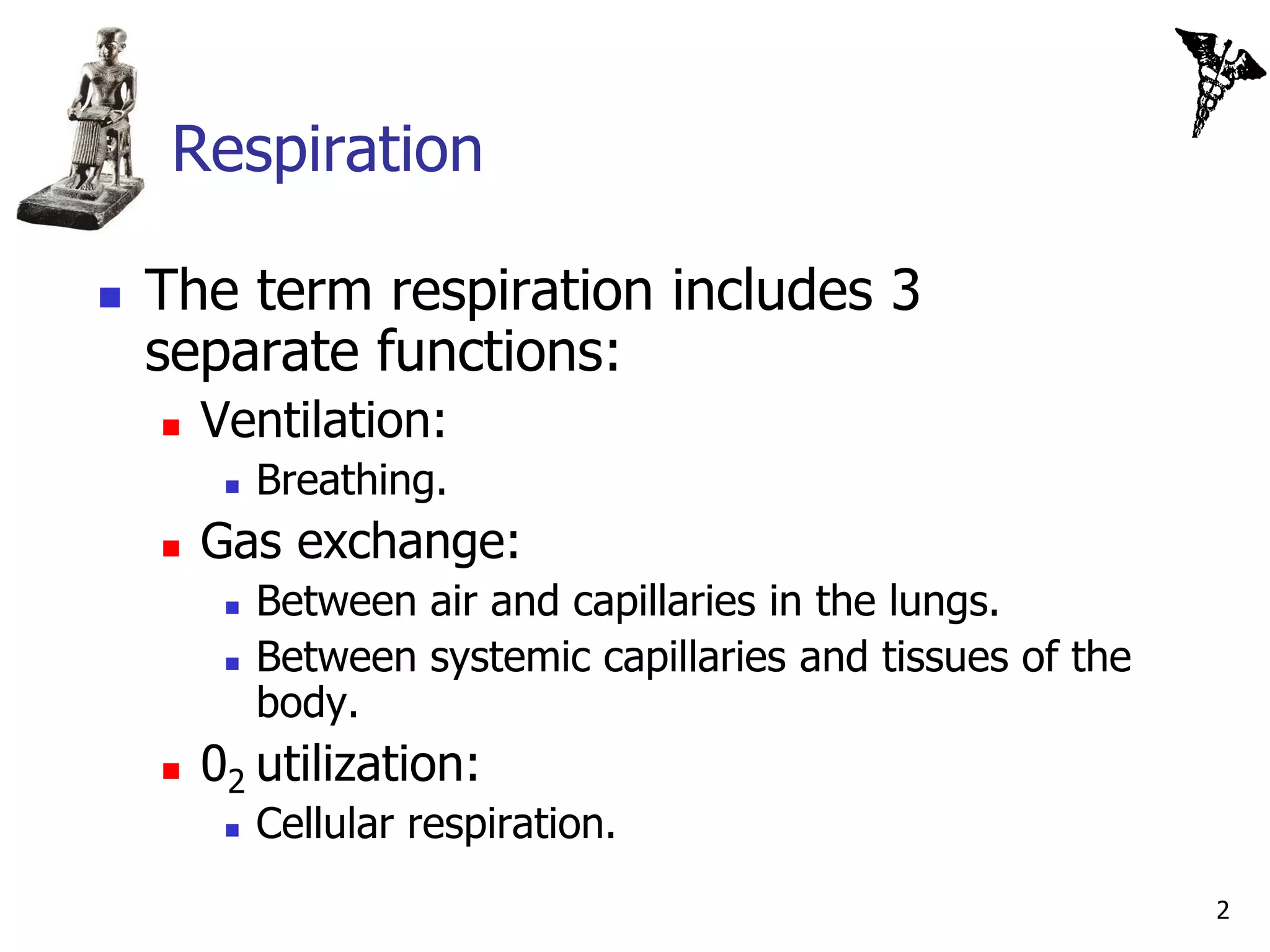
Respiration

   The term respiration includes 3
    separate functions:
       Ventilation:
            Breathing.
       Gas exchange:
            Between air and capillaries in the lungs.
            Between systemic capillaries and tissues of the
             body.
       02 utilization:
            Cellular respiration.
                                                               2
Ventilation
   Mechanical process that moves
    air in and out of the lungs.
   [O2] of air is higher in the lungs    Insert 16.1
    than in the blood, O2 diffuses
    from air to the blood.
   C02 moves from the blood to
    the air by diffusing down its
    concentration gradient.
   Gas exchange occurs entirely
    by diffusion:
        Diffusion is rapid because of
         the large surface area and the
         small diffusion distance.


                                                        3
Alveoli
   Polyhedral in shape and clustered like
    units of honeycomb.
   ~ 300 million air sacs (alveoli).
        Large surface area (60–80 m2).
        Each alveolus is 1 cell layer thick.
             Total air barrier is 2 cells across (2 mm).
   2 types of cells:
        Alveolar type I:
             Structural cells.
        Alveolar type II:
             Secrete surfactant.                           4
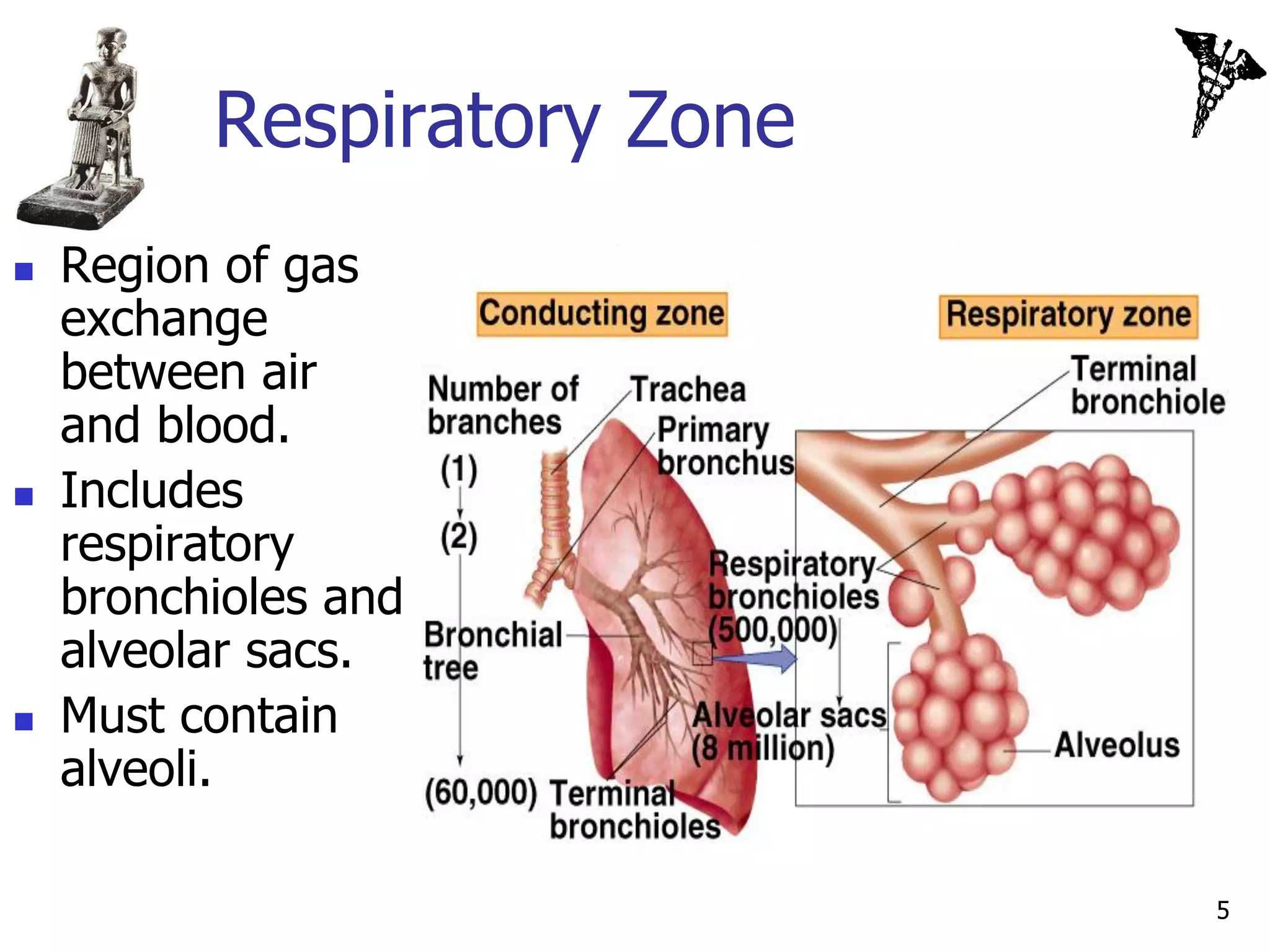
Respiratory Zone
   Region of gas
    exchange
    between air
    and blood.
   Includes
    respiratory
    bronchioles and
    alveolar sacs.
   Must contain
    alveoli.

                             5
Conducting Zone

   All the structures air
    passes through before           Insert fig. 16.5
    reaching the
    respiratory zone.
   Warms and humidifies
    inspired air.
   Filters and cleans:
       Mucus secreted to trap
        particles in the inspired
        air.
       Mucus moved by cilia to
        be expectorated.


                                                       6
Thoracic Cavity

   Diaphragm:
       Sheets of striated muscle divides anterior body
        cavity into 2 parts.
   Above diaphragm: thoracic cavity:
       Contains heart, large blood vessels, trachea,
        esophagus, thymus, and lungs.
   Below diaphragm: abdominopelvic cavity:
       Contains liver, pancreas, GI tract, spleen, and
        genitourinary tract.
   Intrapleural space:
       Space between visceral and parietal pleurae.

                                                          7
Intrapulmonary and Intrapleural
        Pressures
   Visceral and parietal pleurae are flush against each
    other.
       The intrapleural space contains only a film of fluid secreted
        by the membranes.
   Lungs normally remain in contact with the chest
    walls.
   Lungs expand and contract along with the thoracic
    cavity.
   Intrapulmonary pressure:
       Intra-alveolar pressure (pressure in the alveoli).
   Intrapleural pressure:
       Pressure in the intrapleural space.
       Pressure is negative, due to lack of air in the intrapleural
        space.                                                          8
Transpulmonary Pressure

   Pressure difference across the wall of
    the lung.
   Intrapulmonary pressure – intrapleural
    pressure.
       Keeps the lungs against the chest wall.


                                                  9
Intrapulmonary and Intrapleural
    Pressures     (continued)


   During inspiration:
       Atmospheric pressure is > intrapulmonary
        pressure (-3 mm Hg).
   During expiration:
       Intrapulmonary pressure (+3 mm Hg) is >
        atmospheric pressure.


                                                   10
Boyle’s Law
   Changes in intrapulmonary pressure occur as
    a result of changes in lung volume.
       Pressure of gas is inversely proportional to its
        volume.
   Increase in lung volume decreases
    intrapulmonary pressure.
       Air goes in.
   Decrease in lung volume, raises
    intrapulmonary pressure above atmosphere.
       Air goes out.

                                                           11
Physical Properties of the Lungs

   Ventilation occurs as a result of
    pressure differences induced by
    changes in lung volume.
   Physical properties that affect lung
    function:
       Compliance.
       Elasticity.
       Surface tension.

                                           12
Compliance
   Distensibility (stretchability):
       Ease with which the lungs can expand.
   Change in lung volume per change in
    transpulmonary pressure.
            DV/DP
   100 x more distensible than a balloon.
       Compliance is reduced by factors that
        produce resistance to distension.


                                                13
Elasticity

   Tendency to return to initial size after
    distension.
   High content of elastin proteins.
       Very elastic and resist distension.
            Recoil ability.
   Elastic tension increases during
    inspiration and is reduced by recoil
    during expiration.

                                               14
Surface Tension
   Force exerted by fluid in alveoli to resist
    distension.
            Lungs secrete and absorb fluid, leaving a very thin film of
             fluid.
       This film of fluid causes surface tension.
       Fluid absorption is driven (osmosis) by Na+ active
        transport.
       Fluid secretion is driven by the active transport of
        Cl- out of the alveolar epithelial cells.
   H20 molecules at the surface are attracted to
    other H20 molecules by attractive forces.
       Force is directed inward, raising pressure in
        alveoli.

                                                                      15
Surface Tension            (continued)


   Law of Laplace:
       Pressure in alveoli is                      Insert fig. 16.11
        directly proportional to
        surface tension; and
        inversely proportional to
        radius of alveoli.
       Pressure in smaller
        alveolus would be greater
        than in larger alveolus, if
        surface tension were the
        same in both.

                                                                        16
Surfactant
   Phospholipid produced
    by alveolar type II cells.      Insert fig. 16.12
   Lowers surface tension.
       Reduces attractive forces
        of hydrogen bonding by
        becoming interspersed
        between H20 molecules.
            Surface tension in
             alveoli is reduced.
   As alveoli radius
    decreases, surfactant’s
    ability to lower surface
    tension increases.
   Disorders:
       RDS.
                                                        17
       ARDS.
Quiet Inspiration

   Active process:
       Contraction of diaphragm, increases thoracic
        volume vertically.
   Parasternal and external intercostals contract,
    raising the ribs; increasing thoracic volume
    laterally.
   Pressure changes:
       Alveolar changes from 0 to –3 mm Hg.
       Intrapleural changes from –4 to –6 mm Hg.
       Transpulmonary pressure = +3 mm Hg.
                                                       18
Expiration

   Quiet expiration is a passive process.
       After being stretched by contractions of the diaphragm
        and thoracic muscles; the diaphragm, thoracic muscles,
        thorax, and lungs recoil.
       Decrease in lung volume raises the pressure within alveoli
        above atmosphere, and pushes air out.
   Pressure changes:
       Intrapulmonary pressure changes from –3 to +3 mm Hg.
       Intrapleural pressure changes from –6 to –3 mm Hg.
       Transpulmonary pressure = +6 mm Hg.

                                                                19
Pulmonary Ventilation


   Insert fig. 16.15


                        20
Pulmonary Function Tests
   Assessed by spirometry.
   Subject breathes into a closed system in which air is
    trapped within a bell floating in H20.
   The bell moves up when the subject exhales and
    down when the subject inhales.


            Insert fig. 16.16


                                                            21
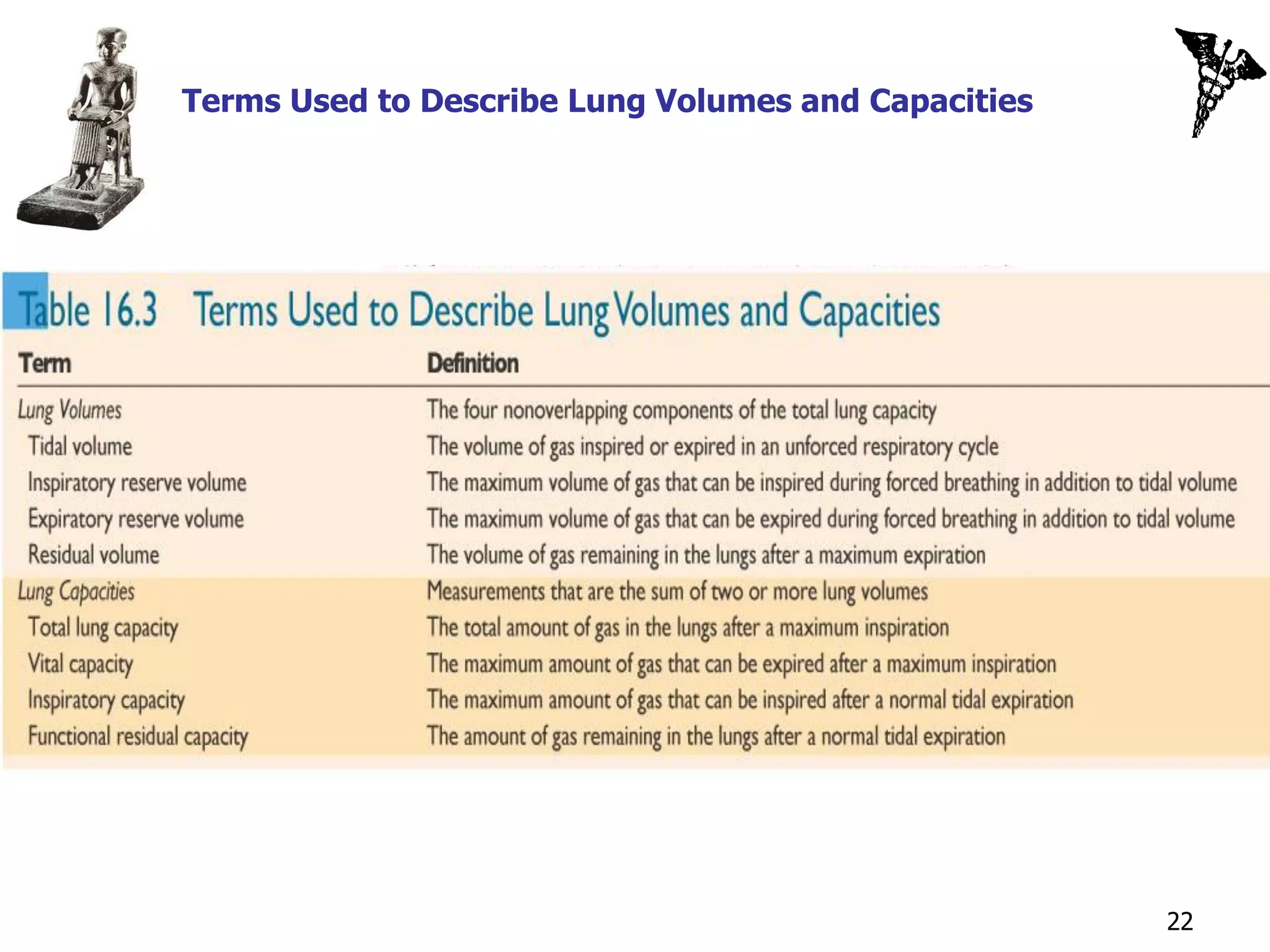
Terms Used to Describe Lung Volumes and Capacities


                                                     22
Anatomical Dead Space
   Not all of the inspired air reached the
    alveoli.
   As fresh air is inhaled it is mixed with air in
    anatomical dead space.
       Conducting zone and alveoli where [02] is lower
        than normal and [C02] is higher than normal.
   Alveolar ventilation = F x (TV- DS).
       F = frequency (breaths/min.).
       TV = tidal volume.
       DS = dead space.
                                                      23
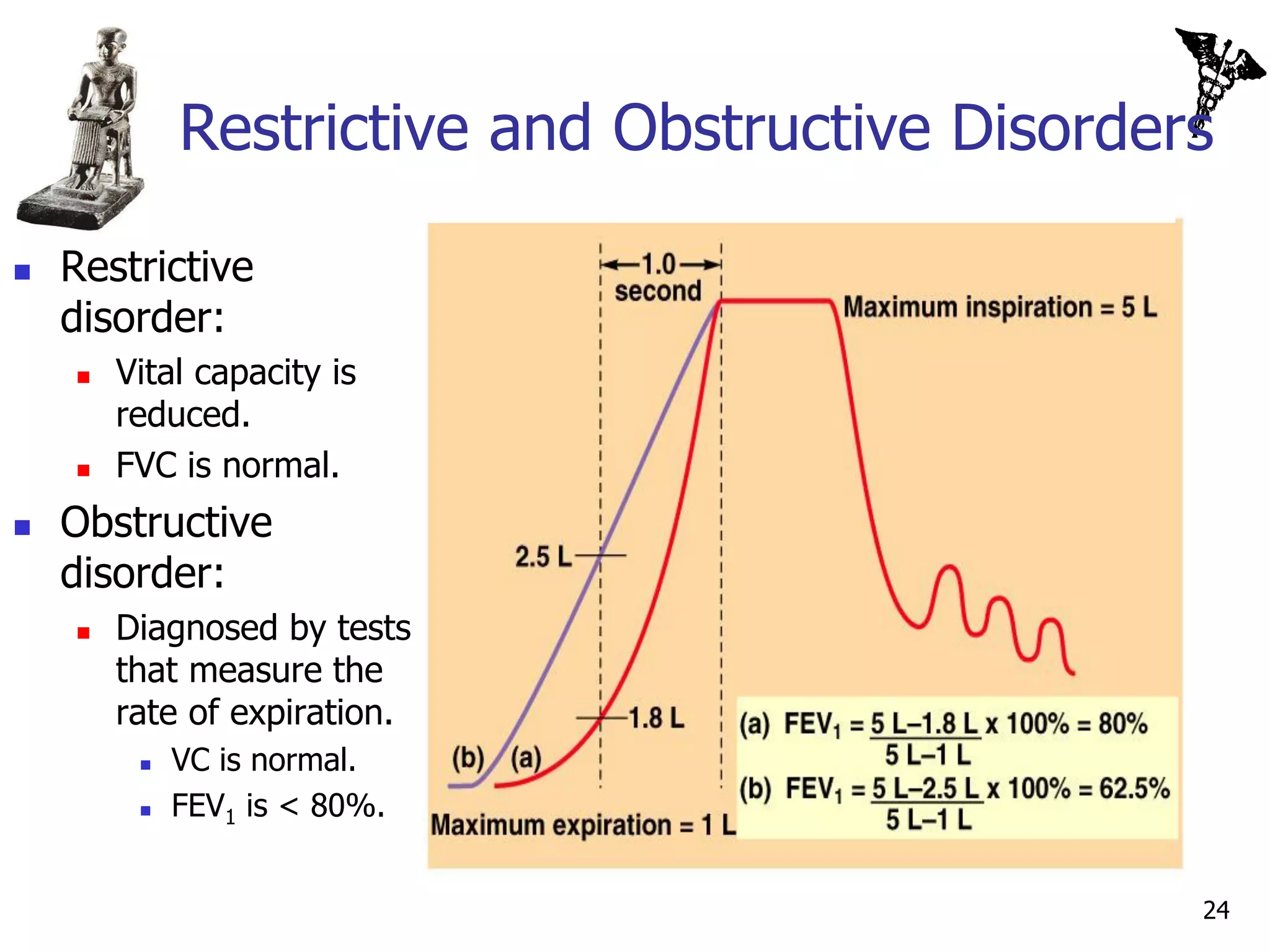
Restrictive and Obstructive Disorders

   Restrictive
    disorder:
       Vital capacity is
        reduced.               Insert fig. 16.17

       FVC is normal.
   Obstructive
    disorder:
       Diagnosed by tests
        that measure the
        rate of expiration.
            VC is normal.
            FEV1 is < 80%.


                                                   24
Pulmonary Disorders

   Dyspnea:
       Shortness of breath.
   COPD (chronic obstructive pulmonary
    disease):
       Asthma:
            Obstructive air flow through bronchioles.
                 Caused by inflammation and mucus secretion.
                     Inflammation contributes to increased airway

                      responsiveness to agents that promote bronchial
                      constriction.
                     IgE, exercise.
                                                                        25
Pulmonary Disorders                          (continued)


       Emphysema:
            Alveolar tissue is destroyed.
            Chronic progressive condition that reduces surface area for
             gas exchange.
                  Decreases ability of bronchioles to remain open during
                   expiration.
                      Cigarette smoking stimulates macrophages and

                        leukocytes to secrete protein digesting enzymes that
                        destroy tissue.

   Pulmonary fibrosis:
       Normal structure of lungs disrupted by accumulation
        of fibrous connective tissue proteins.
            Anthracosis.
                                                                               26
Gas Exchange in the Lungs
   Dalton’s Law:
       Total pressure of a gas mixture is = to the sum
        of the pressures that each gas in the mixture
        would exert independently.
   Partial pressure:
       The pressure that an particular gas exerts
        independently.
   PATM = PN2 + P02 + PC02 + PH20= 760 mm Hg.
       02 is humidified = 105 mm Hg.
            H20 contributes to partial pressure (47 mm Hg).
                    P02 (sea level) = 150 mm Hg.
       PC0 = 40 mm Hg.
             2


                                                               27
Partial Pressures of Gases in Inspired
Air and Alveolar Air

           Insert fig. 16.20


                                         28
Partial Pressures of Gases in Blood
   When a liquid or gas (blood and alveolar air)
    are at equilibrium:
       The amount of gas dissolved in fluid reaches a
        maximum value (Henry’s Law).
   Depends upon:
       Solubility of gas in the fluid.
       Temperature of the fluid.
       Partial pressure of the gas.
   [Gas] dissolved in a fluid depends directly on
    its partial pressure in the gas mixture.

                                                         29
Significance of Blood P0 and PC0
                                     2     2


         Measurements

   At normal
    P0 arterial
     2

    blood is
    about 100
    mm Hg.
   P0 level in
     2

    the systemic
    veins is
    about 40
    mm Hg.
 P is 46 mm Hg in the systemic veins.
 C02

Provides a good index of lung function.
                                               30
Pulmonary Circulation
   Rate of blood flow through the pulmonary
    circulation is = flow rate through the systemic
    circulation.
       Driving pressure is about 10 mm Hg.
   Pulmonary vascular resistance is low.
       Low pressure pathway produces less net filtration
        than produced in the systemic capillaries.
            Avoids pulmonary edema.
   Autoregulation:
       Pulmonary arterioles constrict when alveolar P0   2

        decreases.
       Matches ventilation/perfusion ratio.
                                                              31
Pulmonary Circulation               (continued)


   In a fetus:
       Pulmonary circulation has a higher vascular
        resistance, because the lungs are partially
        collapsed.
   After birth, vascular resistance decreases:
       Opening the vessels as a result of subatmospheric
        intrapulmonary pressure.
       Physical stretching of the lungs.
       Dilation of pulmonary arterioles in response to
        increased alveolar P0 .
                            2


                                                            32
Lung Ventilation/Perfusion Ratios


   Functionally:             Insert fig. 16.24
       Alveoli at
        apex are
        underperfused
        (overventilated).
       Alveoli at the base
        are underventilated
        (overperfused).


                                                  33
Disorders Caused by High Partial
        Pressures of Gases
   Nitrogen narcosis:
       At sea level nitrogen is physiologically inert.
       Under hyperbaric conditions:
            Nitrogen dissolves slowly.
                  Can have deleterious effects.
                      Resembles alcohol intoxication.


   Decompression sickness:
       Amount of nitrogen dissolved in blood as a diver
        ascends decreases due to a decrease in PN .               2


            If occurs rapidly, bubbles of nitrogen gas can form in
             tissues and enter the blood.
                  Block small blood vessels producing the “bends.”

                                                                      34
Brain Stem Respiratory Centers

   Neurons in the
    reticular formation of
    the medulla                   Insert fig. 16.25
    oblongata form the
    rhythmicity center:
       Controls automatic
        breathing.
       Consists of interacting
        neurons that fire
        either during
        inspiration (I neurons)
        or expiration
        (E neurons).
                                                      35
Brain Stem Respiratory Centers        (continued)


   I neurons project to, and stimulate
    spinal motor neurons that innervate
    respiratory muscles.
   Expiration is a passive process that
    occurs when the I neurons are
    inhibited.
   Activity varies in a reciprocal way.


                                                    36
Rhythmicity Center
   I neurons located primarily in dorsal respiratory
    group (DRG):
        Regulate activity of phrenic nerve.
             Project to and stimulate spinal interneurons that
              innervate respiratory muscles.
   E neurons located in ventral respiratory group
    (VRG):
        Passive process.
             Controls motor neurons to the internal intercostal
              muscles.
   Activity of E neurons inhibit I neurons.
        Rhythmicity of I and E neurons may be due to
         pacemaker neurons.
                                                                   37
Pons Respiratory Centers
   Activities of medullary rhythmicity center
    is influenced by pons.
   Apneustic center:
       Promotes inspiration by stimulating the I
        neurons in the medulla.
   Pneumotaxic center:
       Antagonizes the apneustic center.
       Inhibits inspiration.

                                                    38
Chemoreceptors
   2 groups of chemo-
    receptors that monitor
    changes in blood PC0 ,                2

                                              Insert fig. 16.27
    P0 , and pH.
        2


   Central:
           Medulla.
   Peripheral:
           Carotid and aortic
            bodies.
                Control breathing
                 indirectly via sensory
                 nerve fibers to the
                 medulla (X, IX).
                                                                  39
Effects of Blood PC0 and pH on
                                2


    Ventilation
   Chemoreceptor input modifies the rate and
    depth of breathing.
        Oxygen content of blood decreases more slowly
         because of the large “reservoir” of oxygen
         attached to hemoglobin.
        Chemoreceptors are more sensitive to changes in
         PC0 .
           2


   H20 + C02           H2C03        H+ + HC03-
   Rate and depth of ventilation adjusted to
    maintain arterial PC0 of 40 mm Hg.
                            2


                                                           40
Chemoreceptor Control
   Central chemoreceptors:
       More sensitive to changes in arterial PC0 .        2


   H20 + C02         H2C03         H+
   H+ cannot cross the blood brain barrier.
   C02 can cross the blood brain barrier and
    will form H2C03.
       Lowers pH of CSF.
            Directly stimulates central chemoreceptors.

                                                               41
Chemoreceptor Control             (continued)


   Peripheral chemoreceptors:
       Are not stimulated directly by changes in
        arterial PC0 .
                  2


   H20 + C02          H2C03         H+
   Stimulated by rise in [H+] of arterial
    blood.
       Increased [H+] stimulates peripheral
        chemoreceptors.
                                                    42
Chemoreceptor Control of Breathing


       Insert fig. 16.29


                                     43
Effects of Blood P0 on Ventilation
                                   2


   Blood P0 affected by breathing indirectly.
               2


       Influences chemoreceptor sensitivity to changes in
        PC0 .
           2


   Hypoxic drive:
       Emphysema blunts the chemoreceptor response to
        PC0 .
           2


       Choroid plexus secrete more HC03- into CSF, buffering
        the fall in CSF pH.
       Abnormally high PC0 enhances sensitivity of carotid
                             2


        bodies to fall in P0 .
                         2


                                                                44
Effects of Pulmonary Receptors on
         Ventilation
   Lungs contain receptors that influence the brain
    stem respiratory control centers via sensory fibers
    in vagus.
       Unmyelinated C fibers can be stimulated by:
            Capsaicin:
                  Produces apnea followed by rapid, shallow breathing.
            Histamine and bradykinin:
                  Released in response to noxious agents.
       Irritant receptors are rapidly adaptive receptors.
   Hering-Breuer reflex:
       Pulmonary stretch receptors activated during inspiration.
            Inhibits respiratory centers to prevent undue tension on lungs.
                                                                               45
Hemoglobin and 02 Transport

   280 million
    hemoglobin/RBC.     Insert fig. 16.32
   Each hemoglobin
    has 4 polypeptide
    chains and 4
    hemes.
   In the center of
    each heme group
    is 1 atom of iron
    that can combine
    with 1 molecule
    02.
                                            46
Hemoglobin
   Oxyhemoglobin:
       Normal heme contains iron in the reduced form
        (Fe2+).
       Fe2+ shares electrons and bonds with oxygen.
   Deoxyhemoglobin:
       When oxyhemoglobin dissociates to release
        oxygen, the heme iron is still in the reduced form.
       Hemoglobin does not lose an electron when it
        combines with 02.


                                                              47
Hemoglobin                 (continued)


   Methemoglobin:
       Has iron in the oxidized form (Fe3+).
            Lacks electrons and cannot bind with 02.
                 Blood normally contains a small amount.
   Carboxyhemoglobin:
       The reduced heme is combined with
        carbon monoxide.
       The bond with carbon monoxide is 210
        times stronger than the bond with oxygen.
            Transport of 02 to tissues is impaired.

                                                            48
Hemoglobin                  (continued)


   Oxygen-carrying capacity of blood determined by
    its [hemoglobin].
       Anemia:
                [Hemoglobin] below normal.
       Polycythemia:
                [Hemoglobin] above normal.
       Hemoglobin production controlled by erythropoietin.
                Production stimulated by PC0 delivery to kidneys.
                                                  2


   Loading/unloading depends:
      P0 of environment.
             2


      Affinity between hemoglobin and 02.

                                                                     49
Oxyhemoglobin Dissociation Curve
   Graphic illustration of the % oxyhemoglobin
    saturation at different values of P0 .            2


       Loading and unloading of 02.
            Steep portion of the sigmoidal curve, small changes in P0
                                                                     2


             produce large differences in % saturation (unload more 02).
   Decreased pH, increased temperature, and
    increased 2,3 DPG:
       Affinity of hemoglobin for 02 decreases.
            Greater unloading of 02:
                  Shift to the curve to the right.


                                                                           50
Oxyhemoglobin Dissociation Curve


      Insert fig.16.34


                                   51
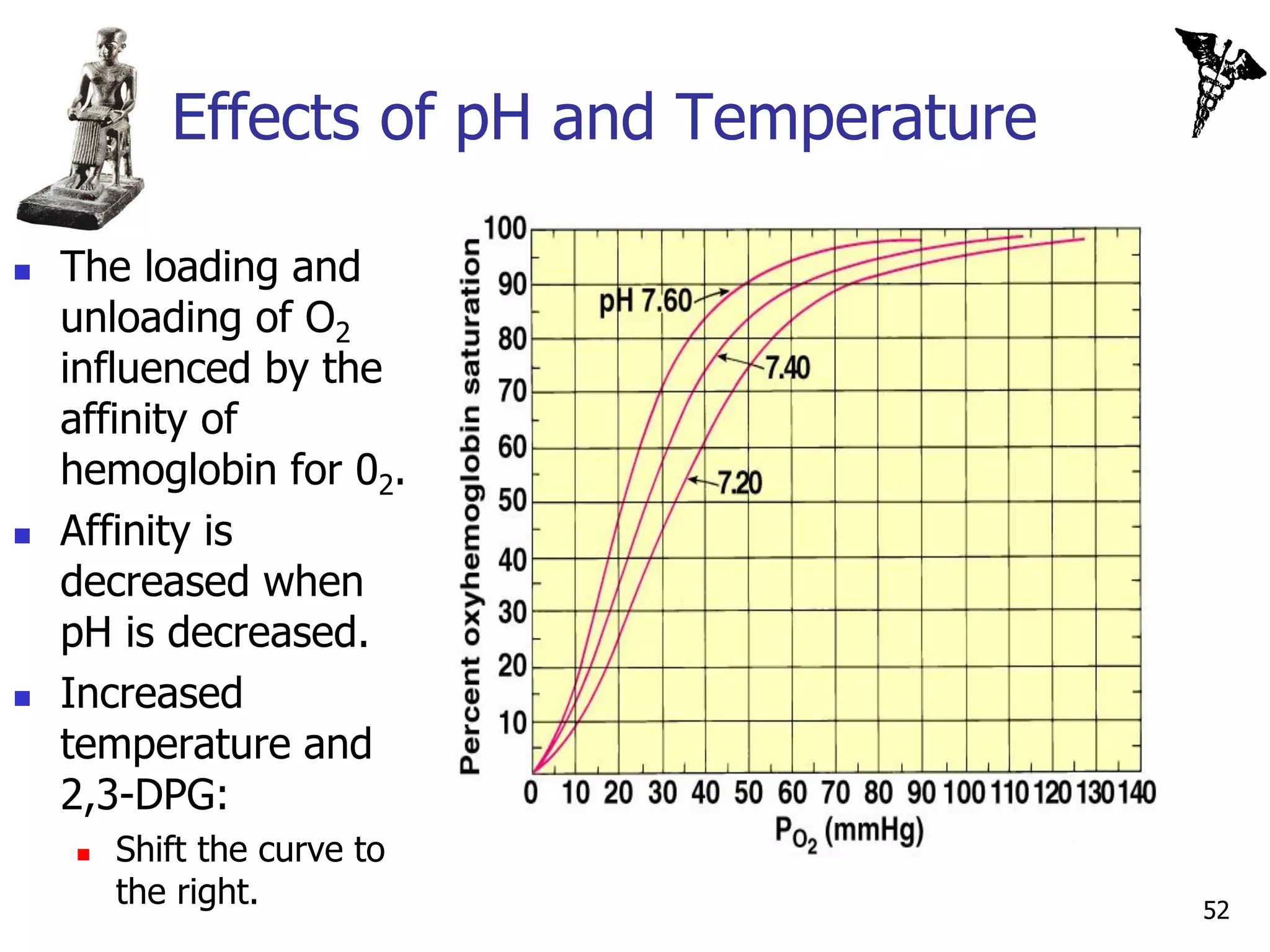
Effects of pH and Temperature

   The loading and
    unloading of O2
    influenced by the          Insert fig. 16.35
    affinity of
    hemoglobin for 02.
   Affinity is
    decreased when
    pH is decreased.
   Increased
    temperature and
    2,3-DPG:
       Shift the curve to
        the right.                                 52
Effect of 2,3 DPG on 02 Transport
   Anemia:
       RBCs total blood [hemoglobin] falls, each
        RBC produces greater amount of 2,3 DPG.
            Since RBCs lack both nuclei and mitochondria,
             produce ATP through anaerobic metabolism.
   Fetal hemoglobin (hemoglobin f):
       Has 2 g-chains in place of the b-chains.
            Hemoglobin f cannot bind to 2,3 DPG.
                 Has a higher affinity for 02.


                                                             53
Inherited Defects in Hemoglobin
    Structure and Function
   Sickle-cell anemia:
       Hemoglobin S differs in that valine is substituted
        for glutamic acid on position 6 of the b chains.
            Cross links form a “paracrystalline gel” within the RBCs.
                  Makes the RBCs less flexible and more fragile.

   Thalassemia:
       Decreased synthesis of a or b chains, increased
        synthesis of g chains.


                                                                         54
Muscle Myoglobin
       Red pigment found
        exclusively in striated
        muscle.                                   Insert fig. 13.37
           Slow-twitch skeletal
            fibers and cardiac
            muscle cells are rich in
            myoglobin.
                Have a higher affinity
                 for 02 than hemoglobin.
           May act as a “go-
            between” in the transfer
            of 02 from blood to the
            mitochondria within
            muscle cells.
       May also have an 02 storage function in
        cardiac muscles.
                                                                      55
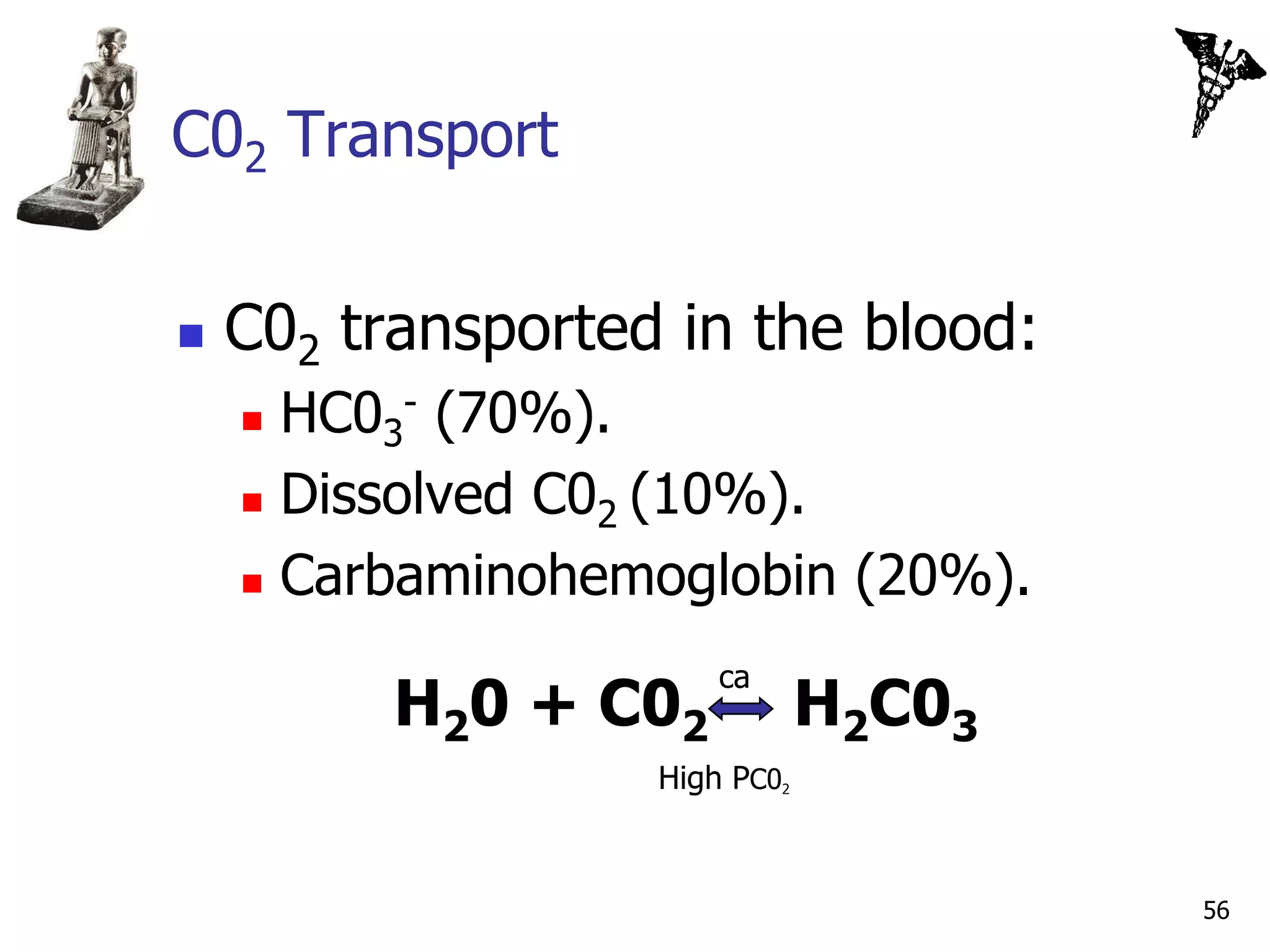
C02 Transport


   C02 transported in the blood:
     HC03- (70%).
     Dissolved C02 (10%).

     Carbaminohemoglobin (20%).


                       ca
          H20 + C02            H2C03
                   High PC02


                                       56
Chloride Shift at Systemic Capillaries
   H20 + C02       H2C03       H+ + HC03-
   At the tissues, C02 diffuses into the RBC; shifts
    the reaction to the right.
       Increased [HC03-] produced in RBC:
            HC03- diffuses into the blood.
       RBC becomes more +.
            Cl- attracted in (Cl- shift).
       H+ released buffered by combining with
        deoxyhemoglobin.
   HbC02 formed.
       Unloading of 02.
                                                   57
Carbon Dioxide Transport and
Chloride Shift


     Insert fig. 16.38


                               58
At Pulmonary Capillaries

   H20 + C02        H2C03        H+ + HC03-
   At the alveoli, C02 diffuses into the alveoli;
    reaction shifts to the left.
   Decreased [HC03-] in RBC, HC03- diffuses into
    the RBC.
       RBC becomes more -.
            Cl- diffuses out (reverse Cl- shift).
   Deoxyhemoglobin converted to
    oxyhemoglobin.
       Has weak affinity for H+.
   Gives off HbC02.
                                                     59
Reverse Chloride Shift in Lungs


         Insert fig. 16.39


                                  60
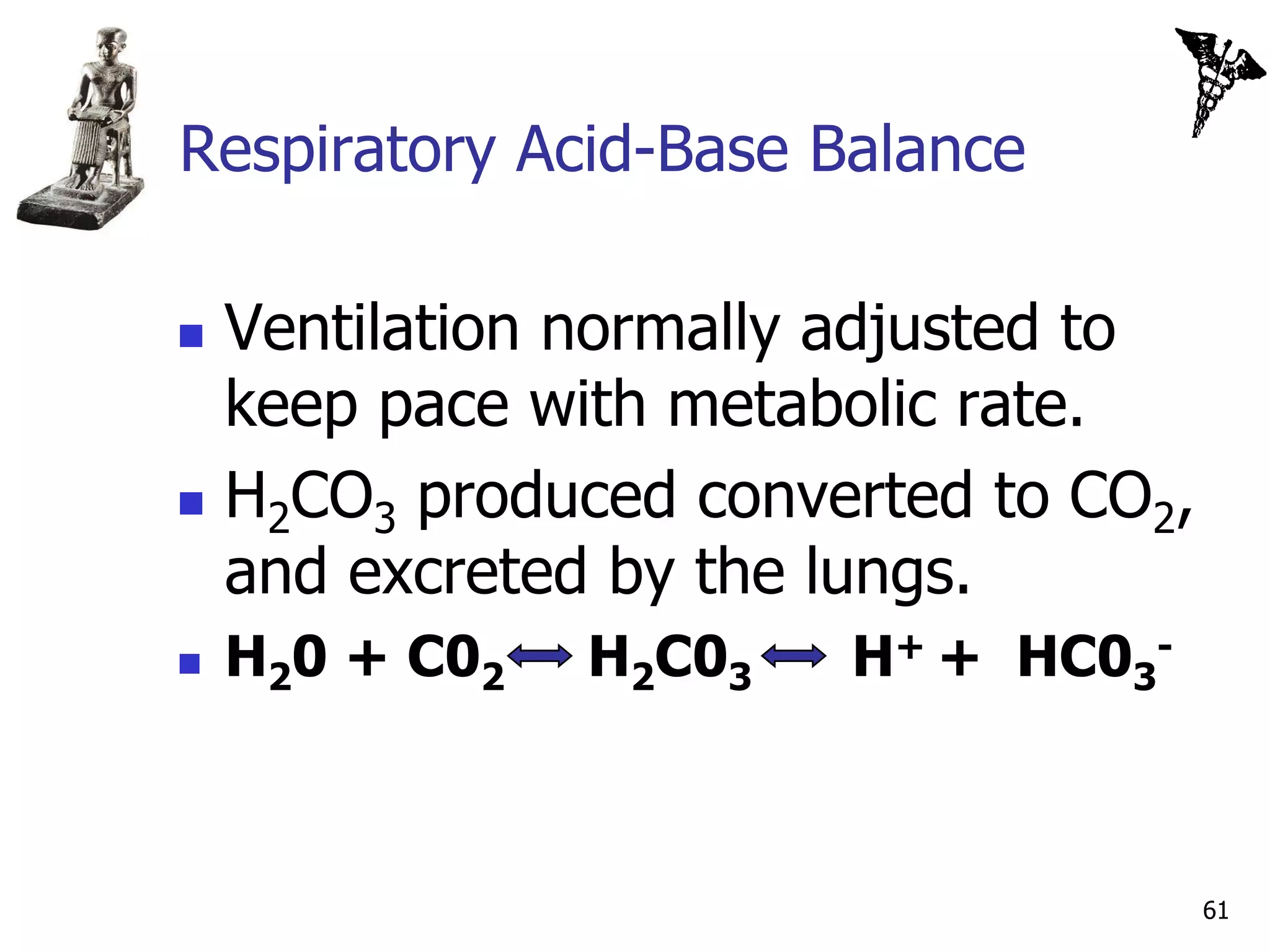
Respiratory Acid-Base Balance

   Ventilation normally adjusted to
    keep pace with metabolic rate.
   H2CO3 produced converted to CO2,
    and excreted by the lungs.
   H20 + C02   H2C03   H+ + HC03-


                                       61
Respiratory Acidosis

   Hypoventilation.
   Accumulation of CO2 in the tissues.
     Pc02 increases.
     pH decreases.

     Plasma HCO3 increases.
                    -


                                          62
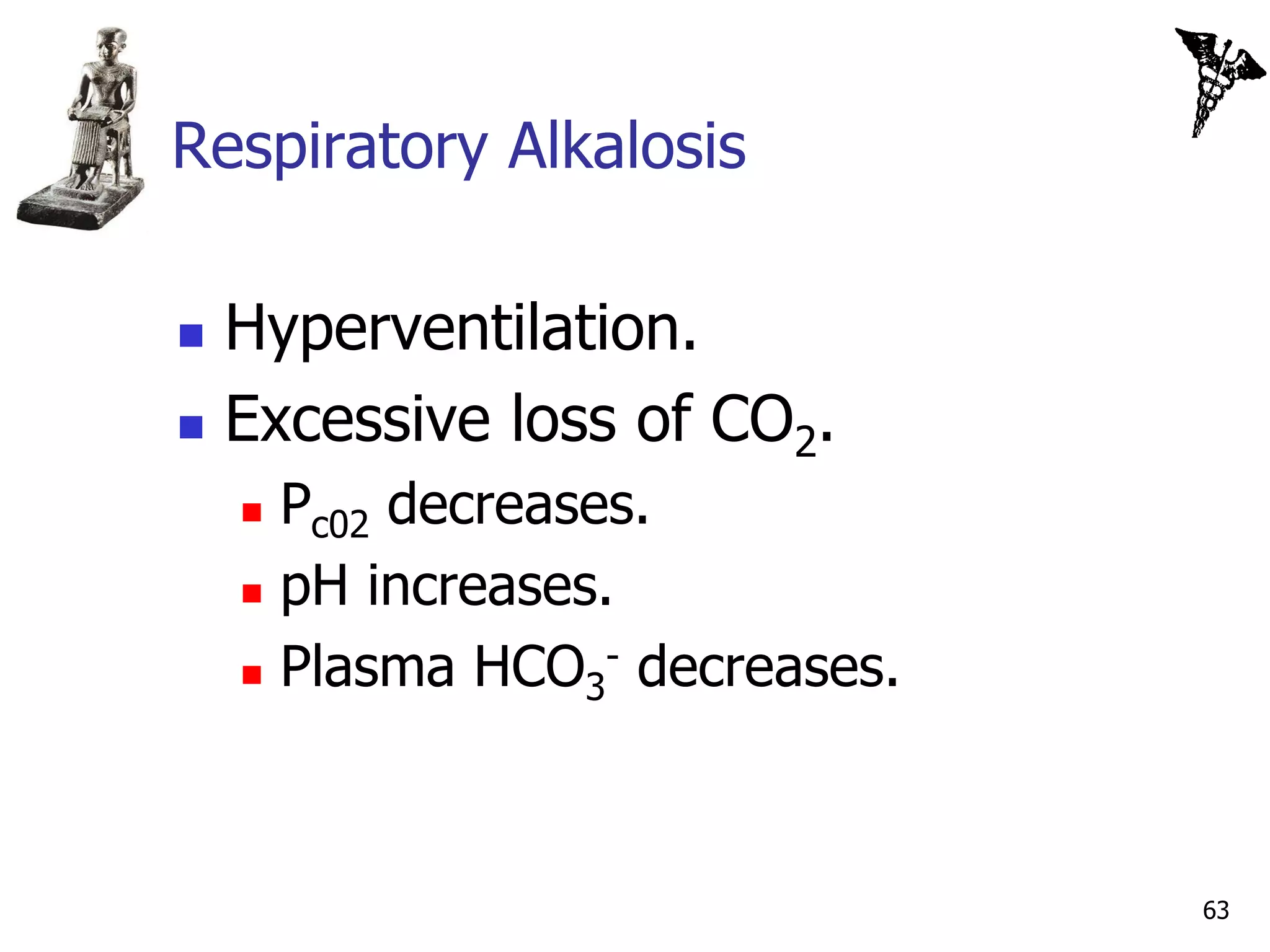
Respiratory Alkalosis

   Hyperventilation.
   Excessive loss of CO2.
     Pc02 decreases.
     pH increases.

     Plasma HCO3 decreases.
                   -


                               63
Effect of Bicarbonate on Blood pH


    Insert fig. 16.40


                                    64
Ventilation During Exercise
   During exercise, breathing
    becomes deeper and more
    rapid.
                                      Insert fig. 16.41
   Produce > total minute volume.
   Neurogenic mechanism:
       Sensory nerve activity from
        exercising muscles
        stimulates the respiratory
        muscles.
       Cerebral cortex input may
        stimulate brain stem
        centers.
   Humoral mechanism:
       PC0 and pH may be different
          2


        at chemoreceptors.
       Cyclic variations in the
        values that cannot be
        detected by blood samples.
                                                          65
Lactate Threshold and Endurance
Training
   Maximum rate of oxygen consumption that
    can be obtained before blood lactic acid
    levels rise as a result of anaerobic
    respiration.
       50-70% maximum 02 uptake has been reached.
   Endurance trained athletes have higher
    lactate threshold, because of higher cardiac
    output.
       Have higher rate of oxygen delivery to muscles.
       Have increased content of mitochondria in skeletal
        muscles.
                                                        66
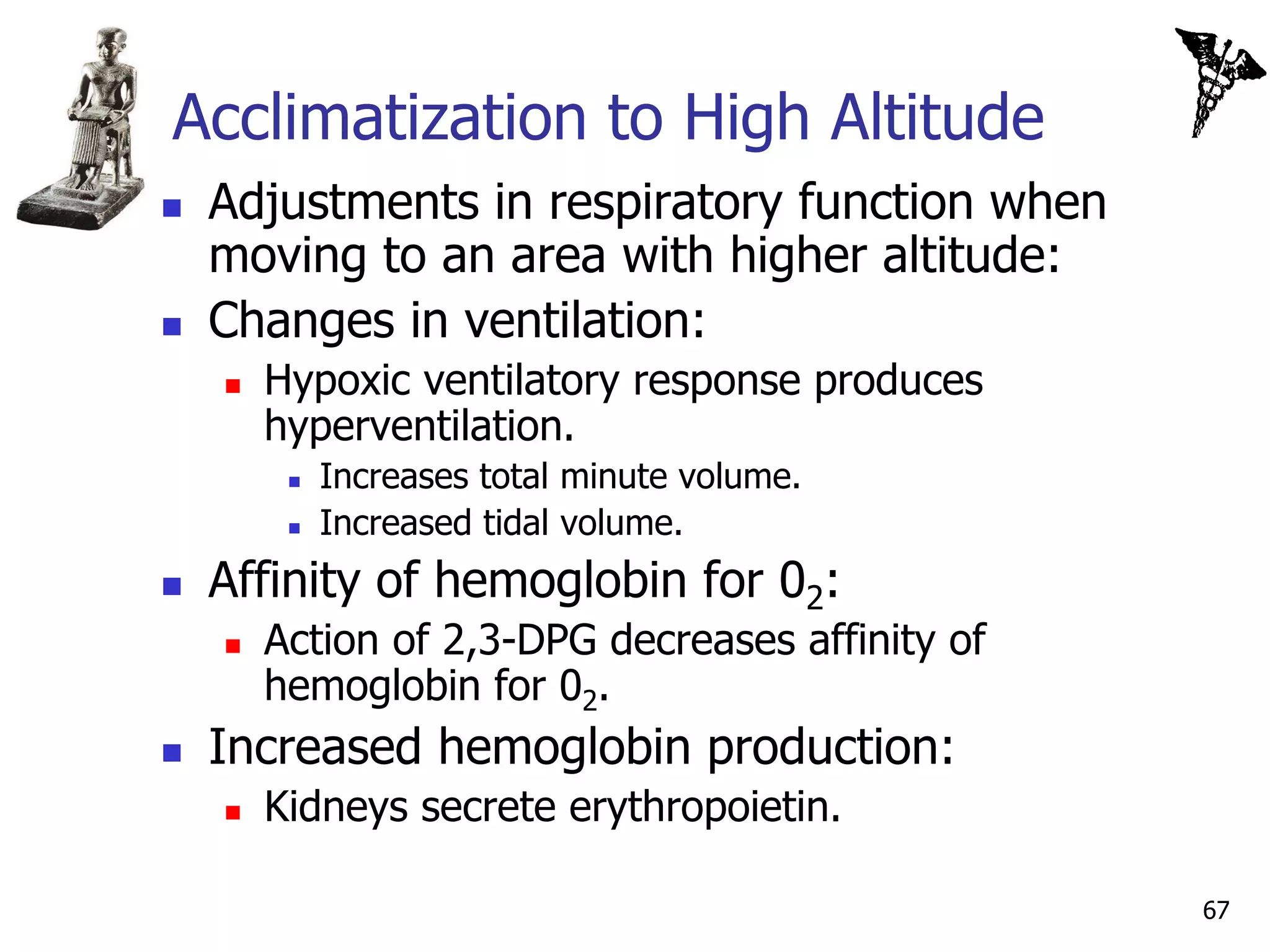
Acclimatization to High Altitude
   Adjustments in respiratory function when
    moving to an area with higher altitude:
   Changes in ventilation:
       Hypoxic ventilatory response produces
        hyperventilation.
            Increases total minute volume.
            Increased tidal volume.
   Affinity of hemoglobin for 02:
       Action of 2,3-DPG decreases affinity of
        hemoglobin for 02.
   Increased hemoglobin production:
       Kidneys secrete erythropoietin.

                                                  67
Selected Online Resources about Asthma:


     http://www.nlm.nih.gov/hmd/breath/asthma.html


                                                     68

IVMS-Respiratory Anatomy and Physiology Global Overview / Review

  • 1.
    Respiratory Anatomy andPhysiology Global Overview / Review Compiled and Presented by Marc Imhotep Cray, M.D. Basic Medical Sciences Professor Pulmonary Pathology IVMS Respiratory Pathology and Pathophysiology and Clinical Presentation
  • 2.
    Respiration  The term respiration includes 3 separate functions:  Ventilation:  Breathing.  Gas exchange:  Between air and capillaries in the lungs.  Between systemic capillaries and tissues of the body.  02 utilization:  Cellular respiration. 2
  • 3.
    Ventilation  Mechanical process that moves air in and out of the lungs.  [O2] of air is higher in the lungs Insert 16.1 than in the blood, O2 diffuses from air to the blood.  C02 moves from the blood to the air by diffusing down its concentration gradient.  Gas exchange occurs entirely by diffusion:  Diffusion is rapid because of the large surface area and the small diffusion distance. 3
  • 4.
    Alveoli  Polyhedral in shape and clustered like units of honeycomb.  ~ 300 million air sacs (alveoli).  Large surface area (60–80 m2).  Each alveolus is 1 cell layer thick.  Total air barrier is 2 cells across (2 mm).  2 types of cells:  Alveolar type I:  Structural cells.  Alveolar type II:  Secrete surfactant. 4
  • 5.
    Respiratory Zone  Region of gas exchange between air and blood.  Includes respiratory bronchioles and alveolar sacs.  Must contain alveoli. 5
  • 6.
    Conducting Zone  All the structures air passes through before Insert fig. 16.5 reaching the respiratory zone.  Warms and humidifies inspired air.  Filters and cleans:  Mucus secreted to trap particles in the inspired air.  Mucus moved by cilia to be expectorated. 6
  • 7.
    Thoracic Cavity  Diaphragm:  Sheets of striated muscle divides anterior body cavity into 2 parts.  Above diaphragm: thoracic cavity:  Contains heart, large blood vessels, trachea, esophagus, thymus, and lungs.  Below diaphragm: abdominopelvic cavity:  Contains liver, pancreas, GI tract, spleen, and genitourinary tract.  Intrapleural space:  Space between visceral and parietal pleurae. 7
  • 8.
    Intrapulmonary and Intrapleural Pressures  Visceral and parietal pleurae are flush against each other.  The intrapleural space contains only a film of fluid secreted by the membranes.  Lungs normally remain in contact with the chest walls.  Lungs expand and contract along with the thoracic cavity.  Intrapulmonary pressure:  Intra-alveolar pressure (pressure in the alveoli).  Intrapleural pressure:  Pressure in the intrapleural space.  Pressure is negative, due to lack of air in the intrapleural space. 8
  • 9.
    Transpulmonary Pressure  Pressure difference across the wall of the lung.  Intrapulmonary pressure – intrapleural pressure.  Keeps the lungs against the chest wall. 9
  • 10.
    Intrapulmonary and Intrapleural Pressures (continued)  During inspiration:  Atmospheric pressure is > intrapulmonary pressure (-3 mm Hg).  During expiration:  Intrapulmonary pressure (+3 mm Hg) is > atmospheric pressure. 10
  • 11.
    Boyle’s Law  Changes in intrapulmonary pressure occur as a result of changes in lung volume.  Pressure of gas is inversely proportional to its volume.  Increase in lung volume decreases intrapulmonary pressure.  Air goes in.  Decrease in lung volume, raises intrapulmonary pressure above atmosphere.  Air goes out. 11
  • 12.
    Physical Properties ofthe Lungs  Ventilation occurs as a result of pressure differences induced by changes in lung volume.  Physical properties that affect lung function:  Compliance.  Elasticity.  Surface tension. 12
  • 13.
    Compliance  Distensibility (stretchability):  Ease with which the lungs can expand.  Change in lung volume per change in transpulmonary pressure. DV/DP  100 x more distensible than a balloon.  Compliance is reduced by factors that produce resistance to distension. 13
  • 14.
    Elasticity  Tendency to return to initial size after distension.  High content of elastin proteins.  Very elastic and resist distension.  Recoil ability.  Elastic tension increases during inspiration and is reduced by recoil during expiration. 14
  • 15.
    Surface Tension  Force exerted by fluid in alveoli to resist distension.  Lungs secrete and absorb fluid, leaving a very thin film of fluid.  This film of fluid causes surface tension.  Fluid absorption is driven (osmosis) by Na+ active transport.  Fluid secretion is driven by the active transport of Cl- out of the alveolar epithelial cells.  H20 molecules at the surface are attracted to other H20 molecules by attractive forces.  Force is directed inward, raising pressure in alveoli. 15
  • 16.
    Surface Tension (continued)  Law of Laplace:  Pressure in alveoli is Insert fig. 16.11 directly proportional to surface tension; and inversely proportional to radius of alveoli.  Pressure in smaller alveolus would be greater than in larger alveolus, if surface tension were the same in both. 16
  • 17.
    Surfactant  Phospholipid produced by alveolar type II cells. Insert fig. 16.12  Lowers surface tension.  Reduces attractive forces of hydrogen bonding by becoming interspersed between H20 molecules.  Surface tension in alveoli is reduced.  As alveoli radius decreases, surfactant’s ability to lower surface tension increases.  Disorders:  RDS. 17  ARDS.
  • 18.
    Quiet Inspiration  Active process:  Contraction of diaphragm, increases thoracic volume vertically.  Parasternal and external intercostals contract, raising the ribs; increasing thoracic volume laterally.  Pressure changes:  Alveolar changes from 0 to –3 mm Hg.  Intrapleural changes from –4 to –6 mm Hg.  Transpulmonary pressure = +3 mm Hg. 18
  • 19.
    Expiration  Quiet expiration is a passive process.  After being stretched by contractions of the diaphragm and thoracic muscles; the diaphragm, thoracic muscles, thorax, and lungs recoil.  Decrease in lung volume raises the pressure within alveoli above atmosphere, and pushes air out.  Pressure changes:  Intrapulmonary pressure changes from –3 to +3 mm Hg.  Intrapleural pressure changes from –6 to –3 mm Hg.  Transpulmonary pressure = +6 mm Hg. 19
  • 20.
    Pulmonary Ventilation Insert fig. 16.15 20
  • 21.
    Pulmonary Function Tests  Assessed by spirometry.  Subject breathes into a closed system in which air is trapped within a bell floating in H20.  The bell moves up when the subject exhales and down when the subject inhales. Insert fig. 16.16 21
  • 22.
    Terms Used toDescribe Lung Volumes and Capacities 22
  • 23.
    Anatomical Dead Space  Not all of the inspired air reached the alveoli.  As fresh air is inhaled it is mixed with air in anatomical dead space.  Conducting zone and alveoli where [02] is lower than normal and [C02] is higher than normal.  Alveolar ventilation = F x (TV- DS).  F = frequency (breaths/min.).  TV = tidal volume.  DS = dead space. 23
  • 24.
    Restrictive and ObstructiveDisorders  Restrictive disorder:  Vital capacity is reduced. Insert fig. 16.17  FVC is normal.  Obstructive disorder:  Diagnosed by tests that measure the rate of expiration.  VC is normal.  FEV1 is < 80%. 24
  • 25.
    Pulmonary Disorders  Dyspnea:  Shortness of breath.  COPD (chronic obstructive pulmonary disease):  Asthma:  Obstructive air flow through bronchioles.  Caused by inflammation and mucus secretion.  Inflammation contributes to increased airway responsiveness to agents that promote bronchial constriction.  IgE, exercise. 25
  • 26.
    Pulmonary Disorders (continued)  Emphysema:  Alveolar tissue is destroyed.  Chronic progressive condition that reduces surface area for gas exchange.  Decreases ability of bronchioles to remain open during expiration.  Cigarette smoking stimulates macrophages and leukocytes to secrete protein digesting enzymes that destroy tissue.  Pulmonary fibrosis:  Normal structure of lungs disrupted by accumulation of fibrous connective tissue proteins.  Anthracosis. 26
  • 27.
    Gas Exchange inthe Lungs  Dalton’s Law:  Total pressure of a gas mixture is = to the sum of the pressures that each gas in the mixture would exert independently.  Partial pressure:  The pressure that an particular gas exerts independently.  PATM = PN2 + P02 + PC02 + PH20= 760 mm Hg.  02 is humidified = 105 mm Hg.  H20 contributes to partial pressure (47 mm Hg).  P02 (sea level) = 150 mm Hg.  PC0 = 40 mm Hg. 2 27
  • 28.
    Partial Pressures ofGases in Inspired Air and Alveolar Air Insert fig. 16.20 28
  • 29.
    Partial Pressures ofGases in Blood  When a liquid or gas (blood and alveolar air) are at equilibrium:  The amount of gas dissolved in fluid reaches a maximum value (Henry’s Law).  Depends upon:  Solubility of gas in the fluid.  Temperature of the fluid.  Partial pressure of the gas.  [Gas] dissolved in a fluid depends directly on its partial pressure in the gas mixture. 29
  • 30.
    Significance of BloodP0 and PC0 2 2 Measurements  At normal P0 arterial 2 blood is about 100 mm Hg.  P0 level in 2 the systemic veins is about 40 mm Hg. P is 46 mm Hg in the systemic veins.  C02 Provides a good index of lung function. 30
  • 31.
    Pulmonary Circulation  Rate of blood flow through the pulmonary circulation is = flow rate through the systemic circulation.  Driving pressure is about 10 mm Hg.  Pulmonary vascular resistance is low.  Low pressure pathway produces less net filtration than produced in the systemic capillaries.  Avoids pulmonary edema.  Autoregulation:  Pulmonary arterioles constrict when alveolar P0 2 decreases.  Matches ventilation/perfusion ratio. 31
  • 32.
    Pulmonary Circulation (continued)  In a fetus:  Pulmonary circulation has a higher vascular resistance, because the lungs are partially collapsed.  After birth, vascular resistance decreases:  Opening the vessels as a result of subatmospheric intrapulmonary pressure.  Physical stretching of the lungs.  Dilation of pulmonary arterioles in response to increased alveolar P0 . 2 32
  • 33.
    Lung Ventilation/Perfusion Ratios  Functionally: Insert fig. 16.24  Alveoli at apex are underperfused (overventilated).  Alveoli at the base are underventilated (overperfused). 33
  • 34.
    Disorders Caused byHigh Partial Pressures of Gases  Nitrogen narcosis:  At sea level nitrogen is physiologically inert.  Under hyperbaric conditions:  Nitrogen dissolves slowly.  Can have deleterious effects.  Resembles alcohol intoxication.  Decompression sickness:  Amount of nitrogen dissolved in blood as a diver ascends decreases due to a decrease in PN . 2  If occurs rapidly, bubbles of nitrogen gas can form in tissues and enter the blood.  Block small blood vessels producing the “bends.” 34
  • 35.
    Brain Stem RespiratoryCenters  Neurons in the reticular formation of the medulla Insert fig. 16.25 oblongata form the rhythmicity center:  Controls automatic breathing.  Consists of interacting neurons that fire either during inspiration (I neurons) or expiration (E neurons). 35
  • 36.
    Brain Stem RespiratoryCenters (continued)  I neurons project to, and stimulate spinal motor neurons that innervate respiratory muscles.  Expiration is a passive process that occurs when the I neurons are inhibited.  Activity varies in a reciprocal way. 36
  • 37.
    Rhythmicity Center  I neurons located primarily in dorsal respiratory group (DRG):  Regulate activity of phrenic nerve.  Project to and stimulate spinal interneurons that innervate respiratory muscles.  E neurons located in ventral respiratory group (VRG):  Passive process.  Controls motor neurons to the internal intercostal muscles.  Activity of E neurons inhibit I neurons.  Rhythmicity of I and E neurons may be due to pacemaker neurons. 37
  • 38.
    Pons Respiratory Centers  Activities of medullary rhythmicity center is influenced by pons.  Apneustic center:  Promotes inspiration by stimulating the I neurons in the medulla.  Pneumotaxic center:  Antagonizes the apneustic center.  Inhibits inspiration. 38
  • 39.
    Chemoreceptors  2 groups of chemo- receptors that monitor changes in blood PC0 , 2 Insert fig. 16.27 P0 , and pH. 2  Central:  Medulla.  Peripheral:  Carotid and aortic bodies.  Control breathing indirectly via sensory nerve fibers to the medulla (X, IX). 39
  • 40.
    Effects of BloodPC0 and pH on 2 Ventilation  Chemoreceptor input modifies the rate and depth of breathing.  Oxygen content of blood decreases more slowly because of the large “reservoir” of oxygen attached to hemoglobin.  Chemoreceptors are more sensitive to changes in PC0 . 2  H20 + C02 H2C03 H+ + HC03-  Rate and depth of ventilation adjusted to maintain arterial PC0 of 40 mm Hg. 2 40
  • 41.
    Chemoreceptor Control  Central chemoreceptors:  More sensitive to changes in arterial PC0 . 2  H20 + C02 H2C03 H+  H+ cannot cross the blood brain barrier.  C02 can cross the blood brain barrier and will form H2C03.  Lowers pH of CSF.  Directly stimulates central chemoreceptors. 41
  • 42.
    Chemoreceptor Control (continued)  Peripheral chemoreceptors:  Are not stimulated directly by changes in arterial PC0 . 2  H20 + C02 H2C03 H+  Stimulated by rise in [H+] of arterial blood.  Increased [H+] stimulates peripheral chemoreceptors. 42
  • 43.
    Chemoreceptor Control ofBreathing Insert fig. 16.29 43
  • 44.
    Effects of BloodP0 on Ventilation 2  Blood P0 affected by breathing indirectly. 2  Influences chemoreceptor sensitivity to changes in PC0 . 2  Hypoxic drive:  Emphysema blunts the chemoreceptor response to PC0 . 2  Choroid plexus secrete more HC03- into CSF, buffering the fall in CSF pH.  Abnormally high PC0 enhances sensitivity of carotid 2 bodies to fall in P0 . 2 44
  • 45.
    Effects of PulmonaryReceptors on Ventilation  Lungs contain receptors that influence the brain stem respiratory control centers via sensory fibers in vagus.  Unmyelinated C fibers can be stimulated by:  Capsaicin:  Produces apnea followed by rapid, shallow breathing.  Histamine and bradykinin:  Released in response to noxious agents.  Irritant receptors are rapidly adaptive receptors.  Hering-Breuer reflex:  Pulmonary stretch receptors activated during inspiration.  Inhibits respiratory centers to prevent undue tension on lungs. 45
  • 46.
    Hemoglobin and 02Transport  280 million hemoglobin/RBC. Insert fig. 16.32  Each hemoglobin has 4 polypeptide chains and 4 hemes.  In the center of each heme group is 1 atom of iron that can combine with 1 molecule 02. 46
  • 47.
    Hemoglobin  Oxyhemoglobin:  Normal heme contains iron in the reduced form (Fe2+).  Fe2+ shares electrons and bonds with oxygen.  Deoxyhemoglobin:  When oxyhemoglobin dissociates to release oxygen, the heme iron is still in the reduced form.  Hemoglobin does not lose an electron when it combines with 02. 47
  • 48.
    Hemoglobin (continued)  Methemoglobin:  Has iron in the oxidized form (Fe3+).  Lacks electrons and cannot bind with 02.  Blood normally contains a small amount.  Carboxyhemoglobin:  The reduced heme is combined with carbon monoxide.  The bond with carbon monoxide is 210 times stronger than the bond with oxygen.  Transport of 02 to tissues is impaired. 48
  • 49.
    Hemoglobin (continued)  Oxygen-carrying capacity of blood determined by its [hemoglobin].  Anemia:  [Hemoglobin] below normal.  Polycythemia:  [Hemoglobin] above normal.  Hemoglobin production controlled by erythropoietin.  Production stimulated by PC0 delivery to kidneys. 2  Loading/unloading depends:  P0 of environment. 2  Affinity between hemoglobin and 02. 49
  • 50.
    Oxyhemoglobin Dissociation Curve  Graphic illustration of the % oxyhemoglobin saturation at different values of P0 . 2  Loading and unloading of 02.  Steep portion of the sigmoidal curve, small changes in P0 2 produce large differences in % saturation (unload more 02).  Decreased pH, increased temperature, and increased 2,3 DPG:  Affinity of hemoglobin for 02 decreases.  Greater unloading of 02:  Shift to the curve to the right. 50
  • 51.
  • 52.
    Effects of pHand Temperature  The loading and unloading of O2 influenced by the Insert fig. 16.35 affinity of hemoglobin for 02.  Affinity is decreased when pH is decreased.  Increased temperature and 2,3-DPG:  Shift the curve to the right. 52
  • 53.
    Effect of 2,3DPG on 02 Transport  Anemia:  RBCs total blood [hemoglobin] falls, each RBC produces greater amount of 2,3 DPG.  Since RBCs lack both nuclei and mitochondria, produce ATP through anaerobic metabolism.  Fetal hemoglobin (hemoglobin f):  Has 2 g-chains in place of the b-chains.  Hemoglobin f cannot bind to 2,3 DPG.  Has a higher affinity for 02. 53
  • 54.
    Inherited Defects inHemoglobin Structure and Function  Sickle-cell anemia:  Hemoglobin S differs in that valine is substituted for glutamic acid on position 6 of the b chains.  Cross links form a “paracrystalline gel” within the RBCs.  Makes the RBCs less flexible and more fragile.  Thalassemia:  Decreased synthesis of a or b chains, increased synthesis of g chains. 54
  • 55.
    Muscle Myoglobin  Red pigment found exclusively in striated muscle. Insert fig. 13.37  Slow-twitch skeletal fibers and cardiac muscle cells are rich in myoglobin.  Have a higher affinity for 02 than hemoglobin.  May act as a “go- between” in the transfer of 02 from blood to the mitochondria within muscle cells.  May also have an 02 storage function in cardiac muscles. 55
  • 56.
    C02 Transport  C02 transported in the blood:  HC03- (70%).  Dissolved C02 (10%).  Carbaminohemoglobin (20%). ca H20 + C02 H2C03 High PC02 56
  • 57.
    Chloride Shift atSystemic Capillaries  H20 + C02 H2C03 H+ + HC03-  At the tissues, C02 diffuses into the RBC; shifts the reaction to the right.  Increased [HC03-] produced in RBC:  HC03- diffuses into the blood.  RBC becomes more +.  Cl- attracted in (Cl- shift).  H+ released buffered by combining with deoxyhemoglobin.  HbC02 formed.  Unloading of 02. 57
  • 58.
    Carbon Dioxide Transportand Chloride Shift Insert fig. 16.38 58
  • 59.
    At Pulmonary Capillaries  H20 + C02 H2C03 H+ + HC03-  At the alveoli, C02 diffuses into the alveoli; reaction shifts to the left.  Decreased [HC03-] in RBC, HC03- diffuses into the RBC.  RBC becomes more -.  Cl- diffuses out (reverse Cl- shift).  Deoxyhemoglobin converted to oxyhemoglobin.  Has weak affinity for H+.  Gives off HbC02. 59
  • 60.
    Reverse Chloride Shiftin Lungs Insert fig. 16.39 60
  • 61.
    Respiratory Acid-Base Balance  Ventilation normally adjusted to keep pace with metabolic rate.  H2CO3 produced converted to CO2, and excreted by the lungs.  H20 + C02 H2C03 H+ + HC03- 61
  • 62.
    Respiratory Acidosis  Hypoventilation.  Accumulation of CO2 in the tissues.  Pc02 increases.  pH decreases.  Plasma HCO3 increases. - 62
  • 63.
    Respiratory Alkalosis  Hyperventilation.  Excessive loss of CO2.  Pc02 decreases.  pH increases.  Plasma HCO3 decreases. - 63
  • 64.
    Effect of Bicarbonateon Blood pH Insert fig. 16.40 64
  • 65.
    Ventilation During Exercise  During exercise, breathing becomes deeper and more rapid. Insert fig. 16.41  Produce > total minute volume.  Neurogenic mechanism:  Sensory nerve activity from exercising muscles stimulates the respiratory muscles.  Cerebral cortex input may stimulate brain stem centers.  Humoral mechanism:  PC0 and pH may be different 2 at chemoreceptors.  Cyclic variations in the values that cannot be detected by blood samples. 65
  • 66.
    Lactate Threshold andEndurance Training  Maximum rate of oxygen consumption that can be obtained before blood lactic acid levels rise as a result of anaerobic respiration.  50-70% maximum 02 uptake has been reached.  Endurance trained athletes have higher lactate threshold, because of higher cardiac output.  Have higher rate of oxygen delivery to muscles.  Have increased content of mitochondria in skeletal muscles. 66
  • 67.
    Acclimatization to HighAltitude  Adjustments in respiratory function when moving to an area with higher altitude:  Changes in ventilation:  Hypoxic ventilatory response produces hyperventilation.  Increases total minute volume.  Increased tidal volume.  Affinity of hemoglobin for 02:  Action of 2,3-DPG decreases affinity of hemoglobin for 02.  Increased hemoglobin production:  Kidneys secrete erythropoietin. 67
  • 68.
    Selected Online Resourcesabout Asthma: http://www.nlm.nih.gov/hmd/breath/asthma.html 68