MANUFACTURE OF VISCOSE
RAYON FIBER
INDUSTRIAL CHEMISTRY
BY: Neetu Kumari
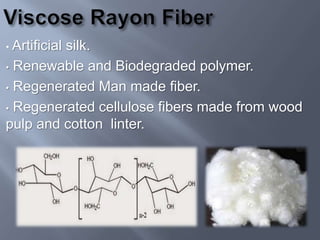
• Artificial silk.
• Renewable and Biodegraded polymer.
• Regenerated Man made fiber.
• Regenerated cellulose fibers made from wood
pulp and cotton linter.
Physical Properties
 Tensile strength : 1.5 – 2.4 gpd in dry and 0.7 – 1.2 gpd in
wet state or high.
 Elasticity : good.
 Elongation at break : 13%
 Density : 1.64 – 1.54 gm/c.cm.
 Moisture absorbtion : 11 – 13%
 Action of heat : lose strength when it heated above 150oC.
 Action of light : Ultra violet ray damage the fibers.
 Insulating : Do not have good insulator.
 Ability to protest friction : Less.
 Color : White.
Chemical Properties
 Action of acid: damaged by strong acids moderate with weak
acids.
 Action of base: Good resistance to weak alkalis but strong
alkali is harmful.
 Action of bleaching: Strong oxidizing agents damage it.
 Action organic solvent: fiber has enough ability to protest
the action of organic solvents.
 Action of soaps : no direct effect on regenerated cellulose
materials.
 Action of insects : not affected except silverfish.
 Action of microorganisms : affect the colour, strength,
dyeing properties and lustre of rayon. Clean and dry viscose
rayon is rarely attacked by moulds and mildew.
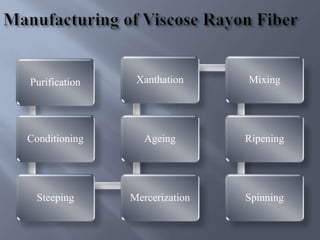
Purification
Conditioning
Steeping Mercerization
Ageing
Xanthation Mixing
Ripening
Spinning
Purification
Spruce trees are cut into timber, barks are removed and cut into pieces.
Pieces treated calcium bisulphite and cooked with steam under pressure
for about 14 hours. lignin is converted into its sulphonated compound
which is soluble in water. This can be washed off, cellulose is treated
with excess of water and treated with a bleaching agent and finally
converted into paper boards or sheets. This is called wood pulp, which is
normally purchased by the manufacturers of viscose rayon.
Conditioning
The pulp sheets are cut by a guillotine and are kept in a special room.
Air moves freely by means of ventilatorys, the temperature is
maintained at 300 C.
Steeping
The wood pulp or a mixture wood pulp and cotton linter pulp is first
bleached and then dipped in 16% NaOH solution for about 2 hours.
Mercerization
The cellulose is still contaminated with some hemicellulose. it is treated with 17-18%
NaOH solution at low temperatures for sometime, it swells up known as
mercerization. It involves partial destruction of intermolecular bonds, penetration of
NaOH in he swollen amorphous regions of the cellulose, where they are held by
hydrogen bonding and sodium cellulose is formed.
Rcell - OH + NaOH ---> [Rcell - OH.NaOH]
Ageing
cellulose undergoes pre-ripening in presence of air. chemical degradation process and
involves :
•Oxidation of primary -OH group to aldehyde or carboxylic acid group.
•Oxidation of secondary -OH group to ketonic group , extending up to carboxylic acids
•Rupture of the terminal oxide ring and polymer chains.
Xanthation
alkali cellulose is separated and taken in a horizontal drum, where it is treated with
60% carbon disulphide. The drum is rotated during the addition of CS2 and temperature
is maintained at about 20oC. The product, sodium cellulose xanthate swells up slowly
and a deep orange coloured gelatinous mass is obtained in 3-4 hours.
[C6H5O5]n + NaOH ---> [C6H10O5.NaOH]n + CS2 ---> (C6H9O4)3.OH.OCS2Na
Mixing
xanthate coagulates into small balls. dissolved in 3-4% NaOH sol., a viscose green
brown solution is obtained which contains sodium cellulose xanthate which is soluble
in dilute NaOH giving rise to a viscous solution known as viscose.
Ripening
Ripening carried out by passing filtered viscose through a series of storage tanks in
series, and it takes about 4 - 5 days. NaCl sol. to initiate coagulation of the viscose. It’s
necessary to impart proper tensile strength and spinning property to he yarn.
composition of deaerated ripened viscose is : 6-7.5% Cellulose ,2.2-2.3% NaOH and
80-83% Water.
Spinning
The ripened viscose is forced by a pump into spinnerete, which is placed in a bath
consists of 4-10% Glucose, 1% ZnSO4, 8-10% H2S04 and 13.5-20% Na2SO4. The
temperature maintained at 40-45oC and ripened viscose is forced out by the action of
compressed air .The threads of sodium cellulose xanthate formed Immediately react
with dil, H2SO4. free sulphur removed by treatment with sodium sulphide.
The silky threads thus obtained are spun on a bobbin, desulphurised, washed with soap
solution, twisted to form the yarn, bleached with NaOCl and dried. This silk is known
as viscose rayon.
Uses
It’s commonly used for making clothes, window drapes, cooling
sheets, mattress flame retardants, mattress protectors, and
cellophane.
Viscose rayon is also used to make synthetic velvet, which is a
cheaper alternative to velvet made with natural fibers.
The silk-like feel of viscose makes it an excellent material for
curtains.
Viscose rayon is blended with silica for making mattresses flame
retardant.
All forms of rayons are good at absorbing water, so they are
often blended with polyester and cotton to make mattress
protectors.
The transparent sheets used to package food are made using
regenerated cellulose.
REFERENCE
Industrial Chemistry :
by B. K. Sharma
Goel Publishing House Meerut
Viscose Rayon Fiber

Viscose Rayon Fiber

  • 1.
    MANUFACTURE OF VISCOSE RAYONFIBER INDUSTRIAL CHEMISTRY BY: Neetu Kumari
  • 3.
    • Artificial silk. •Renewable and Biodegraded polymer. • Regenerated Man made fiber. • Regenerated cellulose fibers made from wood pulp and cotton linter.
  • 4.
    Physical Properties  Tensilestrength : 1.5 – 2.4 gpd in dry and 0.7 – 1.2 gpd in wet state or high.  Elasticity : good.  Elongation at break : 13%  Density : 1.64 – 1.54 gm/c.cm.  Moisture absorbtion : 11 – 13%  Action of heat : lose strength when it heated above 150oC.  Action of light : Ultra violet ray damage the fibers.  Insulating : Do not have good insulator.  Ability to protest friction : Less.  Color : White.
  • 5.
    Chemical Properties  Actionof acid: damaged by strong acids moderate with weak acids.  Action of base: Good resistance to weak alkalis but strong alkali is harmful.  Action of bleaching: Strong oxidizing agents damage it.  Action organic solvent: fiber has enough ability to protest the action of organic solvents.  Action of soaps : no direct effect on regenerated cellulose materials.  Action of insects : not affected except silverfish.  Action of microorganisms : affect the colour, strength, dyeing properties and lustre of rayon. Clean and dry viscose rayon is rarely attacked by moulds and mildew.
  • 6.
  • 7.
    Purification Spruce trees arecut into timber, barks are removed and cut into pieces. Pieces treated calcium bisulphite and cooked with steam under pressure for about 14 hours. lignin is converted into its sulphonated compound which is soluble in water. This can be washed off, cellulose is treated with excess of water and treated with a bleaching agent and finally converted into paper boards or sheets. This is called wood pulp, which is normally purchased by the manufacturers of viscose rayon. Conditioning The pulp sheets are cut by a guillotine and are kept in a special room. Air moves freely by means of ventilatorys, the temperature is maintained at 300 C. Steeping The wood pulp or a mixture wood pulp and cotton linter pulp is first bleached and then dipped in 16% NaOH solution for about 2 hours.
  • 8.
    Mercerization The cellulose isstill contaminated with some hemicellulose. it is treated with 17-18% NaOH solution at low temperatures for sometime, it swells up known as mercerization. It involves partial destruction of intermolecular bonds, penetration of NaOH in he swollen amorphous regions of the cellulose, where they are held by hydrogen bonding and sodium cellulose is formed. Rcell - OH + NaOH ---> [Rcell - OH.NaOH] Ageing cellulose undergoes pre-ripening in presence of air. chemical degradation process and involves : •Oxidation of primary -OH group to aldehyde or carboxylic acid group. •Oxidation of secondary -OH group to ketonic group , extending up to carboxylic acids •Rupture of the terminal oxide ring and polymer chains. Xanthation alkali cellulose is separated and taken in a horizontal drum, where it is treated with 60% carbon disulphide. The drum is rotated during the addition of CS2 and temperature is maintained at about 20oC. The product, sodium cellulose xanthate swells up slowly and a deep orange coloured gelatinous mass is obtained in 3-4 hours. [C6H5O5]n + NaOH ---> [C6H10O5.NaOH]n + CS2 ---> (C6H9O4)3.OH.OCS2Na
  • 9.
    Mixing xanthate coagulates intosmall balls. dissolved in 3-4% NaOH sol., a viscose green brown solution is obtained which contains sodium cellulose xanthate which is soluble in dilute NaOH giving rise to a viscous solution known as viscose. Ripening Ripening carried out by passing filtered viscose through a series of storage tanks in series, and it takes about 4 - 5 days. NaCl sol. to initiate coagulation of the viscose. It’s necessary to impart proper tensile strength and spinning property to he yarn. composition of deaerated ripened viscose is : 6-7.5% Cellulose ,2.2-2.3% NaOH and 80-83% Water. Spinning The ripened viscose is forced by a pump into spinnerete, which is placed in a bath consists of 4-10% Glucose, 1% ZnSO4, 8-10% H2S04 and 13.5-20% Na2SO4. The temperature maintained at 40-45oC and ripened viscose is forced out by the action of compressed air .The threads of sodium cellulose xanthate formed Immediately react with dil, H2SO4. free sulphur removed by treatment with sodium sulphide. The silky threads thus obtained are spun on a bobbin, desulphurised, washed with soap solution, twisted to form the yarn, bleached with NaOCl and dried. This silk is known as viscose rayon.
  • 10.
    Uses It’s commonly usedfor making clothes, window drapes, cooling sheets, mattress flame retardants, mattress protectors, and cellophane. Viscose rayon is also used to make synthetic velvet, which is a cheaper alternative to velvet made with natural fibers. The silk-like feel of viscose makes it an excellent material for curtains. Viscose rayon is blended with silica for making mattresses flame retardant. All forms of rayons are good at absorbing water, so they are often blended with polyester and cotton to make mattress protectors. The transparent sheets used to package food are made using regenerated cellulose.
  • 11.
    REFERENCE Industrial Chemistry : byB. K. Sharma Goel Publishing House Meerut