Hamza
Sameen
Assigment of
textile
SPANDEX FIBER
DEFINATION
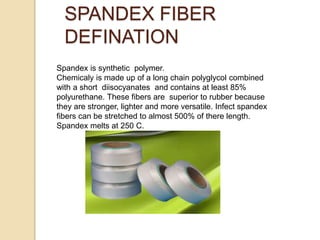
Spandex is synthetic polymer.
Chemicaly is made up of a long chain polyglycol combined
with a short diisocyanates and contains at least 85%
polyurethane. These fibers are superior to rubber because
they are stronger, lighter and more versatile. Infect spandex
fibers can be stretched to almost 500% of there length.
Spandex melts at 250 C.
MANUFACTURING OF
SPANDEX FIBER
 Spandex, Lycra or elastane is a synthetic fiber known for its
exceptional elasticity. It is stronger and more durable than
natural rubber. It is a polyester-polyurethane copolymer that
was invented in 1958 by chemist Joseph Shivers at DuPont's
Benger Laboratory in Waynesboro, Virginia.
 Spandex fibers are produced in four different ways.
 Melt extrusion
 Reaction spinning
 Dry spinning
 Wet spinning
All of these methods include the initial step of
reacting monomers to produce a prepolymer. Once the
prepolymer is formed, it is reacted further in various
ways and drawn out to make the fibers.
The solution dry spinning method is used to
produce over 94.5% of the world's spandex fibers
Solution dry spinning
There are five step of solution dry
spinning.
STEP 2.
THE PREPOLYMER IS FURTHER REACTED WITH AN EQUAL AMOUNT
OF DIAMINE. THIS REACTION IS KNOWN AS CHAIN EXTENSION
REACTION. THE RESULTING SOLUTION IS DILUTED WITH A SOLVENT
(DMAC) TO PRODUCE THE SPINNING SOLUTION
Step 1.
The first step is to produce the prepolymer. This is done by mixing a
macroglycol with a diisocyanate monomer. The two compounds are mixed in a
reaction vessel to produce a prepolymer. A typical ratio of glycol to
diisocyanate is 1:2
Step 3.
The spinning solution is pumped into a cylindrical spinning cell
where it is cured and converted into fibres. In this cell, the polymer
solution is forced through a metal plate called a spinneret. This
causes the solution to be aligned in strands of liquid polymer.
Step 4.
As the fibers exit the cell, an amount of solid strands are bundled together to
produce the desired thickness. Each fiber of spandex is made up of many smaller
individual fibres that adhere to one another due to the natural stickiness of their
surface.
Step 5.
The resulting fibers are then treated with a finishing agent which can
be magnesium stearate or another polymer. This treatment prevents the fibers'
sticking together and aids in textile manufacture. The fibers are then transferred
through a series of rollers onto a spool.
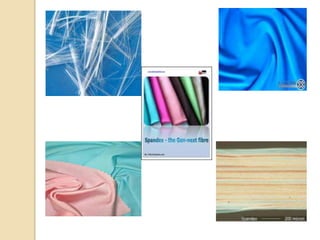
PICTURE OF SPANDEX
FIBER
There are many picture of spandex fiber.
Such as
Physical Properties of
Spandex Fiber:
1. Cross section- Spandex filaments are
extruded usually from circular orifices, but the
evaporation of solvent or the effects of drying
may produce non-circular cross-sectional
shapes. This may take various forms. In the
multi-filament yarns, individual filaments are
often fused together in places. The number of
filaments in a yarn may be as few as 12 or as
many as 50;the linear density of filaments
ranges from 0.1 to 3 tex (g/km).
2. Density: The density of spandex filaments ranges from 1.15 to 1.32
g/cc, the fibers lower density being based on polyesters.
3. Moisture regain: The moisture of fibers from which the surface
finish has been removed lies between 0.8 & 1.2%
4. Length: It can be of any length. May be used as filament or staple
fiber
5. Color: It has white or nearly white color.
6. Luster : It has usually dull luster.
7. Strength: Low strength compared to most other synthetic fiber.
8. Elasticity: Elastic properties are excellent. This is the outstanding
characteristic of the fiber.
9. Heat: The heat resistance varies considerably amongst the different
degrades over 300 F.
Chemical
Properties of
Spandex Fiber:
1. Acid: Good resistance to most of acids unless
exposure is over 24 hours.
2. Alkalies: Good resistance to most of the alkalis,
but some types of alkalis may damage the fiber.
3. Organic solvents: Offer resistance to dry
cleaning solvents.
4. Bleaches: Can be degraded by sodium hypo
chloride. chlorine bleach should not be used.
5. Dyeing: A full range of colures is available. Some
types are more difficult to dye than others.
USES
* Apparel and clothing articles where stretch is desired,
generally for comfort and fit, such as:
o Athletic, aerobic, and exercise apparel
o Wetsuits
o Swimsuits/bathing suits
o Competitive swimwear
o Netball bodysuits
o Bra straps and side panels
o Ski pants
o Disco jeans
o Slacks
o Hosiery
o Leggings
o Socks
o Diapers
o Skinny jeans
o Belts
o Underwear

Spandex fiber

  • 1.
  • 2.
    SPANDEX FIBER DEFINATION Spandex issynthetic polymer. Chemicaly is made up of a long chain polyglycol combined with a short diisocyanates and contains at least 85% polyurethane. These fibers are superior to rubber because they are stronger, lighter and more versatile. Infect spandex fibers can be stretched to almost 500% of there length. Spandex melts at 250 C.
  • 3.
    MANUFACTURING OF SPANDEX FIBER Spandex, Lycra or elastane is a synthetic fiber known for its exceptional elasticity. It is stronger and more durable than natural rubber. It is a polyester-polyurethane copolymer that was invented in 1958 by chemist Joseph Shivers at DuPont's Benger Laboratory in Waynesboro, Virginia.  Spandex fibers are produced in four different ways.  Melt extrusion  Reaction spinning  Dry spinning  Wet spinning
  • 4.
    All of thesemethods include the initial step of reacting monomers to produce a prepolymer. Once the prepolymer is formed, it is reacted further in various ways and drawn out to make the fibers. The solution dry spinning method is used to produce over 94.5% of the world's spandex fibers Solution dry spinning There are five step of solution dry spinning.
  • 5.
    STEP 2. THE PREPOLYMERIS FURTHER REACTED WITH AN EQUAL AMOUNT OF DIAMINE. THIS REACTION IS KNOWN AS CHAIN EXTENSION REACTION. THE RESULTING SOLUTION IS DILUTED WITH A SOLVENT (DMAC) TO PRODUCE THE SPINNING SOLUTION Step 1. The first step is to produce the prepolymer. This is done by mixing a macroglycol with a diisocyanate monomer. The two compounds are mixed in a reaction vessel to produce a prepolymer. A typical ratio of glycol to diisocyanate is 1:2 Step 3. The spinning solution is pumped into a cylindrical spinning cell where it is cured and converted into fibres. In this cell, the polymer solution is forced through a metal plate called a spinneret. This causes the solution to be aligned in strands of liquid polymer.
  • 6.
    Step 4. As thefibers exit the cell, an amount of solid strands are bundled together to produce the desired thickness. Each fiber of spandex is made up of many smaller individual fibres that adhere to one another due to the natural stickiness of their surface. Step 5. The resulting fibers are then treated with a finishing agent which can be magnesium stearate or another polymer. This treatment prevents the fibers' sticking together and aids in textile manufacture. The fibers are then transferred through a series of rollers onto a spool. PICTURE OF SPANDEX FIBER There are many picture of spandex fiber. Such as
  • 8.
    Physical Properties of SpandexFiber: 1. Cross section- Spandex filaments are extruded usually from circular orifices, but the evaporation of solvent or the effects of drying may produce non-circular cross-sectional shapes. This may take various forms. In the multi-filament yarns, individual filaments are often fused together in places. The number of filaments in a yarn may be as few as 12 or as many as 50;the linear density of filaments ranges from 0.1 to 3 tex (g/km).
  • 9.
    2. Density: Thedensity of spandex filaments ranges from 1.15 to 1.32 g/cc, the fibers lower density being based on polyesters. 3. Moisture regain: The moisture of fibers from which the surface finish has been removed lies between 0.8 & 1.2% 4. Length: It can be of any length. May be used as filament or staple fiber 5. Color: It has white or nearly white color. 6. Luster : It has usually dull luster. 7. Strength: Low strength compared to most other synthetic fiber. 8. Elasticity: Elastic properties are excellent. This is the outstanding characteristic of the fiber. 9. Heat: The heat resistance varies considerably amongst the different degrades over 300 F.
  • 10.
    Chemical Properties of Spandex Fiber: 1.Acid: Good resistance to most of acids unless exposure is over 24 hours. 2. Alkalies: Good resistance to most of the alkalis, but some types of alkalis may damage the fiber. 3. Organic solvents: Offer resistance to dry cleaning solvents. 4. Bleaches: Can be degraded by sodium hypo chloride. chlorine bleach should not be used. 5. Dyeing: A full range of colures is available. Some types are more difficult to dye than others.
  • 11.
    USES * Apparel andclothing articles where stretch is desired, generally for comfort and fit, such as: o Athletic, aerobic, and exercise apparel o Wetsuits o Swimsuits/bathing suits o Competitive swimwear o Netball bodysuits o Bra straps and side panels o Ski pants o Disco jeans o Slacks o Hosiery o Leggings o Socks o Diapers o Skinny jeans o Belts o Underwear