WELCOME
To the presentation
Presented By :
 2013631032
 2013631035
 2013631037
 2013631038
 2013631039
 2013631042
 2013631043
 2013631044
 2013631045
 2013631046
 20136310
Rayon
Manufacture & Uses
Introduction
Definition : Rayon is a manufactured regenerated cellulose fiber.
“Man made textile fibers and filament composed of regenerated
cellulose”
--------The US trade commission
History
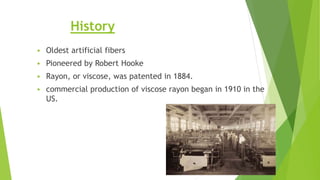
 Oldest artificial fibers
 Pioneered by Robert Hooke
 Rayon, or viscose, was patented in 1884.
 commercial production of viscose rayon began in 1910 in the
US.
Rayon Production Process
Viscose-rayon process
 Viscose is the most widely produced form of rayon
 Made from purified cellulose, primarily from wood pulp, which is
chemically converted into a soluble compound.
 viscose process is a batch operation.
Raw materials
Cellulose
• Wood pulp
• Cotton linters
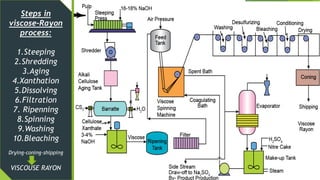
Steps in
viscose-Rayon
process:
1.Steeping
2.Shredding
3.Aging
4.Xanthation
5.Dissolving
6.Filtration
7. Ripenning
8.Spinning
9.Washing
10.Bleaching
Drying-coning-shipping
VISCOUSE RAYON
Manufacture
1. Steeping:
Cellulose pulp is immersed in 17-30% aqueous sodium hydroxide (NaOH) at a
temperature in the range of 18 to 35°C in order to swell the cellulose fibers and to
convert cellulose to alkali cellulose.
2. Shredding:
The pressed alkali cellulose is shredded mechanically to yield finely divided, fluffy
particles called “crumbs”. This step provides increased surface area of the alkali
cellulose, thereby increasing its ability to react in the steps that follow.
3. Ageing:
The alkali cellulose is discharged in cans with loosely fitted cover and kept in a
temperature controlled ageing room.
4. Xanthation:
In this step the aged alkali cellulose is converted into cellulose xanthate by treating it
with carbon disulphide for 2-3 hours in Churn at 20-350C degree.
5. Dissolving:
The cellulose xanthate is dissolved in dilute caustic soda solution in a mixture tank
forming into viscose.
6. Filtration:
The viscose is filtered to remove undissolved materials.
7. Ripening:
To make the viscose fit for spinning and casting, it is stored in a controlled condition of
time and temperature to permit ripening.
8. Spinning ( convertion of viscose into rayon filament):
The viscose solution is metered through a spinneret into a spin bath containing sulphuric
acid(8-10%), sodium sulphate(13-31%) and zinc sulphate(4-10%). Once the cellulose
xanthate is neutralized and acidified, rapid coagulation of the rayon filaments occurs
which is followed by simultaneous stretching and decomposition of cellulose xanthate to
regenerated cellulose.
9. Washing:
The yarn is the washed, dried and desulphurized.
10. Bleaching:
To obtain pure, white color the yarn is bleached with hypochlorite solution and dried
again.
Properties of Rayon
 Highly absorbent
 Soft and comfortable
 durable
 Easy to dye
 Drapes well
 Wrinkles easily
 Resist insect damages
Uses
 Jackets
 Linings
 Millinery
 Slacks
 Sportswear
 Suits
 Ties
 Bedspreads
 Blanket
 Curtain
 Slip covers
 Table cloth
THE FUTURE
The future of rayon is bright. Not only is there a growing demand for
rayon worldwide, but there are many new technologies that promise
to make rayon even better and cheaper.
For a while in the 1970s there was a trend in the clothing industry
toward purely synthetic materials like polyester. However, since
purely synthetic material does not "breath" like natural material, these
products were not well received by the consumer. Today there is a
strong trend toward blended fabrics. Blends offer the best of both
worlds.
Thank You

RAYON PROCESSING

  • 1.
  • 2.
    Presented By : 2013631032  2013631035  2013631037  2013631038  2013631039  2013631042  2013631043  2013631044  2013631045  2013631046  20136310
  • 3.
  • 4.
    Introduction Definition : Rayonis a manufactured regenerated cellulose fiber. “Man made textile fibers and filament composed of regenerated cellulose” --------The US trade commission
  • 5.
    History  Oldest artificialfibers  Pioneered by Robert Hooke  Rayon, or viscose, was patented in 1884.  commercial production of viscose rayon began in 1910 in the US.
  • 6.
  • 7.
    Viscose-rayon process  Viscoseis the most widely produced form of rayon  Made from purified cellulose, primarily from wood pulp, which is chemically converted into a soluble compound.  viscose process is a batch operation.
  • 8.
    Raw materials Cellulose • Woodpulp • Cotton linters
  • 9.
  • 10.
    Manufacture 1. Steeping: Cellulose pulpis immersed in 17-30% aqueous sodium hydroxide (NaOH) at a temperature in the range of 18 to 35°C in order to swell the cellulose fibers and to convert cellulose to alkali cellulose. 2. Shredding: The pressed alkali cellulose is shredded mechanically to yield finely divided, fluffy particles called “crumbs”. This step provides increased surface area of the alkali cellulose, thereby increasing its ability to react in the steps that follow. 3. Ageing: The alkali cellulose is discharged in cans with loosely fitted cover and kept in a temperature controlled ageing room. 4. Xanthation: In this step the aged alkali cellulose is converted into cellulose xanthate by treating it with carbon disulphide for 2-3 hours in Churn at 20-350C degree.
  • 11.
    5. Dissolving: The cellulosexanthate is dissolved in dilute caustic soda solution in a mixture tank forming into viscose. 6. Filtration: The viscose is filtered to remove undissolved materials. 7. Ripening: To make the viscose fit for spinning and casting, it is stored in a controlled condition of time and temperature to permit ripening. 8. Spinning ( convertion of viscose into rayon filament): The viscose solution is metered through a spinneret into a spin bath containing sulphuric acid(8-10%), sodium sulphate(13-31%) and zinc sulphate(4-10%). Once the cellulose xanthate is neutralized and acidified, rapid coagulation of the rayon filaments occurs which is followed by simultaneous stretching and decomposition of cellulose xanthate to regenerated cellulose.
  • 12.
    9. Washing: The yarnis the washed, dried and desulphurized. 10. Bleaching: To obtain pure, white color the yarn is bleached with hypochlorite solution and dried again.
  • 13.
    Properties of Rayon Highly absorbent  Soft and comfortable  durable  Easy to dye  Drapes well  Wrinkles easily  Resist insect damages
  • 14.
    Uses  Jackets  Linings Millinery  Slacks  Sportswear  Suits  Ties  Bedspreads  Blanket  Curtain  Slip covers  Table cloth
  • 15.
    THE FUTURE The futureof rayon is bright. Not only is there a growing demand for rayon worldwide, but there are many new technologies that promise to make rayon even better and cheaper. For a while in the 1970s there was a trend in the clothing industry toward purely synthetic materials like polyester. However, since purely synthetic material does not "breath" like natural material, these products were not well received by the consumer. Today there is a strong trend toward blended fabrics. Blends offer the best of both worlds.
  • 16.