Welcome To My Presentation 
Presentation On 
Viscose Rayon Production 
Presented By: 
Md. Yousuf Hossain. 
Id No. :120103063 
Md. Yousuf Hossain, Green University Of Bangladesh, yousuf_te@yahoo.com
Viscose Rayon: 
Viscose Rayon is a re-generated cellulosic fiber. It is a manmade fiber and it is produced from the cellulose. 
Viscose Rayon is also called as artificial silk. 
Mainly viscose rayon is used as the alternatives of natural silk fiber. 
Pulp is the raw material which is produced from the wood, seed hair, leaf, grasses and bamboo which contain cellulose. 
Md. Yousuf Hossain, Green University Of Bangladesh, yousuf_te@yahoo.com
Characteristics of Viscose Fiber : 
Highly absorbent. 
Soft and comfortable. 
Easy to dye . 
Drapes well . 
Versatile. 
It does not shrink when heated 
It is biodegradable. 
Md. Yousuf Hossain, Green University Of Bangladesh, yousuf_te@yahoo.com
Properties Of Viscose Fiber: 
i.Dry Tenacity (GPD) : 2.5 to 3 
ii.Wet Tenacity (GPD) : 40 to 50% less 
iii.Moisture Regain : 13% 
iv.Lusture : Light to bright 
v.Elasticity : Good 
vi.Melting Point : ퟏퟓퟎퟎ풄 
vii.Elongation Percentage : 20-25% 
Md. Yousuf Hossain, Green University Of Bangladesh, yousuf_te@yahoo.com
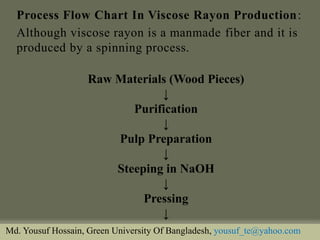
Raw Materials (Wood Pieces) 
↓ 
Purification 
↓ 
Pulp Preparation 
↓ 
Steeping in NaOH 
↓ 
Pressing 
↓ 
Process Flow Chart In Viscose Rayon Production: 
Although viscose rayon is a manmade fiber and it is produced by a spinning process. 
Md. Yousuf Hossain, Green University Of Bangladesh, yousuf_te@yahoo.com
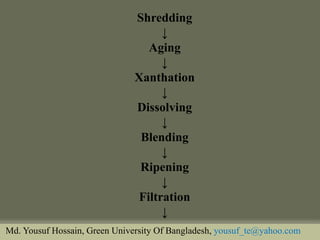
Shredding 
↓ 
Aging 
↓ 
Xanthation 
↓ 
Dissolving 
↓ 
Blending 
↓ 
Ripening 
↓ 
Filtration 
↓ 
Md. Yousuf Hossain, Green University Of Bangladesh, yousuf_te@yahoo.com
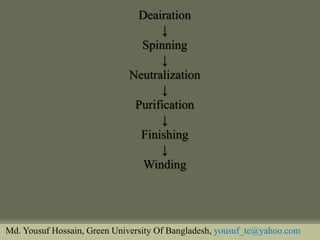
Deairation 
↓ 
Spinning 
↓ 
Neutralization 
↓ 
Purification 
↓ 
Finishing 
↓ 
Winding 
Md. Yousuf Hossain, Green University Of Bangladesh, yousuf_te@yahoo.com
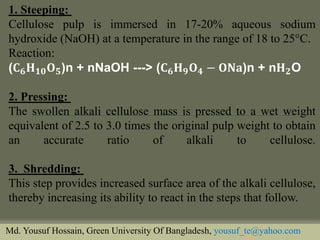
1. Steeping: 
Cellulose pulp is immersed in 17-20% aqueous sodium hydroxide (NaOH) at a temperature in the range of 18 to 25°C. 
Reaction: 
(퐂ퟔ퐇ퟏퟎ퐎ퟓ)n + nNaOH ---> (퐂ퟔ퐇ퟗ퐎ퟒ−퐎퐍퐚)n + n퐇ퟐO 
2. Pressing: 
The swollen alkali cellulose mass is pressed to a wet weight equivalent of 2.5 to 3.0 times the original pulp weight to obtain an accurate ratio of alkali to cellulose. 
3. Shredding: 
This step provides increased surface area of the alkali cellulose, thereby increasing its ability to react in the steps that follow. 
Md. Yousuf Hossain, Green University Of Bangladesh, yousuf_te@yahoo.com
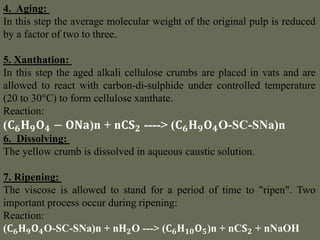
4. Aging: 
In this step the average molecular weight of the original pulp is reduced by a factor of two to three. 
5. Xanthation: 
In this step the aged alkali cellulose crumbs are placed in vats and are allowed to react with carbon-di-sulphide under controlled temperature (20 to 30°C) to form cellulose xanthate. 
Reaction: 
(퐂ퟔ퐇ퟗ퐎ퟒ−퐎퐍퐚)n + n퐂퐒ퟐ ----> (퐂ퟔ퐇ퟗ퐎ퟒO-SC-SNa)n 
6. Dissolving: 
The yellow crumb is dissolved in aqueous caustic solution. 
7. Ripening: 
The viscose is allowed to stand for a period of time to "ripen". Two important process occur during ripening: 
Reaction: 
(퐂ퟔ퐇ퟗ퐎ퟒO-SC-SNa)n + n퐇ퟐO ---> (퐂ퟔ퐇ퟏퟎ퐎ퟓ)n + nC퐒ퟐ + nNaOH
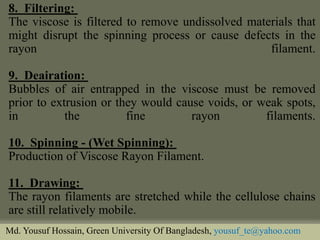
8. Filtering: 
The viscose is filtered to remove undissolved materials that might disrupt the spinning process or cause defects in the rayon filament. 
9. Deairation: 
Bubbles of air entrapped in the viscose must be removed prior to extrusion or they would cause voids, or weak spots, in the fine rayon filaments. 
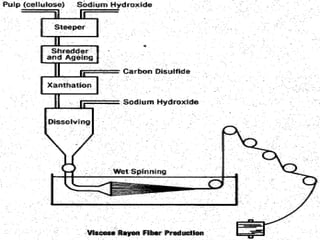
10. Spinning - (Wet Spinning): 
Production of Viscose Rayon Filament. 
11. Drawing: 
The rayon filaments are stretched while the cellulose chains are still relatively mobile. 
Md. Yousuf Hossain, Green University Of Bangladesh, yousuf_te@yahoo.com
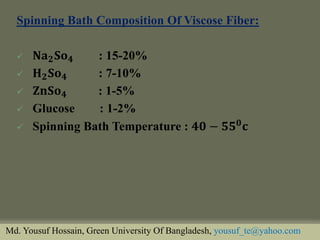
Spinning Bath Composition Of Viscose Fiber: 
퐍퐚ퟐ퐒퐨ퟒ : 15-20% 
퐇ퟐ퐒퐨ퟒ : 7-10% 
퐙퐧퐒퐨ퟒ : 1-5% 
Glucose : 1-2% 
Spinning Bath Temperature : ퟒퟎ−ퟓퟓퟎ퐜 
Md. Yousuf Hossain, Green University Of Bangladesh, yousuf_te@yahoo.com
End-Uses 
It is used in many apparel end-uses. 
Often blended with other fibers, and in hygienic disposables where its high absorbency is of great advantage. 
It is used very little in home furnishing fabrics but in the industrial field, because of its thermal stability. 
Md. Yousuf Hossain, Green University Of Bangladesh, yousuf_te@yahoo.com
Any Question? 
1.? 
2.? 
3.? 
4.? 
Md. Yousuf Hossain, Green University Of Bangladesh, yousuf_te@yahoo.com
Thanks To ALL 
Md. Yousuf Hossain, Green University Of Bangladesh, yousuf_te@yahoo.com

Viscose rayon fiber production process

  • 1.
    Welcome To MyPresentation Presentation On Viscose Rayon Production Presented By: Md. Yousuf Hossain. Id No. :120103063 Md. Yousuf Hossain, Green University Of Bangladesh, yousuf_te@yahoo.com
  • 2.
    Viscose Rayon: ViscoseRayon is a re-generated cellulosic fiber. It is a manmade fiber and it is produced from the cellulose. Viscose Rayon is also called as artificial silk. Mainly viscose rayon is used as the alternatives of natural silk fiber. Pulp is the raw material which is produced from the wood, seed hair, leaf, grasses and bamboo which contain cellulose. Md. Yousuf Hossain, Green University Of Bangladesh, yousuf_te@yahoo.com
  • 3.
    Characteristics of ViscoseFiber : Highly absorbent. Soft and comfortable. Easy to dye . Drapes well . Versatile. It does not shrink when heated It is biodegradable. Md. Yousuf Hossain, Green University Of Bangladesh, yousuf_te@yahoo.com
  • 4.
    Properties Of ViscoseFiber: i.Dry Tenacity (GPD) : 2.5 to 3 ii.Wet Tenacity (GPD) : 40 to 50% less iii.Moisture Regain : 13% iv.Lusture : Light to bright v.Elasticity : Good vi.Melting Point : ퟏퟓퟎퟎ풄 vii.Elongation Percentage : 20-25% Md. Yousuf Hossain, Green University Of Bangladesh, yousuf_te@yahoo.com
  • 5.
    Raw Materials (WoodPieces) ↓ Purification ↓ Pulp Preparation ↓ Steeping in NaOH ↓ Pressing ↓ Process Flow Chart In Viscose Rayon Production: Although viscose rayon is a manmade fiber and it is produced by a spinning process. Md. Yousuf Hossain, Green University Of Bangladesh, yousuf_te@yahoo.com
  • 6.
    Shredding ↓ Aging ↓ Xanthation ↓ Dissolving ↓ Blending ↓ Ripening ↓ Filtration ↓ Md. Yousuf Hossain, Green University Of Bangladesh, yousuf_te@yahoo.com
  • 7.
    Deairation ↓ Spinning ↓ Neutralization ↓ Purification ↓ Finishing ↓ Winding Md. Yousuf Hossain, Green University Of Bangladesh, yousuf_te@yahoo.com
  • 9.
    1. Steeping: Cellulosepulp is immersed in 17-20% aqueous sodium hydroxide (NaOH) at a temperature in the range of 18 to 25°C. Reaction: (퐂ퟔ퐇ퟏퟎ퐎ퟓ)n + nNaOH ---> (퐂ퟔ퐇ퟗ퐎ퟒ−퐎퐍퐚)n + n퐇ퟐO 2. Pressing: The swollen alkali cellulose mass is pressed to a wet weight equivalent of 2.5 to 3.0 times the original pulp weight to obtain an accurate ratio of alkali to cellulose. 3. Shredding: This step provides increased surface area of the alkali cellulose, thereby increasing its ability to react in the steps that follow. Md. Yousuf Hossain, Green University Of Bangladesh, yousuf_te@yahoo.com
  • 10.
    4. Aging: Inthis step the average molecular weight of the original pulp is reduced by a factor of two to three. 5. Xanthation: In this step the aged alkali cellulose crumbs are placed in vats and are allowed to react with carbon-di-sulphide under controlled temperature (20 to 30°C) to form cellulose xanthate. Reaction: (퐂ퟔ퐇ퟗ퐎ퟒ−퐎퐍퐚)n + n퐂퐒ퟐ ----> (퐂ퟔ퐇ퟗ퐎ퟒO-SC-SNa)n 6. Dissolving: The yellow crumb is dissolved in aqueous caustic solution. 7. Ripening: The viscose is allowed to stand for a period of time to "ripen". Two important process occur during ripening: Reaction: (퐂ퟔ퐇ퟗ퐎ퟒO-SC-SNa)n + n퐇ퟐO ---> (퐂ퟔ퐇ퟏퟎ퐎ퟓ)n + nC퐒ퟐ + nNaOH
  • 11.
    8. Filtering: Theviscose is filtered to remove undissolved materials that might disrupt the spinning process or cause defects in the rayon filament. 9. Deairation: Bubbles of air entrapped in the viscose must be removed prior to extrusion or they would cause voids, or weak spots, in the fine rayon filaments. 10. Spinning - (Wet Spinning): Production of Viscose Rayon Filament. 11. Drawing: The rayon filaments are stretched while the cellulose chains are still relatively mobile. Md. Yousuf Hossain, Green University Of Bangladesh, yousuf_te@yahoo.com
  • 12.
    Spinning Bath CompositionOf Viscose Fiber: 퐍퐚ퟐ퐒퐨ퟒ : 15-20% 퐇ퟐ퐒퐨ퟒ : 7-10% 퐙퐧퐒퐨ퟒ : 1-5% Glucose : 1-2% Spinning Bath Temperature : ퟒퟎ−ퟓퟓퟎ퐜 Md. Yousuf Hossain, Green University Of Bangladesh, yousuf_te@yahoo.com
  • 13.
    End-Uses It isused in many apparel end-uses. Often blended with other fibers, and in hygienic disposables where its high absorbency is of great advantage. It is used very little in home furnishing fabrics but in the industrial field, because of its thermal stability. Md. Yousuf Hossain, Green University Of Bangladesh, yousuf_te@yahoo.com
  • 14.
    Any Question? 1.? 2.? 3.? 4.? Md. Yousuf Hossain, Green University Of Bangladesh, yousuf_te@yahoo.com
  • 15.
    Thanks To ALL Md. Yousuf Hossain, Green University Of Bangladesh, yousuf_te@yahoo.com