Viscose Rayon
Rayons
According to FTC (Federal trade commission):
A manufactured fiber composed of regenerated cellulose
in which substituent have replaced not more than 15 %
of hydrogen of hydroxyl groups
Viscose Rayon
 Rayon is the oldest commercial manmade fiber.
 The process of making viscose was discovered
by C.F.Cross and E.J.Bevan in 1891
 It is now manufactured abundantly as its raw
material is cellulose and is available in large
quantities in timber and vegetable matter
 Initially there were so many names of Rayon.
Viscose Rayon
 The viscose method is relatively inexpensive and of particular
significance in the production of nonwoven fabrics.
 It is not synthetic rather it is regeneration of cellulose.
 Its properties are more similar to cotton and flax rather than
polyester and nylon.
 Viscose Rayon has silk like aesthetic and good feel.
 The name viscose was derived from the word viscous, which
mean liquid state of spinning solution.
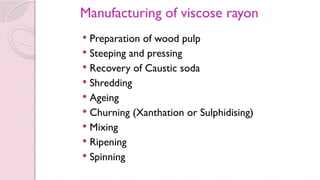
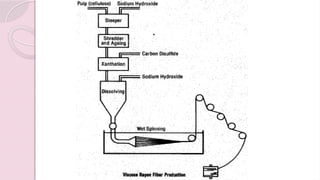
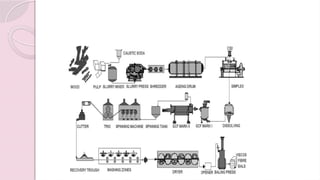
Manufacturing of viscose rayon
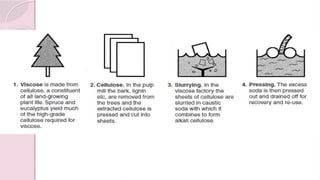
 Preparation of wood pulp
 Steeping and pressing
 Recovery of Caustic soda
 Shredding
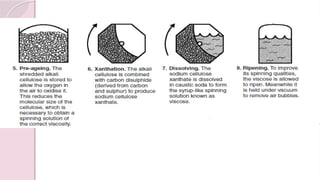
 Ageing
 Churning (Xanthation or Sulphidising)
 Mixing
 Ripening
 Spinning
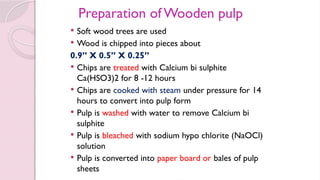
Preparation of Wooden pulp
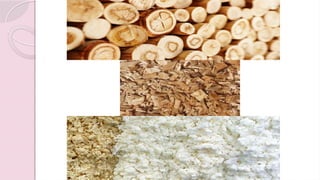
 Soft wood trees are used
 Wood is chipped into pieces about
0.9’’ X 0.5’’ X 0.25’’
 Chips are treated with Calcium bi sulphite
Ca(HSO3)2 for 8 -12 hours
 Chips are cooked with steam under pressure for 14
hours to convert into pulp form
 Pulp is washed with water to remove Calcium bi
sulphite
 Pulp is bleached with sodium hypo chlorite (NaOCl)
solution
 Pulp is converted into paper board or bales of pulp
sheets
Steeping and pressing
 The cellulose pulp sheets are steeped in 17.5 % NaOH
solution for 1-4 hours
 It is then pressed to remove excess solution
 This process is called “ steeping”
 Cellulose is swollen and liquid turn brown
 Excess of alkali is pressed out
 This process is known as “ pressing”
 Moist soda cellulose mass is obtained
Recovery of caustic soda
 Moist soda cellulose is allowed to diffuse through
membranes to obtain pure caustic soda
 Recovery of caustic soda is important for economic
purpose
 Used Caustic soda is concentrated and mixed with fresh
caustic soda to reuse it
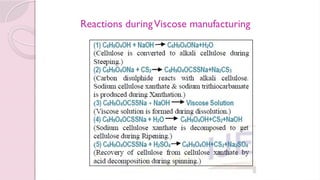
Empirical formulae of cellulose = (C6H10O5)n
Steeping:
(C6H10O5)n + NaOH = [C6H9O4-ONa]n
(Soda cellulose)
Shredding
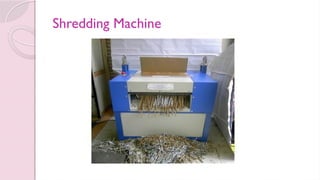
 The shredding machine consists of drum inside which
high speed revolving blades with serrated edges are
installed
 Moist soda sheets are shredded and converted into fine
crumbs
Shredding Machine
Ageing
 Carried out in stirring vessel
 Very important for properties of fibre
 Polymeric chains of cellulose are
degraded in the presence of atmospheric
oxygen at temp 20-25 degree centigrade
 Completed in 1-2 days
Xanthation
 Stainless steel air-tight rotating drum
 It can rotate at about 2 rpm
 Soda cellulose crumbs contain about 30% cellulose
 10% CS2 solution is added to soda cellulose
crumbs
 Soda cellulose and CS2 are churned together to
form deep orange gelatinous mass of sodium
cellulose xanthate
 Xanthation is completed after 3 hours
 After completion of Xanthation, sodium cellulose
xanthate is discharged
Mixing and blending
 Dilute NaOH soln is added in sodium cellulose
xanthate and mixing is carried out for 4-5 hours
 A clear viscous liquid is obtained which is known as
viscose
 Viscose contains 6.5 % NaOH and 7.5 % of cellulose
 Different viscose solutions obtained from different
mixers are blended together along with TiO2 to
balance inequalities and to obtain uniform
homogeneous mixture
 Uniform homogeneous mixture produces better quality of Rayon
 It is filtered to remove any un dissolved particles
 Air bubbles are removed
Ripening
 It is very important part of manufacturing process
 The uniform homogenous viscous solution is stored in stainless
steel vessel at 10-18 ◦
C for 4-5 days for ripening
 During ripening, first of all the viscosity of solution falls down and
then again reaches to its original viscosity
 When original viscosity reaches, this is the proper time
to spin the solution and solution is immediately spun
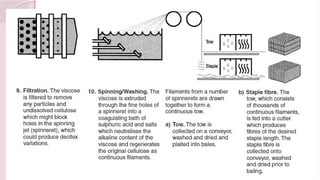
Filtration
Regardless of how well the xanthate is brought into
solution, there will always be particulate material in
the viscose.
This type of impurity needs to be substantially
removed prior to spinning to prevent blockage of the
holes in the spinning jet.
A ripened viscose solution is forced to a centrifugal pump
by compressed air, which delivers it to filtering media.
Filtration
Historically, cloth filters were employed in filter
presses
to remove particulates, with typically three stages of
filtration, each stage consisting of a number of plate
and frame (P&F) units in parallel.
Once blinded by particulates, cloths would be
removed manually and washed for re-use or
discarded.
Filters
Deaeration
To ensure continuity at spinning, the viscose must be deaerated
to remove any dispersed air or other gases that might otherwise
cause small bubbles to form as the viscose is extruded into
filament form through the jet.
Traditional deaeration techniques are employed where a vacuum
is applied while the viscose is passed over a surface. Some CS2
and water is lost from the viscose at deaeration.
Additives
Spinning aids, modifiers and pigments can be added to the viscose
shortly before spinning.
A range of surface active materials can be used to aid spinning
performance. Largely these are fatty acid or fatty amine
ethoxylates.
Most only need a short residence time in viscose, and are added
via a mixer around 10–15min before spinning.
Titanium dioxide can also be added at this point to produce dull or
matt fibres.
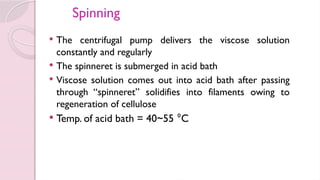
Spinning
 The centrifugal pump delivers the viscose solution
constantly and regularly
 The spinneret is submerged in acid bath
 Viscose solution comes out into acid bath after passing
through “spinneret” solidifies into filaments owing to
regeneration of cellulose
 Temp. of acid bath = 40~55 ⁰C
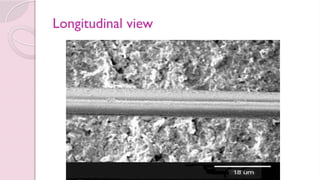
Longitudinal view
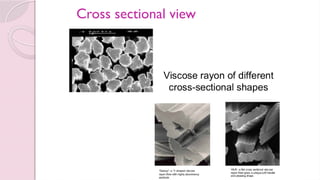
Cross sectional view
Properties of viscose rayon:
Tensile strength:
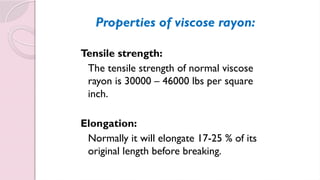
The tensile strength of normal viscose
rayon is 30000 – 46000 lbs per square
inch.
Elongation:
Normally it will elongate 17-25 % of its
original length before breaking.
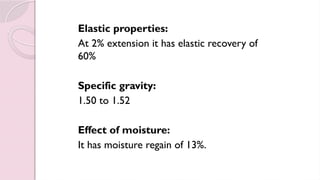
Elastic properties:
At 2% extension it has elastic recovery of
60%
Specific gravity:
1.50 to 1.52
Effect of moisture:
It has moisture regain of 13%.
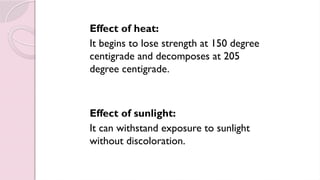
Effect of heat:
It begins to lose strength at 150 degree
centigrade and decomposes at 205
degree centigrade.
Effect of sunlight:
It can withstand exposure to sunlight
without discoloration.
Chemical properties:
It can be attacked by oxidizing agents like
hydrogen peroxide.
Effect of Acids:
Can be attacked by hot dilute acids and
cold concentrated acids.
Effect of alkali:
It has high resistance to dilute alkali and
can be attacked by strong alkalis.
Resistance to insects:
Resistance to insects is good but can be
attacked by silver fish.
Microorganisms:
Resistance to mildews is much better
than cotton.
Major uses of Rayon:
 Apparel: Accessories, dresses, jackets,
sport shirts, sportswear, suits, ties, work
clothes etc.
 Home Furnishings: Bedspreads, blankets,
curtains, sheets, tablecloths.
Reactions duringViscose manufacturing

11- Viscose Rayon properties and structure..pptx

  • 1.
  • 2.
    Rayons According to FTC(Federal trade commission): A manufactured fiber composed of regenerated cellulose in which substituent have replaced not more than 15 % of hydrogen of hydroxyl groups
  • 3.
    Viscose Rayon  Rayonis the oldest commercial manmade fiber.  The process of making viscose was discovered by C.F.Cross and E.J.Bevan in 1891  It is now manufactured abundantly as its raw material is cellulose and is available in large quantities in timber and vegetable matter  Initially there were so many names of Rayon.
  • 4.
    Viscose Rayon  Theviscose method is relatively inexpensive and of particular significance in the production of nonwoven fabrics.  It is not synthetic rather it is regeneration of cellulose.  Its properties are more similar to cotton and flax rather than polyester and nylon.  Viscose Rayon has silk like aesthetic and good feel.  The name viscose was derived from the word viscous, which mean liquid state of spinning solution.
  • 5.
    Manufacturing of viscoserayon  Preparation of wood pulp  Steeping and pressing  Recovery of Caustic soda  Shredding  Ageing  Churning (Xanthation or Sulphidising)  Mixing  Ripening  Spinning
  • 7.
    Preparation of Woodenpulp  Soft wood trees are used  Wood is chipped into pieces about 0.9’’ X 0.5’’ X 0.25’’  Chips are treated with Calcium bi sulphite Ca(HSO3)2 for 8 -12 hours  Chips are cooked with steam under pressure for 14 hours to convert into pulp form  Pulp is washed with water to remove Calcium bi sulphite  Pulp is bleached with sodium hypo chlorite (NaOCl) solution  Pulp is converted into paper board or bales of pulp sheets
  • 9.
    Steeping and pressing The cellulose pulp sheets are steeped in 17.5 % NaOH solution for 1-4 hours  It is then pressed to remove excess solution  This process is called “ steeping”  Cellulose is swollen and liquid turn brown  Excess of alkali is pressed out  This process is known as “ pressing”  Moist soda cellulose mass is obtained
  • 10.
    Recovery of causticsoda  Moist soda cellulose is allowed to diffuse through membranes to obtain pure caustic soda  Recovery of caustic soda is important for economic purpose  Used Caustic soda is concentrated and mixed with fresh caustic soda to reuse it
  • 11.
    Empirical formulae ofcellulose = (C6H10O5)n Steeping: (C6H10O5)n + NaOH = [C6H9O4-ONa]n (Soda cellulose)
  • 12.
    Shredding  The shreddingmachine consists of drum inside which high speed revolving blades with serrated edges are installed  Moist soda sheets are shredded and converted into fine crumbs
  • 13.
  • 14.
    Ageing  Carried outin stirring vessel  Very important for properties of fibre  Polymeric chains of cellulose are degraded in the presence of atmospheric oxygen at temp 20-25 degree centigrade  Completed in 1-2 days
  • 15.
    Xanthation  Stainless steelair-tight rotating drum  It can rotate at about 2 rpm  Soda cellulose crumbs contain about 30% cellulose  10% CS2 solution is added to soda cellulose crumbs  Soda cellulose and CS2 are churned together to form deep orange gelatinous mass of sodium cellulose xanthate  Xanthation is completed after 3 hours  After completion of Xanthation, sodium cellulose xanthate is discharged
  • 16.
    Mixing and blending Dilute NaOH soln is added in sodium cellulose xanthate and mixing is carried out for 4-5 hours  A clear viscous liquid is obtained which is known as viscose  Viscose contains 6.5 % NaOH and 7.5 % of cellulose  Different viscose solutions obtained from different mixers are blended together along with TiO2 to balance inequalities and to obtain uniform homogeneous mixture
  • 17.
     Uniform homogeneousmixture produces better quality of Rayon  It is filtered to remove any un dissolved particles  Air bubbles are removed
  • 18.
    Ripening  It isvery important part of manufacturing process  The uniform homogenous viscous solution is stored in stainless steel vessel at 10-18 ◦ C for 4-5 days for ripening  During ripening, first of all the viscosity of solution falls down and then again reaches to its original viscosity
  • 19.
     When originalviscosity reaches, this is the proper time to spin the solution and solution is immediately spun
  • 20.
    Filtration Regardless of howwell the xanthate is brought into solution, there will always be particulate material in the viscose. This type of impurity needs to be substantially removed prior to spinning to prevent blockage of the holes in the spinning jet. A ripened viscose solution is forced to a centrifugal pump by compressed air, which delivers it to filtering media.
  • 21.
    Filtration Historically, cloth filterswere employed in filter presses to remove particulates, with typically three stages of filtration, each stage consisting of a number of plate and frame (P&F) units in parallel. Once blinded by particulates, cloths would be removed manually and washed for re-use or discarded. Filters
  • 22.
    Deaeration To ensure continuityat spinning, the viscose must be deaerated to remove any dispersed air or other gases that might otherwise cause small bubbles to form as the viscose is extruded into filament form through the jet. Traditional deaeration techniques are employed where a vacuum is applied while the viscose is passed over a surface. Some CS2 and water is lost from the viscose at deaeration.
  • 23.
    Additives Spinning aids, modifiersand pigments can be added to the viscose shortly before spinning. A range of surface active materials can be used to aid spinning performance. Largely these are fatty acid or fatty amine ethoxylates. Most only need a short residence time in viscose, and are added via a mixer around 10–15min before spinning. Titanium dioxide can also be added at this point to produce dull or matt fibres.
  • 24.
    Spinning  The centrifugalpump delivers the viscose solution constantly and regularly  The spinneret is submerged in acid bath  Viscose solution comes out into acid bath after passing through “spinneret” solidifies into filaments owing to regeneration of cellulose  Temp. of acid bath = 40~55 ⁰C
  • 28.
  • 29.
  • 31.
    Properties of viscoserayon: Tensile strength: The tensile strength of normal viscose rayon is 30000 – 46000 lbs per square inch. Elongation: Normally it will elongate 17-25 % of its original length before breaking.
  • 32.
    Elastic properties: At 2%extension it has elastic recovery of 60% Specific gravity: 1.50 to 1.52 Effect of moisture: It has moisture regain of 13%.
  • 33.
    Effect of heat: Itbegins to lose strength at 150 degree centigrade and decomposes at 205 degree centigrade. Effect of sunlight: It can withstand exposure to sunlight without discoloration.
  • 34.
    Chemical properties: It canbe attacked by oxidizing agents like hydrogen peroxide. Effect of Acids: Can be attacked by hot dilute acids and cold concentrated acids. Effect of alkali: It has high resistance to dilute alkali and can be attacked by strong alkalis.
  • 35.
    Resistance to insects: Resistanceto insects is good but can be attacked by silver fish. Microorganisms: Resistance to mildews is much better than cotton.
  • 37.
    Major uses ofRayon:  Apparel: Accessories, dresses, jackets, sport shirts, sportswear, suits, ties, work clothes etc.  Home Furnishings: Bedspreads, blankets, curtains, sheets, tablecloths.
  • 39.

Editor's Notes

  • #12 Serrated----- saw like
  • #14 Galvanized----- stirring For storage purpose------
  • #16 TiO2