DEPARTMENT OF FASHION DESIGN AND
TECHNOLAGY
UTTARA,DHAKA-1230
Presentation
SUBMITED TO :
• SUDIPTA BAIN
• SENIOR LACTURE
• UTTRA UNIVERSITY
• UTTARA,DHAKA -1203
• COURSE TITLE: TEXTILE RAW MATERIALS -2
• COURSE CODE : IE 3002
GROUP MEMBER
NO NAME ID-NUMBER
01 KAZI IQBAL HOSSAIN 2163401030
02 MISHARE AKTHER TONNI 2163401013
03 SANZIDA AKTHER 2163401012
04 SHOVO HOSSAIN 2163401034
05 ASHIKUR RAHMAN 2163401005
06 SIAM HOSSAIN 2163401017
STUDENT INFORMATION
:
KAZI IQBAL HOSSAIN
Department : fdt
Subject : TRM-2
Id : 2163401030
Semester : 4TH
Batch : 13th
ACKNOWLEDGEMENT
• THE HIGHEST HAPPINESS THAT
ACCOMPANIES THE SUCCESSFUL
COMPLETION OF ANY TUSK WOULD BE
INCOMPLETE WITH OUT THE EXPRESSION OF
GRATITUDE TO ALL THOSE PEOPLE WHO
HAVE HELPED ME THOROUGH OUT THIS
PROJECT AS SUCCESS IS THE ABSTRACT OF
HARD WORK.
• I WOULD LIKE TO EXPRESS MY HEARTFELT
GRATITUDE TO OUR HONORABLE TEACHER
( ENG.SADIQUR RAHAMAN ) PERMITTING ME
TO DO THE PROJECT (PRODUCTION
MANAGEMENT )AND ALSO FOR HIS
INSPIRING GUIDANCE, SUPPORT ,VALUABLE
INPUTS AND CONSTRUCTIVE CRITICISM TO
DEVELOP AND COMPLETE THIS
ASSIGNMENT…
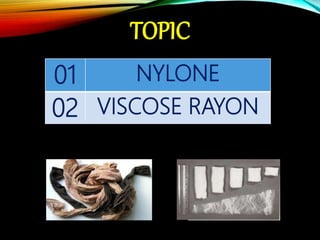
TOPIC
01 NYLONE
02 VISCOSE RAYON
NYLON
NYLON
NO TOPIC
01 GENERAL INFORMATION ABOUT NYLON
02 DISCUS ABOUT MONOMER
03 DESCRIBE POLYMERIZATION
04 DESCRIBE MANUFACTURING PROSSES
05 COMPOSITION IN TERMS OF PROPERTIES
06 NYLON USES
INTRODUCTION ABOUT NYLONE
• First created by William Carother, a
Lecturer from Harvard University, in
1934 at DuPont Company research lab
• DuPont scientist created Nylon 6.6
• German scientist created Nylon 6
• Second most used fiber in the U.S.A
• First used in a nylon toothbrush
Nylon is a generic designation for a family of synthetic
polymers, based on aliphatic or semi-aromatic polyamides.
Nylon is a thermoplastic silky material[1] that can be melt-
processed into fibers, filmsor shapes.
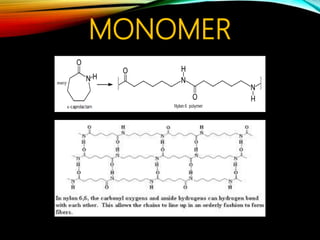
MONOMER
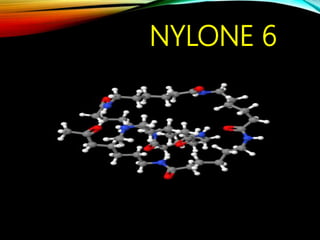
NYLONE 6
NYLONE 6.6
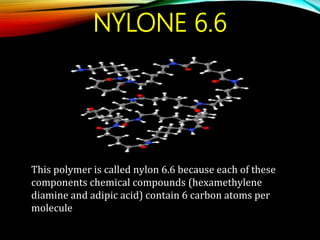
This polymer is called nylon 6.6 because each of these
components chemical compounds (hexamethylene
diamine and adipic acid) contain 6 carbon atoms per
molecule
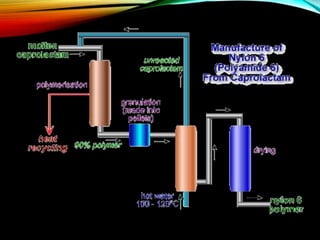
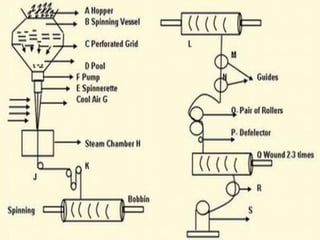
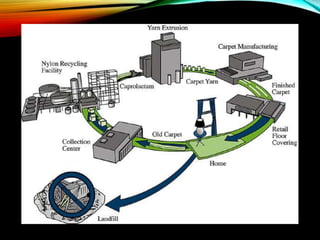
MANUFACTURING PROCESS OF
NYLON
PROPARTIES OF NYLON
CHEMICAL PROPERTIES
• Effect of acid:
• Easily destroyed by cold concentrated acid
• Effect of alkali:
• High resistant to alkali
• Effect of bleaches:
• Strong bleaches destroy nylon 6.6
• Effect of organic solvent: little or no effect
• Dye affinity: Good
• Nylon is hydrophobic
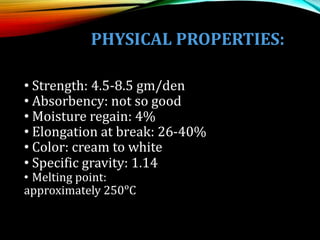
PHYSICAL PROPERTIES:
• Strength: 4.5-8.5 gm/den
• Absorbency: not so good
• Moisture regain: 4%
• Elongation at break: 26-40%
• Color: cream to white
• Specific gravity: 1.14
• Melting point:
approximately 250ᵒC
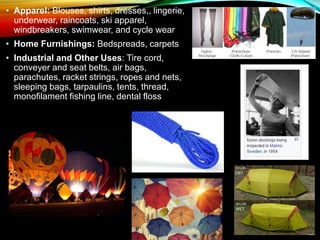
USES OF NYLON
• Apparel: Blouses, shirts, dresses,, lingerie,
underwear, raincoats, ski apparel,
windbreakers, swimwear, and cycle wear
• Home Furnishings: Bedspreads, carpets
• Industrial and Other Uses: Tire cord,
conveyer and seat belts, air bags,
parachutes, racket strings, ropes and nets,
sleeping bags, tarpaulins, tents, thread,
monofilament fishing line, dental floss
VISCOS RAYON
VISCOSE RAYON
NO TOPIC
01 General information about viscose rayon
02 Discus about monomer
03 Describe polymerization
04 Describe manufacturing prosses
05 Composition in terms of properties
06 viscose rayon uses
VISCOS
• Viscose is a semi-synthetic fiber. "Viscose" can mean:
• A viscous solution of cellulose, which can be made into
rayon or cellophane
• A synonym for rayon
• A specific term for viscose rayon—rayon made using
the viscose (cellulose xanthate) process
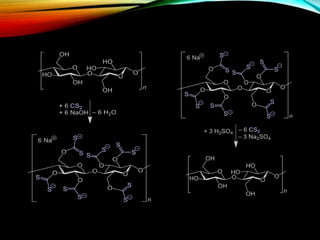
• The viscose process dissolves pulpwith aqueous sodium
hydroxide in the presence of carbon disulfide. This
viscous solution bears the name viscose. The cellulose
solution is used to spin the viscose rayon fiber, which
may also be called viscose. Viscose rayon fiber is a soft
fiber commonly used in dresses, linings, shirts, shorts,
coats, jackets, and other outerwear. It is also used in
industrial yarns (tyre cord), upholstery and carpets, and
in the casting of cellophane.
MONOMER
• Viscose rayon is a fiber of regenerated cellulose; it is
structurally similar to cotton but may be produced from a
variety of plants such as soy, bamboo, and sugar cane.
Cellulose is a linear polymer of β-D-glucose units with the
empirical formula (C6H10O5)n.[2] To prepare viscose, dissolving
pulp is treated with aqueous sodium hydroxide (typically 16-
19% w/w) to form "alkali cellulose," which has the
approximate formula [C6H9O4-ONa]n. The alkali cellulose is
then treated with carbon disulfide to form sodium
cellulose xanthate.[3]
• [C6H9O4-ONa]n + nCS2 → [C6H9O4-OCS2Na]n
• Rayon fiber is produced from the ripened solutions by
treatment with a mineral acid, such as sulfuric acid. In this
step, the xanthate groups are hydrolyzed to regenerate
cellulose and release dithiocarbonic acid that later
decomposes to carbon disulfide and water:[5]
• [C6H9O4-OCS2Na]2n + nH2SO4 → [C6H9O4-OH]2n +2nCS2 +
nNa2SO4
• H2COS2 → H2O + CS2
SHOVO HOSSAIN
Department : fdt
Subject : TRM-2
Id : 2163401034
Semester : 4TH
Batch : 13th
POLEMAR OF VISCOSE
RAYON
MANUFACTUER
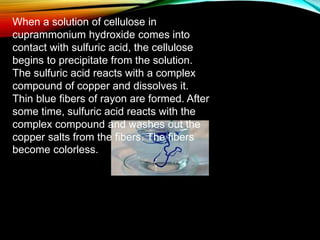
When a solution of cellulose in
cuprammonium hydroxide comes into
contact with sulfuric acid, the cellulose
begins to precipitate from the solution.
The sulfuric acid reacts with a complex
compound of copper and dissolves it.
Thin blue fibers of rayon are formed. After
some time, sulfuric acid reacts with the
complex compound and washes out the
copper salts from the fibers. The fibers
become colorless.
ASIKUR RAHMAN
Department : fdt
Subject : TRM-2
Id : 2163401005
Semester : 4TH
Batch : 13th
• Rayon or artificial silk is a manufactured regenerated cellulose
fiber.
• It is made from purified cellulose, primarily from wood pulp, which
is chemically converted into a soluble compound. It is then
dissolved and forced through a spinneret to produce filaments
which are chemically solidified, resulting in synthetic fibers of
nearly pure cellulose.[1]
• Workers can be seriously harmed by the carbon disulfide used to
make most rayon.[2][3]
• Because rayon is manufactured from naturally occurring polymers,
it is considered a semi-synthetic fiber.[4] Specific types of rayon
include viscose, modal and lyocell, each of which differs in
manufacturing process and properties of the finished product.
PROPARTIES
• The durability and appearance retention of regular viscose
rayon are low, especially when wet; also, rayon has the
lowest elastic recovery of any fiber. However, HWM rayon
(high-wet-modulus rayon) is much stronger and exhibits
higher durability and appearance retention. Recommended
care for regular viscose rayon is dry-cleaning only. HWM
rayon can be machine washed.[10]
• Rayon industrial yarns outperform polyester and are
produced for belts in high performance tires (e.g. Cordenka,
Germany).
SIAM HOSSAIN
Department : fdt
Subject : TRM-2
Id : 2163401017
Semester : 4TH
Batch : 13th
USES OF VISCOSE RAYON
• Rayon is a versatile fiber and is widely claimed to
have the same comfort properties as natural fibers,
although the drape and slipperiness of rayon
textiles are often more like nylon. It can imitate the
feel and texture of silk, wool, cotton and linen. The
fibers are easily dyed in a wide range of colors.
Rayon fabrics are soft, smooth, cool, comfortable,
and highly absorbent, but they do not insulate body
heat, making them ideal for use in hot and humid
climates, although also making their "hand" (feel)
cool and sometimes almost slimy to the touch
THANK TO ALL

Nylon and viscos

  • 1.
    DEPARTMENT OF FASHIONDESIGN AND TECHNOLAGY UTTARA,DHAKA-1230 Presentation
  • 2.
    SUBMITED TO : •SUDIPTA BAIN • SENIOR LACTURE • UTTRA UNIVERSITY • UTTARA,DHAKA -1203 • COURSE TITLE: TEXTILE RAW MATERIALS -2 • COURSE CODE : IE 3002
  • 3.
    GROUP MEMBER NO NAMEID-NUMBER 01 KAZI IQBAL HOSSAIN 2163401030 02 MISHARE AKTHER TONNI 2163401013 03 SANZIDA AKTHER 2163401012 04 SHOVO HOSSAIN 2163401034 05 ASHIKUR RAHMAN 2163401005 06 SIAM HOSSAIN 2163401017
  • 4.
    STUDENT INFORMATION : KAZI IQBALHOSSAIN Department : fdt Subject : TRM-2 Id : 2163401030 Semester : 4TH Batch : 13th
  • 5.
    ACKNOWLEDGEMENT • THE HIGHESTHAPPINESS THAT ACCOMPANIES THE SUCCESSFUL COMPLETION OF ANY TUSK WOULD BE INCOMPLETE WITH OUT THE EXPRESSION OF GRATITUDE TO ALL THOSE PEOPLE WHO HAVE HELPED ME THOROUGH OUT THIS PROJECT AS SUCCESS IS THE ABSTRACT OF HARD WORK. • I WOULD LIKE TO EXPRESS MY HEARTFELT GRATITUDE TO OUR HONORABLE TEACHER ( ENG.SADIQUR RAHAMAN ) PERMITTING ME TO DO THE PROJECT (PRODUCTION MANAGEMENT )AND ALSO FOR HIS INSPIRING GUIDANCE, SUPPORT ,VALUABLE INPUTS AND CONSTRUCTIVE CRITICISM TO DEVELOP AND COMPLETE THIS ASSIGNMENT…
  • 6.
  • 7.
  • 8.
    NYLON NO TOPIC 01 GENERALINFORMATION ABOUT NYLON 02 DISCUS ABOUT MONOMER 03 DESCRIBE POLYMERIZATION 04 DESCRIBE MANUFACTURING PROSSES 05 COMPOSITION IN TERMS OF PROPERTIES 06 NYLON USES
  • 9.
    INTRODUCTION ABOUT NYLONE •First created by William Carother, a Lecturer from Harvard University, in 1934 at DuPont Company research lab • DuPont scientist created Nylon 6.6 • German scientist created Nylon 6 • Second most used fiber in the U.S.A • First used in a nylon toothbrush Nylon is a generic designation for a family of synthetic polymers, based on aliphatic or semi-aromatic polyamides. Nylon is a thermoplastic silky material[1] that can be melt- processed into fibers, filmsor shapes.
  • 10.
  • 11.
  • 12.
    NYLONE 6.6 This polymeris called nylon 6.6 because each of these components chemical compounds (hexamethylene diamine and adipic acid) contain 6 carbon atoms per molecule
  • 13.
  • 18.
  • 19.
    CHEMICAL PROPERTIES • Effectof acid: • Easily destroyed by cold concentrated acid • Effect of alkali: • High resistant to alkali • Effect of bleaches: • Strong bleaches destroy nylon 6.6 • Effect of organic solvent: little or no effect • Dye affinity: Good • Nylon is hydrophobic
  • 20.
    PHYSICAL PROPERTIES: • Strength:4.5-8.5 gm/den • Absorbency: not so good • Moisture regain: 4% • Elongation at break: 26-40% • Color: cream to white • Specific gravity: 1.14 • Melting point: approximately 250ᵒC
  • 21.
  • 22.
    • Apparel: Blouses,shirts, dresses,, lingerie, underwear, raincoats, ski apparel, windbreakers, swimwear, and cycle wear • Home Furnishings: Bedspreads, carpets • Industrial and Other Uses: Tire cord, conveyer and seat belts, air bags, parachutes, racket strings, ropes and nets, sleeping bags, tarpaulins, tents, thread, monofilament fishing line, dental floss
  • 23.
  • 24.
    VISCOSE RAYON NO TOPIC 01General information about viscose rayon 02 Discus about monomer 03 Describe polymerization 04 Describe manufacturing prosses 05 Composition in terms of properties 06 viscose rayon uses
  • 25.
    VISCOS • Viscose isa semi-synthetic fiber. "Viscose" can mean: • A viscous solution of cellulose, which can be made into rayon or cellophane • A synonym for rayon • A specific term for viscose rayon—rayon made using the viscose (cellulose xanthate) process • The viscose process dissolves pulpwith aqueous sodium hydroxide in the presence of carbon disulfide. This viscous solution bears the name viscose. The cellulose solution is used to spin the viscose rayon fiber, which may also be called viscose. Viscose rayon fiber is a soft fiber commonly used in dresses, linings, shirts, shorts, coats, jackets, and other outerwear. It is also used in industrial yarns (tyre cord), upholstery and carpets, and in the casting of cellophane.
  • 26.
    MONOMER • Viscose rayonis a fiber of regenerated cellulose; it is structurally similar to cotton but may be produced from a variety of plants such as soy, bamboo, and sugar cane. Cellulose is a linear polymer of β-D-glucose units with the empirical formula (C6H10O5)n.[2] To prepare viscose, dissolving pulp is treated with aqueous sodium hydroxide (typically 16- 19% w/w) to form "alkali cellulose," which has the approximate formula [C6H9O4-ONa]n. The alkali cellulose is then treated with carbon disulfide to form sodium cellulose xanthate.[3] • [C6H9O4-ONa]n + nCS2 → [C6H9O4-OCS2Na]n
  • 27.
    • Rayon fiberis produced from the ripened solutions by treatment with a mineral acid, such as sulfuric acid. In this step, the xanthate groups are hydrolyzed to regenerate cellulose and release dithiocarbonic acid that later decomposes to carbon disulfide and water:[5] • [C6H9O4-OCS2Na]2n + nH2SO4 → [C6H9O4-OH]2n +2nCS2 + nNa2SO4 • H2COS2 → H2O + CS2
  • 28.
    SHOVO HOSSAIN Department :fdt Subject : TRM-2 Id : 2163401034 Semester : 4TH Batch : 13th
  • 29.
  • 31.
  • 32.
    When a solutionof cellulose in cuprammonium hydroxide comes into contact with sulfuric acid, the cellulose begins to precipitate from the solution. The sulfuric acid reacts with a complex compound of copper and dissolves it. Thin blue fibers of rayon are formed. After some time, sulfuric acid reacts with the complex compound and washes out the copper salts from the fibers. The fibers become colorless.
  • 33.
    ASIKUR RAHMAN Department :fdt Subject : TRM-2 Id : 2163401005 Semester : 4TH Batch : 13th
  • 34.
    • Rayon orartificial silk is a manufactured regenerated cellulose fiber. • It is made from purified cellulose, primarily from wood pulp, which is chemically converted into a soluble compound. It is then dissolved and forced through a spinneret to produce filaments which are chemically solidified, resulting in synthetic fibers of nearly pure cellulose.[1] • Workers can be seriously harmed by the carbon disulfide used to make most rayon.[2][3] • Because rayon is manufactured from naturally occurring polymers, it is considered a semi-synthetic fiber.[4] Specific types of rayon include viscose, modal and lyocell, each of which differs in manufacturing process and properties of the finished product.
  • 35.
  • 36.
    • The durabilityand appearance retention of regular viscose rayon are low, especially when wet; also, rayon has the lowest elastic recovery of any fiber. However, HWM rayon (high-wet-modulus rayon) is much stronger and exhibits higher durability and appearance retention. Recommended care for regular viscose rayon is dry-cleaning only. HWM rayon can be machine washed.[10] • Rayon industrial yarns outperform polyester and are produced for belts in high performance tires (e.g. Cordenka, Germany).
  • 37.
    SIAM HOSSAIN Department :fdt Subject : TRM-2 Id : 2163401017 Semester : 4TH Batch : 13th
  • 38.
  • 39.
    • Rayon isa versatile fiber and is widely claimed to have the same comfort properties as natural fibers, although the drape and slipperiness of rayon textiles are often more like nylon. It can imitate the feel and texture of silk, wool, cotton and linen. The fibers are easily dyed in a wide range of colors. Rayon fabrics are soft, smooth, cool, comfortable, and highly absorbent, but they do not insulate body heat, making them ideal for use in hot and humid climates, although also making their "hand" (feel) cool and sometimes almost slimy to the touch
  • 41.