Presentation on
Disperse Dyes
Presented By :
Venue: NUB, Date : November 27, 2016
Name ID
1) Sihab uddin BTX-150100372
2) Shekh Sahriaz Kaiser BTX-15000375
3)Saiful islam BTX-150100376
4) Muhammad Nafiz Reza BTX-150100377
Welcome To Our Presentation
Venue: NUB, Date : November 27, 2016
Disperse Dyes :
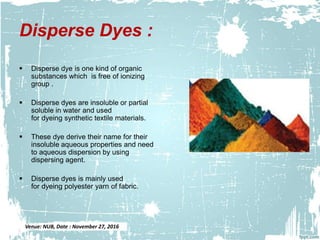
 Disperse dye is one kind of organic
substances which is free of ionizing
group .
 Disperse dyes are insoluble or partial
soluble in water and used
for dyeing synthetic textile materials.
 These dye derive their name for their
insoluble aqueous properties and need
to aqueous dispersion by using
dispersing agent.
 Disperse dyes is mainly used
for dyeing polyester yarn of fabric.
Venue: NUB, Date : November 27, 2016
History of disperse dye
• In 1922, Green and Saunders made one type of colored azo
compound, in which a solubilizing group is attached to amino group.
• In dye bath, they are slowly hydrolyzed and produce azo compound
and formaldehyde bi sulphate. This free azo compound was capable
of dyeing cellulose acetate fibers. This dye was named “ionamine”.
But this ion amine did not give satisfactory result in dyeing.
• Later in 1924, Baddiley and Ellis produced sulpho ricinoleic acid
(SRA) for dyeing acetate fibers. This SRA was used as dispersing
agent. Later it was seen that SRA was capable of dyeing Nylon,
polyester, acrylic etc.
• In 1953 this dye was named as “Disperse Dye”.
Venue: NUB, Date : November 27, 2016
Properties of disperse dye :
• Disperse dye is one kind of organic substances which is free of
ionizing group
• Disperse dye are non-soluble in nature.
• Disperse dye are insoluble in water.
• Dispersing agent are needed for dyeing with disperse dye.
• Fastness properties specially wet and light fastness is good to
excellent.
• Disperse dye widely used for dyeing synthetic fibers. Polyester fiber
is dyed by disperse dye.
• Disperse dye dyeing is carried out in high temperature.
• Molecular size of disperse dyes are smaller than other dye.
• In some case carrier method are applied for polyester dyeing.
Venue: NUB, Date : November 27, 2016
Classification of disperse dye :
According to Chemical Structure:
• Nitro Dyes.
• Amino Kenton dyes.
• Anthraquinonoid dyes.
• Mono azo dyes.
• Di- azo dyes.
Venue: NUB, Date : November 27, 2016
Classification of disperse dye :
According to Fastness Property :
• Group A: These dyes have excellent dyeing properties and good
fastness properties.
• Group B: These dyes are excellent in high temperature and for
carrier dyeing with moderate fastness.
• Group C: These dyes are moderate for carrier and high temperature
dyeing with higher fastness property than group B dyes.
• Group D: These dyes are of excellent fastness to heat but for
dyeing properties on carrier method.
Venue: NUB, Date : November 27, 2016
Dispersing Agent :
The dispersing agent is an organic compound which can
perform many functions in dyeing. Dispersing agents are
effective under the dyeing conditions and stable to hard
water, high temperature and other dye assistance which
help to maintain dispersion of dye molecule in the dye
bath. It assists the process of dye particle size reduction
and helpful to solubilize the dye particle. Dispersing
agent increases the solubility of disperse dye in water.
Example: Urea, Lyoprint G.
Venue: NUB, Date : November 27, 2016
Function of Dispersing Agent
used in Disperse Dyeing :
• It assists the reduction of dye particle size
• It enables the dye to be formed in the powder form.
• When the powder is added to dye bath, it facilitates the
reconversion of the powder into a dispersion that is
required for carrying out the dyeing.
• It maintains the dispersion in a fine form in the dye bath
through the dyeing process.
• It increases the solubility of the disperse dye in water.
• It affects on the rate of dyeing.
Venue: NUB, Date : November 27, 2016
High temperature dyeing :
There are many advantages associated with dyeing
polyester at temperature range between 120°C and
130°C. Heavy shade can be dyed pleated because of
the permanency of the crease so formed. When dyeing
at atmospheric pressure, only dyes of low molecular
weight which tends to sublime during pleating can be
used, the more satisfactory colours with higher molecular
weights can be applied at 120°C -130°C.
Venue: NUB, Date : November 27,
2016
Carrier dyeing :
Carrier is an organic compound which helps to dye take
up at lower temperature and lower pressure over the
textile material. It acts as a substantive swelling agent.
Carriers are dyeing assistance which alter the dispersing
properties of the dyes and physical characteristics of the
fiber so that more of the dye can be transferred from the
dye bath to the fiber.
Venue: NUB, Date : November 27, 2016
Commercial (Trade name) Name
of Carrier :
• Tumescal –A.C.I.
• Matexil –A.C.I.
• Levagol –Bayer.
• Dilatin –Sandoz.
• Invalon –Ciba.
• Hisogal –Hoechst.
Venue: NUB, Date : November 27, 2016
Function of carrier :
 Dye carry.
 Solubility of dyes.
 T.G (glass trangition temperature) reduce.
Venue: NUB, Date : November 27, 2016
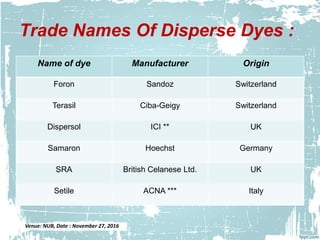
Trade Names Of Disperse Dyes :
Name of dye Manufacturer Origin
Foron Sandoz Switzerland
Terasil Ciba-Geigy Switzerland
Dispersol ICI ** UK
Samaron Hoechst Germany
SRA British Celanese Ltd. UK
Setile ACNA *** Italy
Venue: NUB, Date : November 27, 2016
Reference :
• http://textilelearner.blogspot.com/2012/01/classification-of-disperse-
dyes.html
• http://textilefashionstudy.com/disperse-dyes-properties-of-disperse-dye/
• https://sites.google.com/site/wwwtextilehelpercom/home/author/archive/disp
erse_dye-history-of-disperse-dye_properties-of-disperse-dyes
• http://textilelibrary.blogspot.com/2009/03/disperse-dye.html
• https://textileapex.blogspot.com/2013/12/disperse-dye_1.htm
Venue: NUB, Date : November 27, 2016
Thank you for your Attention
Venue: NUB, Date : November 27, 2016

Disperse dye

  • 1.
    Presentation on Disperse Dyes PresentedBy : Venue: NUB, Date : November 27, 2016 Name ID 1) Sihab uddin BTX-150100372 2) Shekh Sahriaz Kaiser BTX-15000375 3)Saiful islam BTX-150100376 4) Muhammad Nafiz Reza BTX-150100377
  • 2.
    Welcome To OurPresentation Venue: NUB, Date : November 27, 2016
  • 3.
    Disperse Dyes : Disperse dye is one kind of organic substances which is free of ionizing group .  Disperse dyes are insoluble or partial soluble in water and used for dyeing synthetic textile materials.  These dye derive their name for their insoluble aqueous properties and need to aqueous dispersion by using dispersing agent.  Disperse dyes is mainly used for dyeing polyester yarn of fabric. Venue: NUB, Date : November 27, 2016
  • 4.
    History of dispersedye • In 1922, Green and Saunders made one type of colored azo compound, in which a solubilizing group is attached to amino group. • In dye bath, they are slowly hydrolyzed and produce azo compound and formaldehyde bi sulphate. This free azo compound was capable of dyeing cellulose acetate fibers. This dye was named “ionamine”. But this ion amine did not give satisfactory result in dyeing. • Later in 1924, Baddiley and Ellis produced sulpho ricinoleic acid (SRA) for dyeing acetate fibers. This SRA was used as dispersing agent. Later it was seen that SRA was capable of dyeing Nylon, polyester, acrylic etc. • In 1953 this dye was named as “Disperse Dye”. Venue: NUB, Date : November 27, 2016
  • 5.
    Properties of dispersedye : • Disperse dye is one kind of organic substances which is free of ionizing group • Disperse dye are non-soluble in nature. • Disperse dye are insoluble in water. • Dispersing agent are needed for dyeing with disperse dye. • Fastness properties specially wet and light fastness is good to excellent. • Disperse dye widely used for dyeing synthetic fibers. Polyester fiber is dyed by disperse dye. • Disperse dye dyeing is carried out in high temperature. • Molecular size of disperse dyes are smaller than other dye. • In some case carrier method are applied for polyester dyeing. Venue: NUB, Date : November 27, 2016
  • 6.
    Classification of dispersedye : According to Chemical Structure: • Nitro Dyes. • Amino Kenton dyes. • Anthraquinonoid dyes. • Mono azo dyes. • Di- azo dyes. Venue: NUB, Date : November 27, 2016
  • 7.
    Classification of dispersedye : According to Fastness Property : • Group A: These dyes have excellent dyeing properties and good fastness properties. • Group B: These dyes are excellent in high temperature and for carrier dyeing with moderate fastness. • Group C: These dyes are moderate for carrier and high temperature dyeing with higher fastness property than group B dyes. • Group D: These dyes are of excellent fastness to heat but for dyeing properties on carrier method. Venue: NUB, Date : November 27, 2016
  • 8.
    Dispersing Agent : Thedispersing agent is an organic compound which can perform many functions in dyeing. Dispersing agents are effective under the dyeing conditions and stable to hard water, high temperature and other dye assistance which help to maintain dispersion of dye molecule in the dye bath. It assists the process of dye particle size reduction and helpful to solubilize the dye particle. Dispersing agent increases the solubility of disperse dye in water. Example: Urea, Lyoprint G. Venue: NUB, Date : November 27, 2016
  • 9.
    Function of DispersingAgent used in Disperse Dyeing : • It assists the reduction of dye particle size • It enables the dye to be formed in the powder form. • When the powder is added to dye bath, it facilitates the reconversion of the powder into a dispersion that is required for carrying out the dyeing. • It maintains the dispersion in a fine form in the dye bath through the dyeing process. • It increases the solubility of the disperse dye in water. • It affects on the rate of dyeing. Venue: NUB, Date : November 27, 2016
  • 10.
    High temperature dyeing: There are many advantages associated with dyeing polyester at temperature range between 120°C and 130°C. Heavy shade can be dyed pleated because of the permanency of the crease so formed. When dyeing at atmospheric pressure, only dyes of low molecular weight which tends to sublime during pleating can be used, the more satisfactory colours with higher molecular weights can be applied at 120°C -130°C. Venue: NUB, Date : November 27, 2016
  • 11.
    Carrier dyeing : Carrieris an organic compound which helps to dye take up at lower temperature and lower pressure over the textile material. It acts as a substantive swelling agent. Carriers are dyeing assistance which alter the dispersing properties of the dyes and physical characteristics of the fiber so that more of the dye can be transferred from the dye bath to the fiber. Venue: NUB, Date : November 27, 2016
  • 12.
    Commercial (Trade name)Name of Carrier : • Tumescal –A.C.I. • Matexil –A.C.I. • Levagol –Bayer. • Dilatin –Sandoz. • Invalon –Ciba. • Hisogal –Hoechst. Venue: NUB, Date : November 27, 2016
  • 13.
    Function of carrier:  Dye carry.  Solubility of dyes.  T.G (glass trangition temperature) reduce. Venue: NUB, Date : November 27, 2016
  • 14.
    Trade Names OfDisperse Dyes : Name of dye Manufacturer Origin Foron Sandoz Switzerland Terasil Ciba-Geigy Switzerland Dispersol ICI ** UK Samaron Hoechst Germany SRA British Celanese Ltd. UK Setile ACNA *** Italy Venue: NUB, Date : November 27, 2016
  • 15.
    Reference : • http://textilelearner.blogspot.com/2012/01/classification-of-disperse- dyes.html •http://textilefashionstudy.com/disperse-dyes-properties-of-disperse-dye/ • https://sites.google.com/site/wwwtextilehelpercom/home/author/archive/disp erse_dye-history-of-disperse-dye_properties-of-disperse-dyes • http://textilelibrary.blogspot.com/2009/03/disperse-dye.html • https://textileapex.blogspot.com/2013/12/disperse-dye_1.htm Venue: NUB, Date : November 27, 2016
  • 16.
    Thank you foryour Attention Venue: NUB, Date : November 27, 2016