Transportation Engineering – II (Town Planning)
1/7/2018
Prof. S.K. Patil, www.skpatil.com 1
.
Course Learning Outcomes:
• At the end of this session, the student will be able to understand
necessity, scope and principles of Town Planning
Introduction to Town Planning
Prof. (Dr.) Sachin Kishor Patil
B.E. Civil, M.E. Civil Environmental Engineering, Ph.D. (IIT, Bombay)
❑ Professor & Head of Department
❑ Department of Civil Engineering
❑ AMGOI, Vathar, Kolhapur, MH, India.
1/7/2018
Prof. S.K. Patil, www.skpatil.com 2
Disclaimer and acknowledgment
The study material presented by Prof. S K Patil is licensed under
The study material presented herewith is web sourced made
available for community use under Creative Commons Attribution-
NonCommercial-ShareAlike 3.0 unported License.
If you feel the ownership of some of the content, I can
acknowledge or remove as the case may be. Permissions beyond
the scope of this license can be requested at www.skpatil.com
Transportation Engineering – II
(Town Planning)
OUTLINE
✓ Introduction
✓ Basics
✓ Objectives
✓ Principles
✓ Necessities
✓ Duties of TPO
3
1/7/2018
Prof. S.K. Patil, www.skpatil.com
What is Town planning ?
1/15/2018Prof.S.K.Patil,www.skpatil.com
4
 The art and science of ordering the use of land and siting of
buildings and communication routes so as to secure the maximum
practicable degree of economy, convenience, and beauty.
 An attempt to formulate the principles that should guide us in
creating a civilized physical background for human life whose main
purpose is thus … foreseeing and guiding change.
 An art of shaping and guiding the physical growth of the town
creating buildings and environments to meet the various needs
such as social, cultural, economic and recreational etc. and to
provide healthy conditions for both rich and poor to live, to work, and
to play or relax, thus bringing about the social and economic well-
being for the majority of mankind.
What is Town planning?
1/15/2018Prof.S.K.Patil,www.skpatil.com
5
 Planning is a process of helping a community, identify its problems
and its central values, formulating goals and alternative
approaches to achieving community objectives, and avoiding
undesired consequences of change. This process of
planning results in frameworks for coping with change. Some are
concepts that serve as guides to action, such as the goal of
becoming a major distribution center or of encouraging investment
in the core of the city. Some are regulatory, reflecting the
desires of the community to encourage good development and
discourage bad development.
 “A city should be built to give its inhabitants security and happiness”
– Aristotle
 “A place where men had a common life for a noble end” – Plato
Town Planning Basics
1/15/2018Prof.S.K.Patil,www.skpatil.com
6
 The goal of planning is creating convenient, equitable, healthy,
efficient and attractive environments.
 Three key aspects of a city
 The physical environment - its location, its climate and its proximity to
sources of food and water.
 The social environment - The social environment includes the groups
of a city's residents belong to the neighbourhoods in which they live.
 The economic environment - the retention and expansion of existing
local businesses.
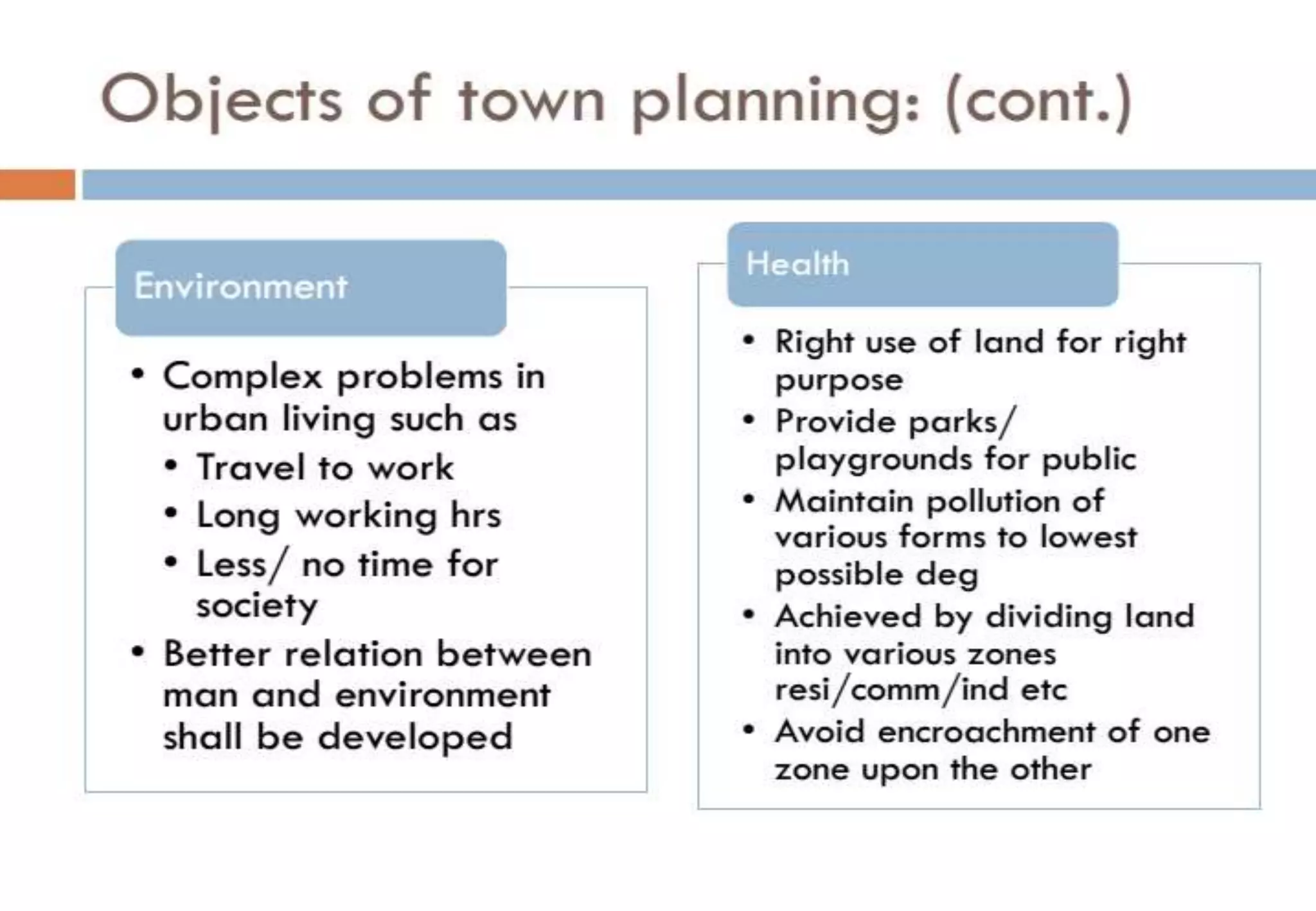
Objectives of Town Planning
 Health:
 To create and promote healthy
conditions and environments
for all
 Zoning, Correct Use, Avoid
haphazard development
 Beauty
 Preserve uniqueness of town
 Aesthetics of all elements,
 Landscaping
 Tree preservation
 Improved domestic living
 Convenience
 Needs: Social, Economic,
Cultural n recreational
 Entertainment
 Amenities
 Transportation
 Communication
 Commercial

1/15/2018
7
Prof.S.K.Patil,www.skpatil.com
Principles of TP
1/15/2018Prof.S.K.Patil,www.skpatil.com
8
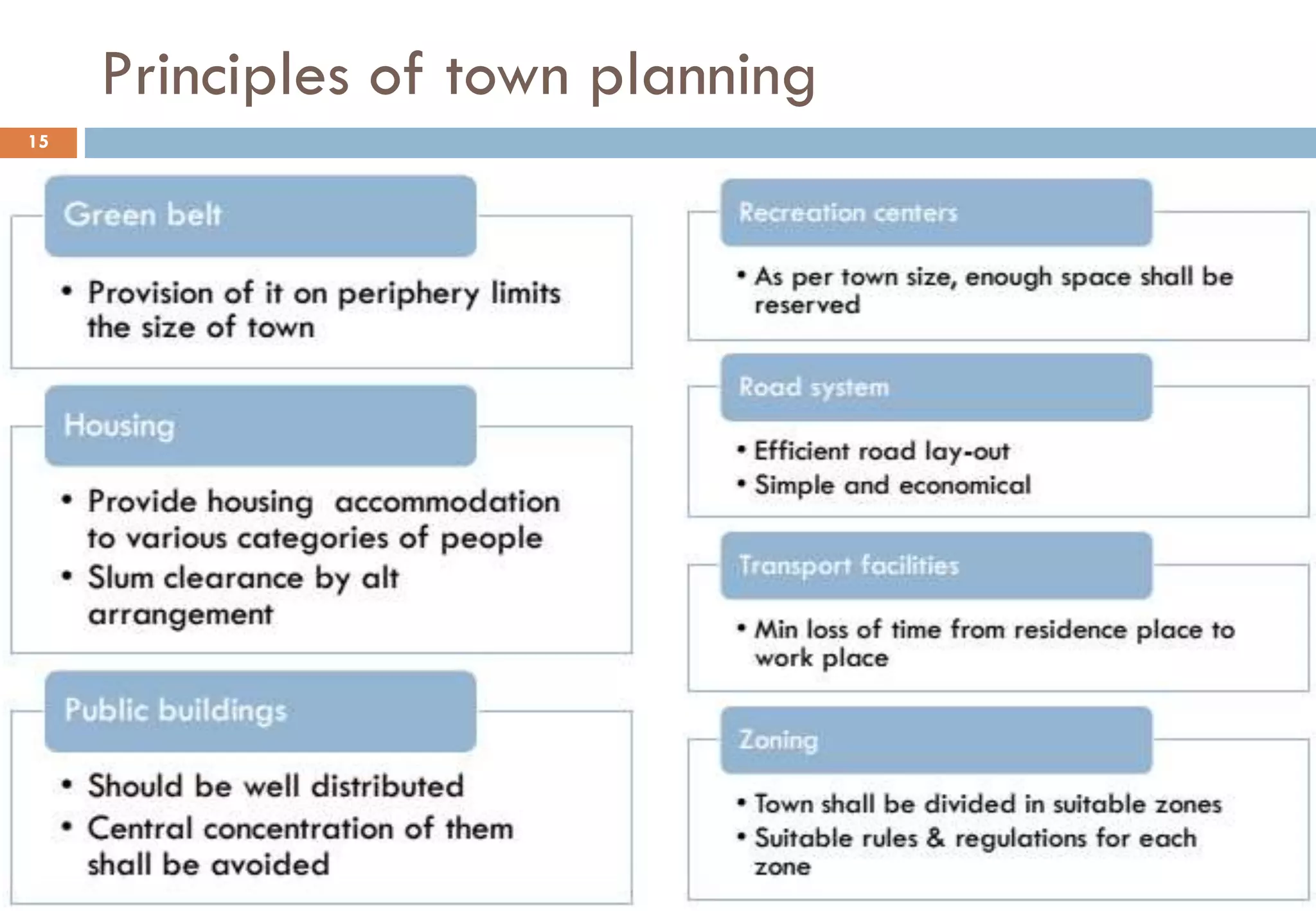
 No haphazard development
 Housing to all
 Amenities to all
 Open spaces : Recreation, expansion
 Grouping of building classes
 Zoning
 Peripheral green belt
 Limit growth, Farming, Recreation, Keep growth distant.
Necessity of TP
 Case of Industrial revolution
(1760-1820)
 Over crowding of city
 Creation of suburbs
 Travelling time
 Traffic density
 Noise
 Industry in locality: Pollution
 Increased jobs:- Slums
 Less open spaces
 Stress on amenities
 Present scenario
 Corrective action : Huge
Costs
 Plan in advance
1/15/2018
9
Prof.S.K.Patil,www.skpatil.com
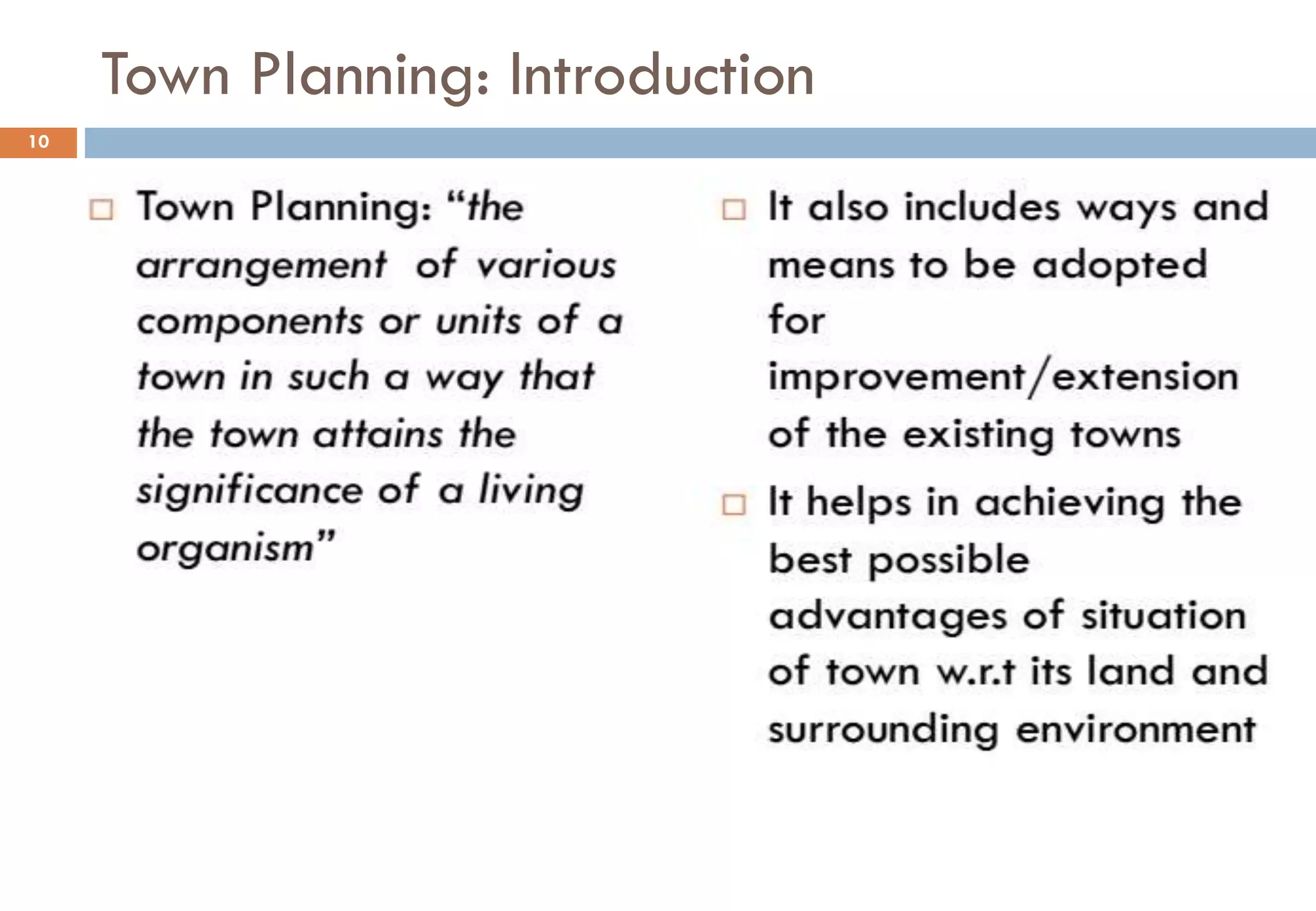
Town Planning: Introduction
10
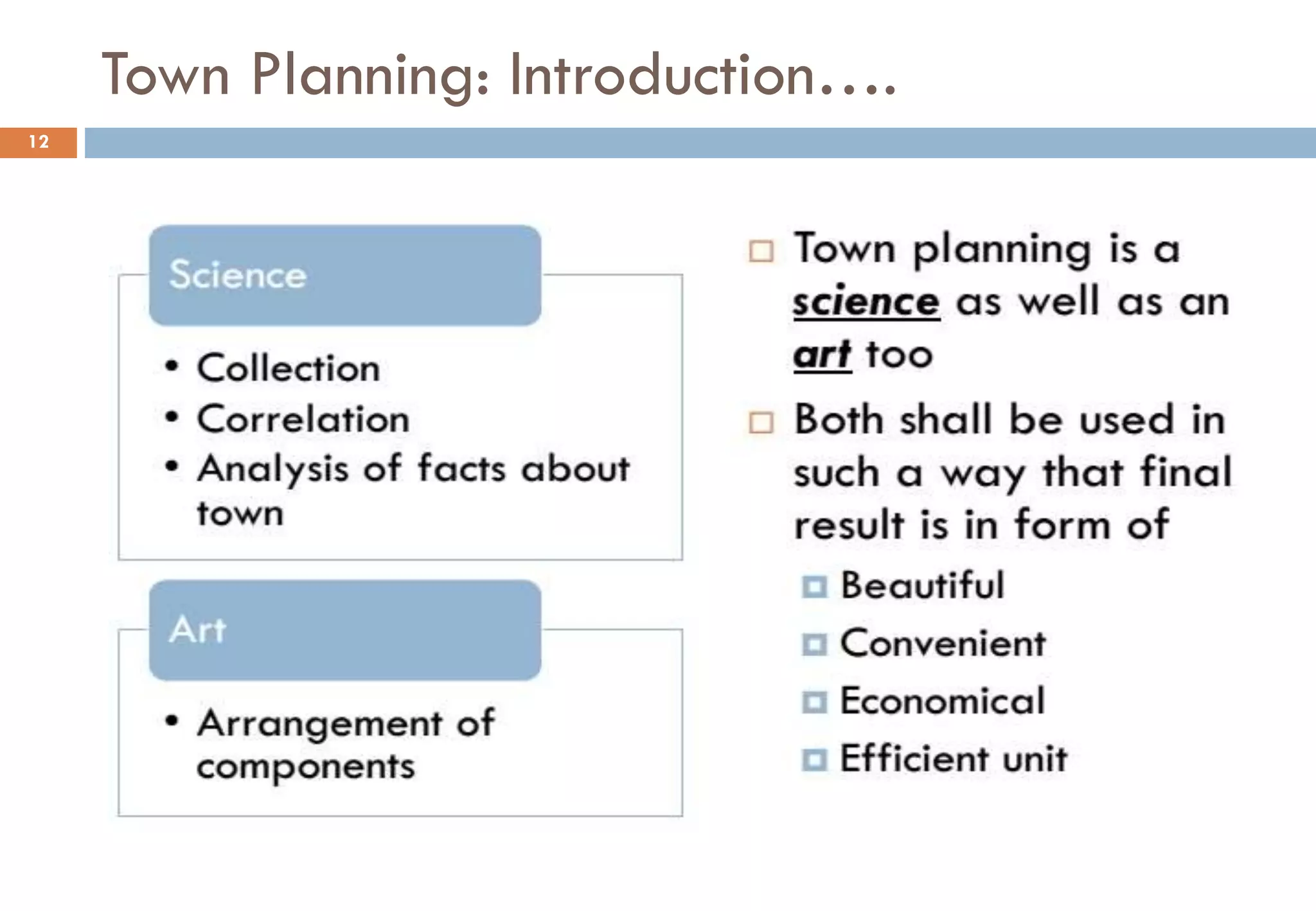
Town Planning: Introduction….
11
Town Planning: Introduction….
12
13
14
Principles of town planning
15
16
Duties of TPO
1/15/2018Prof.S.K.Patil,www.skpatil.com
17
 Conduct survey and collect data for future developments
 Public place demarcation
 Plot distribution
 Estimating and costing
 Compensation against acquisition
 Cess against benefits
 Act as expert valuator and financial advisor
 Guard interest of citizen

1.1 Town Planning Introduction

  • 1.
    Transportation Engineering –II (Town Planning) 1/7/2018 Prof. S.K. Patil, www.skpatil.com 1 . Course Learning Outcomes: • At the end of this session, the student will be able to understand necessity, scope and principles of Town Planning Introduction to Town Planning
  • 2.
    Prof. (Dr.) SachinKishor Patil B.E. Civil, M.E. Civil Environmental Engineering, Ph.D. (IIT, Bombay) ❑ Professor & Head of Department ❑ Department of Civil Engineering ❑ AMGOI, Vathar, Kolhapur, MH, India. 1/7/2018 Prof. S.K. Patil, www.skpatil.com 2 Disclaimer and acknowledgment The study material presented by Prof. S K Patil is licensed under The study material presented herewith is web sourced made available for community use under Creative Commons Attribution- NonCommercial-ShareAlike 3.0 unported License. If you feel the ownership of some of the content, I can acknowledge or remove as the case may be. Permissions beyond the scope of this license can be requested at www.skpatil.com
  • 3.
    Transportation Engineering –II (Town Planning) OUTLINE ✓ Introduction ✓ Basics ✓ Objectives ✓ Principles ✓ Necessities ✓ Duties of TPO 3 1/7/2018 Prof. S.K. Patil, www.skpatil.com
  • 4.
    What is Townplanning ? 1/15/2018Prof.S.K.Patil,www.skpatil.com 4  The art and science of ordering the use of land and siting of buildings and communication routes so as to secure the maximum practicable degree of economy, convenience, and beauty.  An attempt to formulate the principles that should guide us in creating a civilized physical background for human life whose main purpose is thus … foreseeing and guiding change.  An art of shaping and guiding the physical growth of the town creating buildings and environments to meet the various needs such as social, cultural, economic and recreational etc. and to provide healthy conditions for both rich and poor to live, to work, and to play or relax, thus bringing about the social and economic well- being for the majority of mankind.
  • 5.
    What is Townplanning? 1/15/2018Prof.S.K.Patil,www.skpatil.com 5  Planning is a process of helping a community, identify its problems and its central values, formulating goals and alternative approaches to achieving community objectives, and avoiding undesired consequences of change. This process of planning results in frameworks for coping with change. Some are concepts that serve as guides to action, such as the goal of becoming a major distribution center or of encouraging investment in the core of the city. Some are regulatory, reflecting the desires of the community to encourage good development and discourage bad development.  “A city should be built to give its inhabitants security and happiness” – Aristotle  “A place where men had a common life for a noble end” – Plato
  • 6.
    Town Planning Basics 1/15/2018Prof.S.K.Patil,www.skpatil.com 6 The goal of planning is creating convenient, equitable, healthy, efficient and attractive environments.  Three key aspects of a city  The physical environment - its location, its climate and its proximity to sources of food and water.  The social environment - The social environment includes the groups of a city's residents belong to the neighbourhoods in which they live.  The economic environment - the retention and expansion of existing local businesses.
  • 7.
    Objectives of TownPlanning  Health:  To create and promote healthy conditions and environments for all  Zoning, Correct Use, Avoid haphazard development  Beauty  Preserve uniqueness of town  Aesthetics of all elements,  Landscaping  Tree preservation  Improved domestic living  Convenience  Needs: Social, Economic, Cultural n recreational  Entertainment  Amenities  Transportation  Communication  Commercial  1/15/2018 7 Prof.S.K.Patil,www.skpatil.com
  • 8.
    Principles of TP 1/15/2018Prof.S.K.Patil,www.skpatil.com 8 No haphazard development  Housing to all  Amenities to all  Open spaces : Recreation, expansion  Grouping of building classes  Zoning  Peripheral green belt  Limit growth, Farming, Recreation, Keep growth distant.
  • 9.
    Necessity of TP Case of Industrial revolution (1760-1820)  Over crowding of city  Creation of suburbs  Travelling time  Traffic density  Noise  Industry in locality: Pollution  Increased jobs:- Slums  Less open spaces  Stress on amenities  Present scenario  Corrective action : Huge Costs  Plan in advance 1/15/2018 9 Prof.S.K.Patil,www.skpatil.com
  • 10.
  • 11.
  • 12.
  • 13.
  • 14.
  • 15.
    Principles of townplanning 15
  • 16.
  • 17.
    Duties of TPO 1/15/2018Prof.S.K.Patil,www.skpatil.com 17 Conduct survey and collect data for future developments  Public place demarcation  Plot distribution  Estimating and costing  Compensation against acquisition  Cess against benefits  Act as expert valuator and financial advisor  Guard interest of citizen