Prof. Samirsinh P Parmar
samirddu@gmail.com
Asst. Prof. Dept. of Civil Engineering,
A Dharmasinh Desai University, Nadiad, Gujarat
Lecture- 4
Content of the presentation
 Objects of town planning
 Principles of Town Planning
 Necessity of town Planning
 Origins of towns
 Stages in TOWN development
 Site for an ideal town
 Conclusion
Town Planning, Semester-IV, DDU, CL
2
General Introduction
 Town Planning – arrangement of various components or units of a town in
such a way that the town as such attains the significance of a living
organism.
 Knowledge of town planning helps in achieving the best possible
advantages of the situation of town with respect to its land and the
surrounding environments.
 The town planning is a Science as well as Art too.
 The art lies in arranging the components of a town in such a way that the
final result is in the form of a beautiful, convenient, economical and
efficient unit.
Town Planning, Semester-IV, DDU, CL
3
Objects of town planning
A. Beauty
B. Convenience
C.Environment
D.Health
Town Planning, Semester-IV, DDU, CL
4
Objects of town planning: A. Beauty
 The potential of the natural surroundings is exploited and the architectural
finished are used to design various components of the town.
 The trees, natural greenery are preserved.
 Architectural control is imposed on the public as well as the semi-public
buildings, ancient architectural buildings, temples, churches, mosques,
buildings of cultural and historical significance etc.
Town Planning, Semester-IV, DDU, CL
5
Objects of town planning: B. Convenience
 It is important to take care that various economic, social and recreational
amenities are given to the public.
 These amenities include cheap power and electricity, proper sites for
industrial wastes, facilities to commercial units etc.
 Recreational spaces are very important to be designed and appropriately
located.
 Places of recreation include open spaces, parks, town halls, playgrounds,
cinema houses, community centers, stadiums etc.
Town Planning, Semester-IV, DDU, CL
6
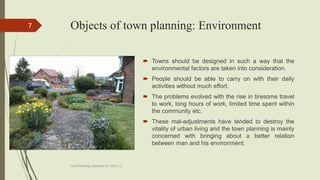
Objects of town planning: Environment
 Towns should be designed in such a way that the
environmental factors are taken into consideration.
 People should be able to carry on with their daily
activities without much effort.
 The problems evolved with the rise in tiresome travel
to work, long hours of work, limited time spent within
the community etc.
 These mal-adjustments have tended to destroy the
vitality of urban living and the town planning is mainly
concerned with bringing about a better relation
between man and his environment.
Town Planning, Semester-IV, DDU, CL
7
Objects of town planning: Health
 Health of the citizens should never be compromised.
 This can be achieved by proper use of land by dividing the land into zones
such as residential, commercial, industrial, recreational etc.
 Dividing the land into different zones prevents encroachment of one zone
upon the smooth and promotes orderly development of the town in future.
Town Planning, Semester-IV, DDU, CL
8
Economic Justification of Town Planning
 Change in quantity of resources
 Demand for goods and services
 Production techniques
 Redistribution of land values
Town Planning, Semester-IV, DDU, CL
9
Principles of Town Planning
 Green Belt
 Housing
 Public Buildings
 Recreation centers
 Road system
 Transport facilities
 Zoning
Town Planning, Semester-IV, DDU, CL
10
Principles of Town Planning (Cont…)
 1. Zoning :
 The town should be divided into suitable zones such as commercial zone,
industrial zone, residential zone, etc. and suitable rules and regulations should be
formed for the development of each zone.
 2. Green belt :
 Green belt is non-development zone on the periphery of the town.
 It prevents the haphazard sprawl of the town restricting its size.
 In essence, a green belt is an invisible line designating a border around a certain
area, preventing development of the area and allowing wildlife to return and be
established.
 Greenways and green wedges have a linear character and may run across the
town and not around the town.
Town Planning, Semester-IV, DDU, CL
11
Principles of Town Planning (Cont…)
 3. Housing
 Housing has to be carefully studied and designed to suit the local population.
 Care should be taken to see that there is no development of slums since it would be
responsible for degrading the life of the citizens.
 There are various types of housing styles.
 When a land use plan is made, zones for independent housing, midrise buildings,
high rise buildings are allocated.
 4. Public buildings
 Public buildings should be well grouped and distributed throughout the town.
Unnecessary concentration of public buildings should be avoided.
 Factors such as parking facilities, road widths have to be taken into
consideration while allocating the space for public buildings.
Town Planning, Semester-IV, DDU, CL
12
Principles of Town Planning (Cont…)
 5. Recreation centres
 Recreation centers have to be given importance while designing a town.
 They are necessary for the recreational activities of the general public. They include
parks for walking and cycling, amusement parks etc.
 6. Road systems
 Road network hierarchy is very important.
 The efficiency of any town is measured by the layout of its roads.
 A nicely designed road system puts a great impression in the minds of people,
especially the visitors to the town.
 The provision of a faulty road system in the initial stages of town formation proves to
be too difficult and costly to repair or to re-arrange in future.
Town Planning, Semester-IV, DDU, CL
13
 7. Transport facilities
 The town should be provided with suitable transport facilities so that there
is minimum loss of time from place of work to the place of residence.
 Efficiency in transport facilities includes both public and private networks.
 Public transportation network includes access to buses, trains, trams and
trolleybuses. Efficiency in using the public transport will determine the
success of that town in terms of design.
Town Planning, Semester-IV, DDU, CL
14 Principles of Town Planning (Cont…)
Necessity of town Planning
Town Planning, Semester-IV, DDU, CL
15
Why is Town planning important?
Ans: To avoid Evil situations within town.
Evil situations are as follows:
1. Defective road system resulting in the formation of narrow streets and lanes;
2. Development of slums and squatter settlements;
3. Heavy traffic congestion during the working hours of the day;
4. Inadequate open spaces for parks and playgrounds resulting in unhealthy living
conditions;
5. Lack of essential amenities like electricity, water supply and drainage;
6. Noisy atmosphere disturbing the peace of city dwellers;
7. Uncontrolled development of the town;
8. Unhealthy living conditions;
Origins of towns
 Topographical features contributing to the origin of towns:
i. Conditions favorable for industrial units,
ii. Hilly areas to achieve the objects of defense,
iii. Plain areas useful for business activities,
iv. River bank for domestic water, transport and fishing,
v. Sea or Ocean fronts for fishing and transport.
Town Planning, Semester-IV, DDU, CL
16
Functional aspects responsible for the origin of Towns:
 Education
 Health resource
 Political
 Religious
 Specific industry
Town Planning, Semester-IV, DDU, CL
17
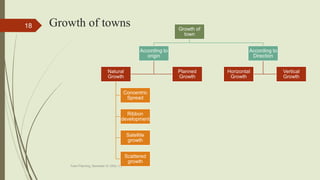
Growth of towns
Town Planning, Semester-IV, DDU, CL
18 Growth of
town
According to
origin
Natural
Growth
Concentric
Spread
Ribbon
development
Satellite
growth
Scattered
growth
Planned
Growth
According to
Direction
Vertical
Growth
Horizontal
Growth
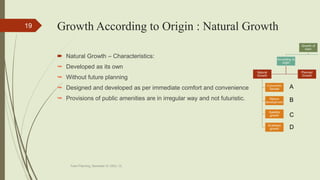
Growth According to Origin : Natural Growth
 Natural Growth – Characteristics:
 Developed as its own
 Without future planning
 Designed and developed as per immediate comfort and convenience
 Provisions of public amenities are in irregular way and not futuristic.
Town Planning, Semester-IV, DDU, CL
19
A
B
C
D
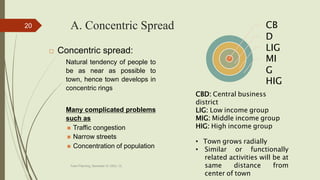
A. Concentric Spread
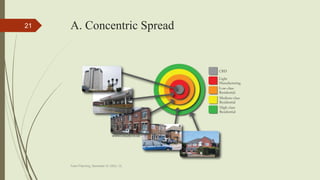
 Concentric spread:
Natural tendency of people to
be as near as possible to
town, hence town develops in
concentric rings
Many complicated problems
such as
 Traffic congestion
 Narrow streets
 Concentration of population
Town Planning, Semester-IV, DDU, CL
20 CB
D
LIG
MI
G
HIG
CBD: Central business
district
LIG: Low income group
MIG: Middle income group
HIG: High income group
• Town grows radially
• Similar or functionally
related activities will be at
same distance from
center of town
A. Concentric Spread
Town Planning, Semester-IV, DDU, CL
21
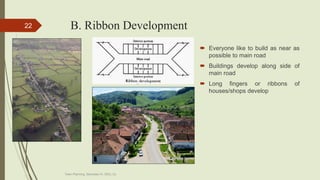
B. Ribbon Development
 Everyone like to build as near as
possible to main road
 Buildings develop along side of
main road
 Long fingers or ribbons of
houses/shops develop
Town Planning, Semester-IV, DDU, CL
22
Disadvantages of Ribbon Development
 Increase in cost of various utility
services like water supply, power,
telephone etc.
 Loose and scatter community – lack of
social life
 Costly and difficult future improvement
 Houses face heavy traffic, noise, dust
 Interior portion left undeveloped,
wastage of land
 Traffic capacity and efficiency of main
road reduces
 More pedestrians on main road causes
traffic accidents/ traffic delays
 Harms naturalness of country, spoils
countryside, aesthetically faulty
 Measures to be taken:
 Land use zoning
 Regulation and control of traffic
 Removal of encroachments from road
side
 Planning road side amenities
 Expressway with complete controlled
access
Town Planning, Semester-IV, DDU, CL
23
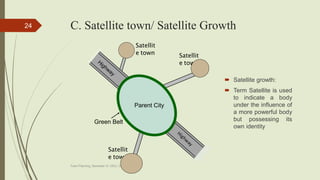
C. Satellite town/ Satellite Growth
 Satellite growth:
 Term Satellite is used
to indicate a body
under the influence of
a more powerful body
but possessing its
own identity
Town Planning, Semester-IV, DDU, CL
24
Satellit
e town
Satellit
e town Satellit
e town
Parent City
Green Belt
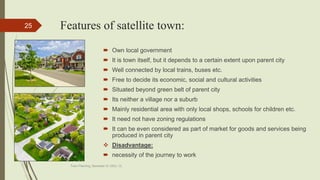
Features of satellite town:
 Own local government
 It is town itself, but it depends to a certain extent upon parent city
 Well connected by local trains, buses etc.
 Free to decide its economic, social and cultural activities
 Situated beyond green belt of parent city
 Its neither a village nor a suburb
 Mainly residential area with only local shops, schools for children etc.
 It need not have zoning regulations
 It can be even considered as part of market for goods and services being
produced in parent city
 Disadvantage:
 necessity of the journey to work
Town Planning, Semester-IV, DDU, CL
25
D. Scattered Growth
 Very irregular
 Traffic congestion
 Encroachment of industries on residential area
 Slums
 Lack of parks and playgrounds
 Complex problems become too difficult to be solved in future
Town Planning, Semester-IV, DDU, CL
26
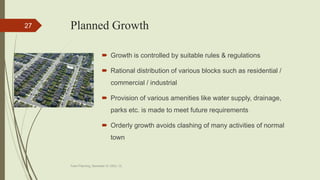
Planned Growth
 Growth is controlled by suitable rules & regulations
 Rational distribution of various blocks such as residential /
commercial / industrial
 Provision of various amenities like water supply, drainage,
parks etc. is made to meet future requirements
 Orderly growth avoids clashing of many activities of normal
town
Town Planning, Semester-IV, DDU, CL
27
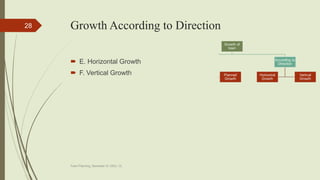
Growth According to Direction
 E. Horizontal Growth
 F. Vertical Growth
Town Planning, Semester-IV, DDU, CL
28
E. Horizontal Growth
 Town develops horizontally in all directions
 It is possible where land is available in plenty at nominal cost
 Advantages:
 Cost saving: buildings are generally 2/3 story
 High tech personnel not required
 Max possible use of natural light
 Restricted density of population
 Surrounding marginal space can be used to develop garden
 Disadvantage:
 Requires more land, so can be uneconomical where land values are high
 Foundation cost per unit area will be more
 Absence of group living
Town Planning, Semester-IV, DDU, CL
29
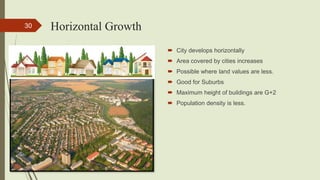
Horizontal Growth
Town Planning, Semester-IV, DDU, CL
30
 City develops horizontally
 Area covered by cities increases
 Possible where land values are less.
 Good for Suburbs
 Maximum height of buildings are G+2
 Population density is less.
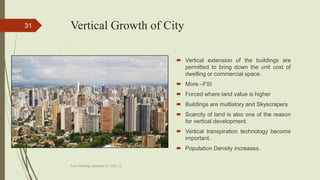
Vertical Growth of City
 Vertical extension of the buildings are
permitted to bring down the unit cost of
dwelling or commercial space.
 More –FSI
 Forced where land value is higher
 Buildings are multistory and Skyscrapers
 Scarcity of land is also one of the reason
for vertical development.
 Vertical transpiration technology become
important.
 Population Density increases.
Town Planning, Semester-IV, DDU, CL
31
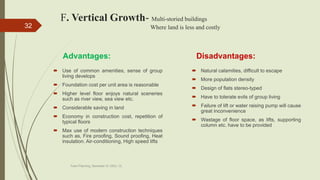
F. Vertical Growth- Multi-storied buildings
Where land is less and costly
Advantages:
 Use of common amenities, sense of group
living develops
 Foundation cost per unit area is reasonable
 Higher level floor enjoys natural sceneries
such as river view, sea view etc.
 Considerable saving in land
 Economy in construction cost, repetition of
typical floors
 Max use of modern construction techniques
such as, Fire proofing, Sound proofing, Heat
insulation. Air-conditioning, High speed lifts
Disadvantages:
 Natural calamities, difficult to escape
 More population density
 Design of flats stereo-typed
 Have to tolerate evils of group living
 Failure of lift or water raising pump will cause
great inconvenience
 Wastage of floor space, as lifts, supporting
column etc. have to be provided
Town Planning, Semester-IV, DDU, CL
32
Stages in TOWN development
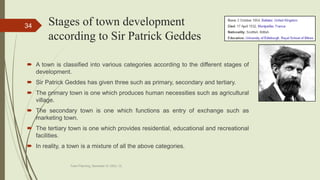
Stages of town development
according to Sir Patrick Geddes
 A town is classified into various categories according to the different stages of
development.
 Sir Patrick Geddes has given three such as primary, secondary and tertiary.
 The primary town is one which produces human necessities such as agricultural
village.
 The secondary town is one which functions as entry of exchange such as
marketing town.
 The tertiary town is one which provides residential, educational and recreational
facilities.
 In reality, a town is a mixture of all the above categories.
Town Planning, Semester-IV, DDU, CL
34
Classification by Harold MacLean Lewis
 According to, “Harold MacLean Lewis”[1] the trends in urban growth can be visualized
through population estimates.
 He classified the towns with relation to their population sizes.
 According to his classification the town population begins from 2500 to 5000 persons. He
further classified town in nine categories.
 i) 2500 to 5000 persons may be termed as Eopolis or Infantile Municipality Town
 ii) 5000 to 10000 persons may be termed as Polis or Juvenile Town
 iii) 10000 to 25000 persons may be termed as Mature Trade/Industrial Town
 iv) 25000 to 50000 persons may be termed as Metropolis or Medium Size City
 v) 50000 to 100000 persons may be termed as Megalopolis Intermediate City
 vi) 100000 to 250000 persons may be termed as Trade/Industry/Service Sector City
 vii) 250000 to 500000 persons may be termed as Primate City
 viii) 500000 to 1000000 persons may be termed as Tyranopolis or a Metropolitan City
 ix) 1000000 or more persons may be termed as Senile City or Mega City
Town Planning, Semester-IV, DDU, CL
35
 Eopolis: The Eopolis indicates the first stage of town as a village community whose economic base is
agriculture.
 Polis: The Polis indicates and association of population with some mechanization and specialization.
 Metropolis: The metropolis is a city or town which serves as a capital of a state or region.
 Megalopolis: The megalopolis indicates the first stage of decline in town or city due to mega problems &
issues, or the reign of town or city shows the signs of decline and deterioration.
 Tyranopolis: the Tyranopolis is the town or city which shows drastic deteriorating situation for example
the trade depression or military powers may occur with different war lords.
 Necropolis: the necropolis is the worst stage of town or city. For example the citizens are shifting to rural
areas or hinter land or village due to war, disease or economic break down. In that case the town may
recover from it after a large internal of time.
Town Planning, Semester-IV, DDU, CL
36
According to Lewis Mumford,
the urban growth or town growth takes place in six stages with respect to their
social order. Each town may pass through these six stages, i.e. Eopolis, Polis,
Metropolis, Megalopolis, Tyranopolis and Necropolis.
Stages of town development according to Griffith Taylor
 Infantile: this is the first stage of town in which a city is not yet divided in separate zones. Or the city in which
zoning regulations is not being prepared yet.
 Juvenile: the juvenile stage of town or city indicates that, shops are being separated from the houses or
residential area and there are some factories or an industry has been established at a minimal level.
 Mature: the mature stage of town shows the divisions of residential zone, commercial zone and industrial
zone in the city. Or the land use and zoning regulations in town shows the stage of mature city / town.
 Senile: Finally the senile stage of town indicates the physical decay in most of the portions of the city. Or the
physical, social & economic degradation is evident in the built environment of town or city.
Town Planning, Semester-IV, DDU, CL
37
According to Mr. Griffith Taylor a town or city passes through four stages, i.e. Infantile,
Juvenile, Mature and senile.
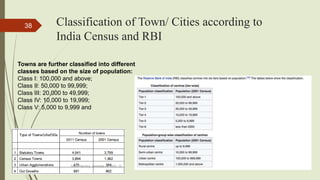
Classification of Town/ Cities according to
India Census and RBI
Town Planning, Semester-IV, DDU, CL
38
Towns are further classified into different
classes based on the size of population:
Class I: 100,000 and above;
Class II: 50,000 to 99,999;
Class III: 20,000 to 49,999;
Class IV: 10,000 to 19,999;
Class V: 5,000 to 9,999 and
Powers required to enforce Town Planning
scheme:
 Power of fixing up the value of property according to some fixed procedure.
 Power to acquire slums and demolish them with a view to improve the town
 Power to acquire land
 Power to compel proper use of lands and buildings
 Powers to introduce zoning
 Power to finance the city planning projects
 Power to prevent the fragmentation of land beyond certain limits
 Power to redevelop buildings and spaces
Town Planning, Semester-IV, DDU, CL
39
What is TP scheme?
A Town Planning scheme is a legal document that applies to a defined area. It confers
rights on land by specifying how this land may be used and developed. ... The aim of a
town planning scheme is to ensure orderly and proper planning.
Site for an ideal town:
 Availability of natural advantages
 Availability of electric power
 Available means of communication
 Climatic conditions
 Contours of area
 Development of surrounding area
 Drainage of area
 Available facility of sewage disposal
 Soil fertility
 Frequency of floods
 Growths of trees
 Nature of soil
 Position of streams and lakes
 Water resources, etc.
Town Planning, Semester-IV, DDU, CL
40
What is Urban Growth?
 It is basically the growth and development of urban areas, over a period of time.
 It can also be understood by the term urban sprawl.
Town Planning, Semester-IV, DDU, CL
41
What is Urban Sprawl?
 Urban sprawl is the term to describe development pattern in cities.
 Unfortunately it lacks a precise definition.
 However it can be understood through visualizing the on going process of growth
in cities.
 The urban sprawl can refer to at least three different patterns.
i. Low density continuous development.
ii. Ribbon development.
iii. Leapfrog development
Town Planning, Semester-IV, DDU, CL
42
Conclusions:
 Thus conclusively the current discussion leads us to following realities.
i. Urban growth can be spontaneous on its own or planned growth as directed by the authorities.
ii. The concept of planning is to provide a vision for future well before the people actually settle in the
settlements and planning may also be appropriate enough to facilitate the process of housing the poor
in the city.
iii. The basic planning component is that incompatible land uses should not be allowed or located together.
iv. Circulation, transport, infrastructure and land use management are the basic tools of planning to guide
the urban growth and transformation in the city.
v. Suburban growth shall be seen as the series of phases through which a particular location passes or it
is the development which proceed from an open land to mature urban development.
vi. The objectives of sound planning should be to develop a set of simple guidelines, or principles which
should be comprehensive and adaptable to changing conditions of the future.
Town Planning, Semester-IV, DDU, CL
43
References:
 http://townplanninglectures.blogspot.com/2009/01/trends-in-urban-growth-objectives-of.html
Town Planning, Semester-IV, DDU, CL
44
Town Planning, Semester-IV, DDU, CL
45

Lec- 4 Introduction to Town Planning.pptx

  • 1.
    Prof. Samirsinh PParmar samirddu@gmail.com Asst. Prof. Dept. of Civil Engineering, A Dharmasinh Desai University, Nadiad, Gujarat Lecture- 4
  • 2.
    Content of thepresentation  Objects of town planning  Principles of Town Planning  Necessity of town Planning  Origins of towns  Stages in TOWN development  Site for an ideal town  Conclusion Town Planning, Semester-IV, DDU, CL 2
  • 3.
    General Introduction  TownPlanning – arrangement of various components or units of a town in such a way that the town as such attains the significance of a living organism.  Knowledge of town planning helps in achieving the best possible advantages of the situation of town with respect to its land and the surrounding environments.  The town planning is a Science as well as Art too.  The art lies in arranging the components of a town in such a way that the final result is in the form of a beautiful, convenient, economical and efficient unit. Town Planning, Semester-IV, DDU, CL 3
  • 4.
    Objects of townplanning A. Beauty B. Convenience C.Environment D.Health Town Planning, Semester-IV, DDU, CL 4
  • 5.
    Objects of townplanning: A. Beauty  The potential of the natural surroundings is exploited and the architectural finished are used to design various components of the town.  The trees, natural greenery are preserved.  Architectural control is imposed on the public as well as the semi-public buildings, ancient architectural buildings, temples, churches, mosques, buildings of cultural and historical significance etc. Town Planning, Semester-IV, DDU, CL 5
  • 6.
    Objects of townplanning: B. Convenience  It is important to take care that various economic, social and recreational amenities are given to the public.  These amenities include cheap power and electricity, proper sites for industrial wastes, facilities to commercial units etc.  Recreational spaces are very important to be designed and appropriately located.  Places of recreation include open spaces, parks, town halls, playgrounds, cinema houses, community centers, stadiums etc. Town Planning, Semester-IV, DDU, CL 6
  • 7.
    Objects of townplanning: Environment  Towns should be designed in such a way that the environmental factors are taken into consideration.  People should be able to carry on with their daily activities without much effort.  The problems evolved with the rise in tiresome travel to work, long hours of work, limited time spent within the community etc.  These mal-adjustments have tended to destroy the vitality of urban living and the town planning is mainly concerned with bringing about a better relation between man and his environment. Town Planning, Semester-IV, DDU, CL 7
  • 8.
    Objects of townplanning: Health  Health of the citizens should never be compromised.  This can be achieved by proper use of land by dividing the land into zones such as residential, commercial, industrial, recreational etc.  Dividing the land into different zones prevents encroachment of one zone upon the smooth and promotes orderly development of the town in future. Town Planning, Semester-IV, DDU, CL 8
  • 9.
    Economic Justification ofTown Planning  Change in quantity of resources  Demand for goods and services  Production techniques  Redistribution of land values Town Planning, Semester-IV, DDU, CL 9
  • 10.
    Principles of TownPlanning  Green Belt  Housing  Public Buildings  Recreation centers  Road system  Transport facilities  Zoning Town Planning, Semester-IV, DDU, CL 10
  • 11.
    Principles of TownPlanning (Cont…)  1. Zoning :  The town should be divided into suitable zones such as commercial zone, industrial zone, residential zone, etc. and suitable rules and regulations should be formed for the development of each zone.  2. Green belt :  Green belt is non-development zone on the periphery of the town.  It prevents the haphazard sprawl of the town restricting its size.  In essence, a green belt is an invisible line designating a border around a certain area, preventing development of the area and allowing wildlife to return and be established.  Greenways and green wedges have a linear character and may run across the town and not around the town. Town Planning, Semester-IV, DDU, CL 11
  • 12.
    Principles of TownPlanning (Cont…)  3. Housing  Housing has to be carefully studied and designed to suit the local population.  Care should be taken to see that there is no development of slums since it would be responsible for degrading the life of the citizens.  There are various types of housing styles.  When a land use plan is made, zones for independent housing, midrise buildings, high rise buildings are allocated.  4. Public buildings  Public buildings should be well grouped and distributed throughout the town. Unnecessary concentration of public buildings should be avoided.  Factors such as parking facilities, road widths have to be taken into consideration while allocating the space for public buildings. Town Planning, Semester-IV, DDU, CL 12
  • 13.
    Principles of TownPlanning (Cont…)  5. Recreation centres  Recreation centers have to be given importance while designing a town.  They are necessary for the recreational activities of the general public. They include parks for walking and cycling, amusement parks etc.  6. Road systems  Road network hierarchy is very important.  The efficiency of any town is measured by the layout of its roads.  A nicely designed road system puts a great impression in the minds of people, especially the visitors to the town.  The provision of a faulty road system in the initial stages of town formation proves to be too difficult and costly to repair or to re-arrange in future. Town Planning, Semester-IV, DDU, CL 13
  • 14.
     7. Transportfacilities  The town should be provided with suitable transport facilities so that there is minimum loss of time from place of work to the place of residence.  Efficiency in transport facilities includes both public and private networks.  Public transportation network includes access to buses, trains, trams and trolleybuses. Efficiency in using the public transport will determine the success of that town in terms of design. Town Planning, Semester-IV, DDU, CL 14 Principles of Town Planning (Cont…)
  • 15.
    Necessity of townPlanning Town Planning, Semester-IV, DDU, CL 15 Why is Town planning important? Ans: To avoid Evil situations within town. Evil situations are as follows: 1. Defective road system resulting in the formation of narrow streets and lanes; 2. Development of slums and squatter settlements; 3. Heavy traffic congestion during the working hours of the day; 4. Inadequate open spaces for parks and playgrounds resulting in unhealthy living conditions; 5. Lack of essential amenities like electricity, water supply and drainage; 6. Noisy atmosphere disturbing the peace of city dwellers; 7. Uncontrolled development of the town; 8. Unhealthy living conditions;
  • 16.
    Origins of towns Topographical features contributing to the origin of towns: i. Conditions favorable for industrial units, ii. Hilly areas to achieve the objects of defense, iii. Plain areas useful for business activities, iv. River bank for domestic water, transport and fishing, v. Sea or Ocean fronts for fishing and transport. Town Planning, Semester-IV, DDU, CL 16
  • 17.
    Functional aspects responsiblefor the origin of Towns:  Education  Health resource  Political  Religious  Specific industry Town Planning, Semester-IV, DDU, CL 17
  • 18.
    Growth of towns TownPlanning, Semester-IV, DDU, CL 18 Growth of town According to origin Natural Growth Concentric Spread Ribbon development Satellite growth Scattered growth Planned Growth According to Direction Vertical Growth Horizontal Growth
  • 19.
    Growth According toOrigin : Natural Growth  Natural Growth – Characteristics:  Developed as its own  Without future planning  Designed and developed as per immediate comfort and convenience  Provisions of public amenities are in irregular way and not futuristic. Town Planning, Semester-IV, DDU, CL 19 A B C D
  • 20.
    A. Concentric Spread Concentric spread: Natural tendency of people to be as near as possible to town, hence town develops in concentric rings Many complicated problems such as  Traffic congestion  Narrow streets  Concentration of population Town Planning, Semester-IV, DDU, CL 20 CB D LIG MI G HIG CBD: Central business district LIG: Low income group MIG: Middle income group HIG: High income group • Town grows radially • Similar or functionally related activities will be at same distance from center of town
  • 21.
    A. Concentric Spread TownPlanning, Semester-IV, DDU, CL 21
  • 22.
    B. Ribbon Development Everyone like to build as near as possible to main road  Buildings develop along side of main road  Long fingers or ribbons of houses/shops develop Town Planning, Semester-IV, DDU, CL 22
  • 23.
    Disadvantages of RibbonDevelopment  Increase in cost of various utility services like water supply, power, telephone etc.  Loose and scatter community – lack of social life  Costly and difficult future improvement  Houses face heavy traffic, noise, dust  Interior portion left undeveloped, wastage of land  Traffic capacity and efficiency of main road reduces  More pedestrians on main road causes traffic accidents/ traffic delays  Harms naturalness of country, spoils countryside, aesthetically faulty  Measures to be taken:  Land use zoning  Regulation and control of traffic  Removal of encroachments from road side  Planning road side amenities  Expressway with complete controlled access Town Planning, Semester-IV, DDU, CL 23
  • 24.
    C. Satellite town/Satellite Growth  Satellite growth:  Term Satellite is used to indicate a body under the influence of a more powerful body but possessing its own identity Town Planning, Semester-IV, DDU, CL 24 Satellit e town Satellit e town Satellit e town Parent City Green Belt
  • 25.
    Features of satellitetown:  Own local government  It is town itself, but it depends to a certain extent upon parent city  Well connected by local trains, buses etc.  Free to decide its economic, social and cultural activities  Situated beyond green belt of parent city  Its neither a village nor a suburb  Mainly residential area with only local shops, schools for children etc.  It need not have zoning regulations  It can be even considered as part of market for goods and services being produced in parent city  Disadvantage:  necessity of the journey to work Town Planning, Semester-IV, DDU, CL 25
  • 26.
    D. Scattered Growth Very irregular  Traffic congestion  Encroachment of industries on residential area  Slums  Lack of parks and playgrounds  Complex problems become too difficult to be solved in future Town Planning, Semester-IV, DDU, CL 26
  • 27.
    Planned Growth  Growthis controlled by suitable rules & regulations  Rational distribution of various blocks such as residential / commercial / industrial  Provision of various amenities like water supply, drainage, parks etc. is made to meet future requirements  Orderly growth avoids clashing of many activities of normal town Town Planning, Semester-IV, DDU, CL 27
  • 28.
    Growth According toDirection  E. Horizontal Growth  F. Vertical Growth Town Planning, Semester-IV, DDU, CL 28
  • 29.
    E. Horizontal Growth Town develops horizontally in all directions  It is possible where land is available in plenty at nominal cost  Advantages:  Cost saving: buildings are generally 2/3 story  High tech personnel not required  Max possible use of natural light  Restricted density of population  Surrounding marginal space can be used to develop garden  Disadvantage:  Requires more land, so can be uneconomical where land values are high  Foundation cost per unit area will be more  Absence of group living Town Planning, Semester-IV, DDU, CL 29
  • 30.
    Horizontal Growth Town Planning,Semester-IV, DDU, CL 30  City develops horizontally  Area covered by cities increases  Possible where land values are less.  Good for Suburbs  Maximum height of buildings are G+2  Population density is less.
  • 31.
    Vertical Growth ofCity  Vertical extension of the buildings are permitted to bring down the unit cost of dwelling or commercial space.  More –FSI  Forced where land value is higher  Buildings are multistory and Skyscrapers  Scarcity of land is also one of the reason for vertical development.  Vertical transpiration technology become important.  Population Density increases. Town Planning, Semester-IV, DDU, CL 31
  • 32.
    F. Vertical Growth-Multi-storied buildings Where land is less and costly Advantages:  Use of common amenities, sense of group living develops  Foundation cost per unit area is reasonable  Higher level floor enjoys natural sceneries such as river view, sea view etc.  Considerable saving in land  Economy in construction cost, repetition of typical floors  Max use of modern construction techniques such as, Fire proofing, Sound proofing, Heat insulation. Air-conditioning, High speed lifts Disadvantages:  Natural calamities, difficult to escape  More population density  Design of flats stereo-typed  Have to tolerate evils of group living  Failure of lift or water raising pump will cause great inconvenience  Wastage of floor space, as lifts, supporting column etc. have to be provided Town Planning, Semester-IV, DDU, CL 32
  • 33.
    Stages in TOWNdevelopment
  • 34.
    Stages of towndevelopment according to Sir Patrick Geddes  A town is classified into various categories according to the different stages of development.  Sir Patrick Geddes has given three such as primary, secondary and tertiary.  The primary town is one which produces human necessities such as agricultural village.  The secondary town is one which functions as entry of exchange such as marketing town.  The tertiary town is one which provides residential, educational and recreational facilities.  In reality, a town is a mixture of all the above categories. Town Planning, Semester-IV, DDU, CL 34
  • 35.
    Classification by HaroldMacLean Lewis  According to, “Harold MacLean Lewis”[1] the trends in urban growth can be visualized through population estimates.  He classified the towns with relation to their population sizes.  According to his classification the town population begins from 2500 to 5000 persons. He further classified town in nine categories.  i) 2500 to 5000 persons may be termed as Eopolis or Infantile Municipality Town  ii) 5000 to 10000 persons may be termed as Polis or Juvenile Town  iii) 10000 to 25000 persons may be termed as Mature Trade/Industrial Town  iv) 25000 to 50000 persons may be termed as Metropolis or Medium Size City  v) 50000 to 100000 persons may be termed as Megalopolis Intermediate City  vi) 100000 to 250000 persons may be termed as Trade/Industry/Service Sector City  vii) 250000 to 500000 persons may be termed as Primate City  viii) 500000 to 1000000 persons may be termed as Tyranopolis or a Metropolitan City  ix) 1000000 or more persons may be termed as Senile City or Mega City Town Planning, Semester-IV, DDU, CL 35
  • 36.
     Eopolis: TheEopolis indicates the first stage of town as a village community whose economic base is agriculture.  Polis: The Polis indicates and association of population with some mechanization and specialization.  Metropolis: The metropolis is a city or town which serves as a capital of a state or region.  Megalopolis: The megalopolis indicates the first stage of decline in town or city due to mega problems & issues, or the reign of town or city shows the signs of decline and deterioration.  Tyranopolis: the Tyranopolis is the town or city which shows drastic deteriorating situation for example the trade depression or military powers may occur with different war lords.  Necropolis: the necropolis is the worst stage of town or city. For example the citizens are shifting to rural areas or hinter land or village due to war, disease or economic break down. In that case the town may recover from it after a large internal of time. Town Planning, Semester-IV, DDU, CL 36 According to Lewis Mumford, the urban growth or town growth takes place in six stages with respect to their social order. Each town may pass through these six stages, i.e. Eopolis, Polis, Metropolis, Megalopolis, Tyranopolis and Necropolis.
  • 37.
    Stages of towndevelopment according to Griffith Taylor  Infantile: this is the first stage of town in which a city is not yet divided in separate zones. Or the city in which zoning regulations is not being prepared yet.  Juvenile: the juvenile stage of town or city indicates that, shops are being separated from the houses or residential area and there are some factories or an industry has been established at a minimal level.  Mature: the mature stage of town shows the divisions of residential zone, commercial zone and industrial zone in the city. Or the land use and zoning regulations in town shows the stage of mature city / town.  Senile: Finally the senile stage of town indicates the physical decay in most of the portions of the city. Or the physical, social & economic degradation is evident in the built environment of town or city. Town Planning, Semester-IV, DDU, CL 37 According to Mr. Griffith Taylor a town or city passes through four stages, i.e. Infantile, Juvenile, Mature and senile.
  • 38.
    Classification of Town/Cities according to India Census and RBI Town Planning, Semester-IV, DDU, CL 38 Towns are further classified into different classes based on the size of population: Class I: 100,000 and above; Class II: 50,000 to 99,999; Class III: 20,000 to 49,999; Class IV: 10,000 to 19,999; Class V: 5,000 to 9,999 and
  • 39.
    Powers required toenforce Town Planning scheme:  Power of fixing up the value of property according to some fixed procedure.  Power to acquire slums and demolish them with a view to improve the town  Power to acquire land  Power to compel proper use of lands and buildings  Powers to introduce zoning  Power to finance the city planning projects  Power to prevent the fragmentation of land beyond certain limits  Power to redevelop buildings and spaces Town Planning, Semester-IV, DDU, CL 39 What is TP scheme? A Town Planning scheme is a legal document that applies to a defined area. It confers rights on land by specifying how this land may be used and developed. ... The aim of a town planning scheme is to ensure orderly and proper planning.
  • 40.
    Site for anideal town:  Availability of natural advantages  Availability of electric power  Available means of communication  Climatic conditions  Contours of area  Development of surrounding area  Drainage of area  Available facility of sewage disposal  Soil fertility  Frequency of floods  Growths of trees  Nature of soil  Position of streams and lakes  Water resources, etc. Town Planning, Semester-IV, DDU, CL 40
  • 41.
    What is UrbanGrowth?  It is basically the growth and development of urban areas, over a period of time.  It can also be understood by the term urban sprawl. Town Planning, Semester-IV, DDU, CL 41
  • 42.
    What is UrbanSprawl?  Urban sprawl is the term to describe development pattern in cities.  Unfortunately it lacks a precise definition.  However it can be understood through visualizing the on going process of growth in cities.  The urban sprawl can refer to at least three different patterns. i. Low density continuous development. ii. Ribbon development. iii. Leapfrog development Town Planning, Semester-IV, DDU, CL 42
  • 43.
    Conclusions:  Thus conclusivelythe current discussion leads us to following realities. i. Urban growth can be spontaneous on its own or planned growth as directed by the authorities. ii. The concept of planning is to provide a vision for future well before the people actually settle in the settlements and planning may also be appropriate enough to facilitate the process of housing the poor in the city. iii. The basic planning component is that incompatible land uses should not be allowed or located together. iv. Circulation, transport, infrastructure and land use management are the basic tools of planning to guide the urban growth and transformation in the city. v. Suburban growth shall be seen as the series of phases through which a particular location passes or it is the development which proceed from an open land to mature urban development. vi. The objectives of sound planning should be to develop a set of simple guidelines, or principles which should be comprehensive and adaptable to changing conditions of the future. Town Planning, Semester-IV, DDU, CL 43
  • 44.
  • 45.