Copyright © Cengage Learning. All rights reserved.
3 Derivatives
Copyright © Cengage Learning. All rights reserved.
3.3
Derivatives of Trigonometric
Functions
3
3
Derivatives of Trigonometric Functions
In particular, it is important to remember that when we talk
about the function f defined for all real numbers x by
f(x) = sin x
it is understood that sin x means the sine of the angle
whose radian measure is x. A similar convention holds for
the other trigonometric functions cos, tan, csc, sec, and cot.
All of the trigonometric functions are continuous at every
number in their domains.
4
4
Derivatives of Trigonometric Functions
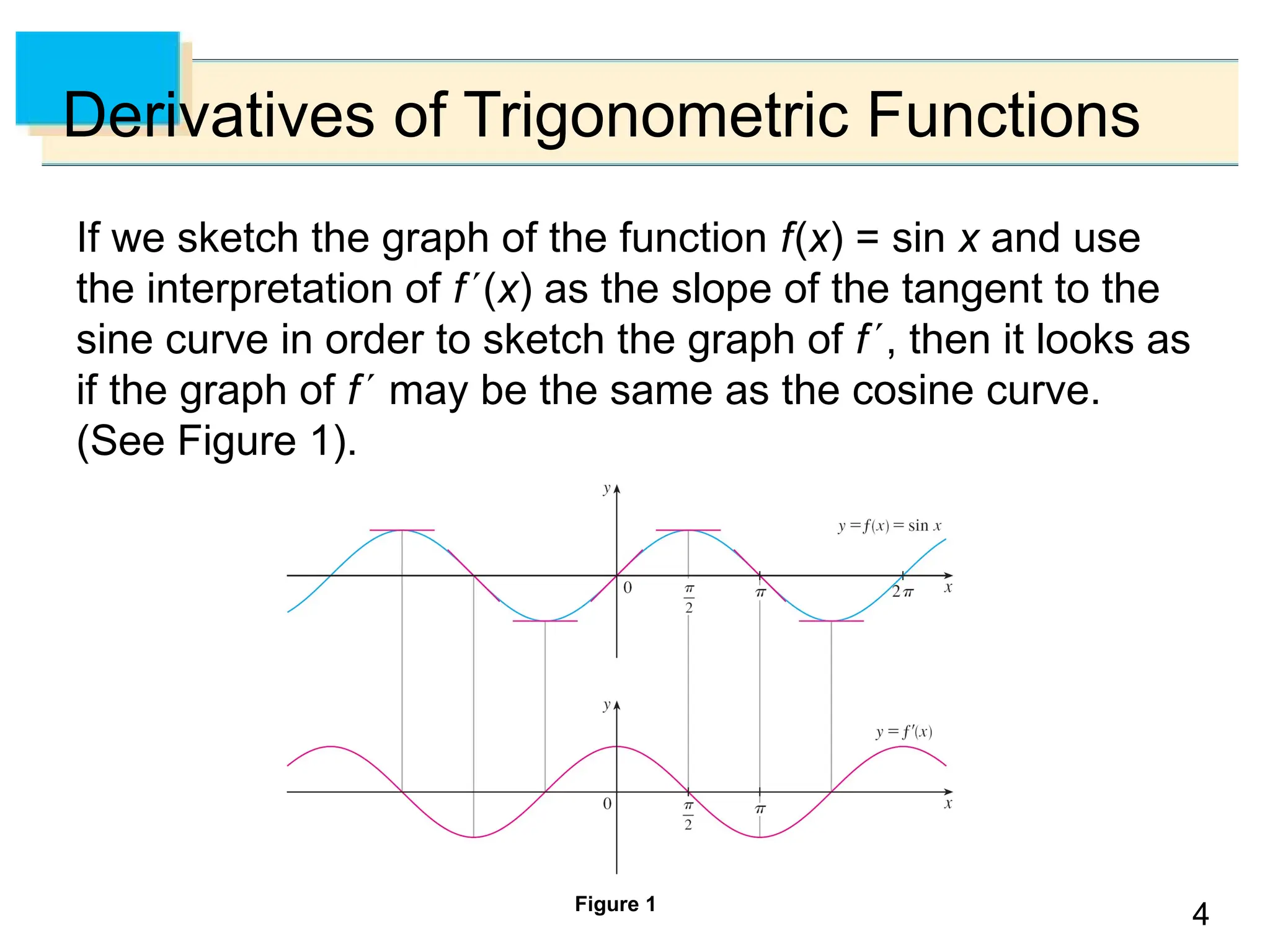
If we sketch the graph of the function f(x) = sin x and use
the interpretation of f(x) as the slope of the tangent to the
sine curve in order to sketch the graph of f, then it looks as
if the graph of f may be the same as the cosine curve.
(See Figure 1).
Figure 1
5
5
Derivatives of Trigonometric Functions
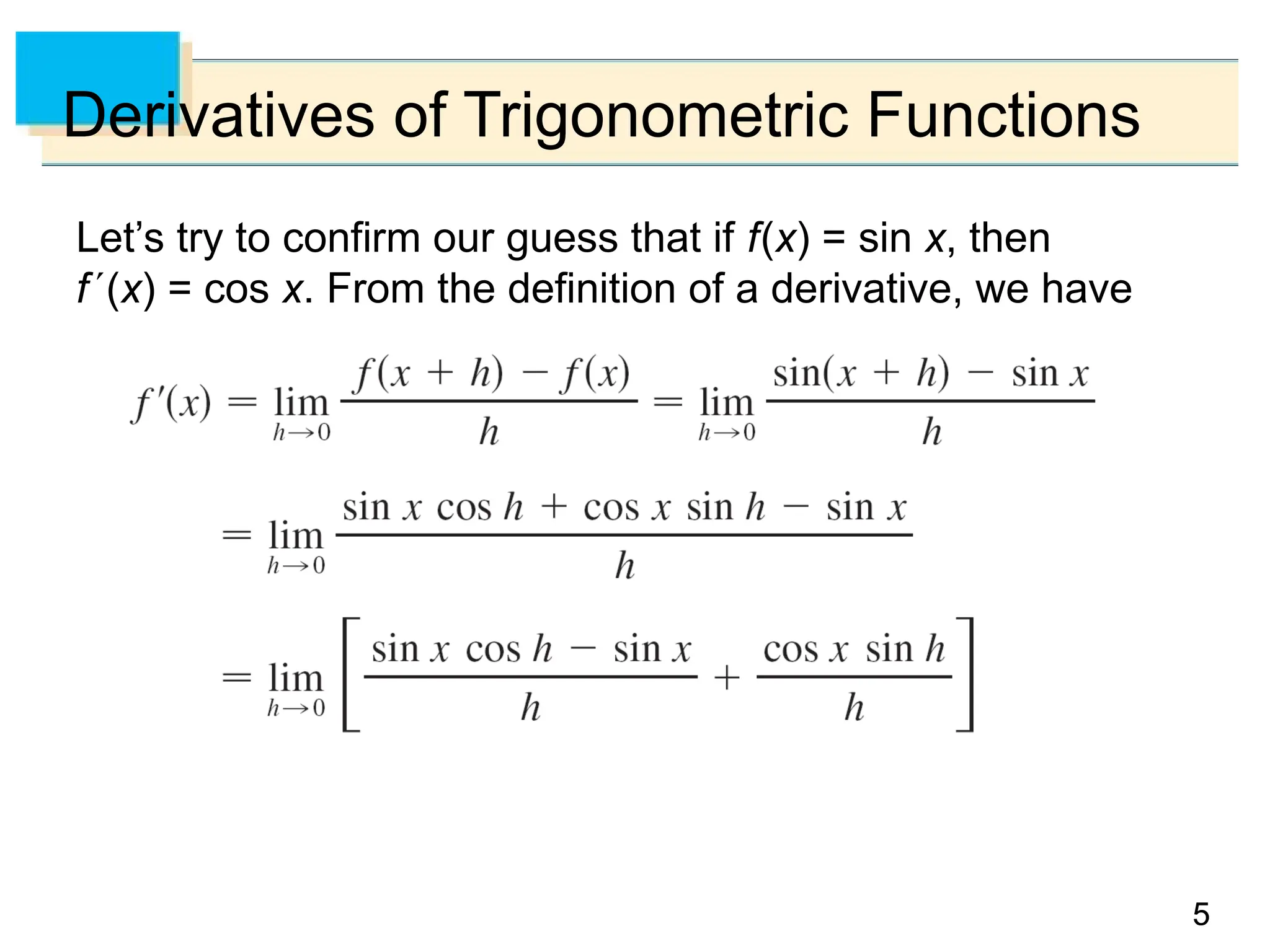
Let’s try to confirm our guess that if f(x) = sin x, then
f(x) = cos x. From the definition of a derivative, we have
6
6
Derivatives of Trigonometric Functions
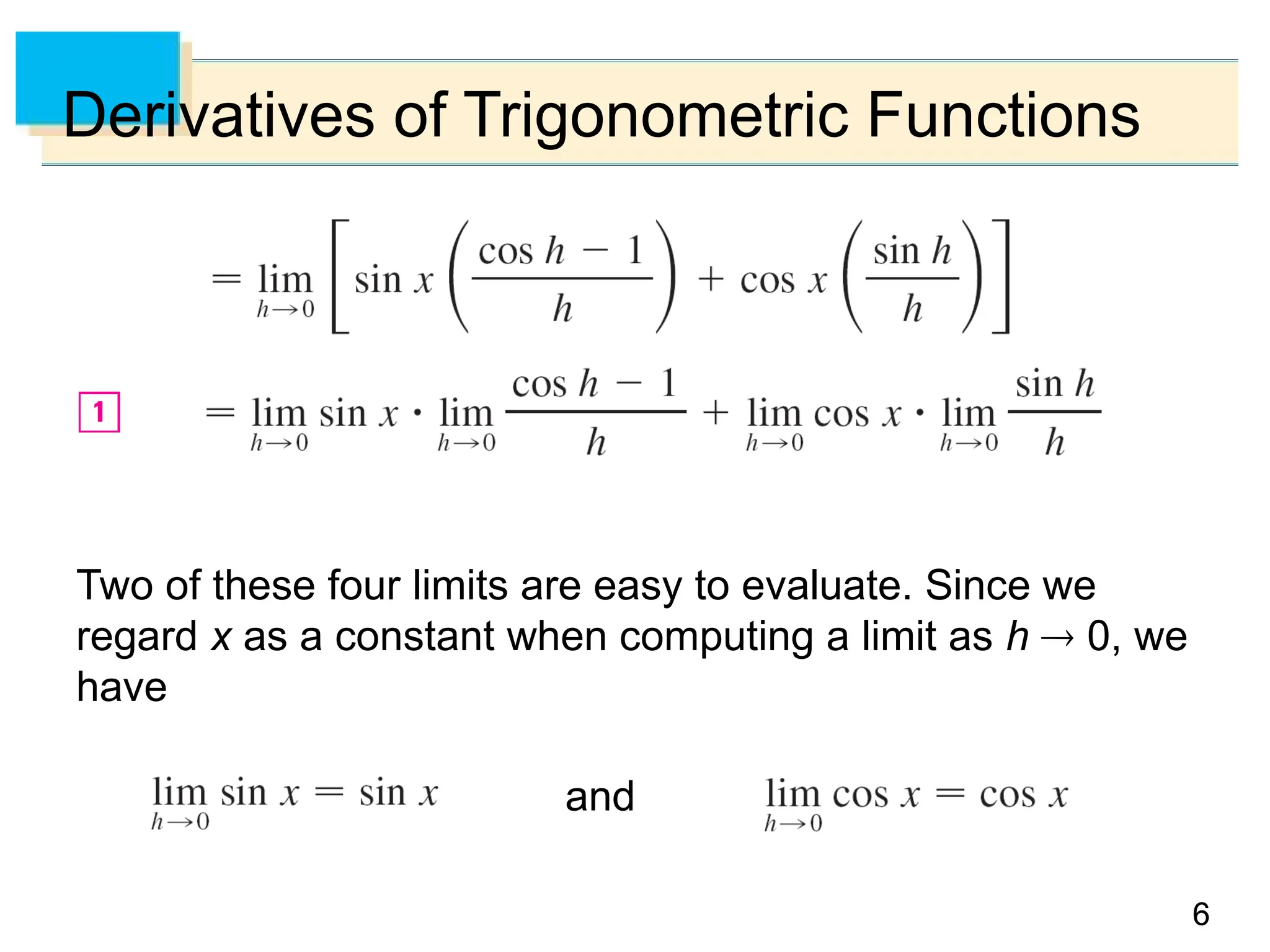
Two of these four limits are easy to evaluate. Since we
regard x as a constant when computing a limit as h  0, we
have
and
7
7
Derivatives of Trigonometric Functions
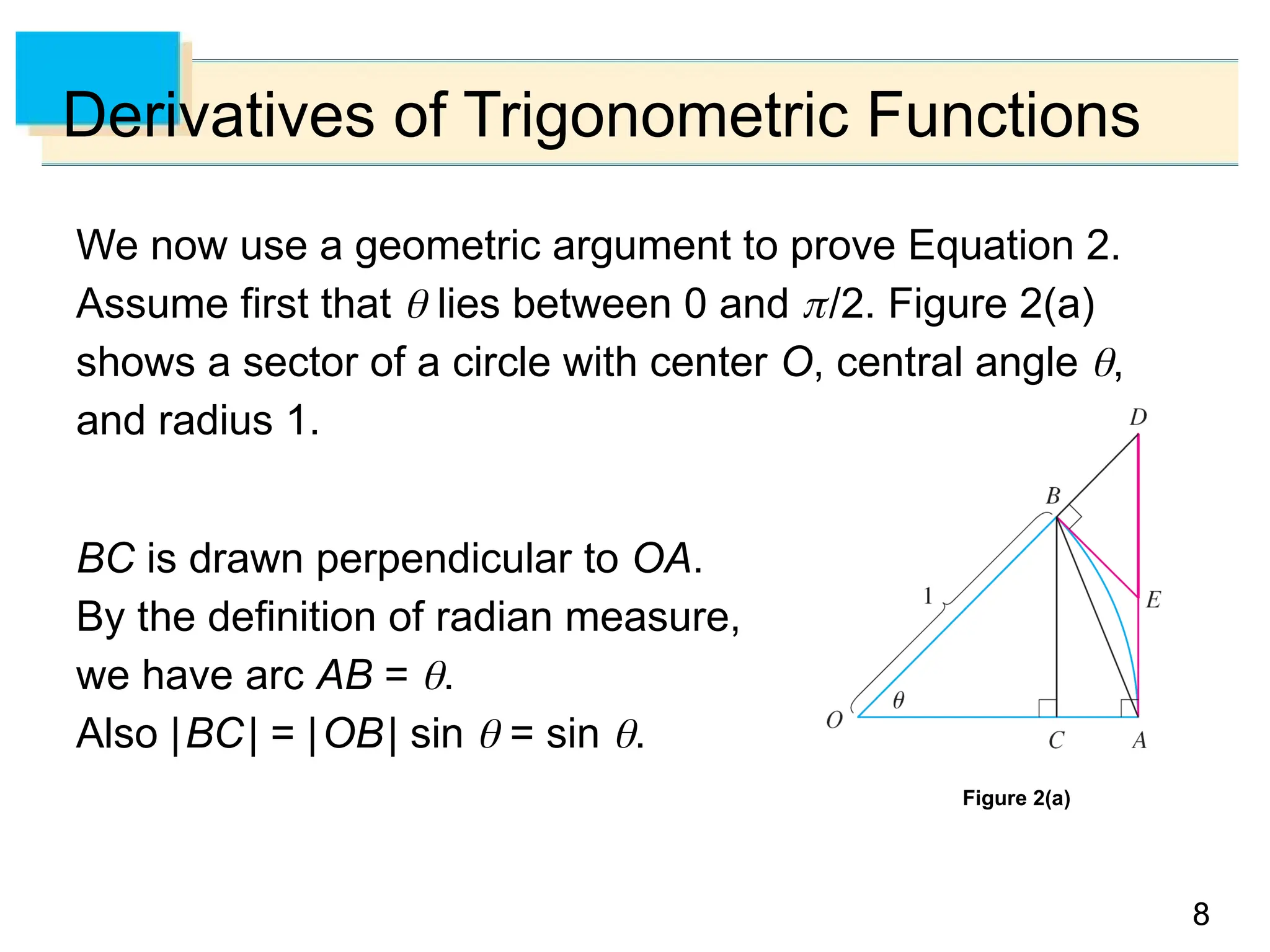
The limit of (sin h)/h is not so obvious. We made the guess,
on the basis of numerical and graphical evidence, that
8
8
Derivatives of Trigonometric Functions
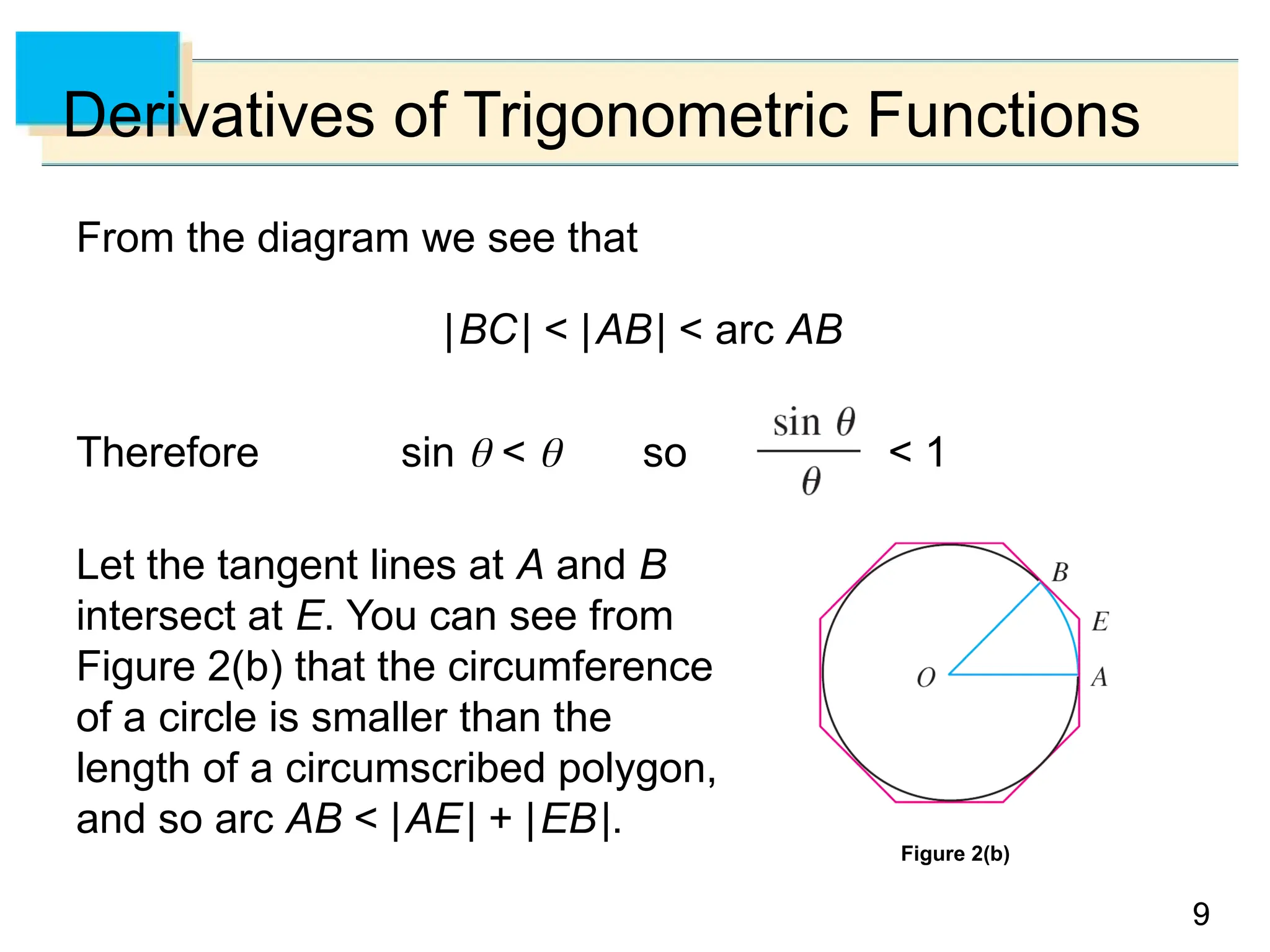
We now use a geometric argument to prove Equation 2.
Assume first that  lies between 0 and /2. Figure 2(a)
shows a sector of a circle with center O, central angle ,
and radius 1.
BC is drawn perpendicular to OA.
By the definition of radian measure,
we have arc AB = .
Also |BC| = |OB| sin  = sin .
Figure 2(a)
9
9
Derivatives of Trigonometric Functions
From the diagram we see that
|BC| < |AB| < arc AB
Therefore sin  <  so < 1
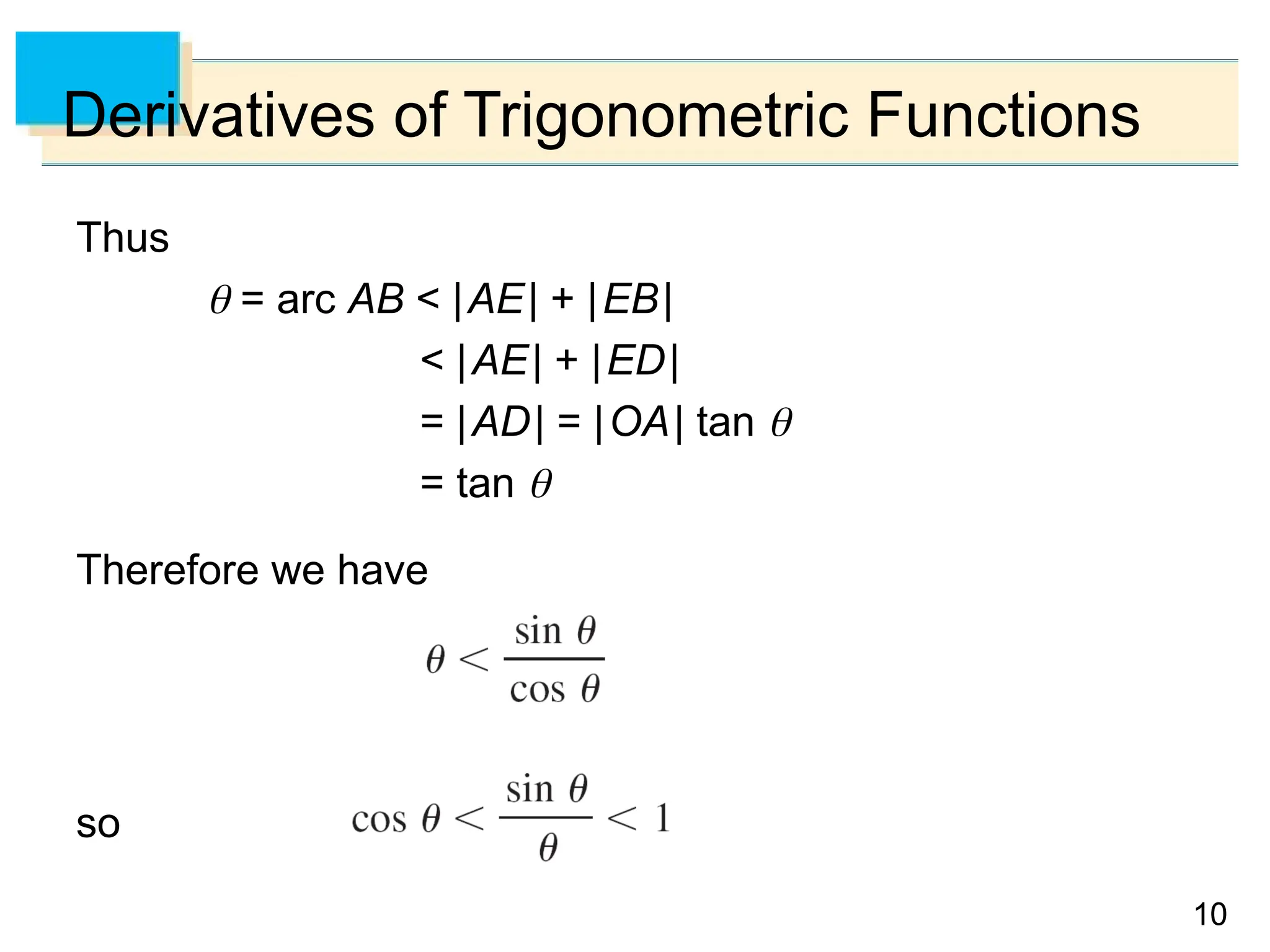
Let the tangent lines at A and B
intersect at E. You can see from
Figure 2(b) that the circumference
of a circle is smaller than the
length of a circumscribed polygon,
and so arc AB < |AE| + |EB|.
Figure 2(b)
10
10
Derivatives of Trigonometric Functions
Thus
 = arc AB < |AE| + |EB|
< |AE| + |ED|
= |AD| = |OA| tan 
= tan 
Therefore we have
so
11
11
Derivatives of Trigonometric Functions
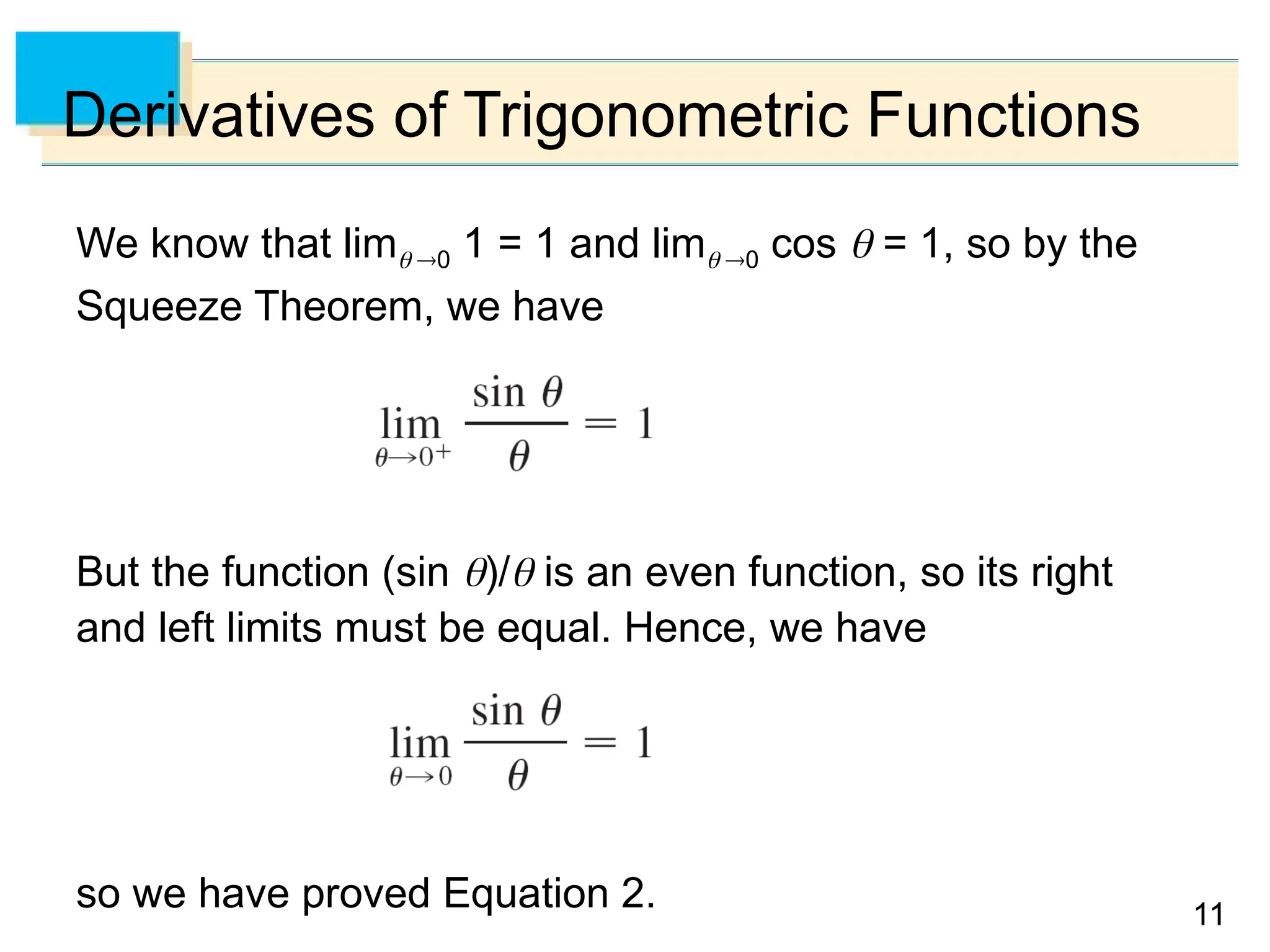
We know that lim 0 1 = 1 and lim 0 cos  = 1, so by the
Squeeze Theorem, we have
But the function (sin )/ is an even function, so its right
and left limits must be equal. Hence, we have
so we have proved Equation 2.
12
12
Derivatives of Trigonometric Functions
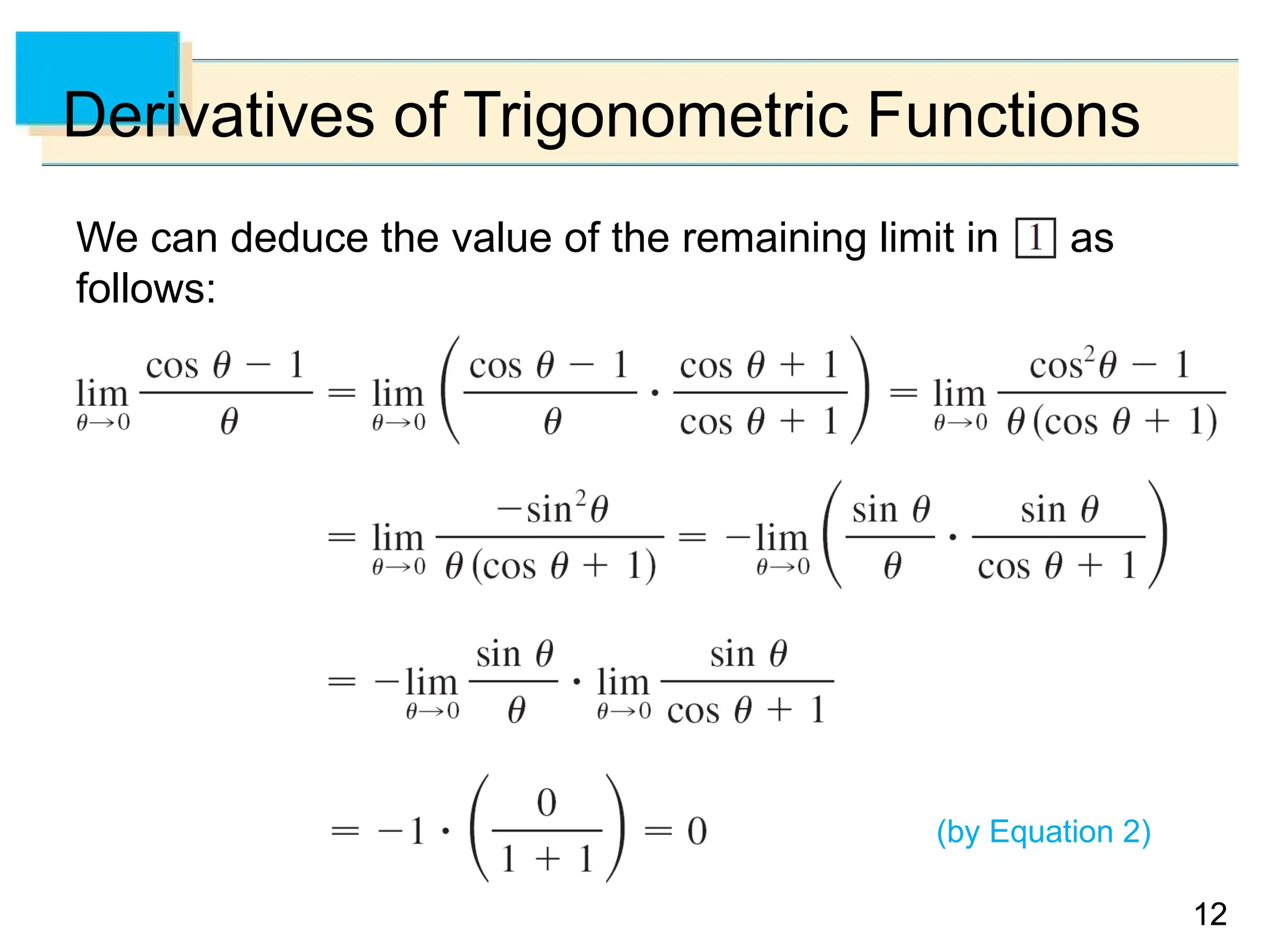
We can deduce the value of the remaining limit in as
follows:
(by Equation 2)
13
13
Derivatives of Trigonometric Functions
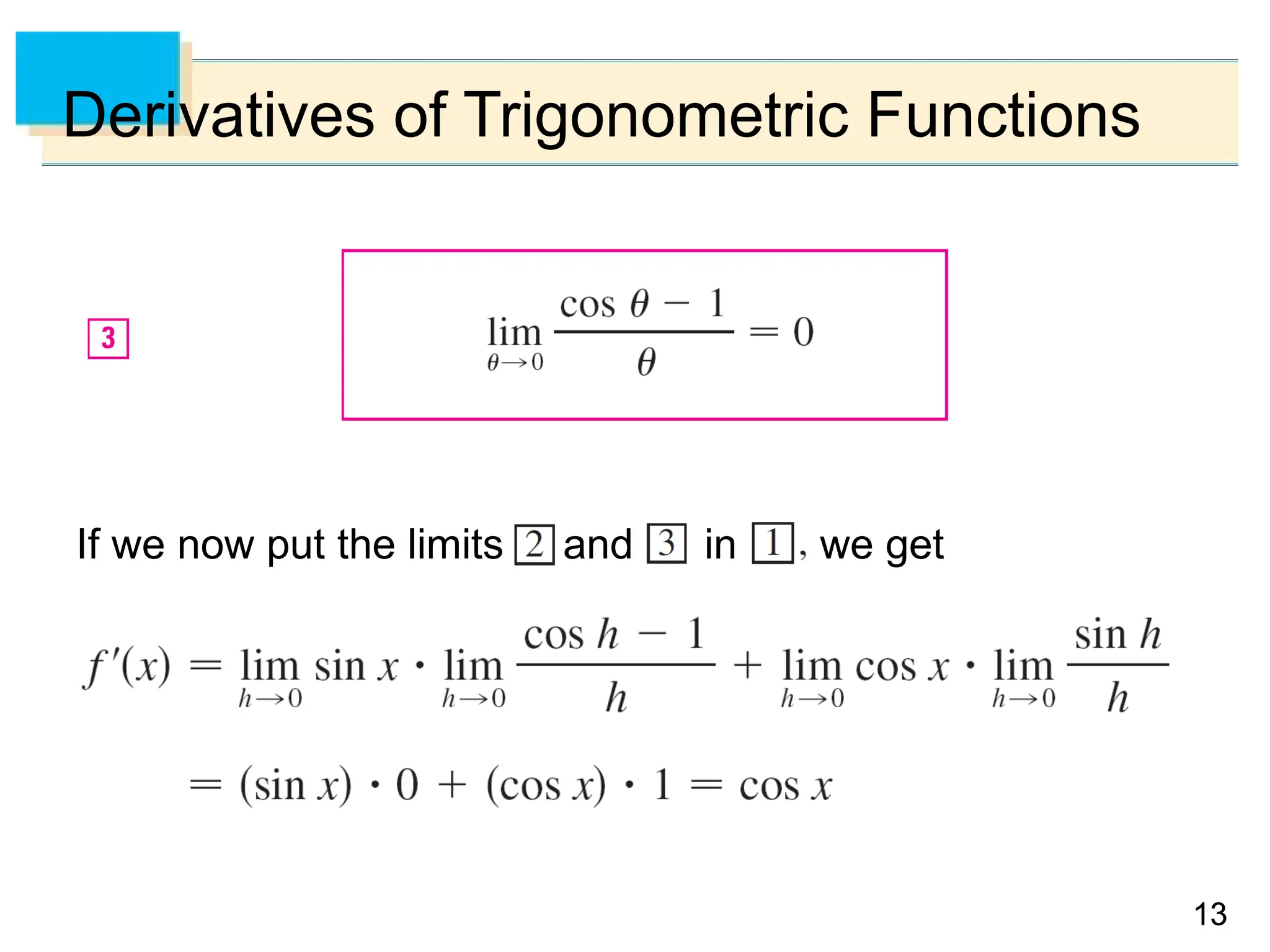
If we now put the limits and in we get
14
14
Derivatives of Trigonometric Functions
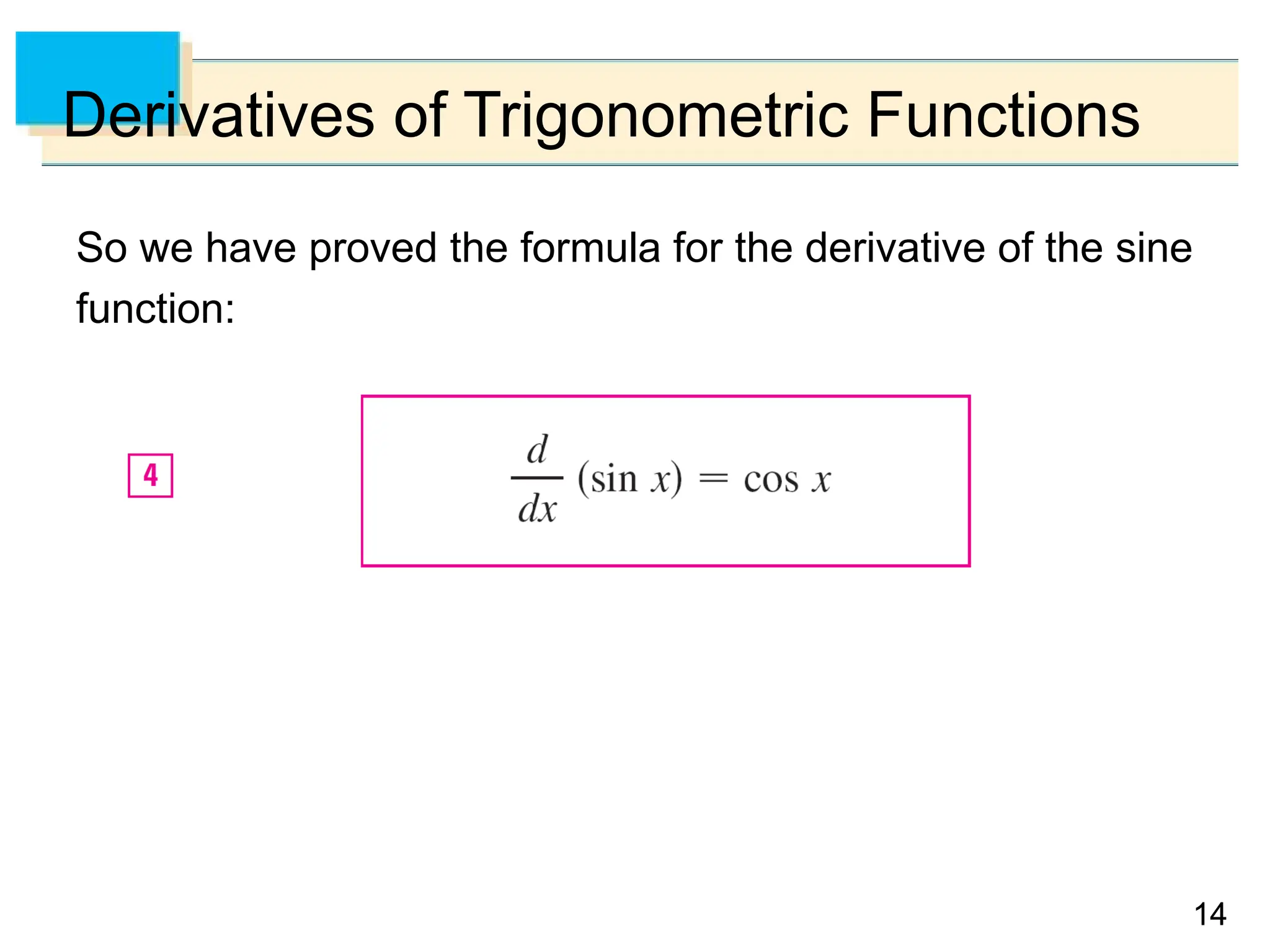
So we have proved the formula for the derivative of the sine
function:
15
15
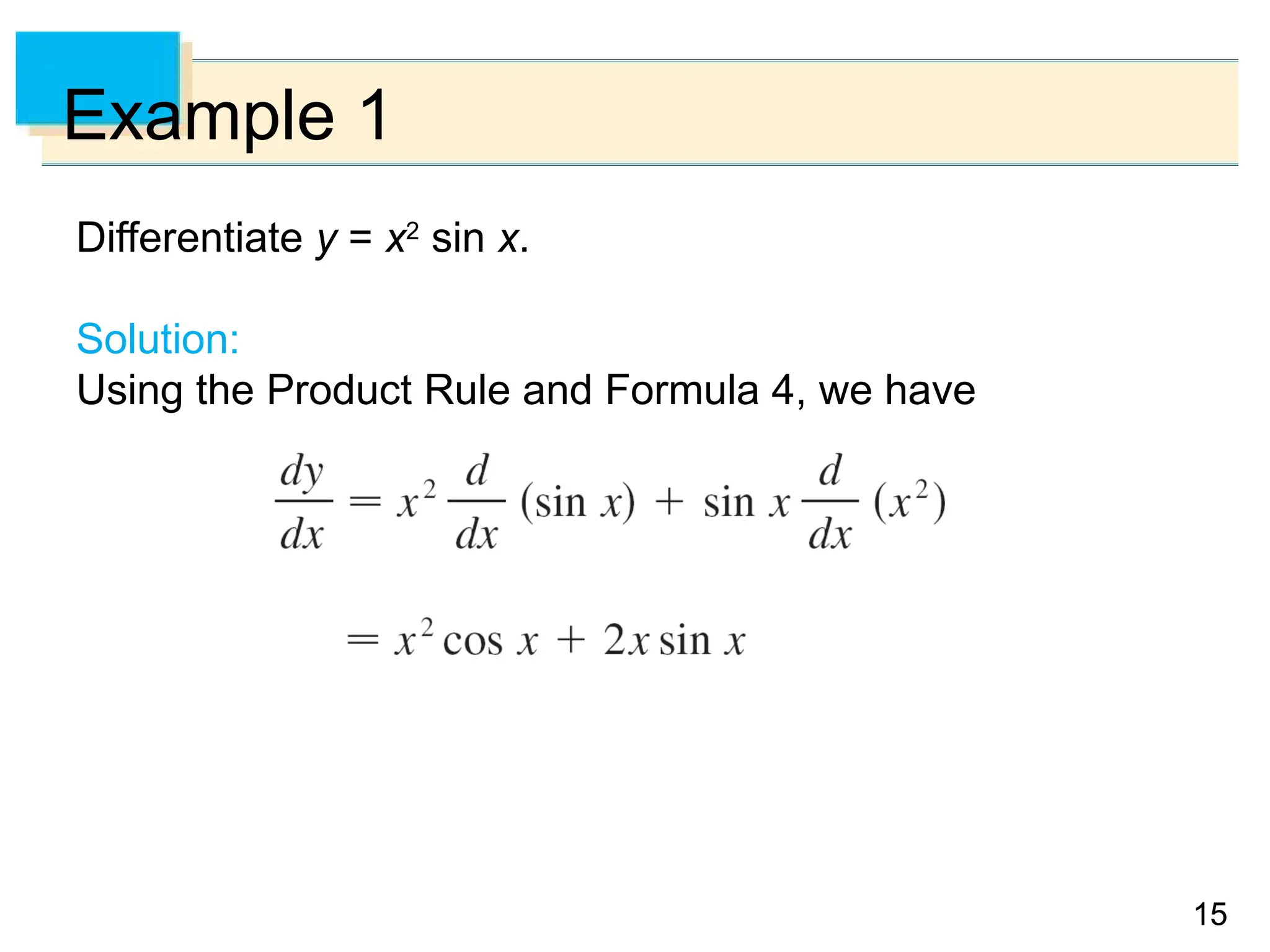
Example 1
Differentiate y = x2
sin x.
Solution:
Using the Product Rule and Formula 4, we have
16
16
Derivatives of Trigonometric Functions
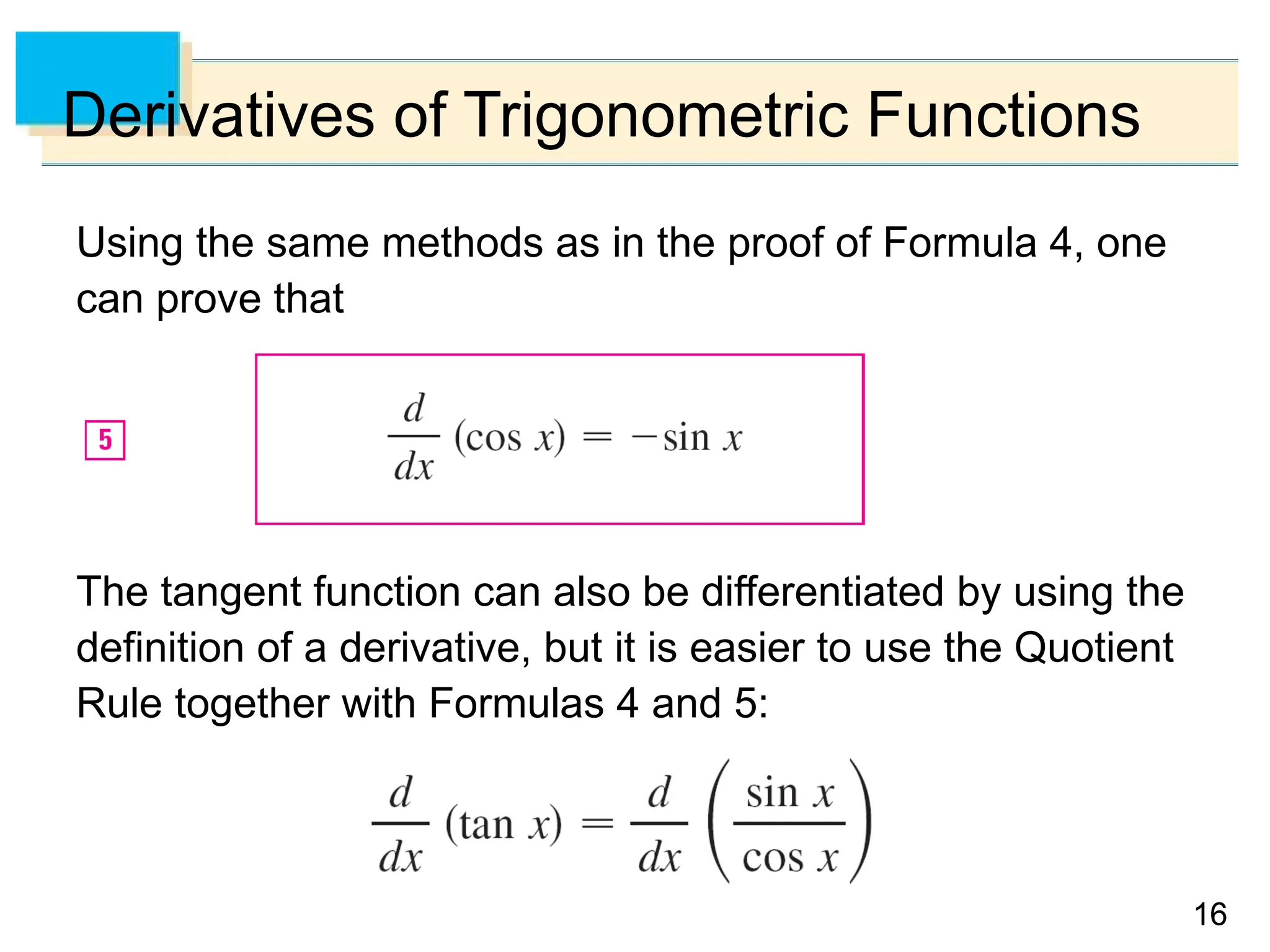
Using the same methods as in the proof of Formula 4, one
can prove that
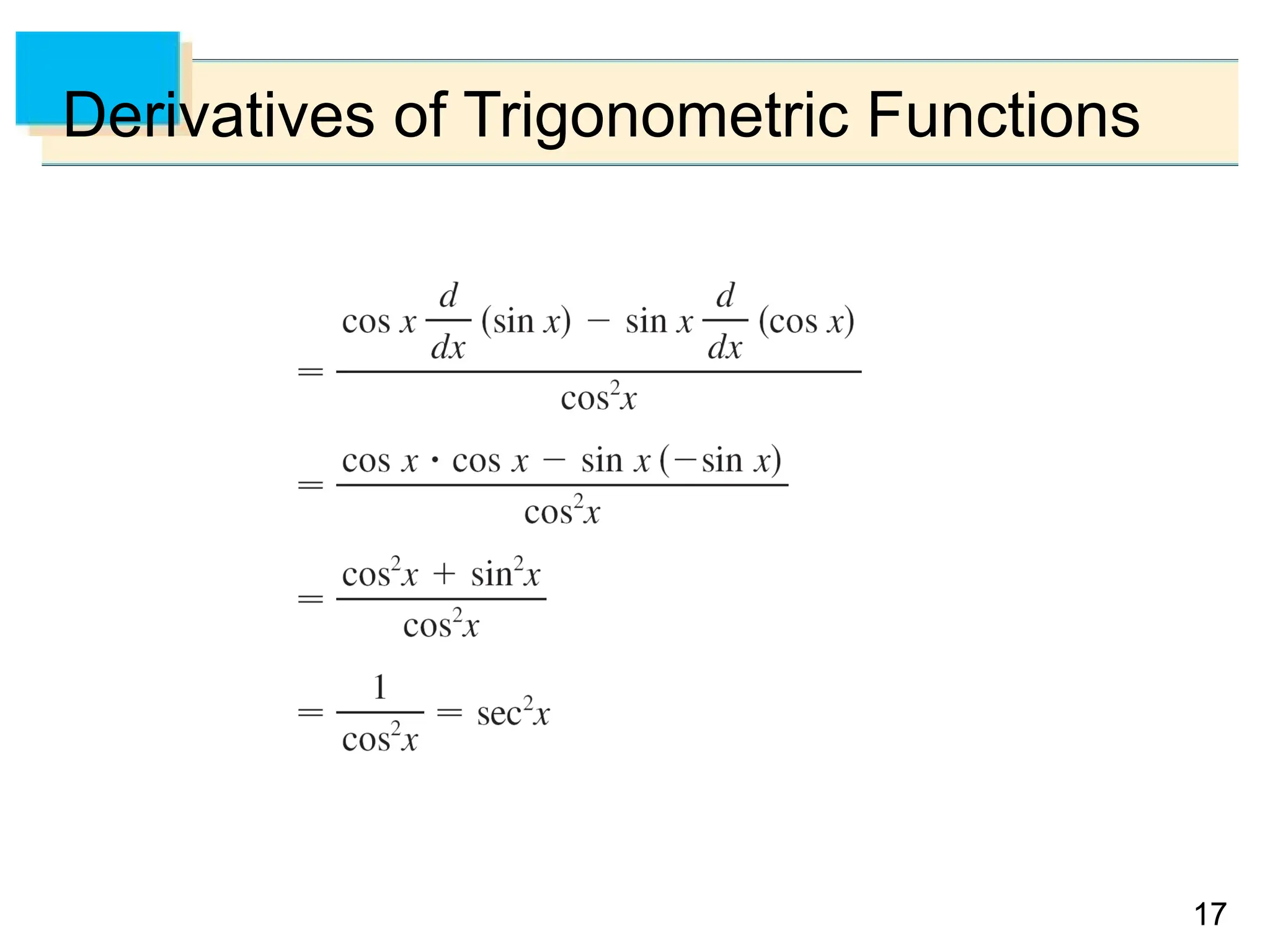
The tangent function can also be differentiated by using the
definition of a derivative, but it is easier to use the Quotient
Rule together with Formulas 4 and 5:
17
17
Derivatives of Trigonometric Functions
18
18
Derivatives of Trigonometric Functions
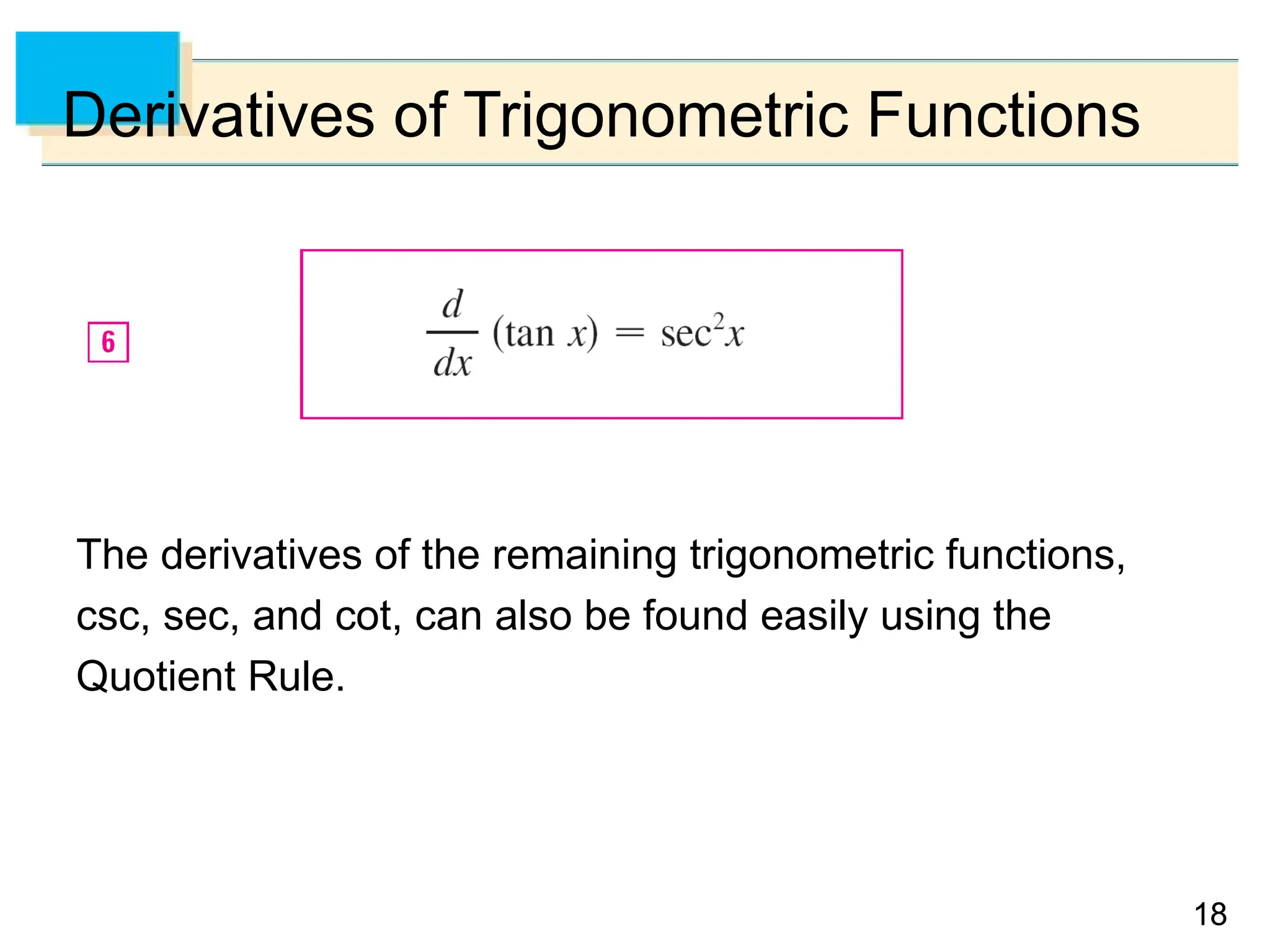
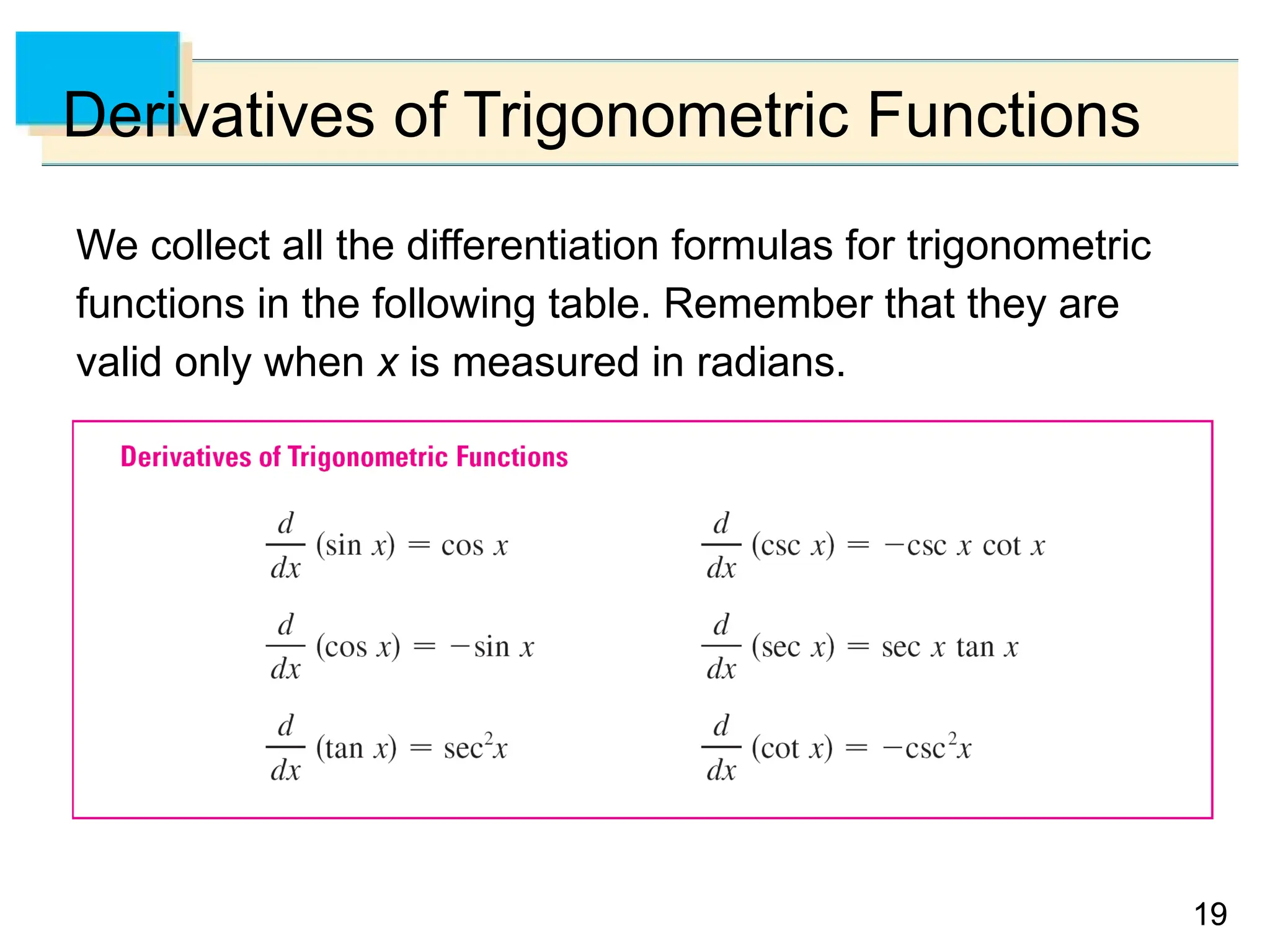
The derivatives of the remaining trigonometric functions,
csc, sec, and cot, can also be found easily using the
Quotient Rule.
19
19
Derivatives of Trigonometric Functions
We collect all the differentiation formulas for trigonometric
functions in the following table. Remember that they are
valid only when x is measured in radians.
20
20
Derivatives of Trigonometric Functions
Trigonometric functions are often used in modeling
real-world phenomena. In particular, vibrations, waves,
elastic motions, and other quantities that vary in a periodic
manner can be described using trigonometric functions. In
the following example we discuss an instance of simple
harmonic motion.
21
21
Example 3
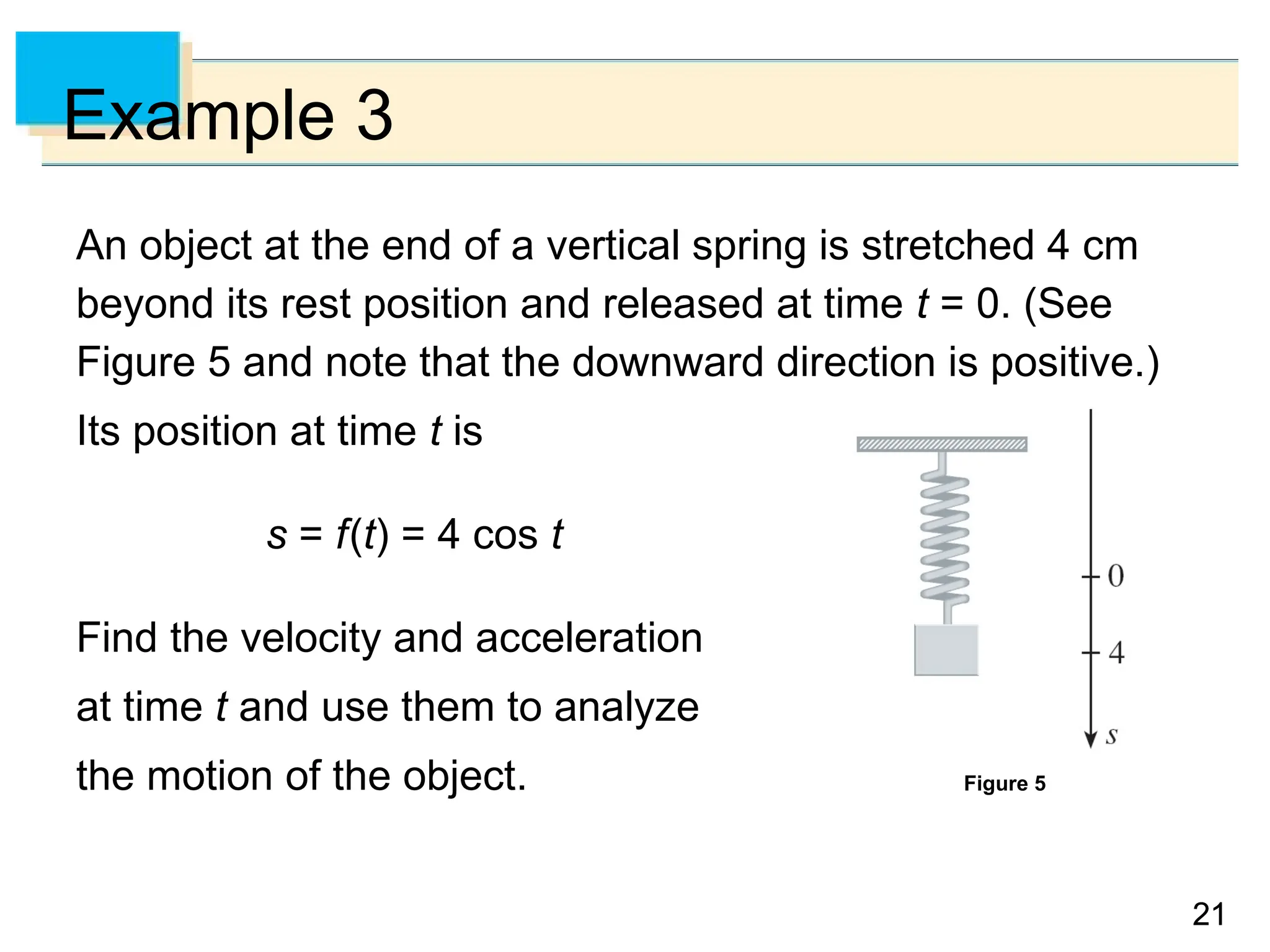
An object at the end of a vertical spring is stretched 4 cm
beyond its rest position and released at time t = 0. (See
Figure 5 and note that the downward direction is positive.)
Its position at time t is
s = f(t) = 4 cos t
Find the velocity and acceleration
at time t and use them to analyze
the motion of the object. Figure 5
22
22
Example 3 – Solution
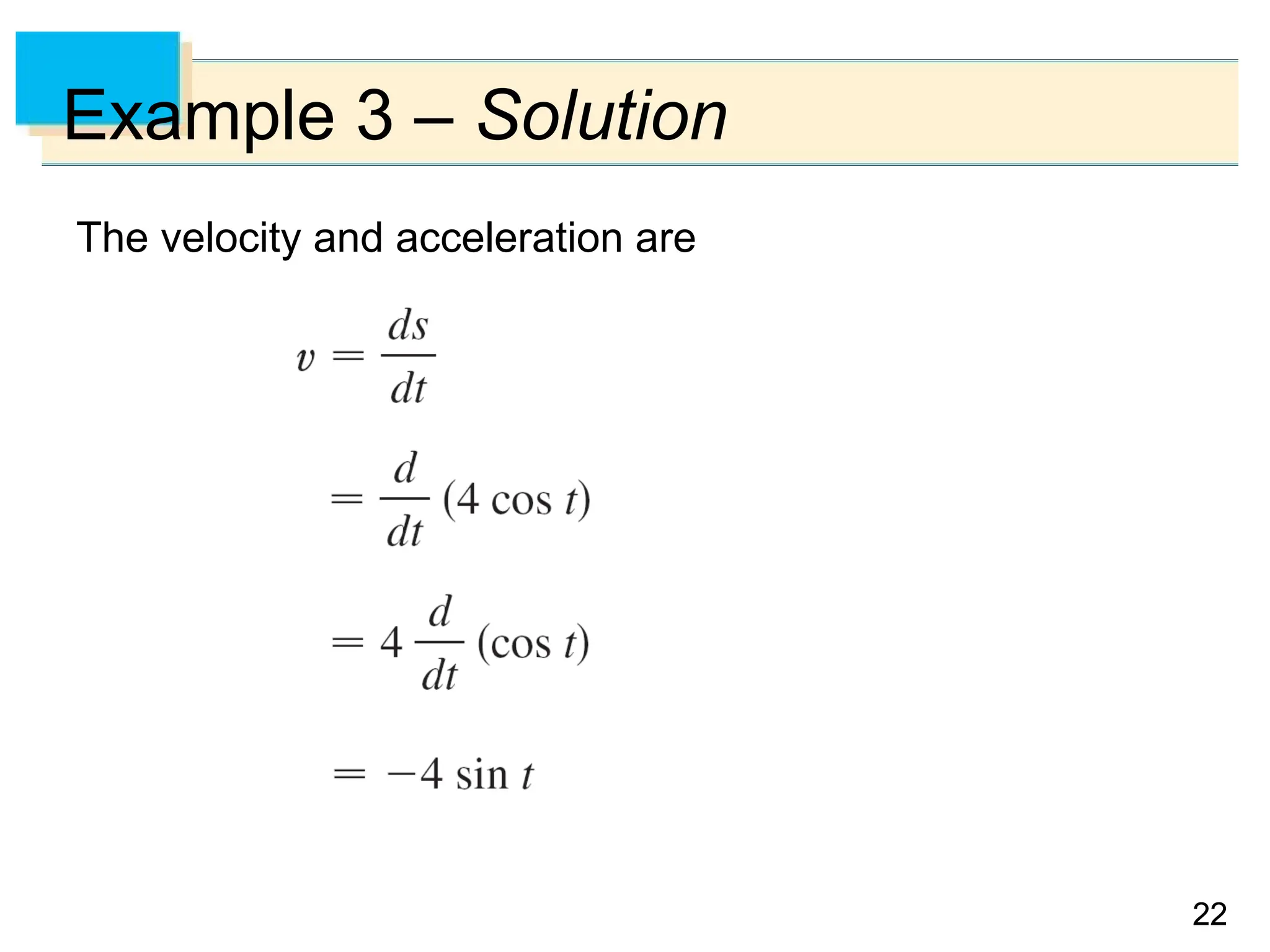
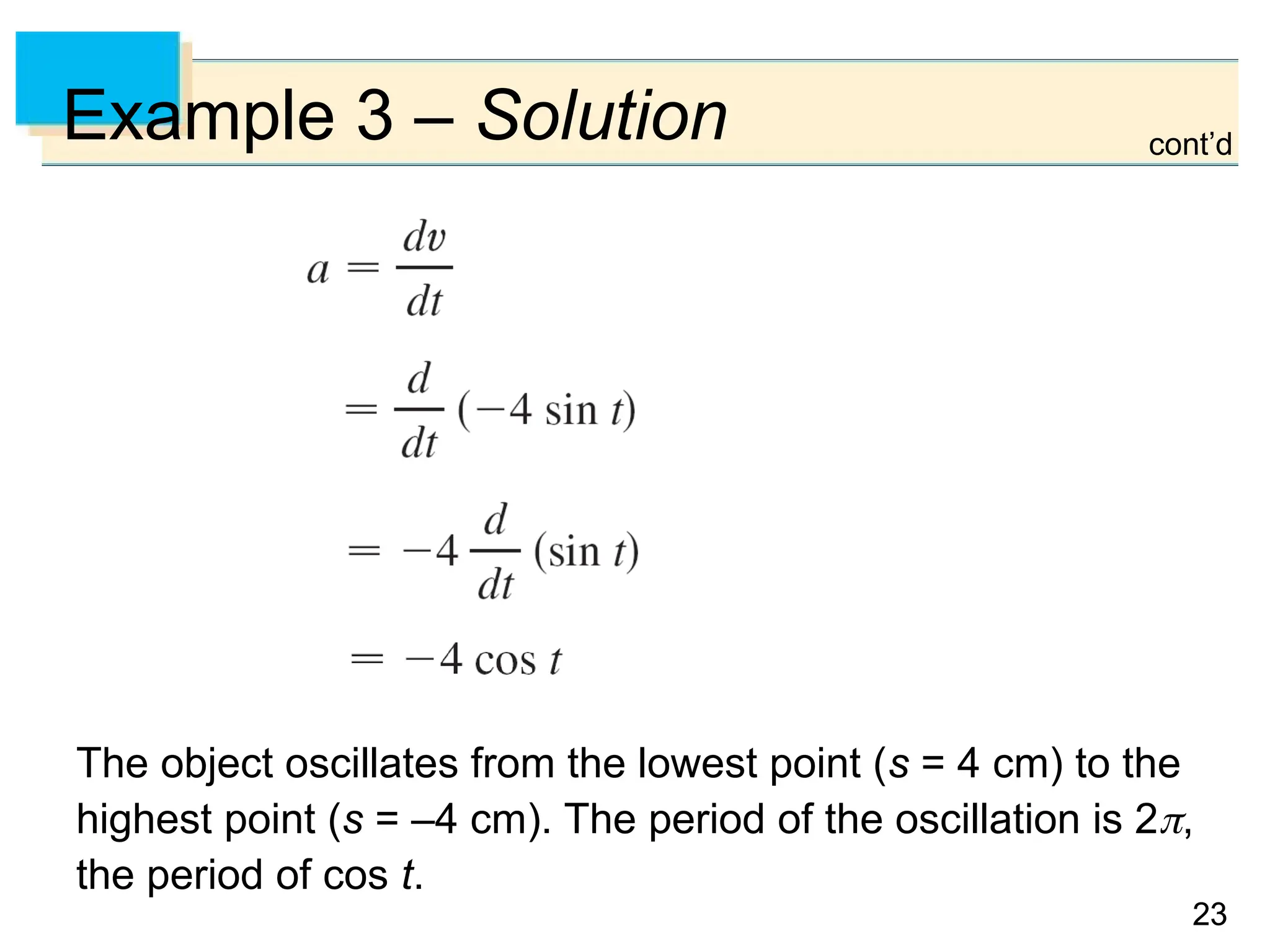
The velocity and acceleration are
23
23
Example 3 – Solution
The object oscillates from the lowest point (s = 4 cm) to the
highest point (s = –4 cm). The period of the oscillation is 2,
the period of cos t.
cont’d
24
24
Example 3 – Solution
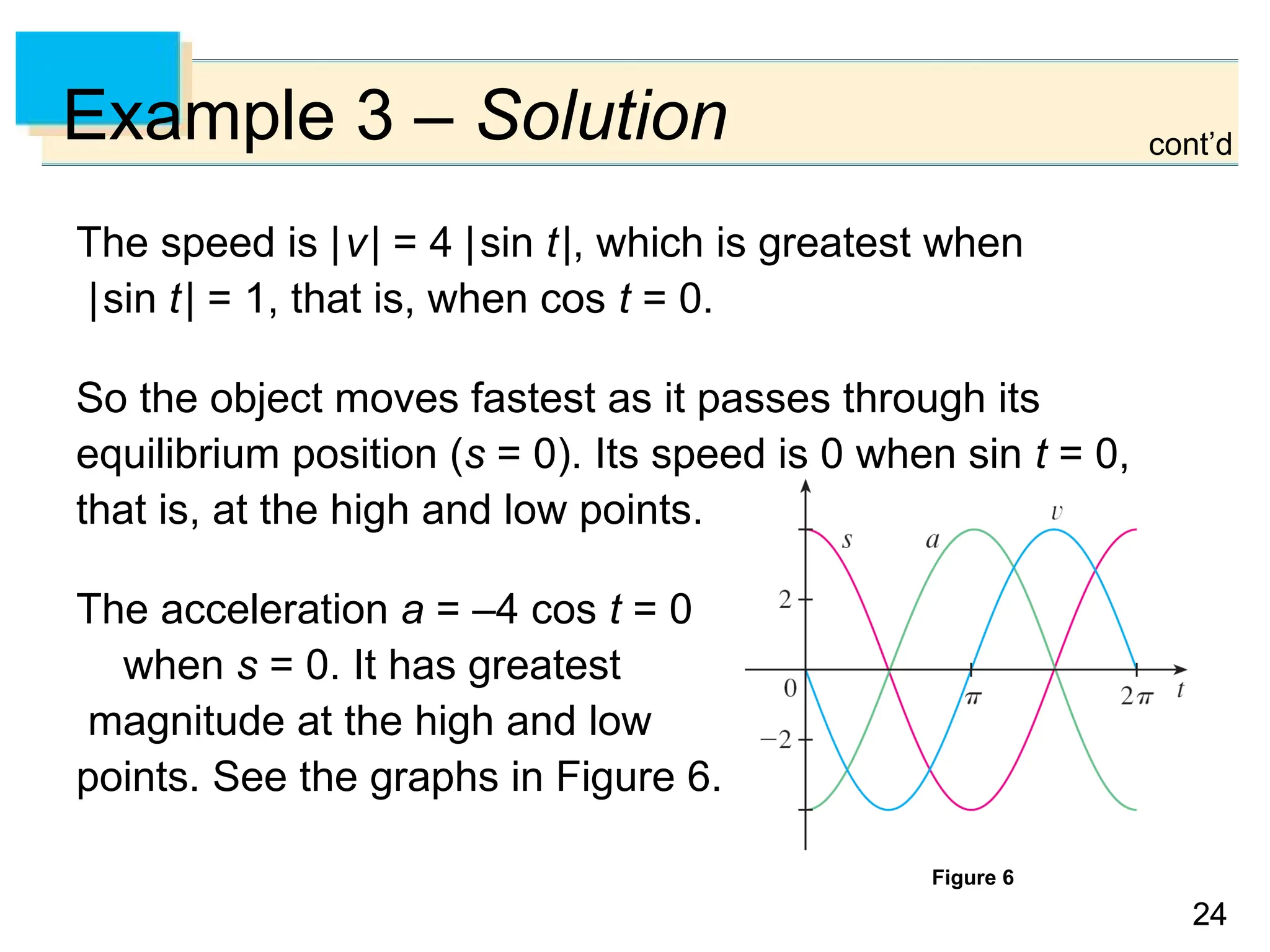
The speed is |v| = 4 |sin t|, which is greatest when
|sin t| = 1, that is, when cos t = 0.
So the object moves fastest as it passes through its
equilibrium position (s = 0). Its speed is 0 when sin t = 0,
that is, at the high and low points.
The acceleration a = –4 cos t = 0
when s = 0. It has greatest
magnitude at the high and low
points. See the graphs in Figure 6.
Figure 6
cont’d
derivative of triginomtric functions....

  • 1.
    Copyright © CengageLearning. All rights reserved. 3 Derivatives
  • 2.
    Copyright © CengageLearning. All rights reserved. 3.3 Derivatives of Trigonometric Functions
  • 3.
    3 3 Derivatives of TrigonometricFunctions In particular, it is important to remember that when we talk about the function f defined for all real numbers x by f(x) = sin x it is understood that sin x means the sine of the angle whose radian measure is x. A similar convention holds for the other trigonometric functions cos, tan, csc, sec, and cot. All of the trigonometric functions are continuous at every number in their domains.
  • 4.
    4 4 Derivatives of TrigonometricFunctions If we sketch the graph of the function f(x) = sin x and use the interpretation of f(x) as the slope of the tangent to the sine curve in order to sketch the graph of f, then it looks as if the graph of f may be the same as the cosine curve. (See Figure 1). Figure 1
  • 5.
    5 5 Derivatives of TrigonometricFunctions Let’s try to confirm our guess that if f(x) = sin x, then f(x) = cos x. From the definition of a derivative, we have
  • 6.
    6 6 Derivatives of TrigonometricFunctions Two of these four limits are easy to evaluate. Since we regard x as a constant when computing a limit as h  0, we have and
  • 7.
    7 7 Derivatives of TrigonometricFunctions The limit of (sin h)/h is not so obvious. We made the guess, on the basis of numerical and graphical evidence, that
  • 8.
    8 8 Derivatives of TrigonometricFunctions We now use a geometric argument to prove Equation 2. Assume first that  lies between 0 and /2. Figure 2(a) shows a sector of a circle with center O, central angle , and radius 1. BC is drawn perpendicular to OA. By the definition of radian measure, we have arc AB = . Also |BC| = |OB| sin  = sin . Figure 2(a)
  • 9.
    9 9 Derivatives of TrigonometricFunctions From the diagram we see that |BC| < |AB| < arc AB Therefore sin  <  so < 1 Let the tangent lines at A and B intersect at E. You can see from Figure 2(b) that the circumference of a circle is smaller than the length of a circumscribed polygon, and so arc AB < |AE| + |EB|. Figure 2(b)
  • 10.
    10 10 Derivatives of TrigonometricFunctions Thus  = arc AB < |AE| + |EB| < |AE| + |ED| = |AD| = |OA| tan  = tan  Therefore we have so
  • 11.
    11 11 Derivatives of TrigonometricFunctions We know that lim 0 1 = 1 and lim 0 cos  = 1, so by the Squeeze Theorem, we have But the function (sin )/ is an even function, so its right and left limits must be equal. Hence, we have so we have proved Equation 2.
  • 12.
    12 12 Derivatives of TrigonometricFunctions We can deduce the value of the remaining limit in as follows: (by Equation 2)
  • 13.
    13 13 Derivatives of TrigonometricFunctions If we now put the limits and in we get
  • 14.
    14 14 Derivatives of TrigonometricFunctions So we have proved the formula for the derivative of the sine function:
  • 15.
    15 15 Example 1 Differentiate y= x2 sin x. Solution: Using the Product Rule and Formula 4, we have
  • 16.
    16 16 Derivatives of TrigonometricFunctions Using the same methods as in the proof of Formula 4, one can prove that The tangent function can also be differentiated by using the definition of a derivative, but it is easier to use the Quotient Rule together with Formulas 4 and 5:
  • 17.
  • 18.
    18 18 Derivatives of TrigonometricFunctions The derivatives of the remaining trigonometric functions, csc, sec, and cot, can also be found easily using the Quotient Rule.
  • 19.
    19 19 Derivatives of TrigonometricFunctions We collect all the differentiation formulas for trigonometric functions in the following table. Remember that they are valid only when x is measured in radians.
  • 20.
    20 20 Derivatives of TrigonometricFunctions Trigonometric functions are often used in modeling real-world phenomena. In particular, vibrations, waves, elastic motions, and other quantities that vary in a periodic manner can be described using trigonometric functions. In the following example we discuss an instance of simple harmonic motion.
  • 21.
    21 21 Example 3 An objectat the end of a vertical spring is stretched 4 cm beyond its rest position and released at time t = 0. (See Figure 5 and note that the downward direction is positive.) Its position at time t is s = f(t) = 4 cos t Find the velocity and acceleration at time t and use them to analyze the motion of the object. Figure 5
  • 22.
    22 22 Example 3 –Solution The velocity and acceleration are
  • 23.
    23 23 Example 3 –Solution The object oscillates from the lowest point (s = 4 cm) to the highest point (s = –4 cm). The period of the oscillation is 2, the period of cos t. cont’d
  • 24.
    24 24 Example 3 –Solution The speed is |v| = 4 |sin t|, which is greatest when |sin t| = 1, that is, when cos t = 0. So the object moves fastest as it passes through its equilibrium position (s = 0). Its speed is 0 when sin t = 0, that is, at the high and low points. The acceleration a = –4 cos t = 0 when s = 0. It has greatest magnitude at the high and low points. See the graphs in Figure 6. Figure 6 cont’d