Managing Demand & Capacity 
Shwetanshu Gupta (49) 
Kritika Handoo (18) 
Tanvi Bhargav (53)
Nature of Service 
 Services are deeds, performances and processes produced 
or co-produced by one person or entity for another person 
or entity 
 Intangibility 
 Heterogeneous 
 Simultaneous consumption and production 
 Perishability 
• Because of the characteristics that service holds, it can’t be 
inventoried. 
• These shortcomings in services combined with fluctuating 
demand lead to variety of potential outcomes
Demand and Capacity 
 Demand is the amount of a particular economic good or 
service that a consumer or group of consumers will want to 
purchase at a given price. Capacity is the amount available at 
given price. 
 Managing Capacity means managing the limits of an 
organization's resources, such as its labor force, 
manufacturing and office space, technology and equipment, 
raw materials, and inventory . 
 Capacity is usually constant whereas demand usually 
fluctuates. 
 Overuse or underuse of a service results in Gap 3 of the Gap 
model- failure to deliver what was designed and planned i.e..
Optimum vs. Maximum Capacity 
 Maximum capacity on the other hand represent the 
absolute limit of service availability. 
 Using capacity at optimum level means the resources 
are fully employed but not overused and customers are 
receiving quality services. 
 Example: Theatre- Maximum capacity= Optimum 
capacity 
:University Classroom- not desirable to have 
maximum capacity utilization
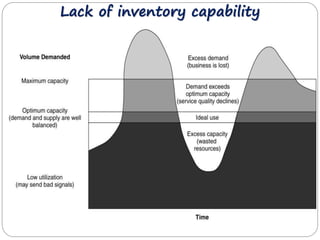
Lack of inventory capability
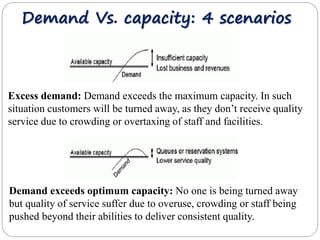
Demand Vs. capacity: 4 scenarios 
Excess demand: Demand exceeds the maximum capacity. In such 
situation customers will be turned away, as they don’t receive quality 
service due to crowding or overtaxing of staff and facilities. 
Demand exceeds optimum capacity: No one is being turned away 
but quality of service suffer due to overuse, crowding or staff being 
pushed beyond their abilities to deliver consistent quality.
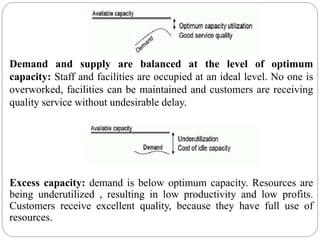
Demand and supply are balanced at the level of optimum 
capacity: Staff and facilities are occupied at an ideal level. No one is 
overworked, facilities can be maintained and customers are receiving 
quality service without undesirable delay. 
Excess capacity: demand is below optimum capacity. Resources are 
being underutilized , resulting in low productivity and low profits. 
Customers receive excellent quality, because they have full use of 
resources.
Cont’d 
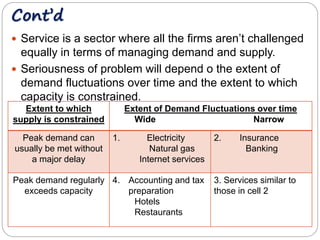
 Service is a sector where all the firms aren’t challenged 
equally in terms of managing demand and supply. 
 Seriousness of problem will depend o the extent of 
demand fluctuations over time and the extent to which 
capacity is constrained. 
Extent to which 
supply is constrained 
Extent of Demand Fluctuations over time 
Wide Narrow 
Peak demand can 
usually be met without 
a major delay 
1. Electricity 
Natural gas 
Internet services 
2. Insurance 
Banking 
Peak demand regularly 
exceeds capacity 
4. Accounting and tax 
preparation 
Hotels 
Restaurants 
3. Services similar to 
those in cell 2
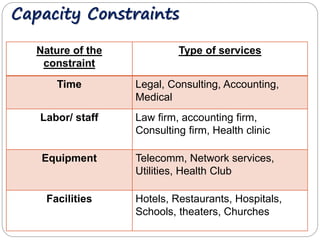
Capacity Constraints 
Nature of the 
constraint 
Type of services 
Time Legal, Consulting, Accounting, 
Medical 
Labor/ staff Law firm, accounting firm, 
Consulting firm, Health clinic 
Equipment Telecomm, Network services, 
Utilities, Health Club 
Facilities Hotels, Restaurants, Hospitals, 
Schools, theaters, Churches
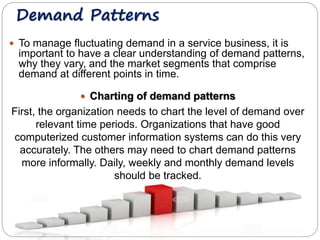
Demand Patterns 
 To manage fluctuating demand in a service business, it is 
important to have a clear understanding of demand patterns, 
why they vary, and the market segments that comprise 
demand at different points in time. 
 Charting of demand patterns 
First, the organization needs to chart the level of demand over 
relevant time periods. Organizations that have good 
computerized customer information systems can do this very 
accurately. The others may need to chart demand patterns 
more informally. Daily, weekly and monthly demand levels 
should be tracked.
 Predictable Cycles 
 When organizations chart down their demand patterns, 
predictable cycles may be detected. 
 Certain service firms have predictable demand patterns. 
 For example for a tax accountant, it is generally predicted 
that demand will be high at times when taxes are due. 
 For hotels it is predicted that demand will be high during 
vacations. 
 Similarly for telecomm industry demand will be high at 
certain holidays and times of the week and day.
 Random Demand Fluctuations : 
 Sometimes the patterns of demand appear to be 
random—there is no apparent predictable cycle. 
 For example. day to-day changes in the weather may 
affect use of recreational, shopping, or entertainment 
facilities. Although the weather cannot be predicted far 
in advance, it may be possible to anticipate demand a 
day or two ahead. 
 Health-related events also cannot be predicted. 
Accidents, heart attacks, and births all increase 
demand for hospital services, but the level of demand 
cannot generally be determined in advance. 
 Example: Flood in J&K
 Demand Patterns by Market Segment: 
 If an organization has detailed records on customer 
transactions, it may be able to disaggregate demand 
by market segment, revealing patterns within patterns. 
Or the analysis may reveal that demand from one 
segment is predictable while demand from another 
segment is relatively random. 
 For example, many auto service centers experience 
more walk- in- customers on Monday morning than 
any other day of the week. 
 Knowing that this pattern exists, some clinics schedule 
more future appointments (which they can control) for 
later days of the week, leaving more of Monday 
available for same-day appointments and walk-ins.
Strategies for matching Capacity & 
Demand 
 When an organisation has clear grasp of its capacity 
constraints & an understanding of demand patterns, it is 
in a good position to develop strategies for matching 
supply and demand. 
 2 general approaches 
1) To smooth the demand fluctuations by shifting demand to 
match existing supply . 
2) To adjust capacity to match fluctuations in demand.
Shifting Demand to Match Capacity 
 An organisation seeks to shift customers away from 
periods in which demand exceeds capacity, perhaps by 
convincing them to use the service during slow demand. 
 During periods of slow demand, the organisation seeks 
to attract more customers to utilize its productive 
capacity. 
 Frequently a firm uses combination of approaches.
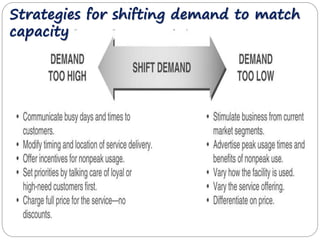
Strategies for shifting demand to match 
capacity
Vary the service offering : This approach is to 
change the nature of the service offering, depending 
upon the season of the year, day of the week or time 
of the day. 
Example 
Communicate with customers : Letting them know 
the times of peak demand so they can choose to use 
the services at alternative times and avoid crowding 
and delays. 
Example
Modify timing & location of service delivery : Some 
firms adjust their hours & days of service delivery to 
more directly reflect customer demand. 
Example 
 Differentiate on Price : A common response during 
slow demand is to discount the price of the service. To 
be effective however, a price differentiation strategy 
depends on understanding of customer price sensitivity 
& demand curves. 
Example
Adjusting Capacity to meet 
Demand 
 The fundamental idea here is to adjust, stretch & align 
capacity to match customer demand. 
 During periods of peak demand the organisation seek to 
stretch or expand its capacity as much as possible. 
 During periods of slow demand it tries to shrink capacity 
so a snot to waste resources.
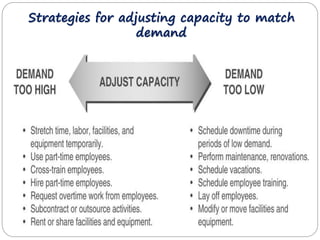
Strategies for adjusting capacity to match 
demand
 Stretch existing capacity : The existing capacity is 
expanded temporarily to match demand. No new 
resources are added; rather the people, facilities, & 
equipment are asked to work harder & for longer. 
 Stretch Time : A health clinic may stay open longer 
during flu season or retailers are open longer hours 
during the festive season. 
 Stretch Labour : In many service organisations, 
employees are asked to work longer & harder during 
period of peak demand.
 Align capacity with demand fluctuations : this 
basic strategy is sometimes called as a “chase 
demand” strategy. By adjusting service resources 
creatively, organisations can in effect the demand 
curves to match capacity with customer demand 
patterns. 
Use part-time employees : In this situation the 
organisation’s labour resource is being aligned with 
demand. Retailer’s hire part-time employees during 
holiday rush, restaurants often ask employees to work 
split shifts(work the lunch shift, leave for few hours, & 
come back for dinner rush) during peak mealtime 
hours.
 Outsourcing : firms that find they have a temporary 
peak in demand for a service that they cannot perform 
themselves may choose to outsource the entire 
service. 
 Schedule downtime during periods of low demand 
: if people, equipment,& facilities are being used at 
maximum capacity during peak periods, then it is 
imperative to schedule repair, maintenance & 
renovation during off-peak season. 
 Cross- train employees : if employees are cross-trained, 
they can shift among tasks, filling in where they 
are most needed. It increases the efficiency of the 
whole system & avoids underutilizing employees in 
some areas while others are being overtaxed.
Yield Management 
 “ It the process of allocating right type of capacity to the 
right type kind of customer at the right price so as to 
maximise revenue or yield.” 
 The goal of yield management is to produce the best 
possible financial return from a limited available 
capacity. 
 Using yield management models, organisations find the 
best balance at a particular point in time among the 
prices charged, the segments sold to, and the capacity 
used. 
 It is the ratio of : 
yield = actual revenue 
potential revenue
Implementing a Yield Management 
System 
 To implement a yield management system, an 
organisation needs detailed data on past demand 
patterns by market segment as well as methods of 
projecting current market demand.
Challenges & Risks in using Yield 
Management 
 Loss of competitive focus : it may cause a firm to over 
focus on profit maximisation & inadvertently neglect 
aspects of the service that provide long-term competitive 
success. 
Customer alienation : if customers learn that they are 
paying a higher price for service than someone else, 
they may perceive the pricing as unfair, particularly if 
they do not understand the reasons. 
Employee morale problems : this system take much 
guesswork & judgement in setting prices away from 
sales & reservations people. Although some employees 
may appreciate, others may resent the rules & 
restrictions on their own discretion.
 Lack of employee training : extensive training is 
required to make a yields system work. Employees 
need to understand its purpose, how it works, how 
they should make decisions, and how the system will 
affect their jobs. 
 Inappropriate organisation of the yield 
management function : to be most effective with 
yields management, an organisation must have 
centralised reservations. Although airlines & some 
large hotel chains do have such centralisation, smaller 
organisations may have decentralised reservation 
system & thus find it difficult to operate a yield 
management system effectively.
Waiting line Strategies : When 
Demand & Capacity can’t be matched 
Sometimes it is not possible to manage capacity to 
match demand or vice versa. It may be too costly - for 
eg, most health clinics would not find it economically 
feasible to add additional facilities or physicians to 
handle peak in demand. Or demand may be very 
unpredictable & the service capacity very inflexible. 
 To deal effectively with the inevitability of waits, 
organisations can utilize a variety of strategies:
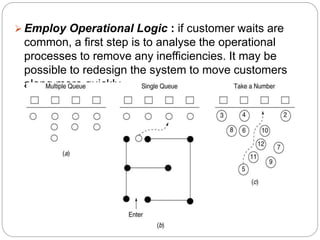
Employ Operational Logic : if customer waits are 
common, a first step is to analyse the operational 
processes to remove any inefficiencies. It may be 
possible to redesign the system to move customers 
along more quickly.
 Establish a Reservation Process : when waiting 
cannot be avoided, a reservation system can help to 
spread demand. Restaurants, transportation 
companies, & many other use reservation systems to 
alleviate long waits.
 Differentiate Waiting Customers : not all customers 
need to wait the same length of time for service. On the 
basis of need or customer priority, organisations 
differentiate among customers. It can be based on 
following factors : 
• Importance of the customer : frequent customers who 
spend large amount of time with the organisations can be 
given priority in service by providing them with a special 
waiting area or segregated lines. 
• Urgency of the job : those customers with the most 
urgent need may be served first. This strategy is used in 
emergency health care. 
• Payment of a premium price : customers who pay extra, 
for eg: first class on airline, are often given priority via
 Making waiting fun: 
All waits need not to be boring to customers. 
Organizations can make waiting a value received by the 
customers. Customers can be satisfied by making waiting 
fun or at least tolerable. There are 9 principles about 
waiting: • unoccupied time feels longer than occupied time 
• preprocess waits feel longer than in-process waits 
• anxiety makes waits seem longer 
• uncertain waits seem longer than known, finite waits 
• unexplained waits seem longer than explained waits 
• unfair waits feel longer than equitable waits 
• the more valuable the service, the longer the customer 
will wait 
• solo waits feel longer than group waits
Supply and demand management in services

Supply and demand management in services

  • 1.
    Managing Demand &Capacity Shwetanshu Gupta (49) Kritika Handoo (18) Tanvi Bhargav (53)
  • 2.
    Nature of Service  Services are deeds, performances and processes produced or co-produced by one person or entity for another person or entity  Intangibility  Heterogeneous  Simultaneous consumption and production  Perishability • Because of the characteristics that service holds, it can’t be inventoried. • These shortcomings in services combined with fluctuating demand lead to variety of potential outcomes
  • 3.
    Demand and Capacity  Demand is the amount of a particular economic good or service that a consumer or group of consumers will want to purchase at a given price. Capacity is the amount available at given price.  Managing Capacity means managing the limits of an organization's resources, such as its labor force, manufacturing and office space, technology and equipment, raw materials, and inventory .  Capacity is usually constant whereas demand usually fluctuates.  Overuse or underuse of a service results in Gap 3 of the Gap model- failure to deliver what was designed and planned i.e..
  • 4.
    Optimum vs. MaximumCapacity  Maximum capacity on the other hand represent the absolute limit of service availability.  Using capacity at optimum level means the resources are fully employed but not overused and customers are receiving quality services.  Example: Theatre- Maximum capacity= Optimum capacity :University Classroom- not desirable to have maximum capacity utilization
  • 5.
  • 6.
    Demand Vs. capacity:4 scenarios Excess demand: Demand exceeds the maximum capacity. In such situation customers will be turned away, as they don’t receive quality service due to crowding or overtaxing of staff and facilities. Demand exceeds optimum capacity: No one is being turned away but quality of service suffer due to overuse, crowding or staff being pushed beyond their abilities to deliver consistent quality.
  • 7.
    Demand and supplyare balanced at the level of optimum capacity: Staff and facilities are occupied at an ideal level. No one is overworked, facilities can be maintained and customers are receiving quality service without undesirable delay. Excess capacity: demand is below optimum capacity. Resources are being underutilized , resulting in low productivity and low profits. Customers receive excellent quality, because they have full use of resources.
  • 8.
    Cont’d  Serviceis a sector where all the firms aren’t challenged equally in terms of managing demand and supply.  Seriousness of problem will depend o the extent of demand fluctuations over time and the extent to which capacity is constrained. Extent to which supply is constrained Extent of Demand Fluctuations over time Wide Narrow Peak demand can usually be met without a major delay 1. Electricity Natural gas Internet services 2. Insurance Banking Peak demand regularly exceeds capacity 4. Accounting and tax preparation Hotels Restaurants 3. Services similar to those in cell 2
  • 9.
    Capacity Constraints Natureof the constraint Type of services Time Legal, Consulting, Accounting, Medical Labor/ staff Law firm, accounting firm, Consulting firm, Health clinic Equipment Telecomm, Network services, Utilities, Health Club Facilities Hotels, Restaurants, Hospitals, Schools, theaters, Churches
  • 10.
    Demand Patterns To manage fluctuating demand in a service business, it is important to have a clear understanding of demand patterns, why they vary, and the market segments that comprise demand at different points in time.  Charting of demand patterns First, the organization needs to chart the level of demand over relevant time periods. Organizations that have good computerized customer information systems can do this very accurately. The others may need to chart demand patterns more informally. Daily, weekly and monthly demand levels should be tracked.
  • 11.
     Predictable Cycles  When organizations chart down their demand patterns, predictable cycles may be detected.  Certain service firms have predictable demand patterns.  For example for a tax accountant, it is generally predicted that demand will be high at times when taxes are due.  For hotels it is predicted that demand will be high during vacations.  Similarly for telecomm industry demand will be high at certain holidays and times of the week and day.
  • 12.
     Random DemandFluctuations :  Sometimes the patterns of demand appear to be random—there is no apparent predictable cycle.  For example. day to-day changes in the weather may affect use of recreational, shopping, or entertainment facilities. Although the weather cannot be predicted far in advance, it may be possible to anticipate demand a day or two ahead.  Health-related events also cannot be predicted. Accidents, heart attacks, and births all increase demand for hospital services, but the level of demand cannot generally be determined in advance.  Example: Flood in J&K
  • 13.
     Demand Patternsby Market Segment:  If an organization has detailed records on customer transactions, it may be able to disaggregate demand by market segment, revealing patterns within patterns. Or the analysis may reveal that demand from one segment is predictable while demand from another segment is relatively random.  For example, many auto service centers experience more walk- in- customers on Monday morning than any other day of the week.  Knowing that this pattern exists, some clinics schedule more future appointments (which they can control) for later days of the week, leaving more of Monday available for same-day appointments and walk-ins.
  • 14.
    Strategies for matchingCapacity & Demand  When an organisation has clear grasp of its capacity constraints & an understanding of demand patterns, it is in a good position to develop strategies for matching supply and demand.  2 general approaches 1) To smooth the demand fluctuations by shifting demand to match existing supply . 2) To adjust capacity to match fluctuations in demand.
  • 15.
    Shifting Demand toMatch Capacity  An organisation seeks to shift customers away from periods in which demand exceeds capacity, perhaps by convincing them to use the service during slow demand.  During periods of slow demand, the organisation seeks to attract more customers to utilize its productive capacity.  Frequently a firm uses combination of approaches.
  • 16.
    Strategies for shiftingdemand to match capacity
  • 17.
    Vary the serviceoffering : This approach is to change the nature of the service offering, depending upon the season of the year, day of the week or time of the day. Example Communicate with customers : Letting them know the times of peak demand so they can choose to use the services at alternative times and avoid crowding and delays. Example
  • 18.
    Modify timing &location of service delivery : Some firms adjust their hours & days of service delivery to more directly reflect customer demand. Example  Differentiate on Price : A common response during slow demand is to discount the price of the service. To be effective however, a price differentiation strategy depends on understanding of customer price sensitivity & demand curves. Example
  • 19.
    Adjusting Capacity tomeet Demand  The fundamental idea here is to adjust, stretch & align capacity to match customer demand.  During periods of peak demand the organisation seek to stretch or expand its capacity as much as possible.  During periods of slow demand it tries to shrink capacity so a snot to waste resources.
  • 20.
    Strategies for adjustingcapacity to match demand
  • 21.
     Stretch existingcapacity : The existing capacity is expanded temporarily to match demand. No new resources are added; rather the people, facilities, & equipment are asked to work harder & for longer.  Stretch Time : A health clinic may stay open longer during flu season or retailers are open longer hours during the festive season.  Stretch Labour : In many service organisations, employees are asked to work longer & harder during period of peak demand.
  • 22.
     Align capacitywith demand fluctuations : this basic strategy is sometimes called as a “chase demand” strategy. By adjusting service resources creatively, organisations can in effect the demand curves to match capacity with customer demand patterns. Use part-time employees : In this situation the organisation’s labour resource is being aligned with demand. Retailer’s hire part-time employees during holiday rush, restaurants often ask employees to work split shifts(work the lunch shift, leave for few hours, & come back for dinner rush) during peak mealtime hours.
  • 23.
     Outsourcing :firms that find they have a temporary peak in demand for a service that they cannot perform themselves may choose to outsource the entire service.  Schedule downtime during periods of low demand : if people, equipment,& facilities are being used at maximum capacity during peak periods, then it is imperative to schedule repair, maintenance & renovation during off-peak season.  Cross- train employees : if employees are cross-trained, they can shift among tasks, filling in where they are most needed. It increases the efficiency of the whole system & avoids underutilizing employees in some areas while others are being overtaxed.
  • 24.
    Yield Management “ It the process of allocating right type of capacity to the right type kind of customer at the right price so as to maximise revenue or yield.”  The goal of yield management is to produce the best possible financial return from a limited available capacity.  Using yield management models, organisations find the best balance at a particular point in time among the prices charged, the segments sold to, and the capacity used.  It is the ratio of : yield = actual revenue potential revenue
  • 25.
    Implementing a YieldManagement System  To implement a yield management system, an organisation needs detailed data on past demand patterns by market segment as well as methods of projecting current market demand.
  • 26.
    Challenges & Risksin using Yield Management  Loss of competitive focus : it may cause a firm to over focus on profit maximisation & inadvertently neglect aspects of the service that provide long-term competitive success. Customer alienation : if customers learn that they are paying a higher price for service than someone else, they may perceive the pricing as unfair, particularly if they do not understand the reasons. Employee morale problems : this system take much guesswork & judgement in setting prices away from sales & reservations people. Although some employees may appreciate, others may resent the rules & restrictions on their own discretion.
  • 27.
     Lack ofemployee training : extensive training is required to make a yields system work. Employees need to understand its purpose, how it works, how they should make decisions, and how the system will affect their jobs.  Inappropriate organisation of the yield management function : to be most effective with yields management, an organisation must have centralised reservations. Although airlines & some large hotel chains do have such centralisation, smaller organisations may have decentralised reservation system & thus find it difficult to operate a yield management system effectively.
  • 28.
    Waiting line Strategies: When Demand & Capacity can’t be matched Sometimes it is not possible to manage capacity to match demand or vice versa. It may be too costly - for eg, most health clinics would not find it economically feasible to add additional facilities or physicians to handle peak in demand. Or demand may be very unpredictable & the service capacity very inflexible.  To deal effectively with the inevitability of waits, organisations can utilize a variety of strategies:
  • 29.
    Employ Operational Logic: if customer waits are common, a first step is to analyse the operational processes to remove any inefficiencies. It may be possible to redesign the system to move customers along more quickly.
  • 30.
     Establish aReservation Process : when waiting cannot be avoided, a reservation system can help to spread demand. Restaurants, transportation companies, & many other use reservation systems to alleviate long waits.
  • 31.
     Differentiate WaitingCustomers : not all customers need to wait the same length of time for service. On the basis of need or customer priority, organisations differentiate among customers. It can be based on following factors : • Importance of the customer : frequent customers who spend large amount of time with the organisations can be given priority in service by providing them with a special waiting area or segregated lines. • Urgency of the job : those customers with the most urgent need may be served first. This strategy is used in emergency health care. • Payment of a premium price : customers who pay extra, for eg: first class on airline, are often given priority via
  • 32.
     Making waitingfun: All waits need not to be boring to customers. Organizations can make waiting a value received by the customers. Customers can be satisfied by making waiting fun or at least tolerable. There are 9 principles about waiting: • unoccupied time feels longer than occupied time • preprocess waits feel longer than in-process waits • anxiety makes waits seem longer • uncertain waits seem longer than known, finite waits • unexplained waits seem longer than explained waits • unfair waits feel longer than equitable waits • the more valuable the service, the longer the customer will wait • solo waits feel longer than group waits