PRICING
AND
PRICING STRATEGIES
What is ‘Pricing’?
• In simple terms, pricing is the process of setting the price of
a product or service.
• The term ‘pricing’ has been derived from ‘price’
• Price is the amount of money a customer has to pay in order
to acquire a product or service
‘Pricing’ Can be Tricky
• Setting prices for products can be a tough task
• If a company sets prices of its products and services too
high, it will miss out on valuable sales because customers
will switch to competitors products
• If the a company sets the prices of its products and services
too low, it will not be able to earn revenue
Objectives of Pricing
• To Earn revenue and make profits
• To Increase / maximize sales
• To Beat the competition
• To Increase market share
• To Achieve price – quality leadership – e.g. Apple, Mercedes Benz
Factors impacting Pricing
• Marketing objectives of the company
• Costs of manufacturing
• Demand & nature of Demand
• Competition in the market
• Government Policies
Pricing Policy
• Generally, pricing policy refers to how a company sets the
prices of its products and services based on costs, value,
demand, and competition.
• Different companies can have different pricing policies
depending upon various factors listed in the previous slide
METHODS OF SETTING PRICE
Methods of Setting Price
• The main types of pricing strategies are:
 Cost-Plus Pricing or Markup Pricing
 Value-Based Pricing
 Competition-Based Pricing
Cost Plus Pricing
• A cost-plus pricing is also called Mark Up pricing
• It’s also known as markup pricing since businesses who use
this strategy “mark up” their products based on how much
they’d like to profit.
• E.g. The shoes cost $25 to make, and the firm wants to make
a $25 profit on each sale. The company will set the price of
the shoes at $50 [at 100 percent Markup]
Value Based Pricing
• A value-based pricing strategy is when companies price their
products or services based on what the customer is willing to
pay
• Value based pricing is customer driven while cost based
pricing is product driven
• E.g. parker pen
Competition Based Pricing
• Competition-based pricing is also known as going rate
pricing. It doesn’t take into account the cost of their product
or consumer demand.
• Instead, a competition-based pricing strategy uses the
competitors’ prices as a benchmark.
• E.g. Pepsi and Coke
PRICING STRATEGIES
Pricing Strategies
• The following types of prominent pricing strategies can be noted:
 Skimming Pricing
 Penetration Pricing
 Dynamic Pricing
 Psychological Pricing
 Freemium Pricing
 Bundle Pricing
Skimming Pricing
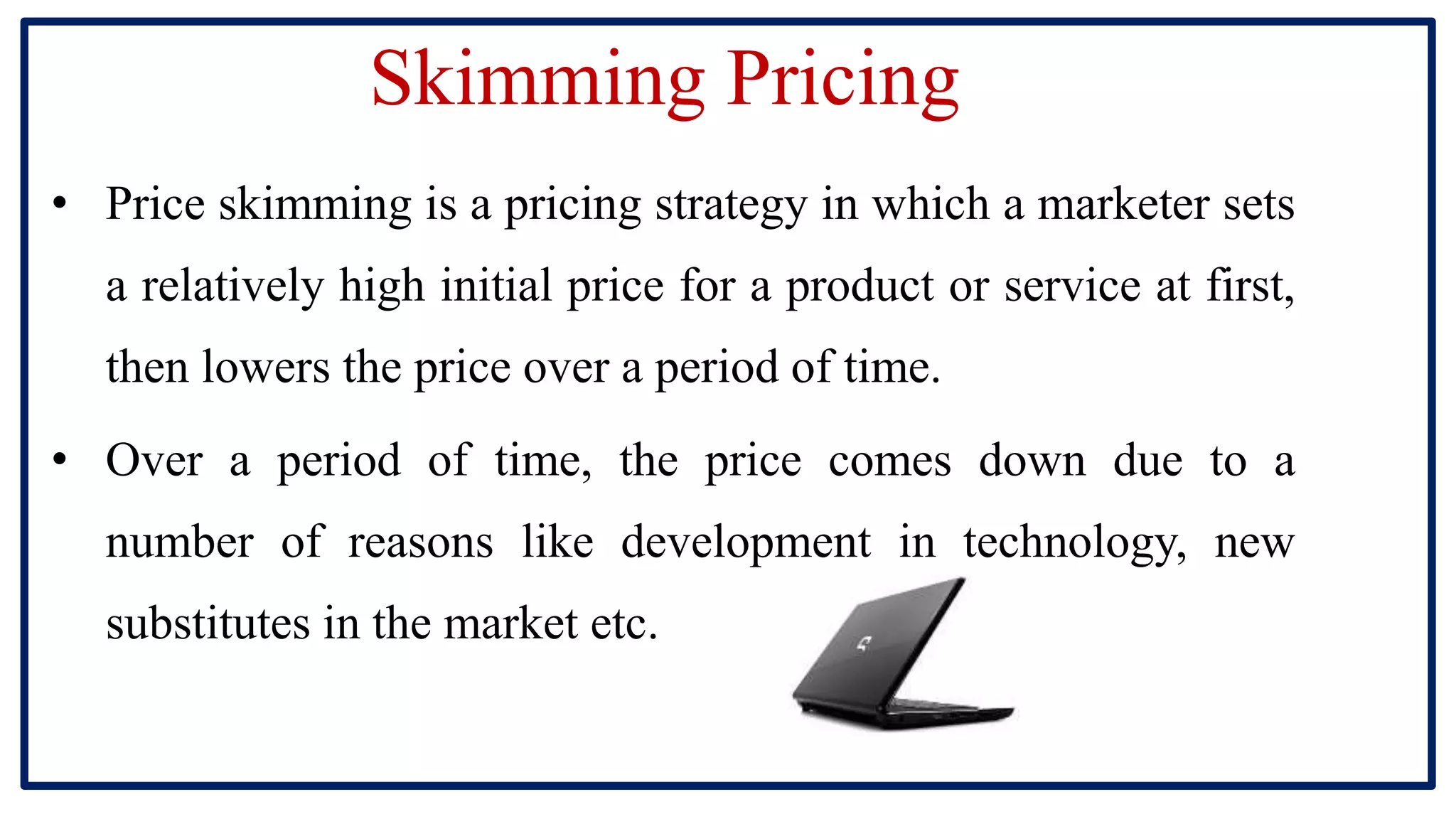
• Price skimming is a pricing strategy in which a marketer sets
a relatively high initial price for a product or service at first,
then lowers the price over a period of time.
• Over a period of time, the price comes down due to a
number of reasons like development in technology, new
substitutes in the market etc.
Penetration Pricing
• Penetration pricing is just opposite to skimming pricing
• In penetration pricing, the companies enter the market with
extremely low price to take the attention of the consumer away
from high priced competitors
• This strategy is suitable only in the short run and is not sustainable
• In the longer run, the prices are gradually increased. The strategy
is based on disruption and temporary loss, hoping to gain a good
market share. E.g. JIO
Dynamic Pricing
• Dynamic pricing is also known as surge pricing, demand pricing,
or time-based pricing.
• It’s a flexible pricing strategy where prices fluctuate based on
market and customer demand.
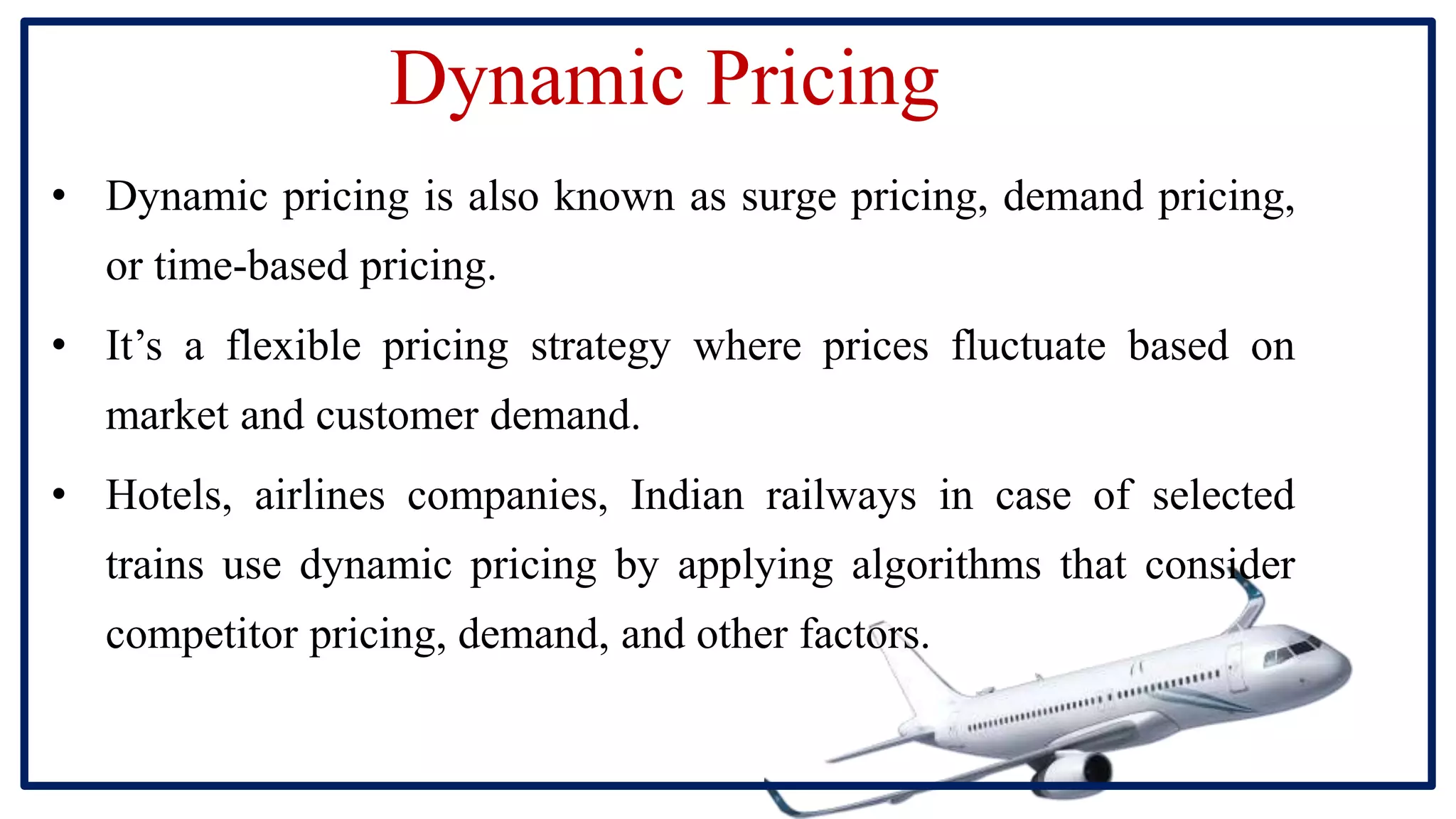
• Hotels, airlines companies, Indian railways in case of selected
trains use dynamic pricing by applying algorithms that consider
competitor pricing, demand, and other factors.
Psychological Pricing
• Psychological pricing is what it sounds like — it targets human
psychology to boost sales.
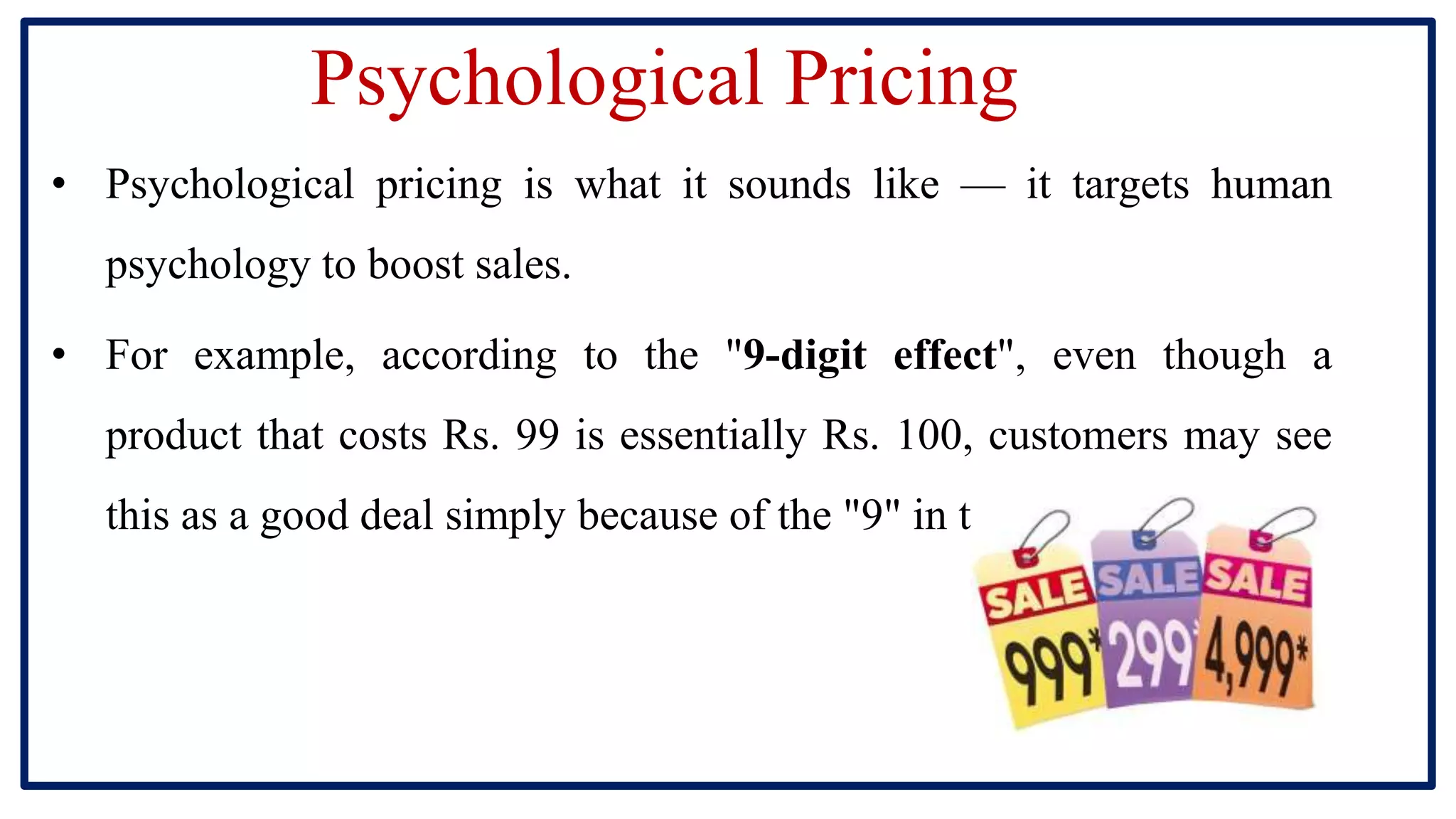
• For example, according to the "9-digit effect", even though a
product that costs Rs. 99 is essentially Rs. 100, customers may see
this as a good deal simply because of the "9" in the price.
Freemium Pricing
• A combination of the words “free” and
“premium,” freemium pricing is when companies offer a basic
version of their product hoping that users will eventually pay to
upgrade or access more features
• Freemium is a pricing strategy commonly used by software
companies.
• They choose this strategy because free trials and limited
memberships offer a “peek” into a software’s full functionality
Bundle Pricing
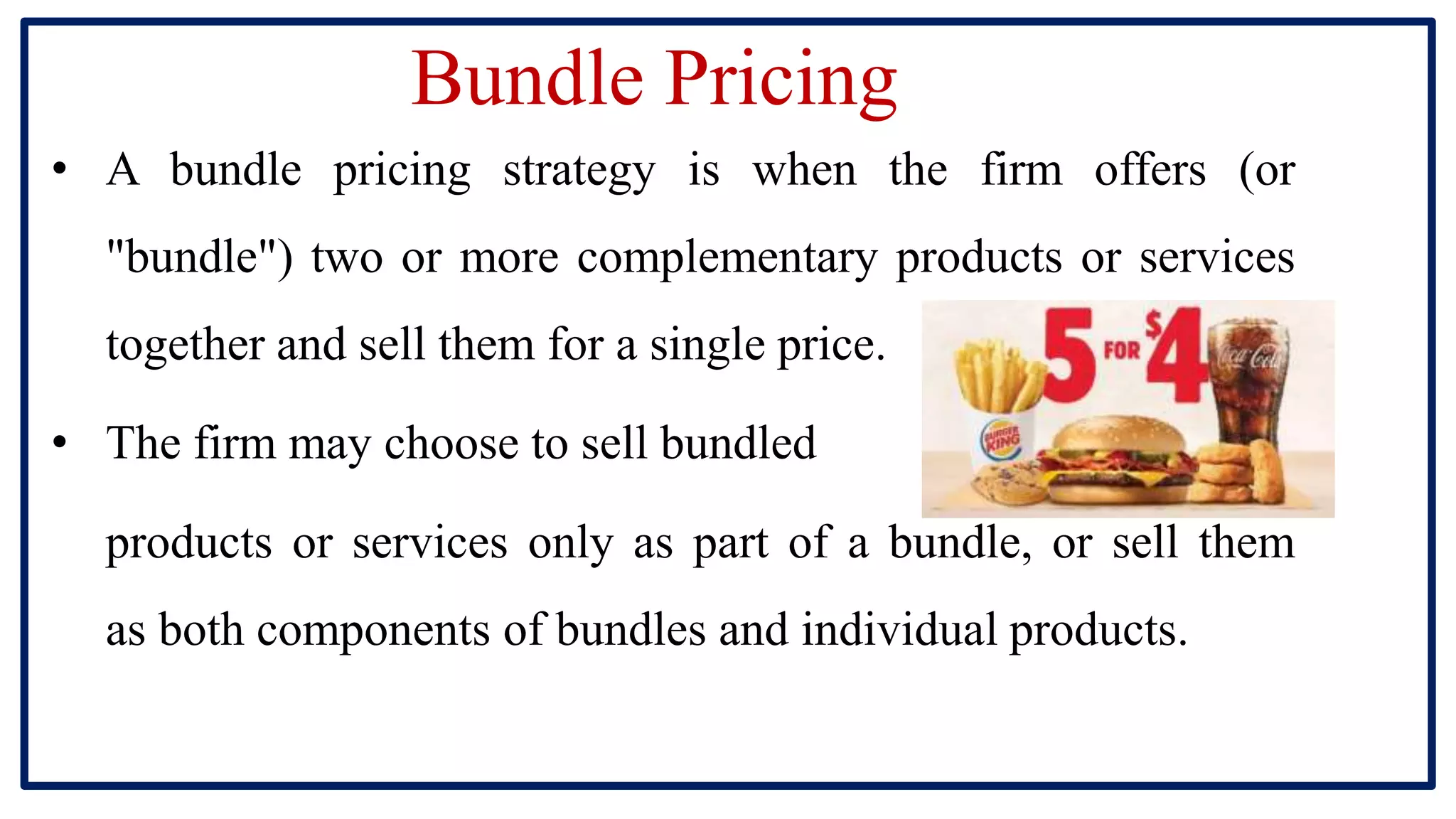
• A bundle pricing strategy is when the firm offers (or
"bundle") two or more complementary products or services
together and sell them for a single price.
• The firm may choose to sell bundled
products or services only as part of a bundle, or sell them
as both components of bundles and individual products.
THANK YOU

Unit 6 part_1_pricing_and_pricing_strategies

  • 1.
  • 2.
    What is ‘Pricing’? •In simple terms, pricing is the process of setting the price of a product or service. • The term ‘pricing’ has been derived from ‘price’ • Price is the amount of money a customer has to pay in order to acquire a product or service
  • 3.
    ‘Pricing’ Can beTricky • Setting prices for products can be a tough task • If a company sets prices of its products and services too high, it will miss out on valuable sales because customers will switch to competitors products • If the a company sets the prices of its products and services too low, it will not be able to earn revenue
  • 4.
    Objectives of Pricing •To Earn revenue and make profits • To Increase / maximize sales • To Beat the competition • To Increase market share • To Achieve price – quality leadership – e.g. Apple, Mercedes Benz
  • 5.
    Factors impacting Pricing •Marketing objectives of the company • Costs of manufacturing • Demand & nature of Demand • Competition in the market • Government Policies
  • 6.
    Pricing Policy • Generally,pricing policy refers to how a company sets the prices of its products and services based on costs, value, demand, and competition. • Different companies can have different pricing policies depending upon various factors listed in the previous slide
  • 7.
  • 8.
    Methods of SettingPrice • The main types of pricing strategies are:  Cost-Plus Pricing or Markup Pricing  Value-Based Pricing  Competition-Based Pricing
  • 9.
    Cost Plus Pricing •A cost-plus pricing is also called Mark Up pricing • It’s also known as markup pricing since businesses who use this strategy “mark up” their products based on how much they’d like to profit. • E.g. The shoes cost $25 to make, and the firm wants to make a $25 profit on each sale. The company will set the price of the shoes at $50 [at 100 percent Markup]
  • 10.
    Value Based Pricing •A value-based pricing strategy is when companies price their products or services based on what the customer is willing to pay • Value based pricing is customer driven while cost based pricing is product driven • E.g. parker pen
  • 11.
    Competition Based Pricing •Competition-based pricing is also known as going rate pricing. It doesn’t take into account the cost of their product or consumer demand. • Instead, a competition-based pricing strategy uses the competitors’ prices as a benchmark. • E.g. Pepsi and Coke
  • 12.
  • 13.
    Pricing Strategies • Thefollowing types of prominent pricing strategies can be noted:  Skimming Pricing  Penetration Pricing  Dynamic Pricing  Psychological Pricing  Freemium Pricing  Bundle Pricing
  • 14.
    Skimming Pricing • Priceskimming is a pricing strategy in which a marketer sets a relatively high initial price for a product or service at first, then lowers the price over a period of time. • Over a period of time, the price comes down due to a number of reasons like development in technology, new substitutes in the market etc.
  • 15.
    Penetration Pricing • Penetrationpricing is just opposite to skimming pricing • In penetration pricing, the companies enter the market with extremely low price to take the attention of the consumer away from high priced competitors • This strategy is suitable only in the short run and is not sustainable • In the longer run, the prices are gradually increased. The strategy is based on disruption and temporary loss, hoping to gain a good market share. E.g. JIO
  • 16.
    Dynamic Pricing • Dynamicpricing is also known as surge pricing, demand pricing, or time-based pricing. • It’s a flexible pricing strategy where prices fluctuate based on market and customer demand. • Hotels, airlines companies, Indian railways in case of selected trains use dynamic pricing by applying algorithms that consider competitor pricing, demand, and other factors.
  • 17.
    Psychological Pricing • Psychologicalpricing is what it sounds like — it targets human psychology to boost sales. • For example, according to the "9-digit effect", even though a product that costs Rs. 99 is essentially Rs. 100, customers may see this as a good deal simply because of the "9" in the price.
  • 18.
    Freemium Pricing • Acombination of the words “free” and “premium,” freemium pricing is when companies offer a basic version of their product hoping that users will eventually pay to upgrade or access more features • Freemium is a pricing strategy commonly used by software companies. • They choose this strategy because free trials and limited memberships offer a “peek” into a software’s full functionality
  • 19.
    Bundle Pricing • Abundle pricing strategy is when the firm offers (or "bundle") two or more complementary products or services together and sell them for a single price. • The firm may choose to sell bundled products or services only as part of a bundle, or sell them as both components of bundles and individual products.
  • 20.