Holy Rosary Academy of Las Pinas City
PHILOSOPHY
Education that is founded on love and respect of the SUPREME BEING
superimposes on the learner the values that predicate academic excellence.
VISION
A school for virtue centered leadership.
MISSION
Developing lifelong learners and leaders with character and competence.
SLOGAN
At HRA, every learner is a leader.
OBJECTIVES
1. To guide the learner towards a learning experience with God on top of all undertakings.
2. To inculcate learning and working habits which are essential in the pursuit of excellence and recognition.
3. To maximize physical and mental capabilities of the learner toward attaining self-fulfillment and success.
4. To enhance the learner’s interpersonal and academic skills that would ensure his competency and global competitiveness.
HAVE A HAPPY DAY!
Physical Science
Learning Goals
Objectives • Virtue
UNDERSTANDING
I forgive myself and
others when I make
mistake.
Objectives:
MECHANICS: Describing Motion
• Describe how the propagation of light, reflection, and
refraction are explained by the wave model and the
particle model of light
• Explain how the photon concept and the fact that the energy of a
photon is directly proportional to its frequency can be used to
explain why red light is used in photographic dark rooms, why we
get easily sunburned in ultraviolet light but not in visible light, and
how we see colors
• Cite experimental evidence showing that electrons can behave
like waves
• Differentiate dispersion, scattering, interference, and diffraction
• Explain various light phenomena
Holy Rosary Academy of Las Pinas City
Foundational Literacies
How students apply core
skills to everyday tasks
Competencies
How students approach
complex challenges
Character Qualities
How students approach their
changing environment
___ Literacy
___ Numeracy
___ Scientific Literacy
___ ICT Literacy
___ Financial Literacy
___ Cultural and civic
literacy
___ Critical thinking/problem
solving
___ Creativity
___ Communication
___ Collaboration
___ Curiosity
___ Initiative
___ Persistency/grit
___ Adaptability
___ Leadership
___ Social and cultural
awareness
21st Century Skills
Lifelong Learning

 
 





OPTICS
• The study of the
behavior and
properties of light.
• VISIBLE LIGHT –
only part of the
electromagnetic
spectrum that is
visible to the eyes
in the form of
colors.
• SPEED OF LIGHT
Thelongestthewavelength,theloweritsfrequency
NATURE OF LIGHT
NATURE OF LIGHT
Isaac Newton
• Corpuscular or Particle
Theory of Light
Christiaan Huygens
• Wave Theory of Light
Aristotle ( Light was emitted from our eyes )
Christian Huygens ( Wave theory of light )
Isaac Newton ( Particle theory of light )
Thomas Young ( Wave theory of light )
Albert Einstein ( Particle theory of light )
de Broglie ( Wave-particle duality of all matter)
NATURE OF LIGHT
Christiaan Huygens
• Wave Theory of Light
Light is a propagating
wave in a hypothetical
material called ether.
Asserts that light has both
electrical and magnetic
components propagating
in space and can be
reflected when it hits an
object.
NATURE OF LIGHT
Isaac Newton
• Corpuscular or Particle
Theory of Light
Light is composed of
particles shooting out from
a source.
Asserts the these particles
collide with any object and
bounce back, or pass
through and interact with
the atoms of the object.
The wave theory of
light was widely
accepted until 1905……
Albert Einstein
1879 - 1955
Wave theory of
light? “No
way!”
 The photoelectric effect is observed when light strikes a metal,
and emits electrons.
 Einstein used the idea of photons (light consists of tiny particles)
to explain results which demonstrate the photoelectric effect.
PHOTOELECTRIC EFFECT
Heinrich Rudolf Hertz
Happens when electrons
are ejected from an
illuminated metallic
surface, which suggests
that light propagates as a
stream of particles
(photons) rather than as
electromagnetic waves.
Albert Einstein provided a piece of convincing
evidence for the particle nature of light ……
Has the story ended yet?
Is light particles or waves?
Louis de Broglie
1892 - 1987
Light is not
particles, not
waves, but BOTH!
PHOTONS AND
THE ATOMIC SPECTRUM
Photons
• Stream of particles (light)
• Characteristics:
 Has the same speed as that of
light
( )
 Can carry energy and momentum
 Can be emitted or absorbed
 Can interact with other particles
like electrons
PHOTONS AND THE ATOMIC SPECTRUM
Photons
• The form of
energy emitted
by electrons
when they go
back from a
higher energy
level to a lower
energy level
PHOTONS AND THE ATOMIC SPECTRUM
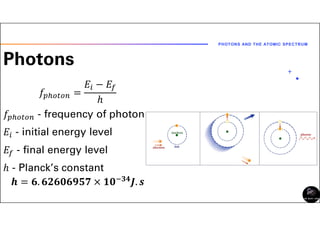
Photons
- frequency of photon
- initial energy level
- final energy level
- Planck’s constant
PHOTONS AND THE ATOMIC SPECTRUM
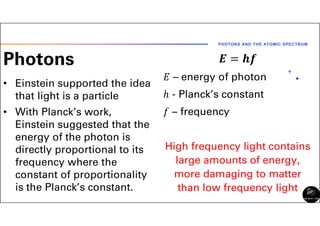
Photons
• Einstein supported the idea
that light is a particle
• With Planck’s work,
Einstein suggested that the
energy of the photon is
directly proportional to its
frequency where the
constant of proportionality
is the Planck’s constant.
PHOTONS AND THE ATOMIC SPECTRUM
– energy of photon
- Planck’s constant
– frequency
High frequency light contains
large amounts of energy,
more damaging to matter
than low frequency light
• Red light is used in
photographic dark rooms.
- It is a room that can be made
completely dark to allow the
processing of the light-
sensitive photographic
materials, including film and
photographic paper.
- Higher-frequency visible light
is damaging to photographic
films.
PHOTONS AND THE ATOMIC SPECTRUM
• The pigments in the skin
also undergo
photochemical reaction
when exposed to UV light.
- UV light has more energy
than the visible light
- UV light causes sunburn
PHOTONS AND THE ATOMIC SPECTRUM
PROPERTIES/
BEHAVIOR OF LIGHT
BEHAVIOR OF LIGHT
1) Reflection
2) Refraction
3) Total Internal Reflection
4) Transmission and Absorption
5) Dispersion
6) Scattering
7) Diffraction
8) Interference
BEHAVIOR OF LIGHT
1) Reflection
BEHAVIOR OF LIGHT
1) Reflection
- The bouncing back of light
when it hits a boundary of
another medium
- Principles:
The incident ray, the reflected
ray, and the normal lie on the
same plane.
The angle of incidence is
equal to the angle of
reflection :
CONCEPTSTOREMEMBER
> INCIDENT RAY - light that strikes a
surface
> REFLECTED RAY - represents the light
reflected by the surface
> REFRATED RAY - represents the light
refracted (bent) by another medium
> NORMAL LINE – a line perpendicular to
the surface / medium of diff. boundaries
BEHAVIOR OF LIGHT
2) Refraction
BEHAVIOR OF LIGHT
2) Refraction
- The bending of light caused by the changing
of its speed through different media.
- When light travels through a given
medium, its speed changes.
- Index of Refraction
- Snell’s Law
If light is traveling from a less dense material to
a denser one, the angle of refraction from the
normal is less than the angle of incidence, and
vice versa.
Lightbendstowardsthenormallineas it passesfrom
lessdensetodenserboundaries.
Dependingonthe object,lightpassesthrough
differently
BEHAVIOR OF LIGHT
3) Total Internal Reflection
BEHAVIOR OF LIGHT
3) Total Internal Reflection
- The reflection of the total
amount of incident light at the
boundary between two media
with different densities.
- Requirements:
1) Light must come from the denser medium approaching
the less dense one
2) The angle of incidence must be greater than the critical
angle - the limiting angle of incidence in the denser
medium resulting in an angle of refraction of with
the normal
BEHAVIOR OF LIGHT
4) Transmission and Absorption
BEHAVIOR OF LIGHT
4) Transmission and Absorption
- Depend on the thickness of the
material and the type of light used.
Thicker objects absorb more light
than thinner ones.
- OPAQUE: Objects that absorb a
particular frequency of light
- TRANSPARENT: Objects that allow
light to pass through materials
without being scattered.
- FILTERS: Transparent materials which
allow selected colors to pass through
Different frequencies of visible light correspond
to different colors; either absorbed or reflected
When light hits an object, some of its frequencies
are either absorbed or reflected.
BEHAVIOR OF LIGHT
5) Dispersion
BEHAVIOR OF LIGHT
5) Dispersion
- The separation of white
light into a spectrum of
colors when it passes
through a prism.
- Occurs because the
refractive index of the
prism is slightly different
for each color.
- Different colors of light
are bent at different
angles.
REFRANGABILITY.The capabilityoflight
raysto berefracted.
NEWTON:Colorisnotapropertyofan
objectbut apropertyoflightthat
illuminatesit.
BEHAVIOR OF LIGHT
6) Scattering
BEHAVIOR OF LIGHT
6) Scattering
- Occurs when the sunlight
are redirected by the
particles suspended in the
atmosphere (scatterers)
Rayleigh Scattering: When
the sizes of the scatters are
smaller than the wavelength
of light being scattered, light
of short wavelengths (e.g.,
blue, violet) is scattered
more effectively than light of
long wavelengths (e.g., red)
BEHAVIOR OF LIGHT
7) Diffraction
BEHAVIOR OF LIGHT
7) Diffraction
- The slight bending of light
around barriers
- For it to be noticeable, the
wavelength of light must be
approximately the same or
bigger than the slit or the
opening of the barriers
- Light of longer wavelengths is
diffracted at a smaller angle
than light of shorter
wavelengths.
BEHAVIOR OF LIGHT
8) Interference
BEHAVIOR OF LIGHT
8) Interference
- Occurs when two waves meet
while travelling through the
same medium
• CONSTRUCTIVE INTERFERENCE:
When two or more waves with
equal phase and frequency
reinforce each other.
• DESCTRUCTIVE INTERFERENCE:
When two or more waves with
opposite phase and equal
frequency interfere and cancel
each other.
BEHAVIOR OF LIGHT
1) Reflection
2) Refraction
3) Total Internal Reflection
4) Transmission and Absorption
5) Dispersion
6) Scattering
7) Diffraction
8) Interference
OPTICAL PHENOMENA
Optical Phenomena
• Reflection on Different Types of
Mirrors
• Mirage
• Haloes and Sun Dogs
• Rainbows
• Clouds
• Blue Sky
• Red Sunsets
OPTICAL PHENOMENA
Reflection on Different Types of Mirrors
• Plane Mirror
• Concave Mirror
• Convex Mirror
OPTICAL PHENOMENA
Reflection on Different Types of Mirrors
• Plane Mirror
- Law of Reflection
OPTICAL PHENOMENA
Reflection on Different Types of Mirrors
• Concave Mirror
• Convex Mirror
OPTICAL PHENOMENA
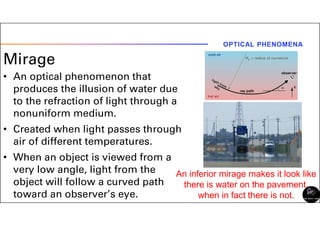
Mirage
• An optical phenomenon that
produces the illusion of water due
to the refraction of light through a
nonuniform medium.
• Created when light passes through
air of different temperatures.
• When an object is viewed from a
very low angle, light from the
object will follow a curved path
toward an observer’s eye.
OPTICAL PHENOMENA
An inferior mirage makes it look like
there is water on the pavement,
when in fact there is not.
Haloes and Sun Dogs
• Haloes – formed around the
moon, Sun, or any celestial
light source when there is
enough elevation for cirrus
clouds.
- When light passes through ice
crystals, light is refracted twice,
making from its original
direction.
OPTICAL PHENOMENA
When Sun is seen at , a halo
can be observed.
Light formed around any celestial
light source.
Haloes and Sun Dogs
• Sun Dogs – patches of light
that appears beside the Sun.
- Also called “mock Suns” or
parhel (Greek word which
means ‘beside the Sun’)
- Have the same mechanism as
how haloes are formed,
however, they are produced
by hexagonal plate of crystals
with their faces nearly
horizontal
OPTICAL PHENOMENA
The blue light is more refracted than the
red light so the blue light is seen at
the outer edges of the Sun dogs.
Rainbows
• When sunlight enters a water
droplet, it is dispersed into
different colors
- These colors are refracted at
slightly different angles: red is
bent the least, violet is bent the
most
- The sunlight then reaches the
back surface of the droplet and
is reflected – primary rainbow.
OPTICAL PHENOMENA
Rainbows
OPTICAL PHENOMENA
Secondary rainbow is the spectrum of
colors that escapes when two
reflections happened inside the water
droplet, with colors in reversed order.
Supernumerary bows are often
greenish-purple bows that are closely
located at the inner side of the primary
rainbow, which happens because of the
interference of the wave crests.
Clouds
OPTICAL PHENOMENA
White is how our eyes perceive all
wavelengths of sunlight mixed
together.
When it's about to rain, clouds darken
because the water vapor is clumping together
into raindrops, leaving larger spaces between
drops of water. Less light is reflected.
The rain cloud appears black or gray.
Blue Sky
• The blue component of the spectrum
of visible light has shorter
wavelengths and higher frequencies
than the red component.
• Thus, as sunlight of all colors passes
through air, the blue part causes
charged particles to oscillate faster
than does the red part.
• The faster the oscillation, the more
scattered light is produced, so blue is
scattered more strongly than red.
OPTICAL PHENOMENA
Blue Sky
• Sunlight reaches Earth's
atmosphere and is scattered
in all directions by all the
gases and particles in the
air.
• Blue light is scattered more
than the other colors
because it travels as shorter,
smaller waves.
OPTICAL PHENOMENA
Red Sunsets
• Within the visible range of
light, red light waves are
scattered the least by
atmospheric gas molecules.
• At sunrise and sunset, when
the sunlight travels a long path
through the atmosphere to
reach our eyes, the blue light
has been mostly removed,
leaving mostly red and yellow
light remaining.
OPTICAL PHENOMENA
Red Sunsets
• As the Sun gets lower in the
sky, its light is passing
through more of the
atmosphere to reach you.
• Even more of the blue light
is scattered, allowing the
reds and yellows to pass
straight through to your
eyes.
OPTICAL PHENOMENA
SUBMISSION: Today
Tabulation of Eval Scores
Eval No. Score/No. of Items
1
-
7
TOTAL SCORE: Total Score/Total No. of Items
HEADS UP!
REMINDER: HEADS UP!
Quiz No. 1 – deployed: MONDAY (Apr. 19 - 21)
- Early views of Motion, and Concept of Motion
- VSMART LMS
FLA NO. 1: Optics (Submission: Until Apr. 25)
Unit Test – deployment: FRIDAY (Apr. 23)
- Early Views of the Universe, Concept of Motion, Light
- recorded as Quarter Exam score, VSMART LMS
Project – Compilation, on or BEFORE FRIDAY (Apr. 30)
- Notes
- WORKS
- Reflection 67
FLA No. 1 Light
69
FLA No. 1 Light
Learning Goals
Objectives • Virtue
UNDERSTANDING
I show empathy and
compassion.
4TH QUARTER
PHYSICAL
SCIENCE
HAVE A
HAPPY DAY!

7 Light Grade 12 Reflection and Refraction

  • 1.
    Holy Rosary Academyof Las Pinas City PHILOSOPHY Education that is founded on love and respect of the SUPREME BEING superimposes on the learner the values that predicate academic excellence. VISION A school for virtue centered leadership. MISSION Developing lifelong learners and leaders with character and competence. SLOGAN At HRA, every learner is a leader. OBJECTIVES 1. To guide the learner towards a learning experience with God on top of all undertakings. 2. To inculcate learning and working habits which are essential in the pursuit of excellence and recognition. 3. To maximize physical and mental capabilities of the learner toward attaining self-fulfillment and success. 4. To enhance the learner’s interpersonal and academic skills that would ensure his competency and global competitiveness.
  • 2.
    HAVE A HAPPYDAY! Physical Science
  • 3.
    Learning Goals Objectives •Virtue UNDERSTANDING I forgive myself and others when I make mistake.
  • 5.
    Objectives: MECHANICS: Describing Motion •Describe how the propagation of light, reflection, and refraction are explained by the wave model and the particle model of light • Explain how the photon concept and the fact that the energy of a photon is directly proportional to its frequency can be used to explain why red light is used in photographic dark rooms, why we get easily sunburned in ultraviolet light but not in visible light, and how we see colors • Cite experimental evidence showing that electrons can behave like waves • Differentiate dispersion, scattering, interference, and diffraction • Explain various light phenomena
  • 6.
    Holy Rosary Academyof Las Pinas City Foundational Literacies How students apply core skills to everyday tasks Competencies How students approach complex challenges Character Qualities How students approach their changing environment ___ Literacy ___ Numeracy ___ Scientific Literacy ___ ICT Literacy ___ Financial Literacy ___ Cultural and civic literacy ___ Critical thinking/problem solving ___ Creativity ___ Communication ___ Collaboration ___ Curiosity ___ Initiative ___ Persistency/grit ___ Adaptability ___ Leadership ___ Social and cultural awareness 21st Century Skills Lifelong Learning          
  • 8.
    OPTICS • The studyof the behavior and properties of light. • VISIBLE LIGHT – only part of the electromagnetic spectrum that is visible to the eyes in the form of colors. • SPEED OF LIGHT
  • 9.
  • 10.
  • 11.
    NATURE OF LIGHT IsaacNewton • Corpuscular or Particle Theory of Light Christiaan Huygens • Wave Theory of Light
  • 12.
    Aristotle ( Lightwas emitted from our eyes ) Christian Huygens ( Wave theory of light ) Isaac Newton ( Particle theory of light ) Thomas Young ( Wave theory of light ) Albert Einstein ( Particle theory of light ) de Broglie ( Wave-particle duality of all matter)
  • 13.
    NATURE OF LIGHT ChristiaanHuygens • Wave Theory of Light Light is a propagating wave in a hypothetical material called ether. Asserts that light has both electrical and magnetic components propagating in space and can be reflected when it hits an object.
  • 14.
    NATURE OF LIGHT IsaacNewton • Corpuscular or Particle Theory of Light Light is composed of particles shooting out from a source. Asserts the these particles collide with any object and bounce back, or pass through and interact with the atoms of the object.
  • 15.
    The wave theoryof light was widely accepted until 1905…… Albert Einstein 1879 - 1955 Wave theory of light? “No way!”  The photoelectric effect is observed when light strikes a metal, and emits electrons.  Einstein used the idea of photons (light consists of tiny particles) to explain results which demonstrate the photoelectric effect.
  • 16.
    PHOTOELECTRIC EFFECT Heinrich RudolfHertz Happens when electrons are ejected from an illuminated metallic surface, which suggests that light propagates as a stream of particles (photons) rather than as electromagnetic waves.
  • 17.
    Albert Einstein provideda piece of convincing evidence for the particle nature of light …… Has the story ended yet? Is light particles or waves? Louis de Broglie 1892 - 1987 Light is not particles, not waves, but BOTH!
  • 18.
  • 19.
    Photons • Stream ofparticles (light) • Characteristics:  Has the same speed as that of light ( )  Can carry energy and momentum  Can be emitted or absorbed  Can interact with other particles like electrons PHOTONS AND THE ATOMIC SPECTRUM
  • 20.
    Photons • The formof energy emitted by electrons when they go back from a higher energy level to a lower energy level PHOTONS AND THE ATOMIC SPECTRUM
  • 21.
    Photons - frequency ofphoton - initial energy level - final energy level - Planck’s constant PHOTONS AND THE ATOMIC SPECTRUM
  • 22.
    Photons • Einstein supportedthe idea that light is a particle • With Planck’s work, Einstein suggested that the energy of the photon is directly proportional to its frequency where the constant of proportionality is the Planck’s constant. PHOTONS AND THE ATOMIC SPECTRUM – energy of photon - Planck’s constant – frequency High frequency light contains large amounts of energy, more damaging to matter than low frequency light
  • 23.
    • Red lightis used in photographic dark rooms. - It is a room that can be made completely dark to allow the processing of the light- sensitive photographic materials, including film and photographic paper. - Higher-frequency visible light is damaging to photographic films. PHOTONS AND THE ATOMIC SPECTRUM
  • 24.
    • The pigmentsin the skin also undergo photochemical reaction when exposed to UV light. - UV light has more energy than the visible light - UV light causes sunburn PHOTONS AND THE ATOMIC SPECTRUM
  • 25.
  • 26.
    BEHAVIOR OF LIGHT 1)Reflection 2) Refraction 3) Total Internal Reflection 4) Transmission and Absorption 5) Dispersion 6) Scattering 7) Diffraction 8) Interference
  • 27.
  • 28.
    BEHAVIOR OF LIGHT 1)Reflection - The bouncing back of light when it hits a boundary of another medium - Principles: The incident ray, the reflected ray, and the normal lie on the same plane. The angle of incidence is equal to the angle of reflection :
  • 29.
    CONCEPTSTOREMEMBER > INCIDENT RAY- light that strikes a surface > REFLECTED RAY - represents the light reflected by the surface > REFRATED RAY - represents the light refracted (bent) by another medium > NORMAL LINE – a line perpendicular to the surface / medium of diff. boundaries
  • 31.
  • 32.
    BEHAVIOR OF LIGHT 2)Refraction - The bending of light caused by the changing of its speed through different media. - When light travels through a given medium, its speed changes. - Index of Refraction - Snell’s Law If light is traveling from a less dense material to a denser one, the angle of refraction from the normal is less than the angle of incidence, and vice versa.
  • 33.
  • 34.
  • 35.
    BEHAVIOR OF LIGHT 3)Total Internal Reflection
  • 36.
    BEHAVIOR OF LIGHT 3)Total Internal Reflection - The reflection of the total amount of incident light at the boundary between two media with different densities. - Requirements: 1) Light must come from the denser medium approaching the less dense one 2) The angle of incidence must be greater than the critical angle - the limiting angle of incidence in the denser medium resulting in an angle of refraction of with the normal
  • 37.
    BEHAVIOR OF LIGHT 4)Transmission and Absorption
  • 38.
    BEHAVIOR OF LIGHT 4)Transmission and Absorption - Depend on the thickness of the material and the type of light used. Thicker objects absorb more light than thinner ones. - OPAQUE: Objects that absorb a particular frequency of light - TRANSPARENT: Objects that allow light to pass through materials without being scattered. - FILTERS: Transparent materials which allow selected colors to pass through
  • 39.
    Different frequencies ofvisible light correspond to different colors; either absorbed or reflected When light hits an object, some of its frequencies are either absorbed or reflected.
  • 40.
  • 41.
    BEHAVIOR OF LIGHT 5)Dispersion - The separation of white light into a spectrum of colors when it passes through a prism. - Occurs because the refractive index of the prism is slightly different for each color. - Different colors of light are bent at different angles.
  • 42.
  • 43.
  • 44.
    BEHAVIOR OF LIGHT 6)Scattering - Occurs when the sunlight are redirected by the particles suspended in the atmosphere (scatterers) Rayleigh Scattering: When the sizes of the scatters are smaller than the wavelength of light being scattered, light of short wavelengths (e.g., blue, violet) is scattered more effectively than light of long wavelengths (e.g., red)
  • 45.
  • 46.
    BEHAVIOR OF LIGHT 7)Diffraction - The slight bending of light around barriers - For it to be noticeable, the wavelength of light must be approximately the same or bigger than the slit or the opening of the barriers - Light of longer wavelengths is diffracted at a smaller angle than light of shorter wavelengths.
  • 47.
  • 48.
    BEHAVIOR OF LIGHT 8)Interference - Occurs when two waves meet while travelling through the same medium • CONSTRUCTIVE INTERFERENCE: When two or more waves with equal phase and frequency reinforce each other. • DESCTRUCTIVE INTERFERENCE: When two or more waves with opposite phase and equal frequency interfere and cancel each other.
  • 49.
    BEHAVIOR OF LIGHT 1)Reflection 2) Refraction 3) Total Internal Reflection 4) Transmission and Absorption 5) Dispersion 6) Scattering 7) Diffraction 8) Interference
  • 50.
  • 51.
    Optical Phenomena • Reflectionon Different Types of Mirrors • Mirage • Haloes and Sun Dogs • Rainbows • Clouds • Blue Sky • Red Sunsets OPTICAL PHENOMENA
  • 52.
    Reflection on DifferentTypes of Mirrors • Plane Mirror • Concave Mirror • Convex Mirror OPTICAL PHENOMENA
  • 53.
    Reflection on DifferentTypes of Mirrors • Plane Mirror - Law of Reflection OPTICAL PHENOMENA
  • 54.
    Reflection on DifferentTypes of Mirrors • Concave Mirror • Convex Mirror OPTICAL PHENOMENA
  • 55.
    Mirage • An opticalphenomenon that produces the illusion of water due to the refraction of light through a nonuniform medium. • Created when light passes through air of different temperatures. • When an object is viewed from a very low angle, light from the object will follow a curved path toward an observer’s eye. OPTICAL PHENOMENA An inferior mirage makes it look like there is water on the pavement, when in fact there is not.
  • 56.
    Haloes and SunDogs • Haloes – formed around the moon, Sun, or any celestial light source when there is enough elevation for cirrus clouds. - When light passes through ice crystals, light is refracted twice, making from its original direction. OPTICAL PHENOMENA When Sun is seen at , a halo can be observed. Light formed around any celestial light source.
  • 57.
    Haloes and SunDogs • Sun Dogs – patches of light that appears beside the Sun. - Also called “mock Suns” or parhel (Greek word which means ‘beside the Sun’) - Have the same mechanism as how haloes are formed, however, they are produced by hexagonal plate of crystals with their faces nearly horizontal OPTICAL PHENOMENA The blue light is more refracted than the red light so the blue light is seen at the outer edges of the Sun dogs.
  • 58.
    Rainbows • When sunlightenters a water droplet, it is dispersed into different colors - These colors are refracted at slightly different angles: red is bent the least, violet is bent the most - The sunlight then reaches the back surface of the droplet and is reflected – primary rainbow. OPTICAL PHENOMENA
  • 59.
    Rainbows OPTICAL PHENOMENA Secondary rainbowis the spectrum of colors that escapes when two reflections happened inside the water droplet, with colors in reversed order. Supernumerary bows are often greenish-purple bows that are closely located at the inner side of the primary rainbow, which happens because of the interference of the wave crests.
  • 60.
    Clouds OPTICAL PHENOMENA White ishow our eyes perceive all wavelengths of sunlight mixed together. When it's about to rain, clouds darken because the water vapor is clumping together into raindrops, leaving larger spaces between drops of water. Less light is reflected. The rain cloud appears black or gray.
  • 61.
    Blue Sky • Theblue component of the spectrum of visible light has shorter wavelengths and higher frequencies than the red component. • Thus, as sunlight of all colors passes through air, the blue part causes charged particles to oscillate faster than does the red part. • The faster the oscillation, the more scattered light is produced, so blue is scattered more strongly than red. OPTICAL PHENOMENA
  • 62.
    Blue Sky • Sunlightreaches Earth's atmosphere and is scattered in all directions by all the gases and particles in the air. • Blue light is scattered more than the other colors because it travels as shorter, smaller waves. OPTICAL PHENOMENA
  • 63.
    Red Sunsets • Withinthe visible range of light, red light waves are scattered the least by atmospheric gas molecules. • At sunrise and sunset, when the sunlight travels a long path through the atmosphere to reach our eyes, the blue light has been mostly removed, leaving mostly red and yellow light remaining. OPTICAL PHENOMENA
  • 64.
    Red Sunsets • Asthe Sun gets lower in the sky, its light is passing through more of the atmosphere to reach you. • Even more of the blue light is scattered, allowing the reds and yellows to pass straight through to your eyes. OPTICAL PHENOMENA
  • 65.
    SUBMISSION: Today Tabulation ofEval Scores Eval No. Score/No. of Items 1 - 7 TOTAL SCORE: Total Score/Total No. of Items
  • 66.
  • 67.
    REMINDER: HEADS UP! QuizNo. 1 – deployed: MONDAY (Apr. 19 - 21) - Early views of Motion, and Concept of Motion - VSMART LMS FLA NO. 1: Optics (Submission: Until Apr. 25) Unit Test – deployment: FRIDAY (Apr. 23) - Early Views of the Universe, Concept of Motion, Light - recorded as Quarter Exam score, VSMART LMS Project – Compilation, on or BEFORE FRIDAY (Apr. 30) - Notes - WORKS - Reflection 67
  • 68.
    FLA No. 1Light
  • 69.
  • 70.
    Learning Goals Objectives •Virtue UNDERSTANDING I show empathy and compassion.
  • 71.