Light has both wave-like and particle-like properties. It travels as an electromagnetic wave and exhibits behaviors of reflection, refraction, diffraction, interference and polarization. Light can be reflected, refracted, absorbed and emitted by matter. It travels in electromagnetic spectrum from radio waves to gamma rays and can be polarized, scattered, or dispersed.
Discusses light as electromagnetic radiation; characteristics, speed (300,000 km/s), and its wave nature.
Explains dual nature of light as both wave (reflection, refraction) and particle (scattering, emission).
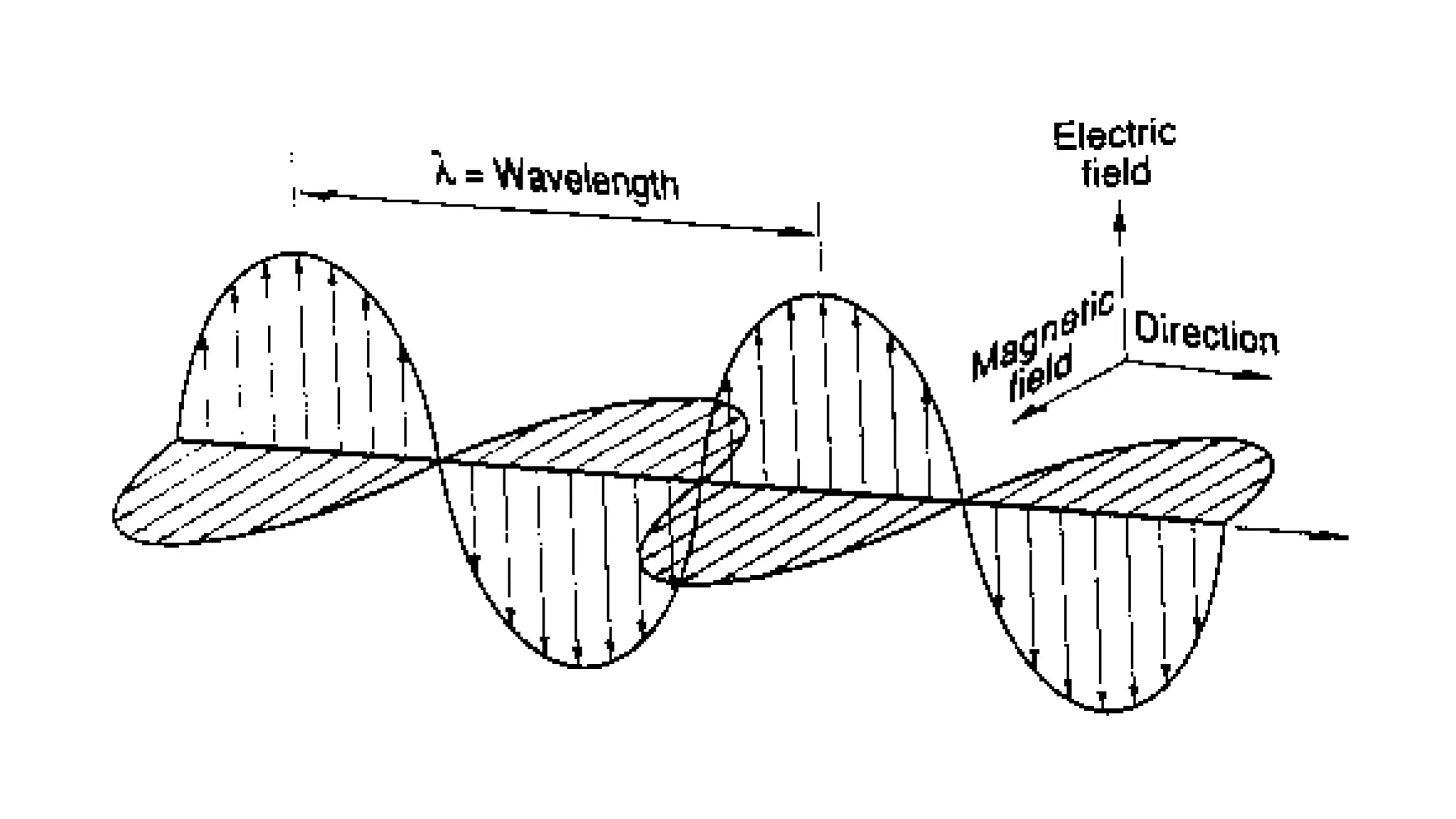
Describes electromagnetic waves generated by changing electric and magnetic fields.
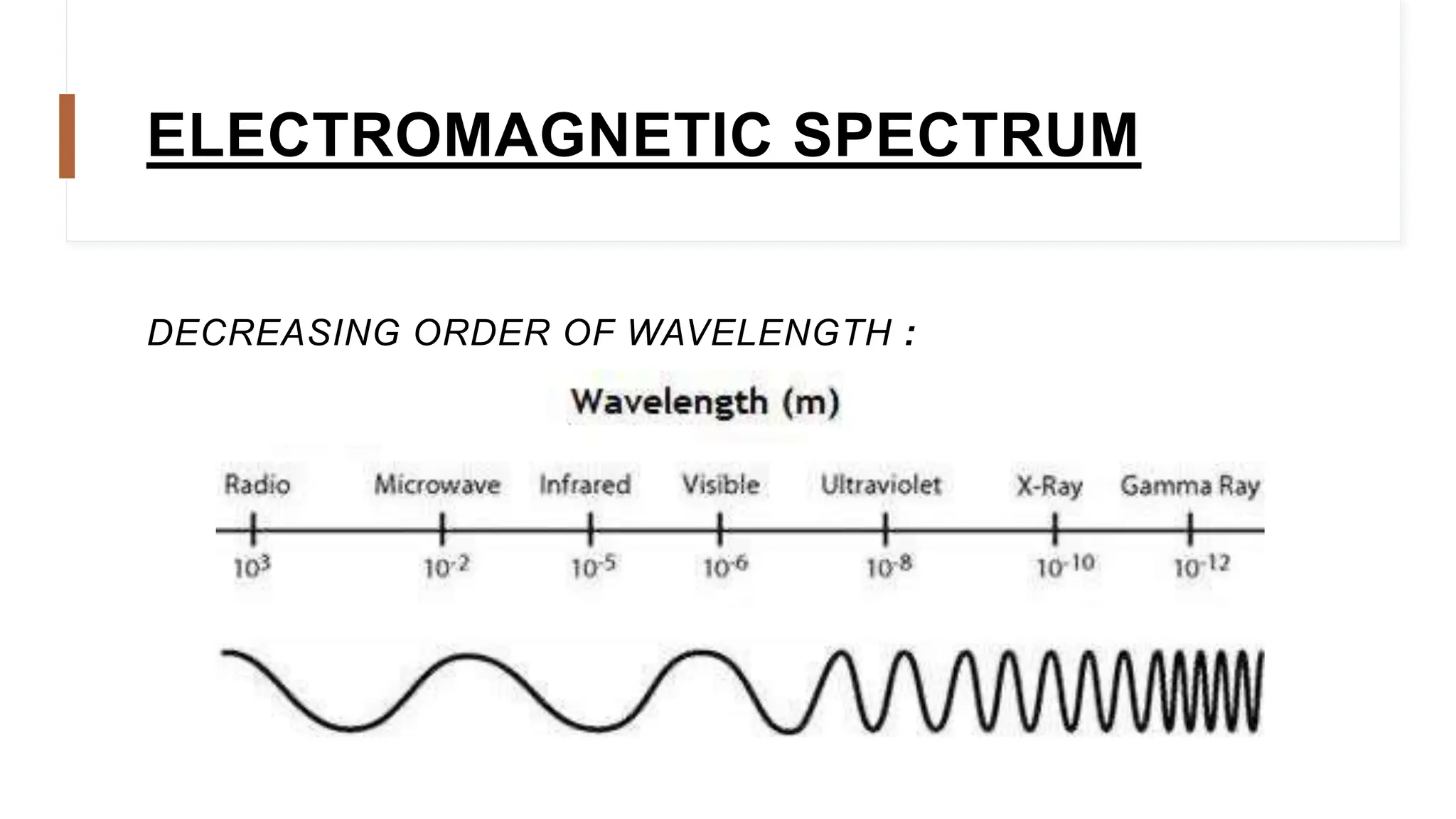
Outlines the electromagnetic spectrum with examples: radio waves, microwaves, infrared, visible light, ultraviolet, X-rays, gamma rays.
Lists the properties of light including reflection, refraction, and diffraction.
Introduces reflection, types (specular and diffuse), and laws of reflection.
Describes the bending of light when passing between media, laws of refraction.
Explains total internal reflection and its use in optical fibers.
Defines polarization and types (linear, circular, elliptical), and applications in sunglasses.Describes how light bends around edges; provides examples of diffraction.
Explains scattering in the atmosphere, emphasizing intensity and wavelength relationship.
Discusses how matter absorbs light, converting it to energy and effects on colors.
Explains spontaneous and stimulated emission processes, including lasers.
Describes dispersion in prisms and rainbows, separating white light into colors.
Introduces interference, types (constructive and destructive), and examples in nature.
LIGHT
• It isthe form of energy known as “Electromagnetic Radiation”.
• Light travels as an Electromagnetic Wave.
• Light travels through the vacuum of space unlike sounds.
• It travels at 300000 km/s (3x10^8m/s).
• Light is the Transverse Wave , it means in the particles in the
wave vibrate perpendicular to the direction of propagation of the
wave. Electromagnetic Wave is an example .
3.
DUAL NATURE OFLIGHT
• Max Plank and Albert Einstein showed that light cannot be simply
classified as Wave or particle..
• Rather, the light has the characteristic of both particles and
waves, so they are called Dual nature of light.
• Example of Wave nature : Reflection, Refraction, Polarisation
• Example of Particle nature : Scattering, Emission, Absorption
4.
ELECTROMAGNETIC RADIATION
• JamesMaxwell proposed that a changing electric field could
create a changing magnetic field and this would create a changing
electric field, this field would continue to generate each other.
• The changing magnetic field and electric field travels through
space as Transverse waves at right angles , this is known as an
Electromagnetic Wave.
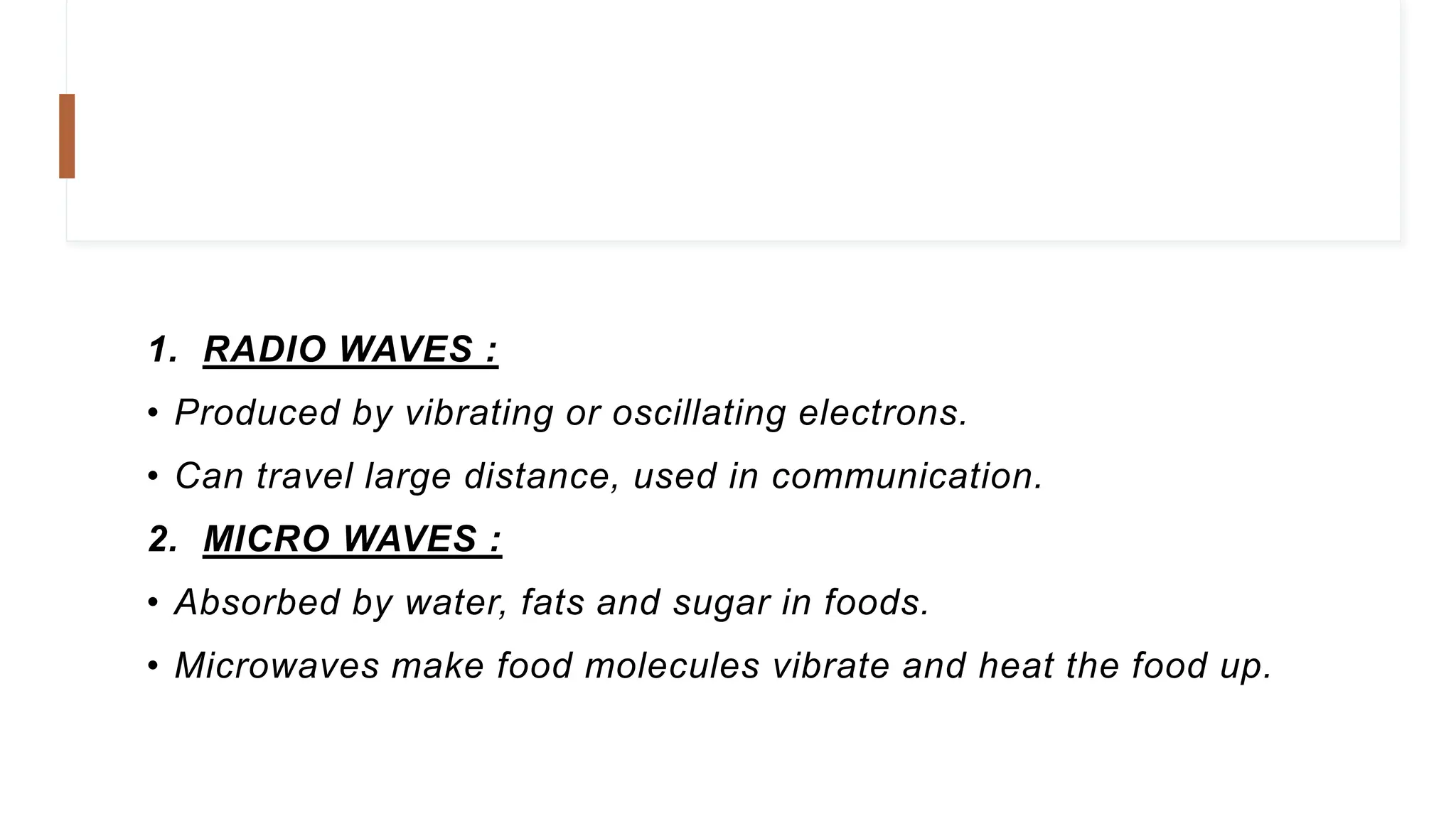
1. RADIO WAVES:
• Produced by vibrating or oscillating electrons.
• Can travel large distance, used in communication.
2. MICRO WAVES :
• Absorbed by water, fats and sugar in foods.
• Microwaves make food molecules vibrate and heat the food up.
8.
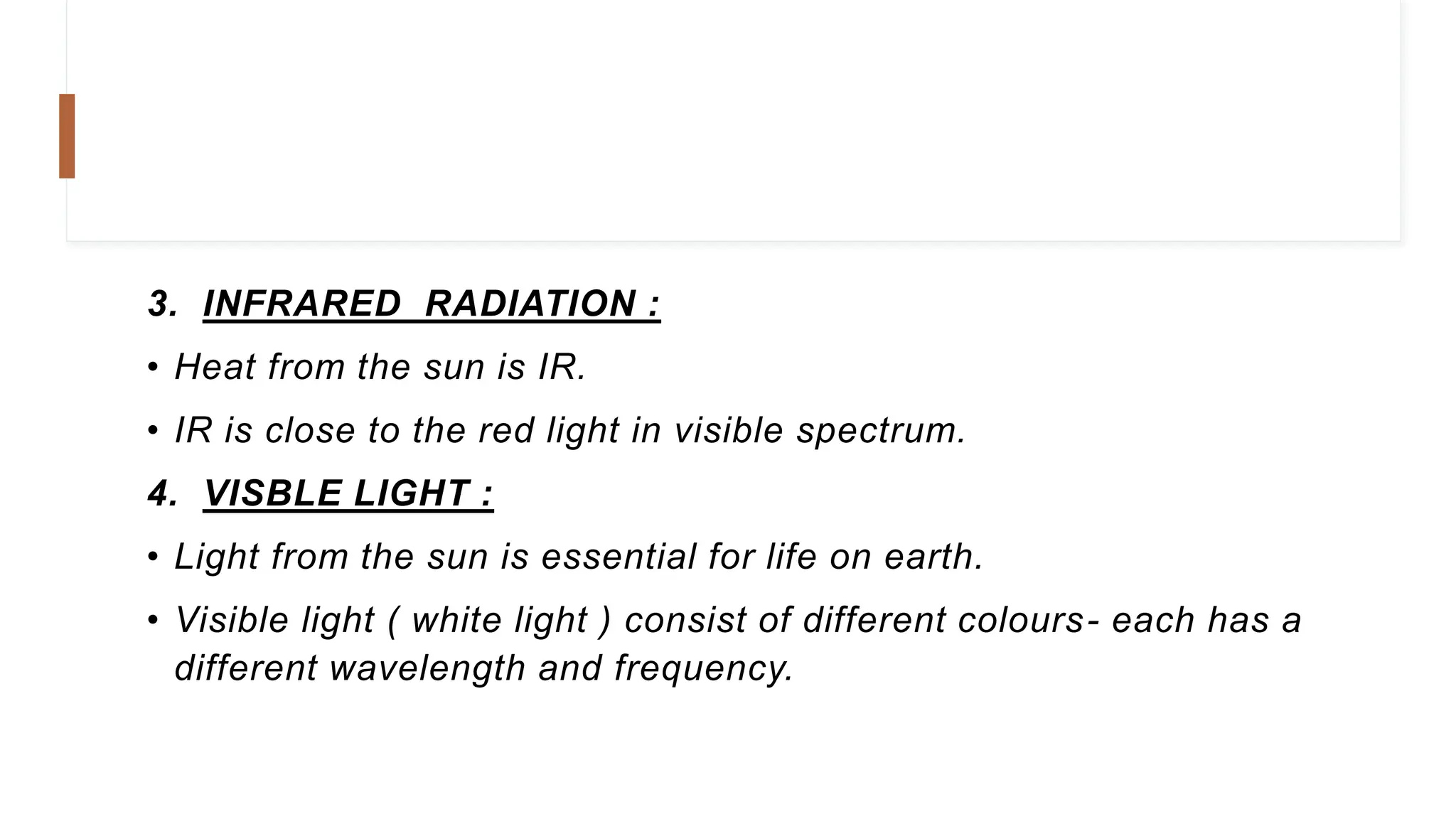
3. INFRARED RADIATION:
• Heat from the sun is IR.
• IR is close to the red light in visible spectrum.
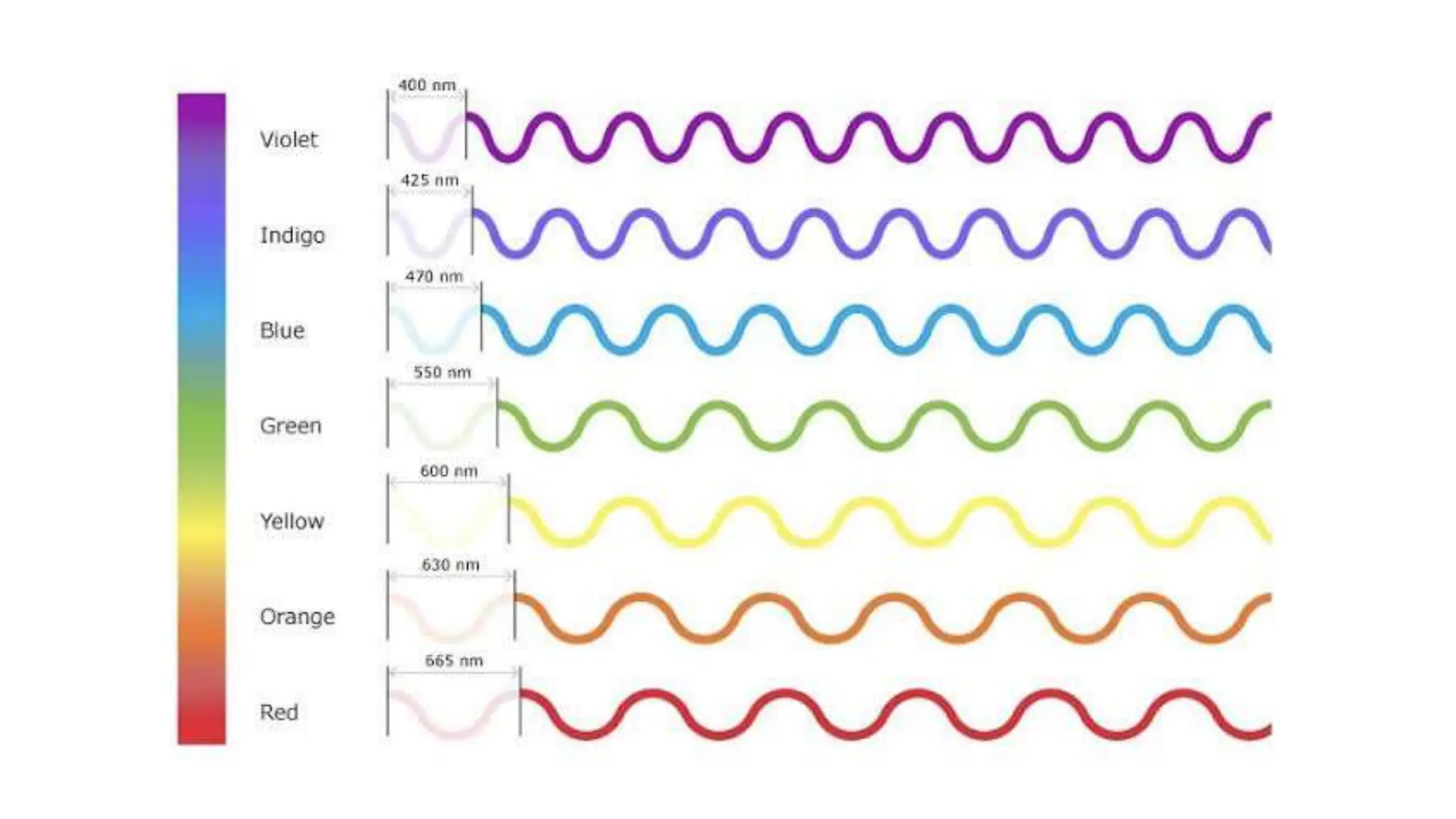
4. VISBLE LIGHT :
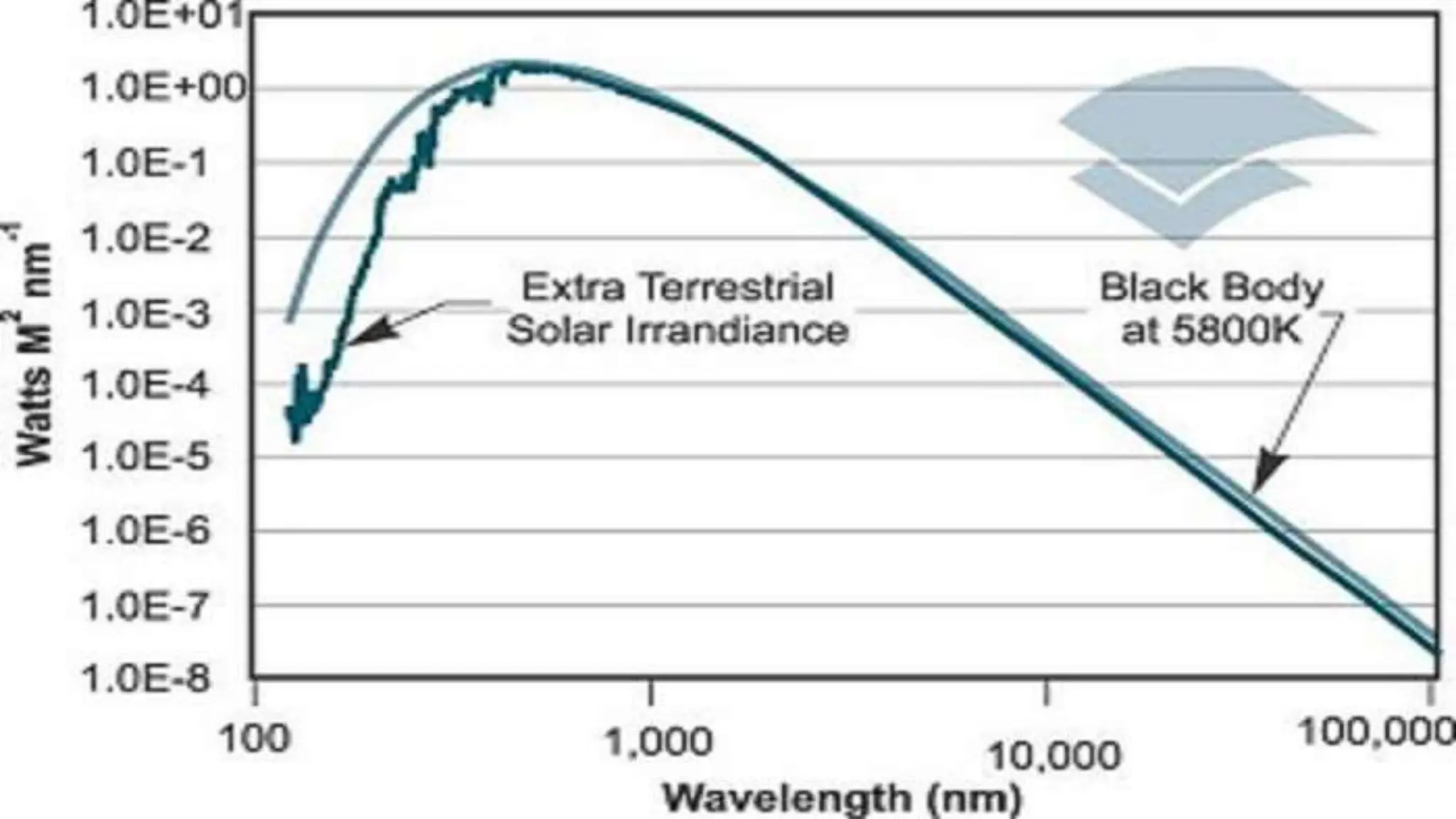
• Light from the sun is essential for life on earth.
• Visible light ( white light ) consist of different colours- each has a
different wavelength and frequency.
10.
5. ULTRA VIOLETLIGHT :
• UV light is radiation with a higher frequency than violet.
• Sunlight contains UV Light.
• You cannot see UV light it does cause sun burn.
6. X RAYS :
• X rays can penetrate object , therefore they are useful in finding
flaws and checking structures.
11.
7. GAMMA RAYS:
• Wavelength of about one hundred billionth of a meter.
• They are produced in the making of nuclear power.
REFLECTION OF LIGHT
•When a ray of light strikes a polished surface, it
bounces back in a particular direction. This is
known as Reflection of light
14.
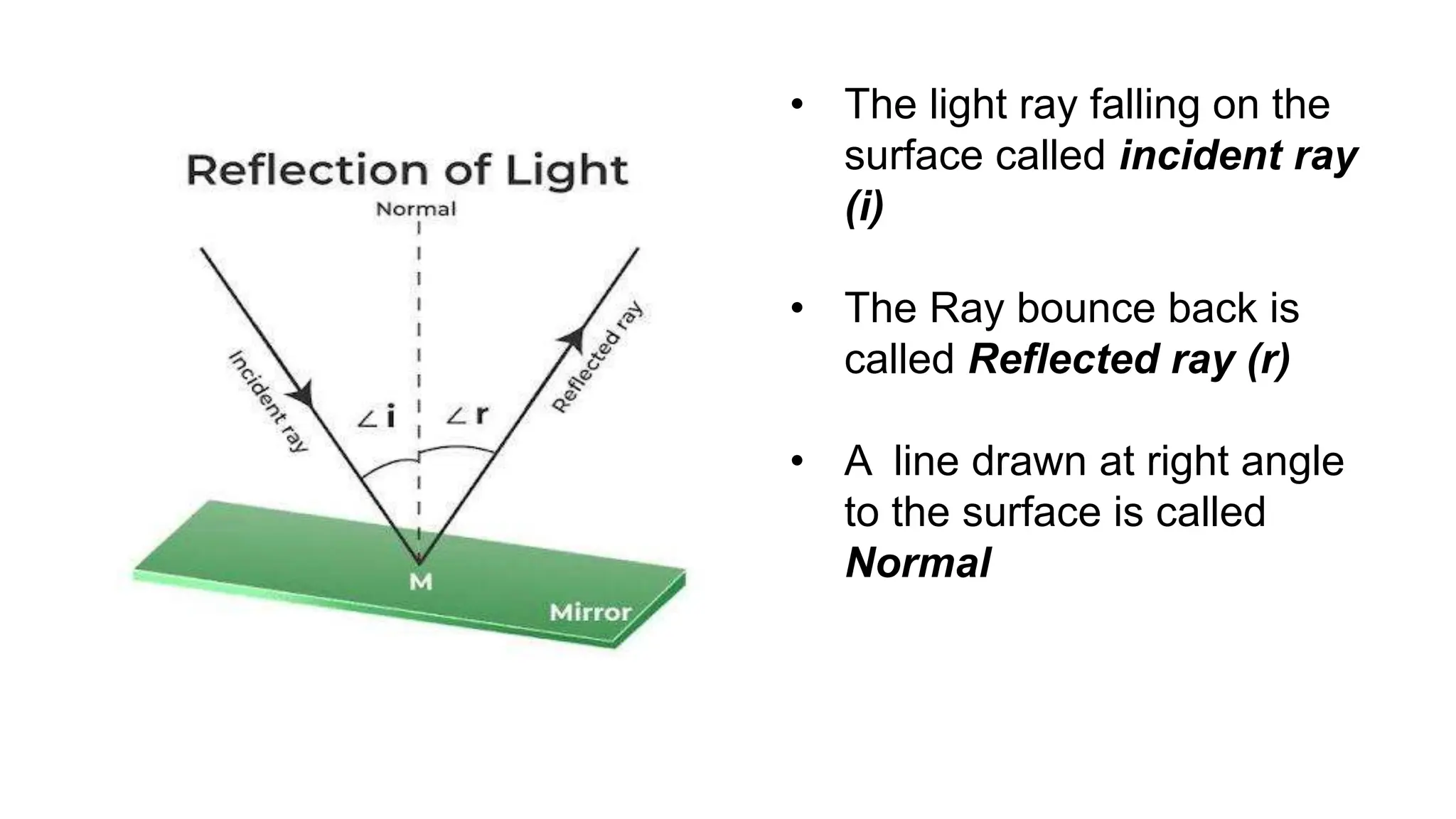
• The lightray falling on the
surface called incident ray
(i)
• The Ray bounce back is
called Reflected ray (r)
• A line drawn at right angle
to the surface is called
Normal
15.
Types of Reflection
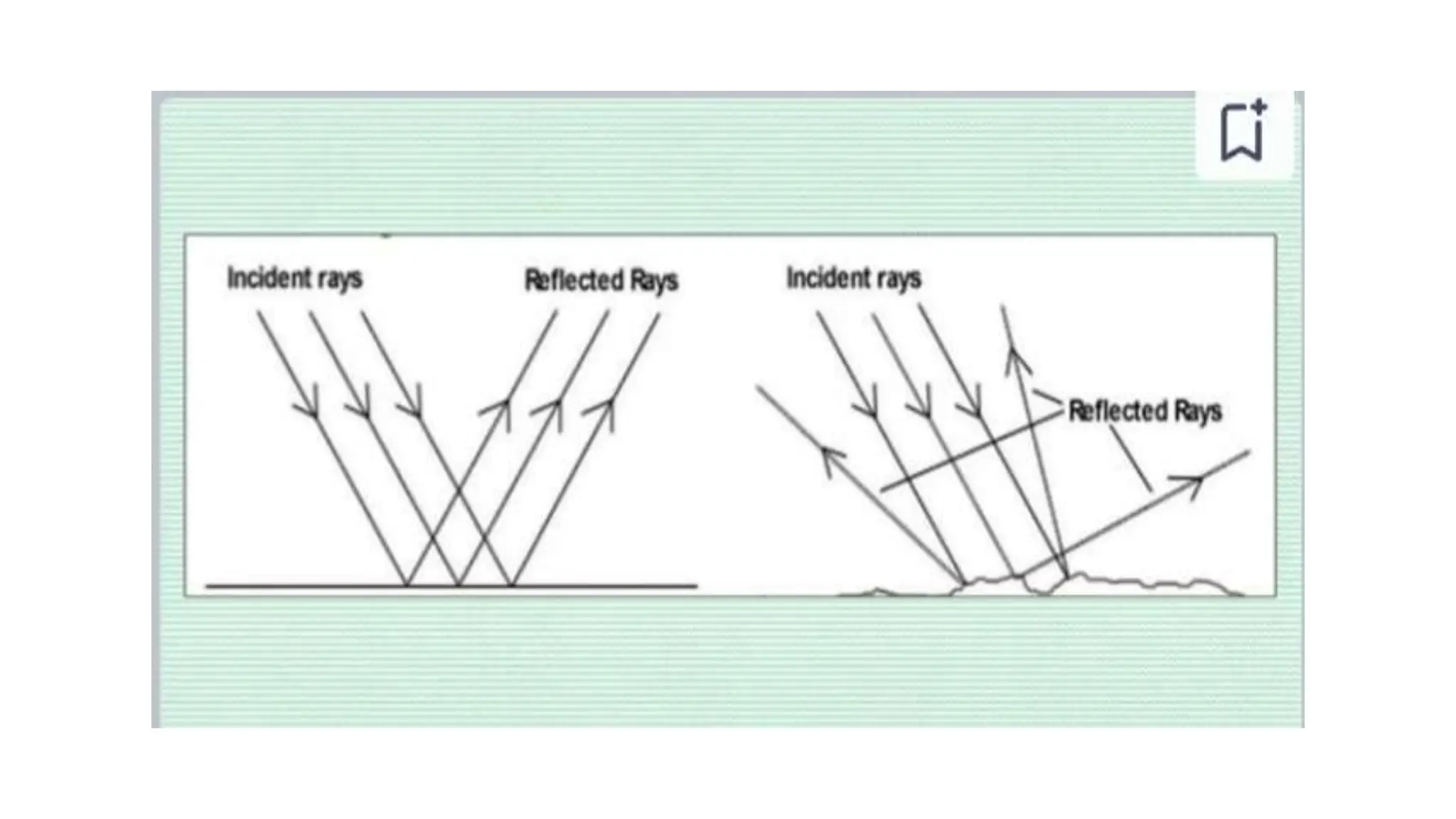
1.Irregular or Diffuse Reflection
When a beam of parallel light rays is incident on a
rough surface, the reflected rays scatter in different
directions
17.
2. Regular orSpecular Reflection
The regular reflection takes place when the
light rays are incident on a polished smooth surface
so, the reflected rays of light move only in a fixed
direction.
18.
Laws of Reflection
•The incident ray, the reflected ray and the normal at the
point of incidence, all lie in the same plane
• The angle of incidence equal to the angle of Reflection
19.
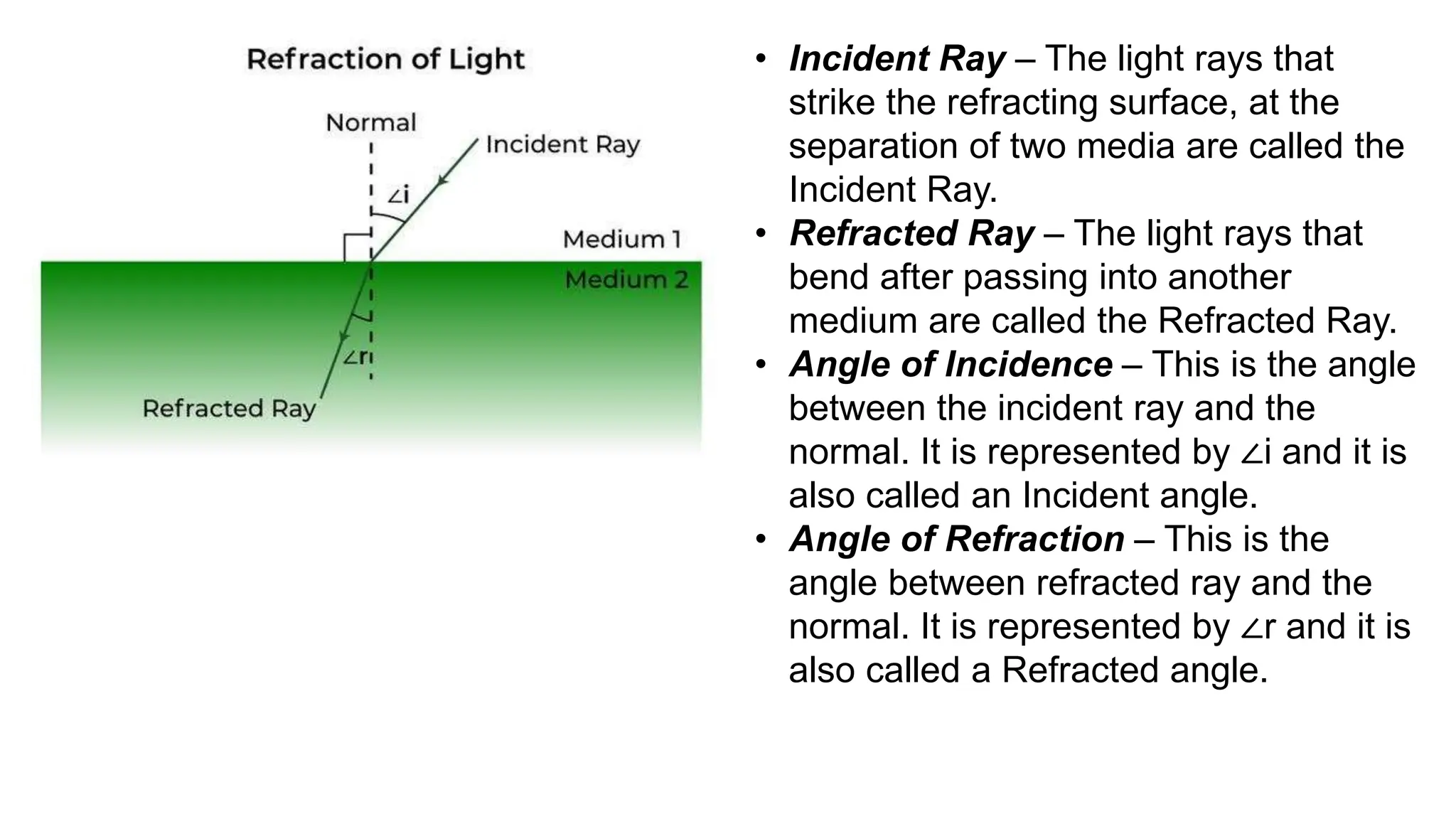
REFRACTION OF LIGHT
•The bending of a light wave when it passes from one
medium to another due to the change in the speed of
the light traveling the two different media is called the
Refraction of light
20.
• When itpasses from denser to rarer medium it deviates
away from the normal
• When it passes from rarer medium to denser medium
deviates towards the normal
• The greater the density difference between the two
media , the more light bends
21.
• Incident Ray– The light rays that
strike the refracting surface, at the
separation of two media are called the
Incident Ray.
• Refracted Ray – The light rays that
bend after passing into another
medium are called the Refracted Ray.
• Angle of Incidence – This is the angle
between the incident ray and the
normal. It is represented by ∠i and it is
also called an Incident angle.
• Angle of Refraction – This is the
angle between refracted ray and the
normal. It is represented by ∠r and it is
also called a Refracted angle.
22.
Laws of Refraction
•The reflected, incident, and the normal at the point of
incidence all will tend to lie in the same plane
• The ratio of the sine of the angle of the incidence and
refraction is constant which is termed Snell’s law.
23.
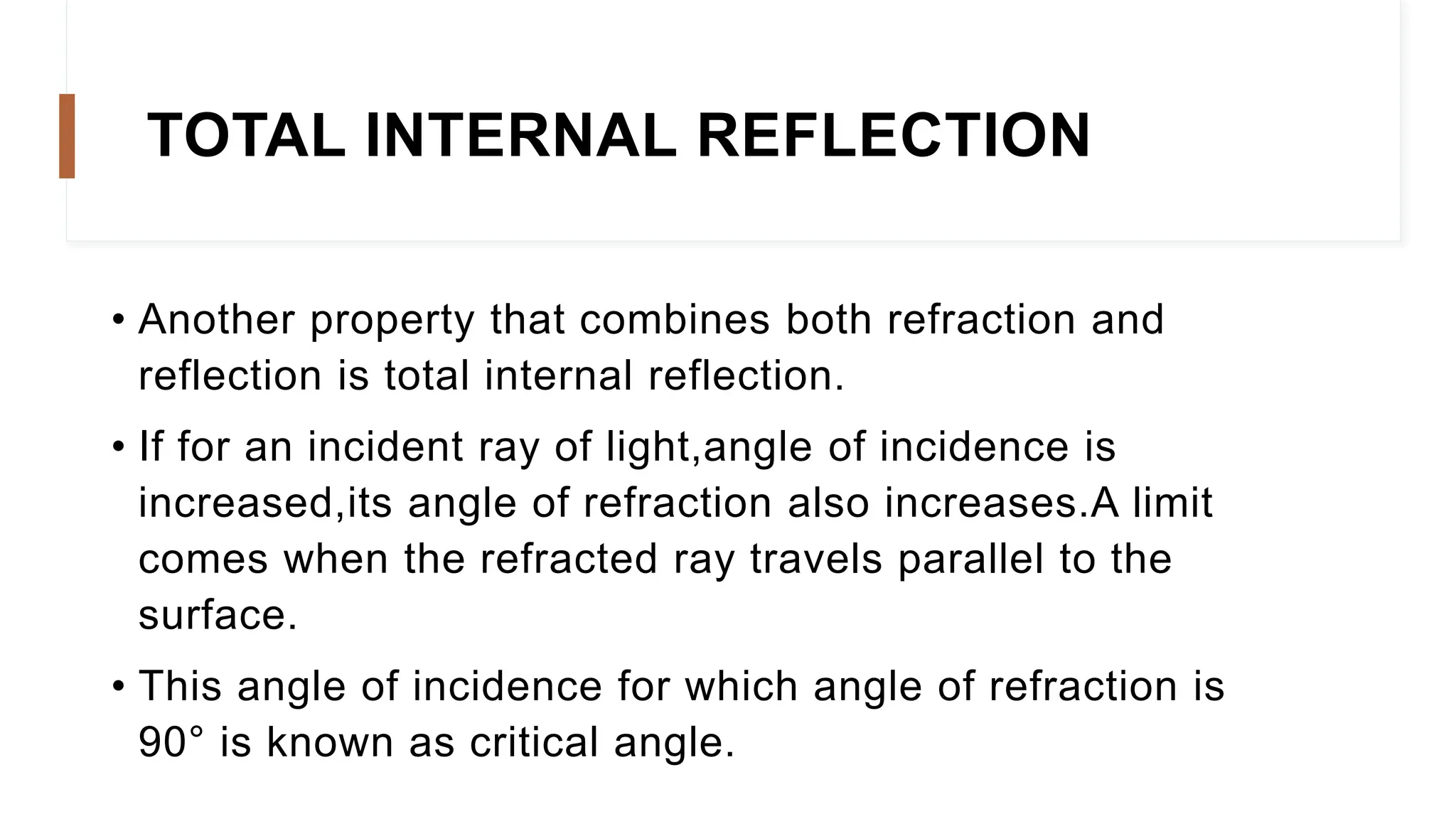
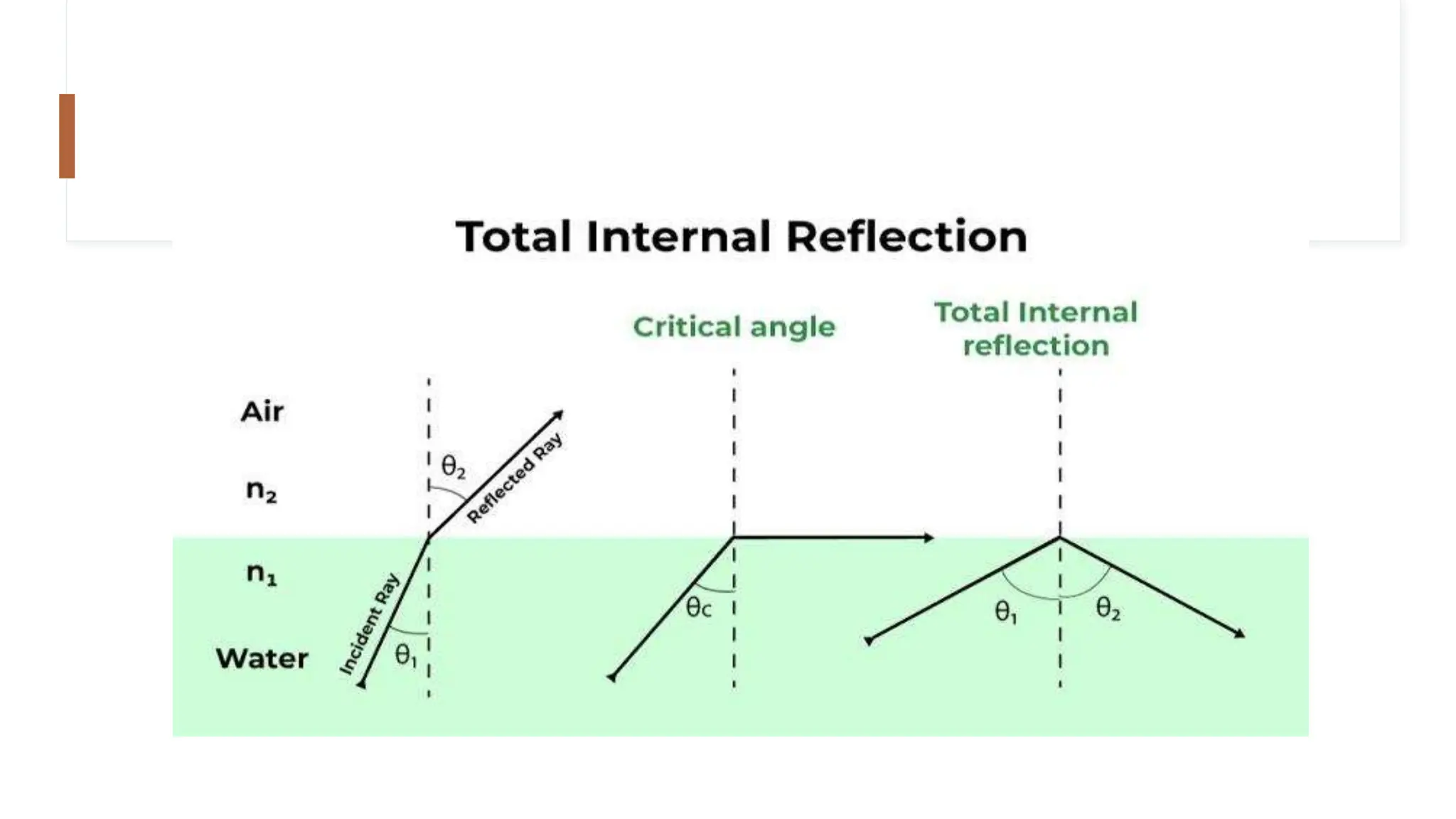
• Another propertythat combines both refraction and
reflection is total internal reflection.
• If for an incident ray of light,angle of incidence is
increased,its angle of refraction also increases.A limit
comes when the refracted ray travels parallel to the
surface.
• This angle of incidence for which angle of refraction is
90° is known as critical angle.
TOTAL INTERNAL REFLECTION
24.
• If angleof incidence is increased further,the refracted ray
bends and travels in the same medium. This is known as
total internal reflection.
26.
• This phenomenonis made use of in making optical
fibres. Diamond shines even in dark because of this
phenomenon.
• Fibre optics uses this property of light to keep the light
beams focused without significant loss, as long as the
bending of the cable is not too sharp.
27.
POLARIZATION
• Polarization isanother property of light.
• The electric and magnetic vibrations of a light wave occur
perpendicular to each other. So,we have one plane
occupied by an electric field, another plane of the
magnetic field perpendicular to it.
• These vibrations can occur in numerous planes.
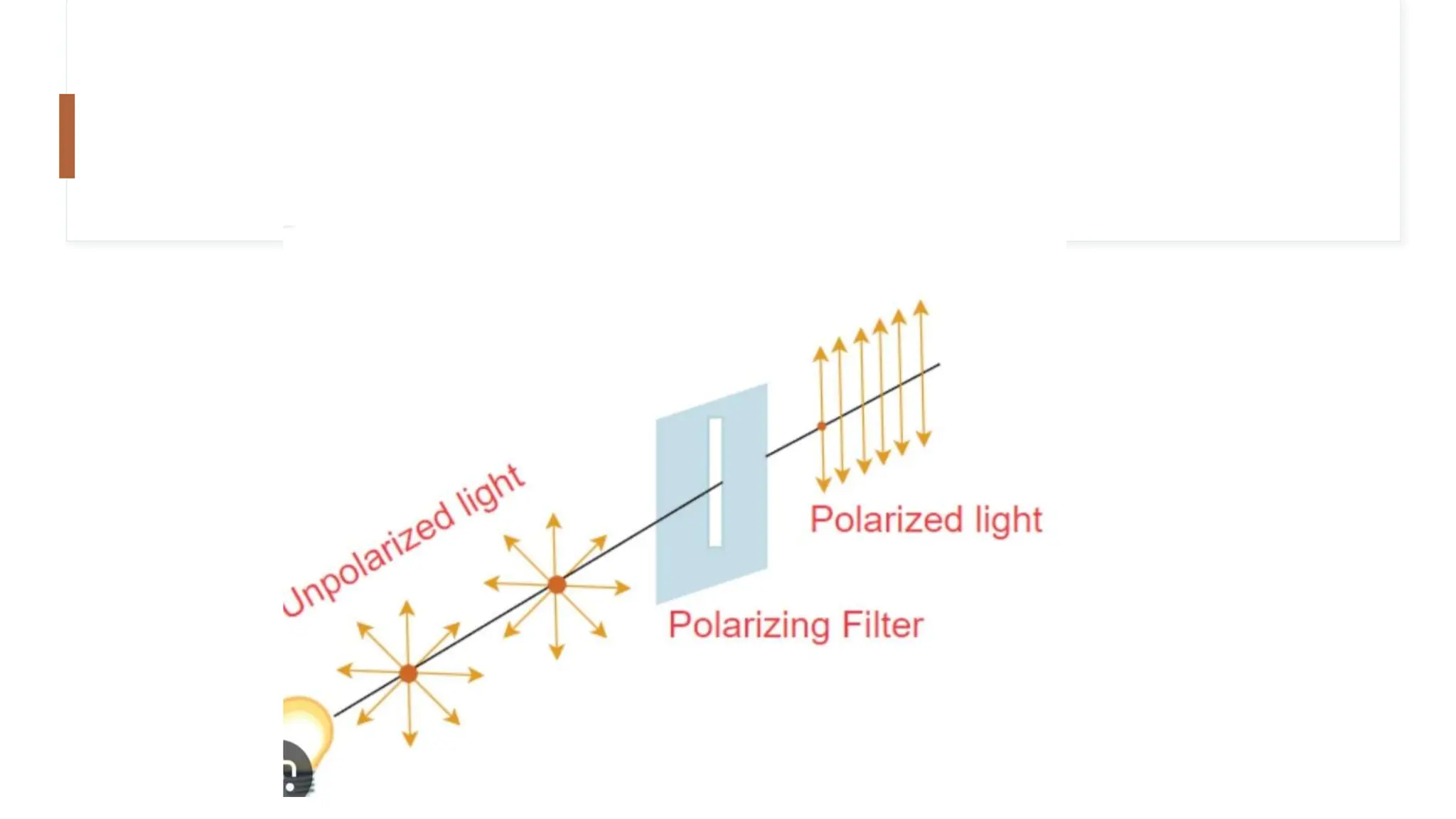
• A light wave that is vibrating in more than one plane is
known as unpolarized light.
28.
• The otherkind of wave is polarized wave. i.e., plane
polarized light vibrates on only one plane.
• Simply, The process of transforming unpolarized light into
polarized light is known as polarization.
• The devices used for polarization of light are polarizers.
30.
TYPES OF POLARIZATION
1.Linear polarization
• In linear polarization, electric field of light is limited to a single
plane along the direction of propagation.
2. Circular polarization
• There are two linear components in the electrical field of light that
are perpendicular to each other such that their amplitudes are
equal, but phase difference is π / 2. The propagation of the
occurring electric field will be in a circular mot motion.
31.
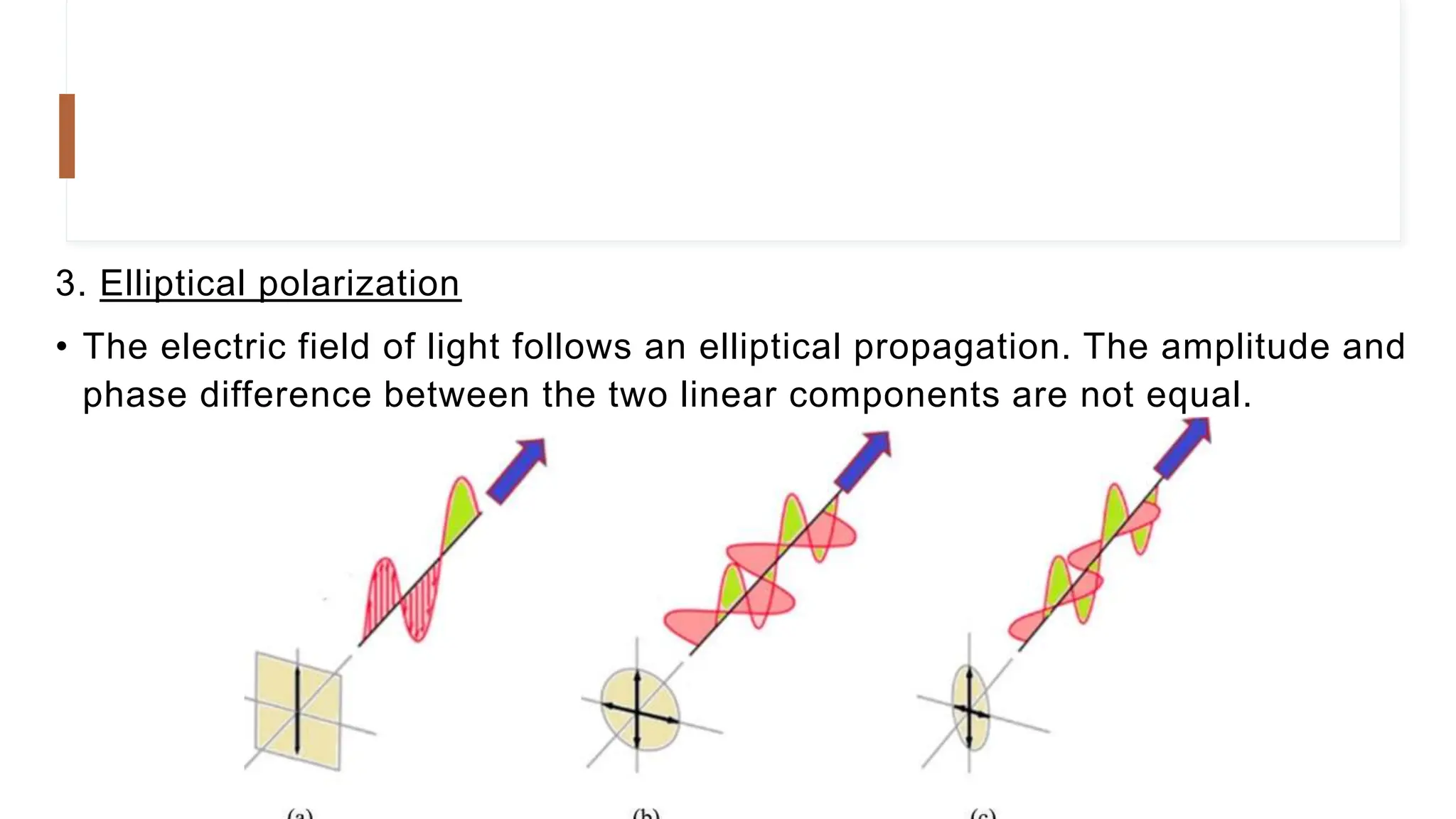
3. Elliptical polarization
•The electric field of light follows an elliptical propagation. The amplitude and
phase difference between the two linear components are not equal.
32.
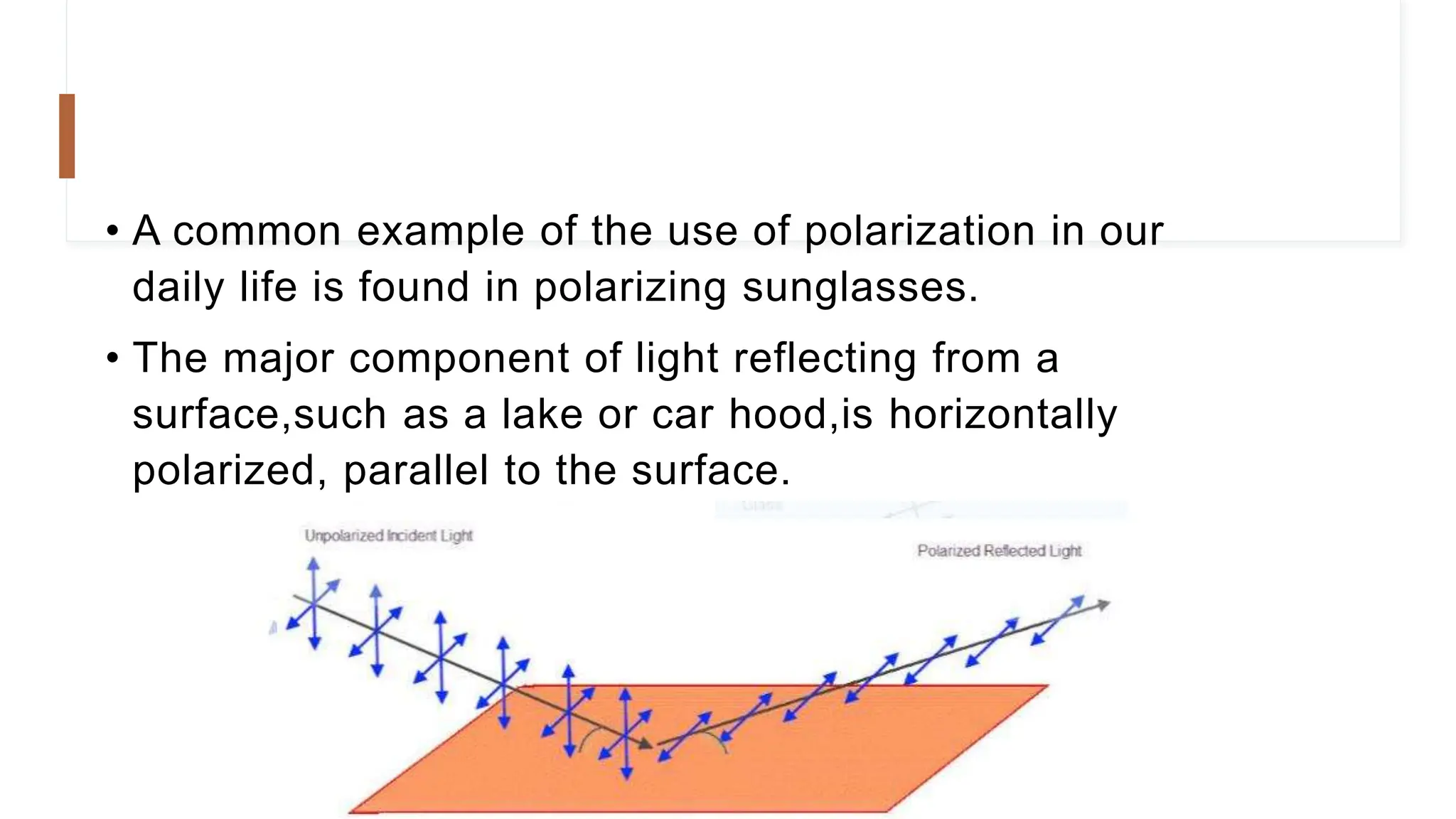
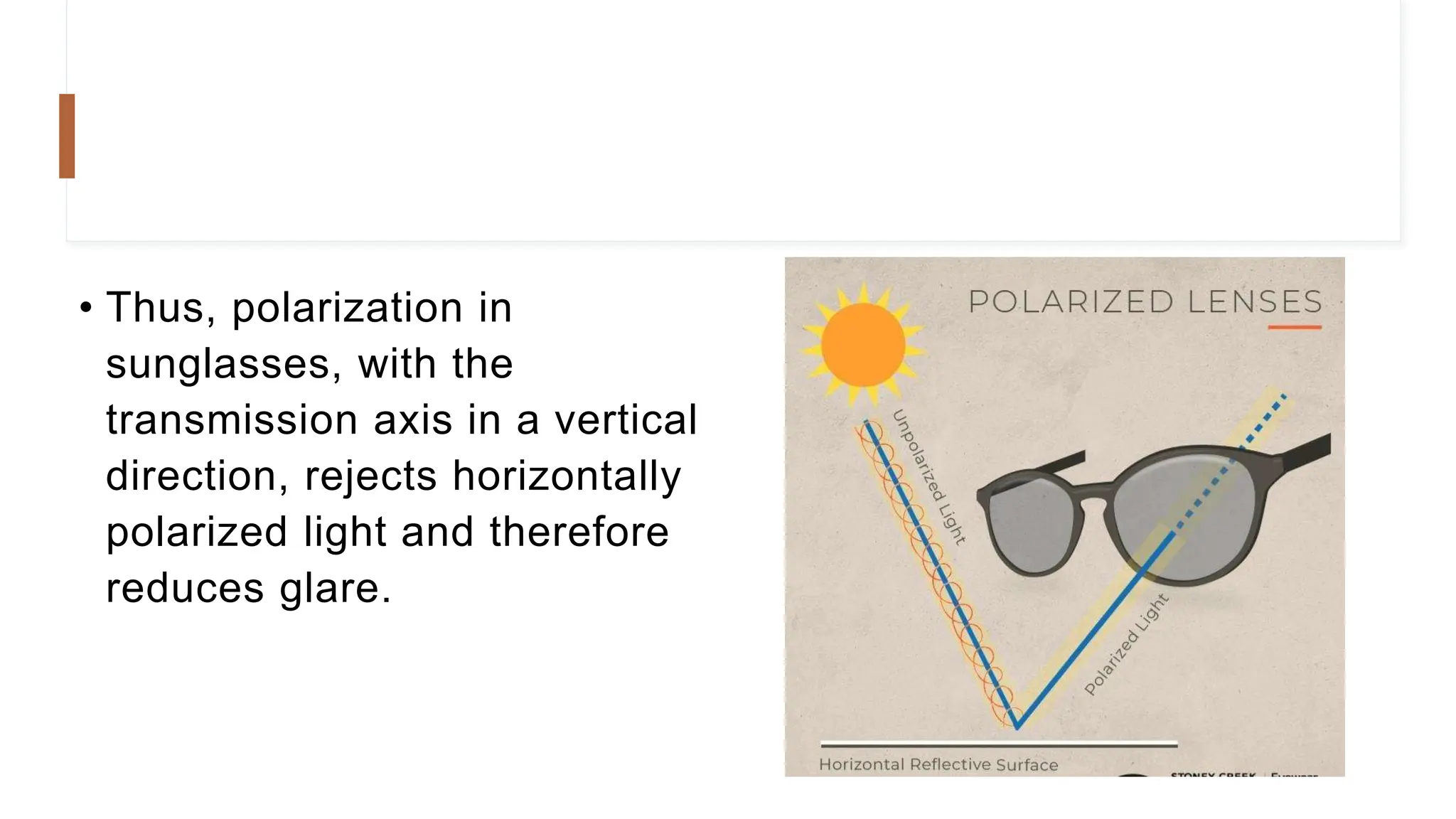
• A commonexample of the use of polarization in our
daily life is found in polarizing sunglasses.
• The major component of light reflecting from a
surface,such as a lake or car hood,is horizontally
polarized, parallel to the surface.
33.
• Thus, polarizationin
sunglasses, with the
transmission axis in a vertical
direction, rejects horizontally
polarized light and therefore
reduces glare.
34.
DIFFRACTION
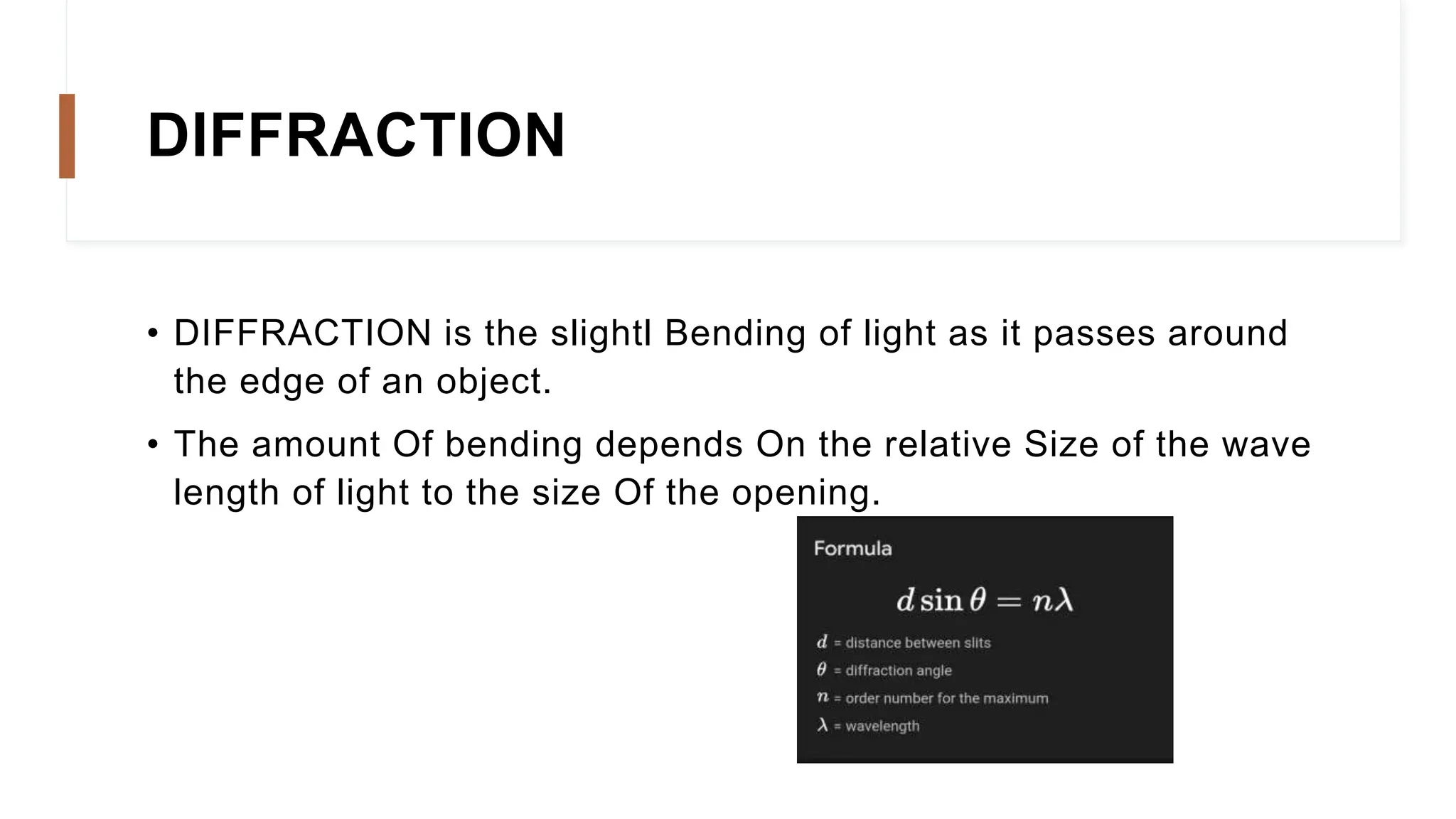
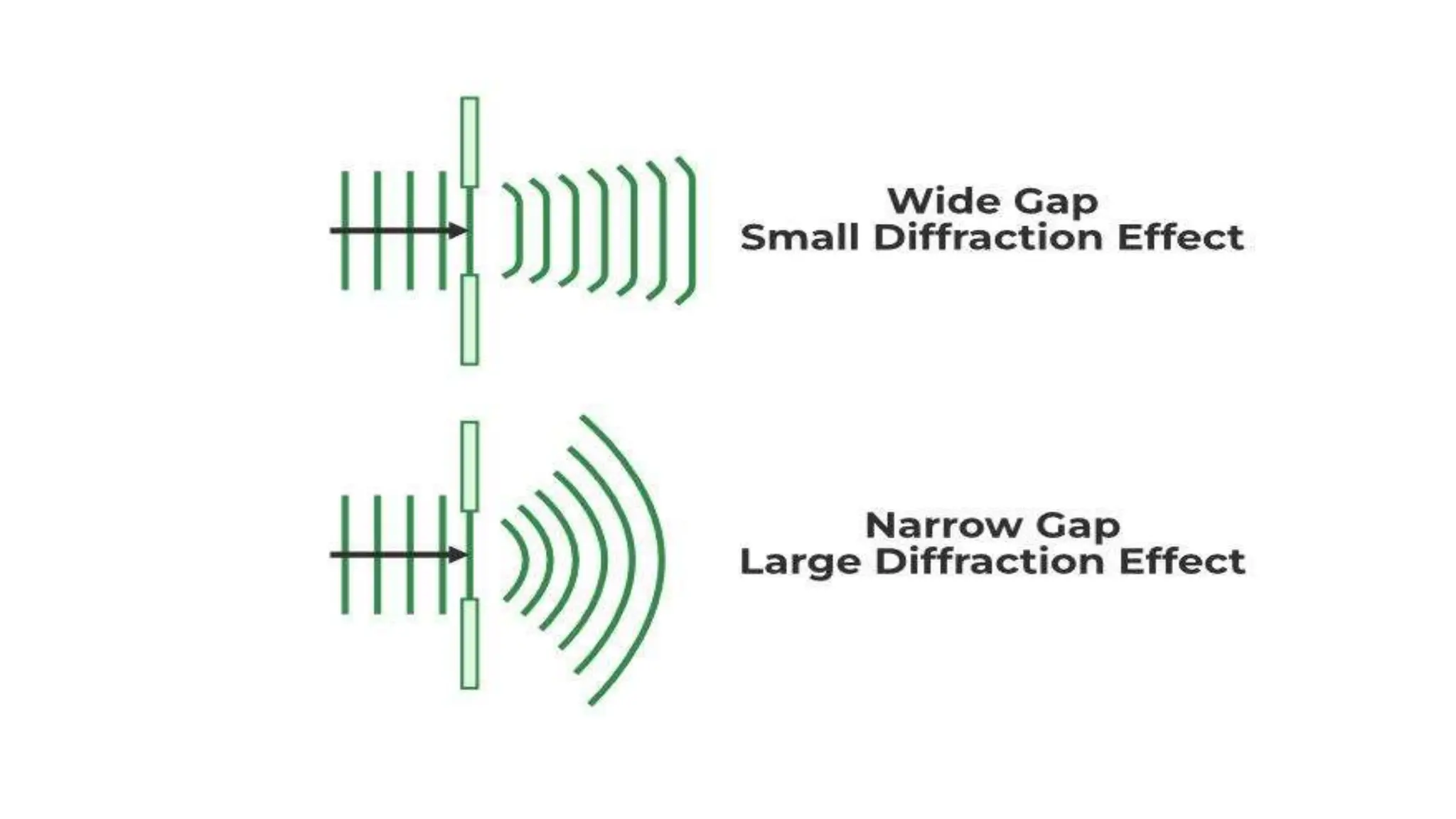
• DIFFRACTION isthe slightl Bending of light as it passes around
the edge of an object.
• The amount Of bending depends On the relative Size of the wave
length of light to the size Of the opening.
35.
Diffraction of lightexamples :-
• The colourful patterns of a light seen on a CD or DVD.
Which is diffraction due to reflection.
• Prisms ,where diffraction due to refraction.
• Rainbows , Where diffraction due to both refraction and
reflection.
37.
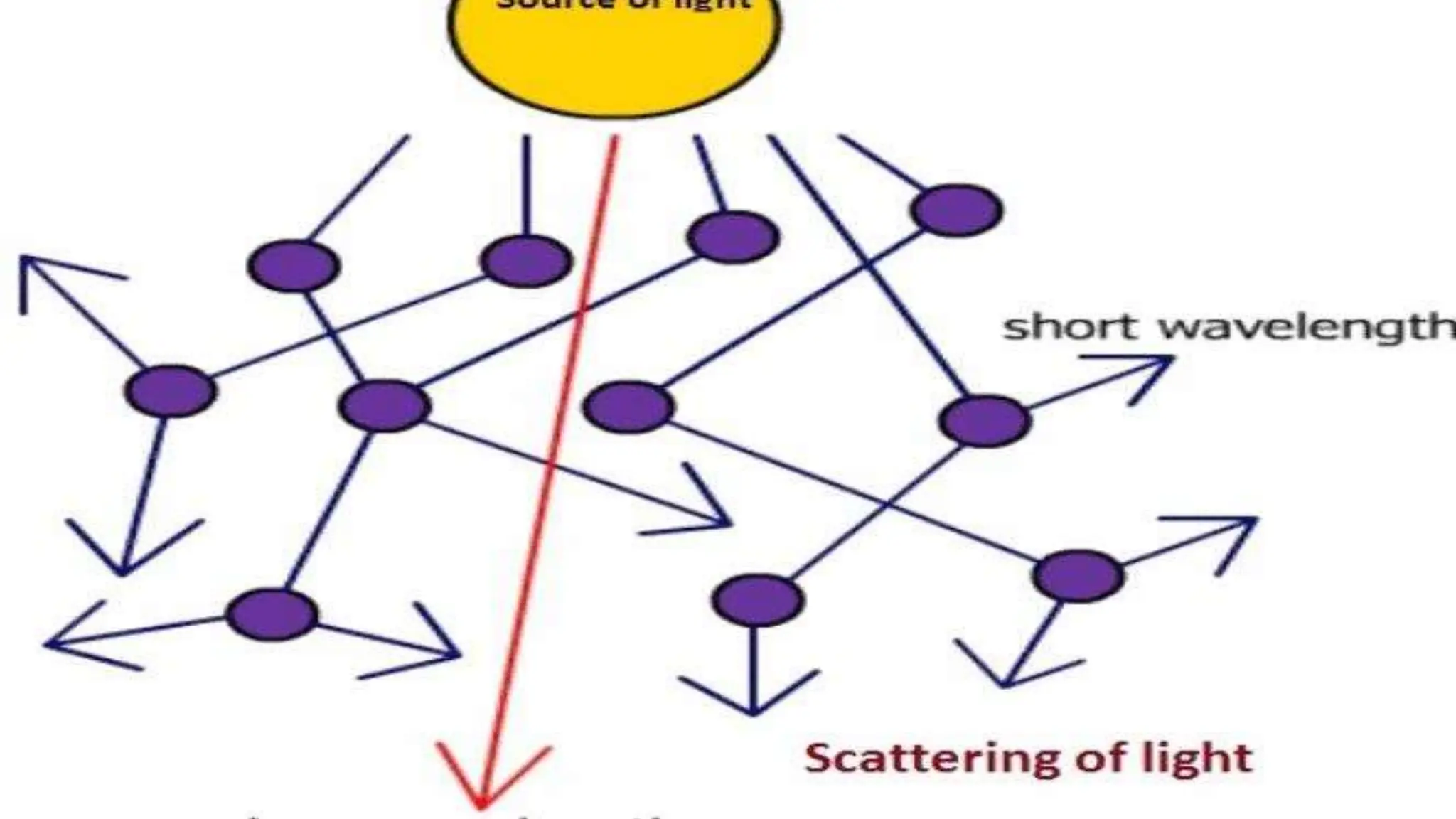
SCATTERING
• When thesunlight is enters the atmosphere of earth, the atoms
and molecules Of different gases present in the air Absorb the
light.
• Then these atoms re-emit in all directions, this process is known
as scattering of light.
• The atoms or particles scatter a light is known as scatterers.
38.
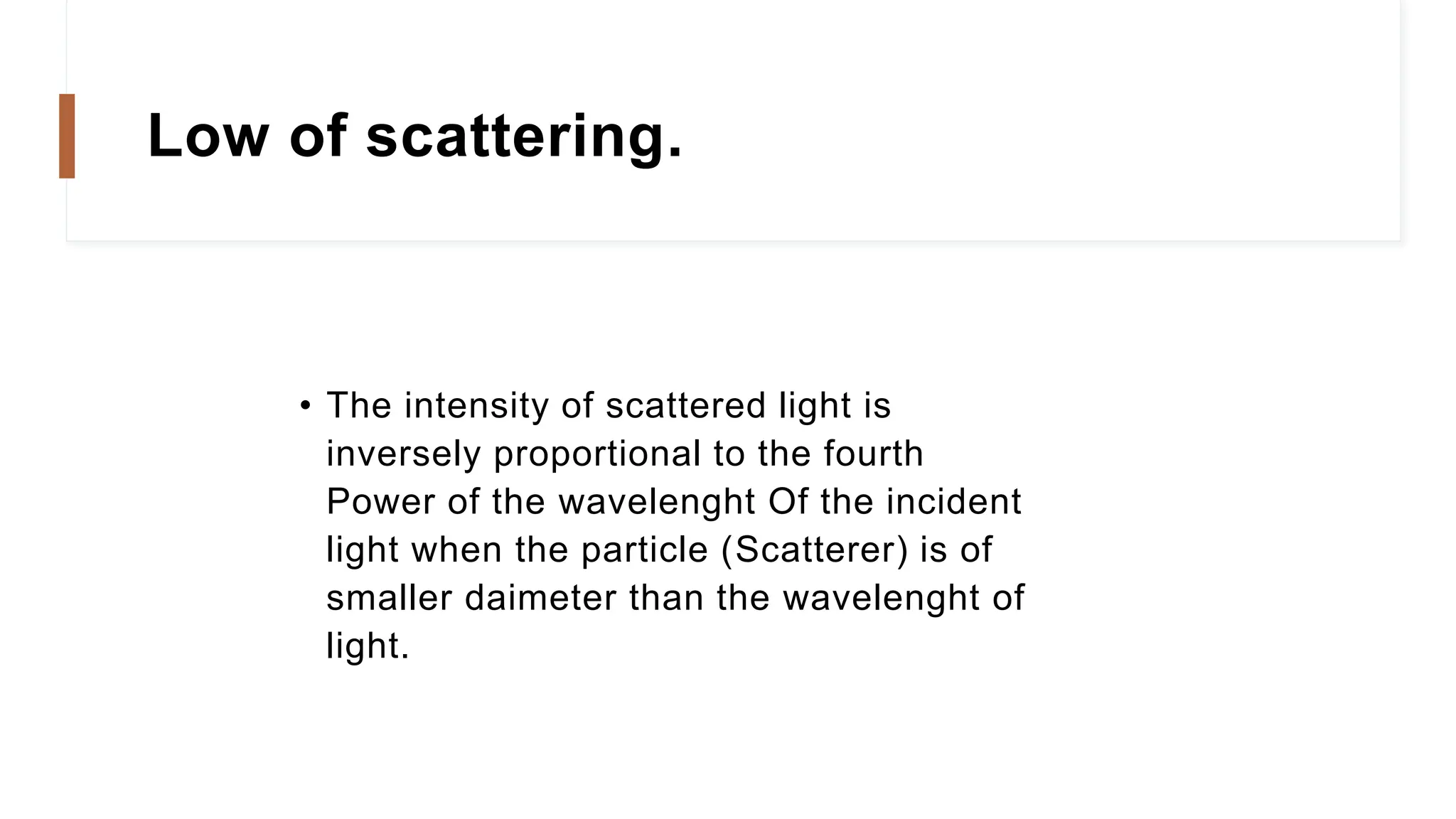
Low of scattering.
•The intensity of scattered light is
inversely proportional to the fourth
Power of the wavelenght Of the incident
light when the particle (Scatterer) is of
smaller daimeter than the wavelenght of
light.
40.
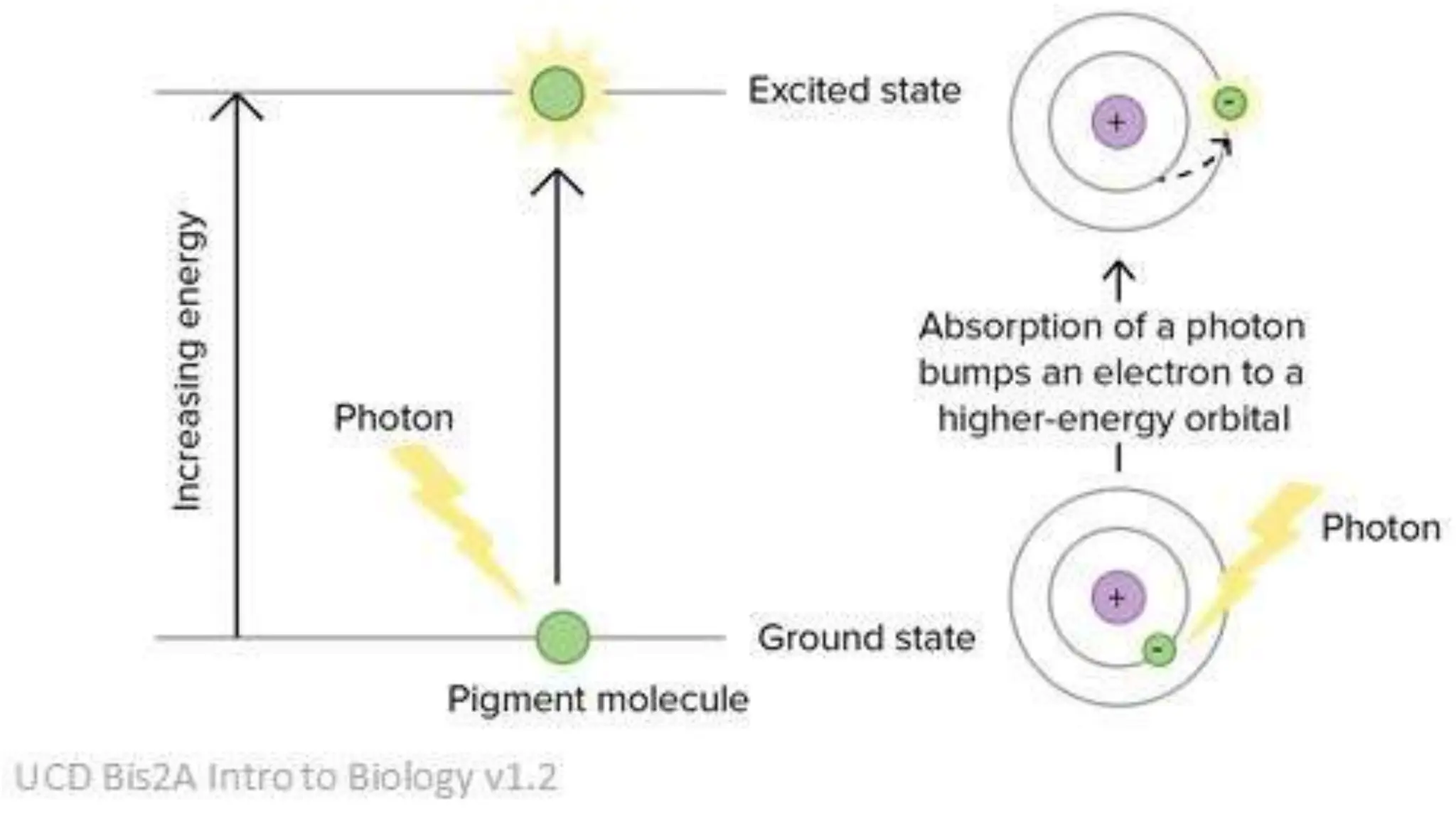
ABSORPTION OF LIGHT
•Light absorption is the process in which light is absorbed by
matter and converted into energy
• In an atom,electrons vibrate at a specific frequency this is called
the natural frequency
• If a wave of light hits a material in which the electrons are
vibrating at the same frequency as the wave of light,the electrons
will absorb the energy and convert it into vibrational motion
• This why objects have different colours-different material’electrons
will vibrate at different rates,and therefore absorb different
frequencies of light
42.
LIGHT EMISSION
• Lightcan be produced by matter which is in an excited state
and,as we will show,excitation can come from a variety of sources
• The atoms and molecules that make up matter typically emit light
at characteristic energies.
• The light emmision can be spontaneous or stimulated
44.
Spontaneous emmision
• Inspontaneous emission,matter at a sufficiently high energy level
can relax by emitting photons of a characteristic energy this is the
process that occurs in flames,or discharge lamps
45.
Stimulated emission
• Stimulatedemission occurs when matter in an excited state is
perturbed by a photon of light and gives rise to a further photon of
light,typically at the same energy and phase as the perturbing
photon.
• This phenomenon is the process which gives rise to laser
emission where you have many photons at the same wavelength
and in phase with each other
46.
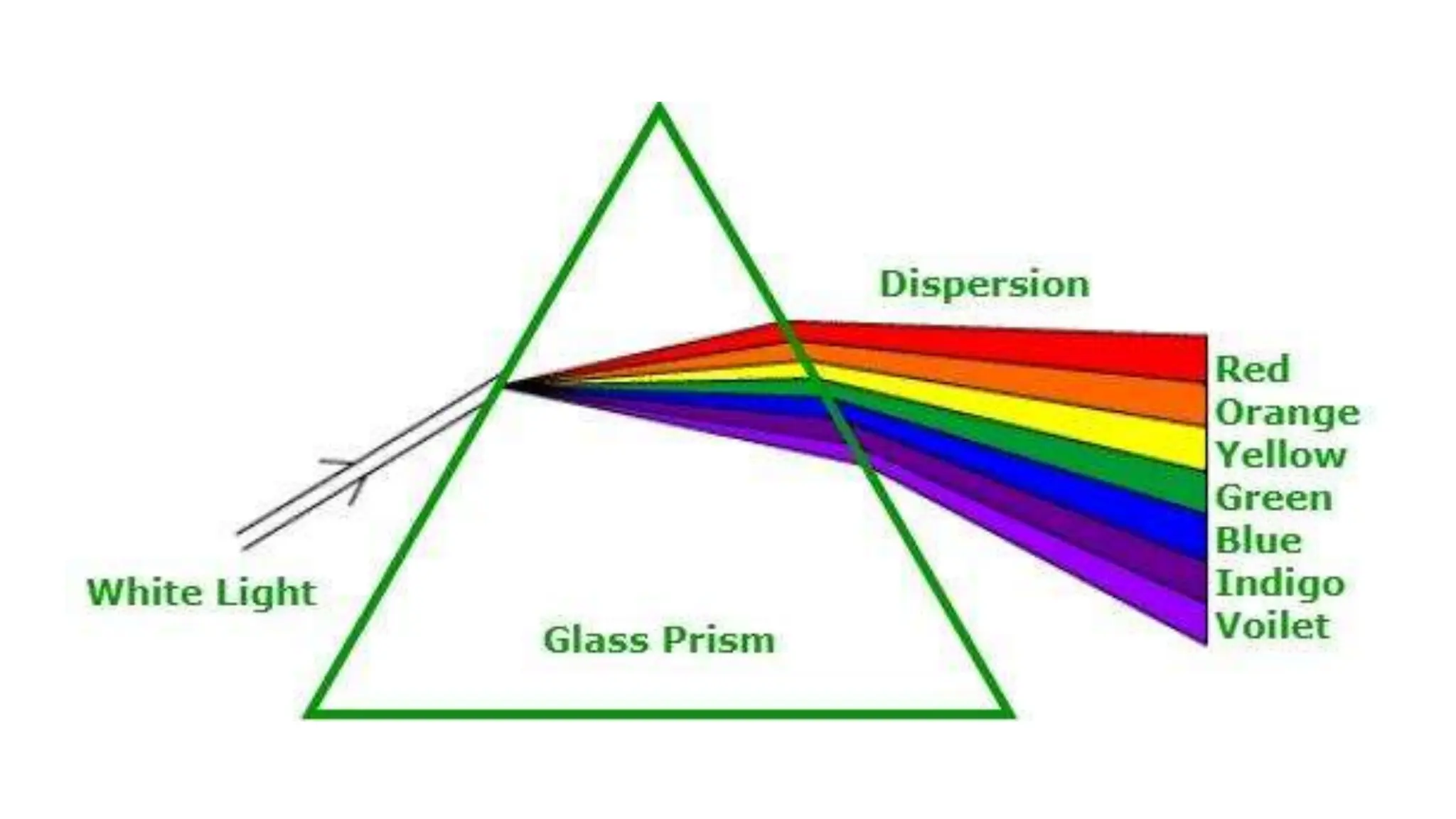
DISPERSION OF LIGHT
•It refers to the ability to break white light into its
constituent colors.
• White light consists of seven colors.
• If white light enters a prism it splits into seven colors with
violet light having shortest wavelength suffers maximum
deviation and red light with longest wavelength suffers
minimum deviation
47.
• Rainbows arenatural phenomena that exemplify all of
the above properties of light.
• They use refraction, dispersion, and internal reflection to
produce their amazing hues
• White light enters raindrops from the sun it gets
dispersed and refracted inside the raindrops.
• When the dispersed light hits the back of the raindrop, it
gets internally reflected, and when it emerges it gets
dispersed even more.
49.
• The coloryou see most vividly in a rainbow depends on
the angle of your eye.
• Generally, you must look higher in the sky to see the red,
and lower to see the blue.
• What you actually see is the red on the top and the blue
on the bottom, with all of the other colors in between.
• The arc of the rainbow depends on the angle that your
line of sight makes relative to the sun behind you.
50.
INTERFERENCE OF LIGHT
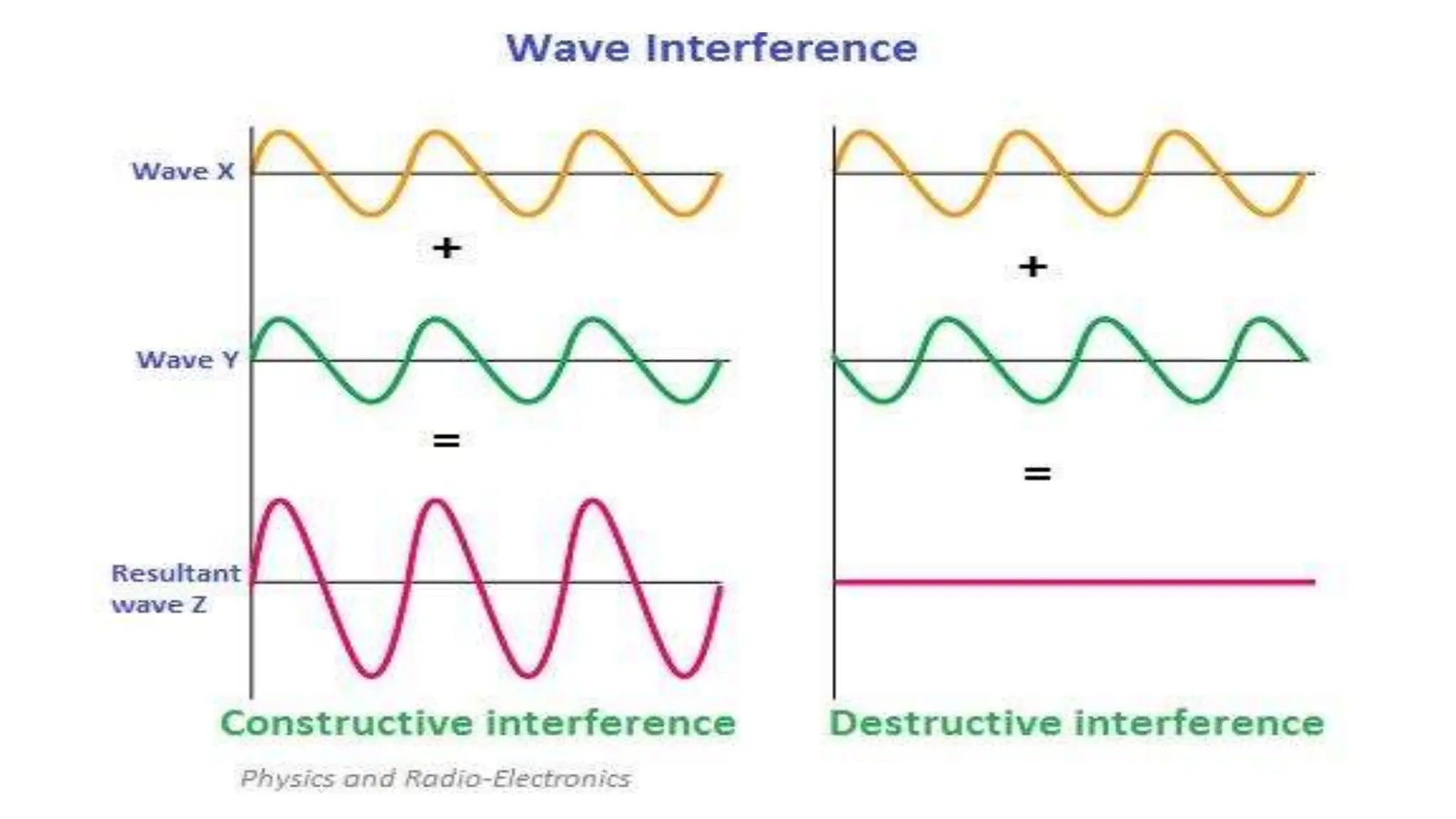
•If two or more light waves of the same frequency over lap
at a point the resultant effect depends on the phase of
the waves as well as there amplitude
• The phenomenon of redistribution of light energy due
to the super position of light waves from two or more
coherent sources is known as INTERFERENCE
51.
• The mostcommon example of interference of light is the
soap bubble which reflects wide colours when illuminated
by a light source
Constructive Interference
Constructive interferencetakes place when the
crest of one wave falls on the crest of another wave
such that the amplitude is maximum. These waves
will have the same displacement and are in the
same phase.
54.
Distructive interference
In destructiveinterference, the crest of one wave
falls on the trough of another wave such that the
amplitude is minimum. The displacement and phase
of these waves are not the same



![Presentation on lights [ physics ]](https://cdn.slidesharecdn.com/ss_thumbnails/presentationonlightsphysics-170809202610-thumbnail.jpg?width=640&height=640&fit=bounds)

![Presentation on lights [ gamma team ]](https://cdn.slidesharecdn.com/ss_thumbnails/presentationonlightsgammateam-170605110522-thumbnail.jpg?width=640&height=640&fit=bounds)


