MANAGEMENT OF ACUTE
SEVERE ASTHMA
Introduction
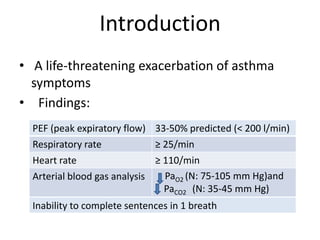
• A life-threatening exacerbation of asthma
symptoms
• Findings:
PEF (peak expiratory flow) 33-50% predicted (< 200 l/min)
Respiratory rate ≥ 25/min
Heart rate ≥ 110/min
Arterial blood gas analysis PaO2 (N: 75-105 mm Hg)and
PaCO2 (N: 35-45 mm Hg)
Inability to complete sentences in 1 breath
Management
• Initial assessment
• Treatment
• Mechanical ventilation
• Monitoring
Initial assessment
Immediate assessment of
ability to speak
Vital signs
Measurement of PEF is mandatory unless the
patient is too ill to cooperate
Arterial blood gas analysis
Treatment
• Oxygen
• High doses of inhaled bronchodilators
• Systemic corticosteroids
• Intravenous fluids
• Subsequent management
Treatment contd…
• Oxygen
– High concentrations of oxygen (humidified if
possible)
– Goal: SaO2 > 92%
– Failure to achieve appropriate oxygenation
 assisted ventilation.
Treatment contd…
• High doses of inhaled bronchodilators
– Short-acting β2-agonists (Salbutamol 5mg/hr)
• via nebuliser driven by oxygen or via a metered
dose inhaler through a spacer device
– An inhaled anticholinergics (Ipratropium bromide
µg) may be added
Treatment contd…
• Systemic corticosteroids
– intravenous hydrocortisone 200 mg : in patients
who are unable to swallow or vomiting.
– Oral prednisolone 0 mg
Treatment contd…
• Intravenous fluids
– To correct dehydration and acidosis
– Normal saline + sodium bicarbonate/lactate
infusion
– Potassium supplements to treat hypokalemia
induced by Salbutamol
Treatment contd…
• Subsequent management
– If patients fail to improve
• Intravenous magnesium sulphate(1.2–2 g over 20
min)
• Intravenous β2 agonists(e.g. Salbutamol)
• Intravenous aminophylline (5mg/kg loading dose
over 20 minutes followed by continuous infusion at
mg/kg/hr )
• Intravenous leukotriene receptor antagonists
• Anaesthetics (e.g. halothane)
Mechanical Ventilation
• Initial goals
– To correct hypoxaemia
– To achieve adequate alveolar ventillation
– To minimize circulatory collapse
– To buy time for medical management to work
• Indications
– Coma
– Respiratory arrest
– Deterioration of arterial blood gas tensions despite
optimal therapy
– Exhaustion, confusion, drowsiness
Monitoring of treatment
• PEF should be recorded every 15-30 minutes
• Pulse oximetry should ensure that SaO2 remains >
92%
• If aminophylline is given, then monitor the serum
concentration (therapeutic range 10–20 µg ml
• Repeat arterial blood gases if
– initial PaCO2 measurement was raised
– PaO2 was < 8 kPa (60 mmHg) or
– the patient deteriorates.
MANAGEMENT OF ACUTE SEVERE ASTHMA

MANAGEMENT OF ACUTE SEVERE ASTHMA

  • 1.
  • 2.
    Introduction • A life-threateningexacerbation of asthma symptoms • Findings: PEF (peak expiratory flow) 33-50% predicted (< 200 l/min) Respiratory rate ≥ 25/min Heart rate ≥ 110/min Arterial blood gas analysis PaO2 (N: 75-105 mm Hg)and PaCO2 (N: 35-45 mm Hg) Inability to complete sentences in 1 breath
  • 3.
    Management • Initial assessment •Treatment • Mechanical ventilation • Monitoring
  • 4.
    Initial assessment Immediate assessmentof ability to speak Vital signs Measurement of PEF is mandatory unless the patient is too ill to cooperate Arterial blood gas analysis
  • 5.
    Treatment • Oxygen • Highdoses of inhaled bronchodilators • Systemic corticosteroids • Intravenous fluids • Subsequent management
  • 6.
    Treatment contd… • Oxygen –High concentrations of oxygen (humidified if possible) – Goal: SaO2 > 92% – Failure to achieve appropriate oxygenation  assisted ventilation.
  • 7.
    Treatment contd… • Highdoses of inhaled bronchodilators – Short-acting β2-agonists (Salbutamol 5mg/hr) • via nebuliser driven by oxygen or via a metered dose inhaler through a spacer device – An inhaled anticholinergics (Ipratropium bromide µg) may be added
  • 8.
    Treatment contd… • Systemiccorticosteroids – intravenous hydrocortisone 200 mg : in patients who are unable to swallow or vomiting. – Oral prednisolone 0 mg
  • 9.
    Treatment contd… • Intravenousfluids – To correct dehydration and acidosis – Normal saline + sodium bicarbonate/lactate infusion – Potassium supplements to treat hypokalemia induced by Salbutamol
  • 10.
    Treatment contd… • Subsequentmanagement – If patients fail to improve • Intravenous magnesium sulphate(1.2–2 g over 20 min) • Intravenous β2 agonists(e.g. Salbutamol) • Intravenous aminophylline (5mg/kg loading dose over 20 minutes followed by continuous infusion at mg/kg/hr ) • Intravenous leukotriene receptor antagonists • Anaesthetics (e.g. halothane)
  • 11.
    Mechanical Ventilation • Initialgoals – To correct hypoxaemia – To achieve adequate alveolar ventillation – To minimize circulatory collapse – To buy time for medical management to work • Indications – Coma – Respiratory arrest – Deterioration of arterial blood gas tensions despite optimal therapy – Exhaustion, confusion, drowsiness
  • 12.
    Monitoring of treatment •PEF should be recorded every 15-30 minutes • Pulse oximetry should ensure that SaO2 remains > 92% • If aminophylline is given, then monitor the serum concentration (therapeutic range 10–20 µg ml • Repeat arterial blood gases if – initial PaCO2 measurement was raised – PaO2 was < 8 kPa (60 mmHg) or – the patient deteriorates.

Editor's Notes

  • #3 Hot potato speech or fragmented speech
  • #5 ABG : to determine the PaCO2elevated level being particularly dangerousVital signspulse raterespiratory rateBlood pressure andSaO2 (oxygen saturation)
  • #7 The presence of a high PaCO2 should not be taken as an indication to reduce oxygen concentration but is a warning sign of a severe or life-threatening attack.
  • #8 Ipratropium + salbutamol : greater bronchodilation than salbutamol aloneif there is not a satisfactory response to β2-agonists alone
  • #9 reduce the inflammatory response and hasten the resolution of exacerbations. should be administered to all patients with an acute severe attack.
  • #10 Normally, respiratory acidosis is compensated by metabolic alkalosis. If compensation is not complete, then sodium bicarbonate should be given. Potassium supplements indicated only if potassium level &lt; 5.5 mEq/ l
  • #11 MgSO4: (bronchodilation in patients with PEF&lt; 30% predicted); Rapid administration may be associated with hypotensionhypermagnesaemia is associated with muscle weakness and may exacerbate respiratory failure in spontaneously breathing patients. also used in eclampsia, arrythmia, laxative etc.Aminophylline : 5 mg kg−1 loading dose over 20 min unless on maintenance oral therapy, then infusion of 0.5–0.75 mg kg−1 min−1); side effects (arrhythmias, restlessness, vomiting, and convulsions)If non-respondent to conventional bronchodilators, may benefit from an anaesthetics (e.g. halothane)
  • #12 PaO2 &lt; 8 kPa (60 mmHg) and falling PaCO2 &gt; 6 kPa (45 mmHg) rising pH low and falling (H+ high and rising)