THE HELIOCENTRIC
THEORY
Carlota Hernández
Ana Martinez
Andrea Carretero
MEANING:
H E L I O C E N T R I C
adjective, Astronomy.
1. Measured or considered as being seen from the center of the sun.
2. Having or representing the sun as a center:
helio- + -centric
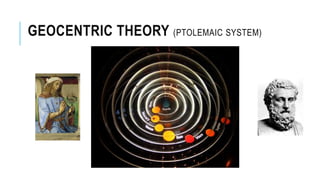
GEOCENTRIC THEORY (PTOLEMAIC SYSTEM)
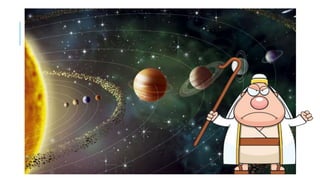
HELIOCENTRIC THEORY
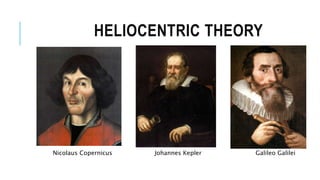
Nicolaus Copernicus Johannes Kepler Galileo Galilei
HELIOCENTRIC THEORY
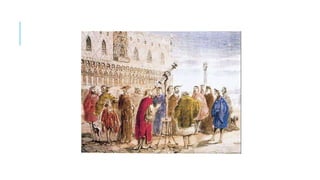
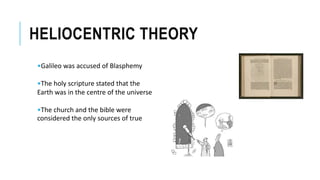
•Galileo was accused of Blasphemy
•The holy scripture stated that the
Earth was in the centre of the universe
•The church and the bible were
considered the only sources of true
HELIOCENTRIC THEORY
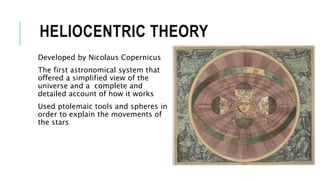
Developed by Nicolaus Copernicus
The first astronomical system that
offered a simplified view of the
universe and a complete and
detailed account of how it works
Used ptolemaic tools and spheres in
order to explain the movements of
the stars
HELIOCENTRIC PRINCIPLES:
Celestial bodies do not all revolve around a single point
The center of the earth is the center of the lunar sphere
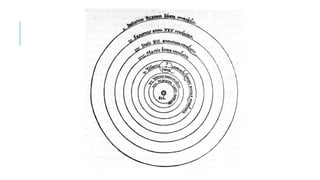
All the spheres rotate around the Sun
Parallax is not observed in the stars
The stars are immovable
Earth is moved in a sphere around the Sun, and has more than one
motion
Earth’s orbital motion around the Sun causes the seeming reverse in
direction of the motions of the planet
THE ASTRONOMERS
 Aristotle~350 BC Earth is the center of the Universe; the stars, the Sun and the
planets revolve around the Earth in circles.
 Copernicus1473 — 1543 The Sun is the center of the Universe; the stars and the
planets revolve around the Sun in circles. Still need epicycles.
 Kepler 1571 — 1630 Kepler’s laws describe planetary motion;
Beginning of mathematical scientific laws.
 Galileo 1564 — 1642 Public support for Copernican theory; first extensive use of the
telescope in astronomy; many revolutionary discoveries: mountains on Moon, moons of
Jupiter, phases of Venus, many faint stars in the Milky Way.
 Newton1642 — 1727 Mathematical theory of gravity explains Kepler’s laws.
 Einstein1879 — 1955 Special and general relativity: generalization of Newton’s
laws.
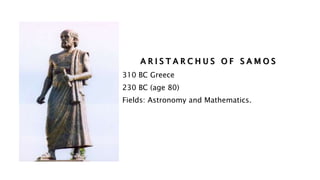
A R I S T A R C H U S O F S A M O S
310 BC Greece
230 BC (age 80)
Fields: Astronomy and Mathematics.
ARISTARCHUS OF SAMOS
C O N T R I B U T I O N T O T H E W O R L D
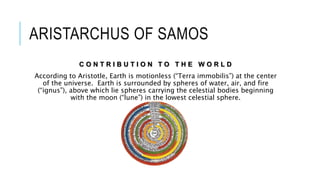
According to Aristotle, Earth is motionless (“Terra immobilis”) at the center
of the universe. Earth is surrounded by spheres of water, air, and fire
(“ignus”), above which lie spheres carrying the celestial bodies beginning
with the moon (“lune”) in the lowest celestial sphere.
ARISTARCHUS OF SAMOS
H I S R O L I N T H E H . T H E O R Y
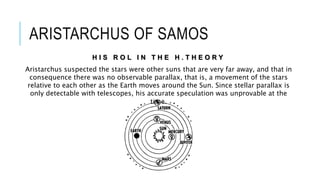
Aristarchus suspected the stars were other suns that are very far away, and that in
consequence there was no observable parallax, that is, a movement of the stars
relative to each other as the Earth moves around the Sun. Since stellar parallax is
only detectable with telescopes, his accurate speculation was unprovable at the
time.
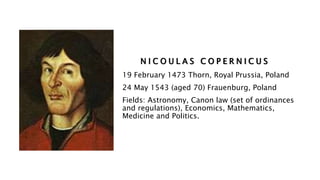
N I C O U L A S C O P E R N I C U S
19 February 1473 Thorn, Royal Prussia, Poland
24 May 1543 (aged 70) Frauenburg, Poland
Fields: Astronomy, Canon law (set of ordinances
and regulations), Economics, Mathematics,
Medicine and Politics.
NICOULAS COPERNICUS
C O N T R I B U T I O N T O T H E W O R L D
Nicolaus Copernicus was the first to say the sun was the center of the universe with proof
involving physics, mathematics, and cosmology. His works influenced Galileo, Keplar,
Descartes, and Newton.
NICOULAS COPERNICUS
E A R LY L I F E
Nicolaus’s father died when Copernicus was ten.
He was cared for by his uncle, Lucas Watzenrode.
In 1448, Copernicus was sent to cathedral school in Wloclauek.
In 1491, he entered the University of Krakow.
Copernicus studied Latin, mathematics, astronomy, geography, philosophy, and astrology.
He left Krakow without a degree.
In 1496, he returned to Italy and enrolled in University of Bologna.
NICOULAS COPERNICUS
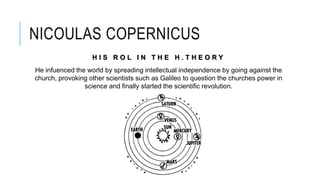
H I S R O L I N T H E H . T H E O R Y
He infuenced the world by spreading intellectual independence by going against the
church, provoking other scientists such as Galileo to question the churches power in
science and finally started the scientific revolution.
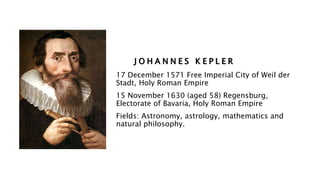
J O H A N N E S K E P L E R
17 December 1571 Free Imperial City of Weil der
Stadt, Holy Roman Empire
15 November 1630 (aged 58) Regensburg,
Electorate of Bavaria, Holy Roman Empire
Fields: Astronomy, astrology, mathematics and
natural philosophy.
JOHANNES KEPLER
C O N T R I B U T I O N T O T H E W O R L D
Kepler found many magical and mysterious mathematical relations in the stars
and planets. He published his findings in two more books: The New
Astronomy, 1609. The Harmony of the World, 1619 Out
of all of this, three laws survive.
 The first two involve a new shape for astronomy, the ellipse.
JOHANNES KEPLER
T H E E L L I P S E
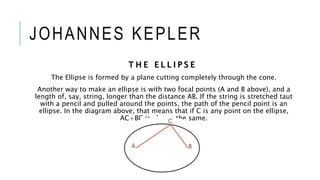
The Ellipse is formed by a plane cutting completely through the cone.
Another way to make an ellipse is with two focal points (A and B above), and a
length of, say, string, longer than the distance AB. If the string is stretched taut
with a pencil and pulled around the points, the path of the pencil point is an
ellipse. In the diagram above, that means that if C is any point on the ellipse,
AC+BC is always the same.
JOHANNES KEPLER
1 s t L A W
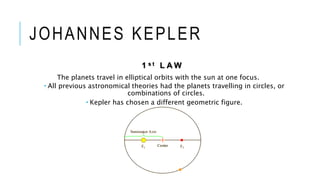
The planets travel in elliptical orbits with the sun at one focus.
 All previous astronomical theories had the planets travelling in circles, or
combinations of circles.
 Kepler has chosen a different geometric figure.
JOHANNES KEPLER
H I S R O L I N T H E H . T H E O R Y
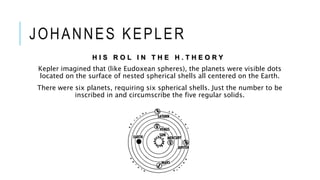
Kepler imagined that (like Eudoxean spheres), the planets were visible dots
located on the surface of nested spherical shells all centered on the Earth.
There were six planets, requiring six spherical shells. Just the number to be
inscribed in and circumscribe the five regular solids.
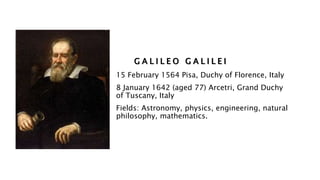
G A L I L E O G A L I L E I
15 February 1564 Pisa, Duchy of Florence, Italy
8 January 1642 (aged 77) Arcetri, Grand Duchy
of Tuscany, Italy
Fields: Astronomy, physics, engineering, natural
philosophy, mathematics.
GALILEO GALILEI
C O N T R I B U T I O N T O T H E W O R L D
 Observed swinging lamps in Cathedral of Pisa and found period to be
independent of the amplitude – idea for a pendulum clock
 Used inclined planes to prove that bodies do not fall with velocities
proportionate to their weight but proportionate to time.
 Disproved Aristotle’s view when he observed a supernova and showed that the
new star could not be close to the earth by parallax arguments
 Found that projectiles follow a parabolic path
GALILEO GALILEI
E A R LY L I F E
 Born 15 Feb. 1564 in Pisa
 Educated in Camaldolese Monastery
 Father wanted him to be a medical doctor
 Interested in mathematics
GALILEO GALILEI
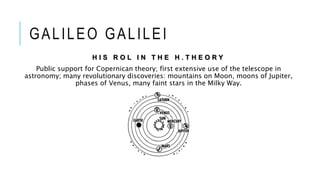
H I S R O L I N T H E H . T H E O R Y
Public support for Copernican theory; first extensive use of the telescope in
astronomy; many revolutionary discoveries: mountains on Moon, moons of Jupiter,
phases of Venus, many faint stars in the Milky Way.

Heliocentric model

  • 1.
  • 2.
    MEANING: H E LI O C E N T R I C adjective, Astronomy. 1. Measured or considered as being seen from the center of the sun. 2. Having or representing the sun as a center: helio- + -centric
  • 4.
  • 5.
    HELIOCENTRIC THEORY Nicolaus CopernicusJohannes Kepler Galileo Galilei
  • 7.
    HELIOCENTRIC THEORY •Galileo wasaccused of Blasphemy •The holy scripture stated that the Earth was in the centre of the universe •The church and the bible were considered the only sources of true
  • 9.
    HELIOCENTRIC THEORY Developed byNicolaus Copernicus The first astronomical system that offered a simplified view of the universe and a complete and detailed account of how it works Used ptolemaic tools and spheres in order to explain the movements of the stars
  • 10.
    HELIOCENTRIC PRINCIPLES: Celestial bodiesdo not all revolve around a single point The center of the earth is the center of the lunar sphere All the spheres rotate around the Sun Parallax is not observed in the stars The stars are immovable Earth is moved in a sphere around the Sun, and has more than one motion Earth’s orbital motion around the Sun causes the seeming reverse in direction of the motions of the planet
  • 12.
    THE ASTRONOMERS  Aristotle~350BC Earth is the center of the Universe; the stars, the Sun and the planets revolve around the Earth in circles.  Copernicus1473 — 1543 The Sun is the center of the Universe; the stars and the planets revolve around the Sun in circles. Still need epicycles.  Kepler 1571 — 1630 Kepler’s laws describe planetary motion; Beginning of mathematical scientific laws.  Galileo 1564 — 1642 Public support for Copernican theory; first extensive use of the telescope in astronomy; many revolutionary discoveries: mountains on Moon, moons of Jupiter, phases of Venus, many faint stars in the Milky Way.  Newton1642 — 1727 Mathematical theory of gravity explains Kepler’s laws.  Einstein1879 — 1955 Special and general relativity: generalization of Newton’s laws.
  • 13.
    A R IS T A R C H U S O F S A M O S 310 BC Greece 230 BC (age 80) Fields: Astronomy and Mathematics.
  • 14.
    ARISTARCHUS OF SAMOS CO N T R I B U T I O N T O T H E W O R L D According to Aristotle, Earth is motionless (“Terra immobilis”) at the center of the universe. Earth is surrounded by spheres of water, air, and fire (“ignus”), above which lie spheres carrying the celestial bodies beginning with the moon (“lune”) in the lowest celestial sphere.
  • 15.
    ARISTARCHUS OF SAMOS HI S R O L I N T H E H . T H E O R Y Aristarchus suspected the stars were other suns that are very far away, and that in consequence there was no observable parallax, that is, a movement of the stars relative to each other as the Earth moves around the Sun. Since stellar parallax is only detectable with telescopes, his accurate speculation was unprovable at the time.
  • 16.
    N I CO U L A S C O P E R N I C U S 19 February 1473 Thorn, Royal Prussia, Poland 24 May 1543 (aged 70) Frauenburg, Poland Fields: Astronomy, Canon law (set of ordinances and regulations), Economics, Mathematics, Medicine and Politics.
  • 17.
    NICOULAS COPERNICUS C ON T R I B U T I O N T O T H E W O R L D Nicolaus Copernicus was the first to say the sun was the center of the universe with proof involving physics, mathematics, and cosmology. His works influenced Galileo, Keplar, Descartes, and Newton.
  • 18.
    NICOULAS COPERNICUS E AR LY L I F E Nicolaus’s father died when Copernicus was ten. He was cared for by his uncle, Lucas Watzenrode. In 1448, Copernicus was sent to cathedral school in Wloclauek. In 1491, he entered the University of Krakow. Copernicus studied Latin, mathematics, astronomy, geography, philosophy, and astrology. He left Krakow without a degree. In 1496, he returned to Italy and enrolled in University of Bologna.
  • 19.
    NICOULAS COPERNICUS H IS R O L I N T H E H . T H E O R Y He infuenced the world by spreading intellectual independence by going against the church, provoking other scientists such as Galileo to question the churches power in science and finally started the scientific revolution.
  • 20.
    J O HA N N E S K E P L E R 17 December 1571 Free Imperial City of Weil der Stadt, Holy Roman Empire 15 November 1630 (aged 58) Regensburg, Electorate of Bavaria, Holy Roman Empire Fields: Astronomy, astrology, mathematics and natural philosophy.
  • 21.
    JOHANNES KEPLER C ON T R I B U T I O N T O T H E W O R L D Kepler found many magical and mysterious mathematical relations in the stars and planets. He published his findings in two more books: The New Astronomy, 1609. The Harmony of the World, 1619 Out of all of this, three laws survive.  The first two involve a new shape for astronomy, the ellipse.
  • 22.
    JOHANNES KEPLER T HE E L L I P S E The Ellipse is formed by a plane cutting completely through the cone. Another way to make an ellipse is with two focal points (A and B above), and a length of, say, string, longer than the distance AB. If the string is stretched taut with a pencil and pulled around the points, the path of the pencil point is an ellipse. In the diagram above, that means that if C is any point on the ellipse, AC+BC is always the same.
  • 23.
    JOHANNES KEPLER 1 st L A W The planets travel in elliptical orbits with the sun at one focus.  All previous astronomical theories had the planets travelling in circles, or combinations of circles.  Kepler has chosen a different geometric figure.
  • 24.
    JOHANNES KEPLER H IS R O L I N T H E H . T H E O R Y Kepler imagined that (like Eudoxean spheres), the planets were visible dots located on the surface of nested spherical shells all centered on the Earth. There were six planets, requiring six spherical shells. Just the number to be inscribed in and circumscribe the five regular solids.
  • 25.
    G A LI L E O G A L I L E I 15 February 1564 Pisa, Duchy of Florence, Italy 8 January 1642 (aged 77) Arcetri, Grand Duchy of Tuscany, Italy Fields: Astronomy, physics, engineering, natural philosophy, mathematics.
  • 26.
    GALILEO GALILEI C ON T R I B U T I O N T O T H E W O R L D  Observed swinging lamps in Cathedral of Pisa and found period to be independent of the amplitude – idea for a pendulum clock  Used inclined planes to prove that bodies do not fall with velocities proportionate to their weight but proportionate to time.  Disproved Aristotle’s view when he observed a supernova and showed that the new star could not be close to the earth by parallax arguments  Found that projectiles follow a parabolic path
  • 27.
    GALILEO GALILEI E AR LY L I F E  Born 15 Feb. 1564 in Pisa  Educated in Camaldolese Monastery  Father wanted him to be a medical doctor  Interested in mathematics
  • 28.
    GALILEO GALILEI H IS R O L I N T H E H . T H E O R Y Public support for Copernican theory; first extensive use of the telescope in astronomy; many revolutionary discoveries: mountains on Moon, moons of Jupiter, phases of Venus, many faint stars in the Milky Way.