An airplane is flying 160 m/s at 76°. If the wind is
  blowing 43.6 m/s at 136°, find the velocity the plane
  will actually fly in.
  (In other words…find the resultant of the following
  vectors:)
  G = 160 m/s @ 76°
 Gx = 160 cos 76 = 38.7 m/s Gy = 160 sin 76 = 155 m/s
  H = 43.6 m/s @ 136°
 Hx = 43.6 cos 136 = -31.4 m/s Hy = 43.6 sin 136 = 30.3 m/s
                  xtot = 7.3 m/s              ytot = 185.3 m/s

                 R = 7.3 + 185.3 = 185m / s
                            2         2


                             185.3 
                    θ = tan 
                            −1
                                    ÷ = 87.7°
                             7.3 
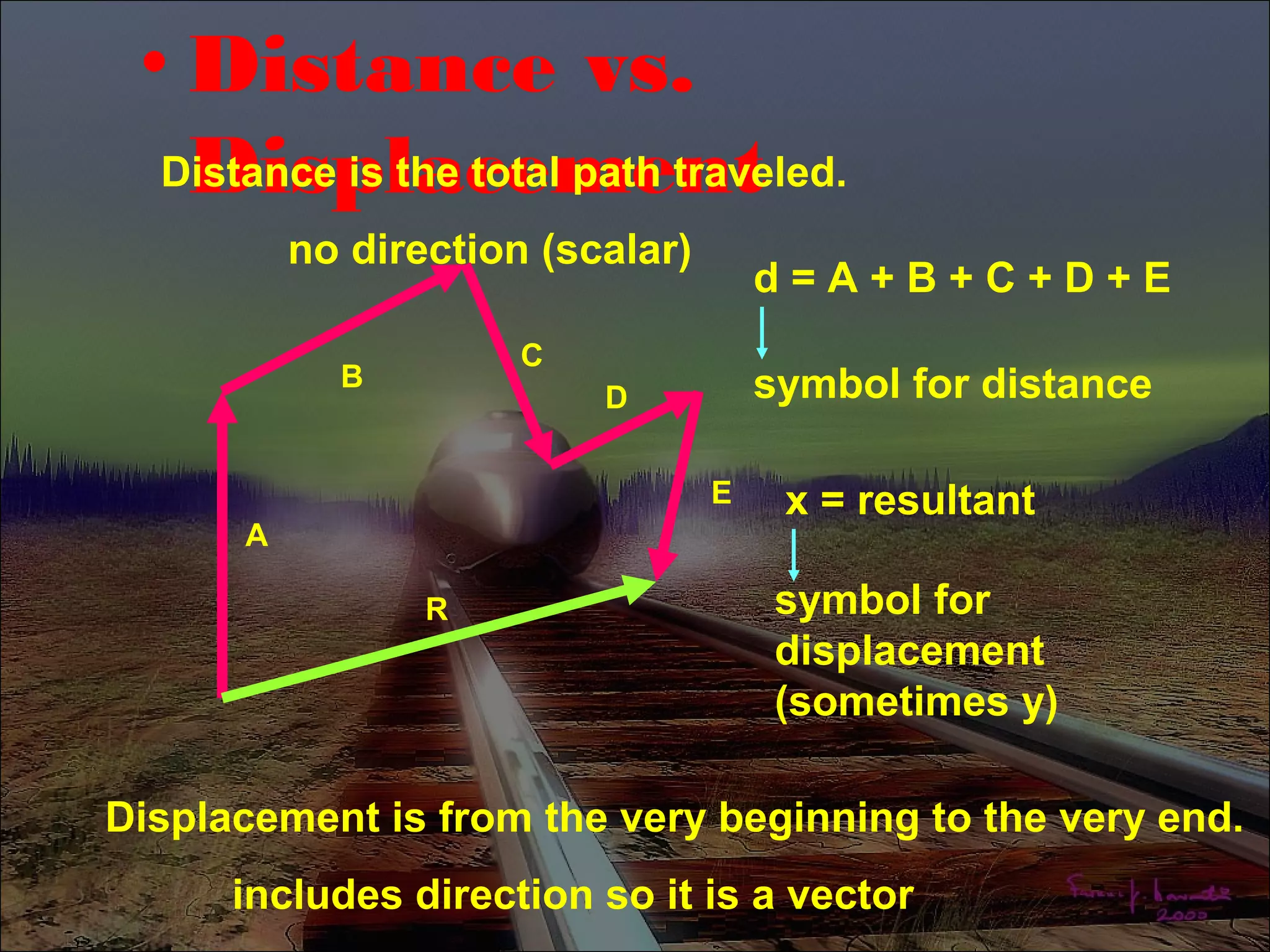
• Distance vs. Displacement
 Distance
   the total path traveled. no direction (scalar)

                                      d=A+B+C+D+E
                      C
           B
                          D           symbol for distance

                                E
      A
                                        x = resultant

                 R                      symbol for
                                        displacement
                                        (sometimes y)
       Displacement
         from the very beginning to the very end.
               includes direction so it is a vector
• Speed vs. Velocity
Speed (s or v)  distance divided by time
                  (no direction, scalar)
Velocity (v)  displacement divided by time (vector)


                  equation measured in
                         x   meters m
                    v=     =       =
                         t   second s
Heather and Matt walk with an average
 velocity of 0.98 m/s eastward. If it takes
 them 34 min to walk to the store, what is
 their displacement?
Step 1: Draw a picture.
Step 2: Write out givens.
        Givens:
         v = 0.98 m/s 60 s
         t = 34 min x      = 2040 s
                      1min
Step 3: Convert units if necessary
Step 4: Write out equation. x = v t
Step 5: Substitute.          x = (0.98)(2040)
Step 6: Solve.
                             x = 2000 m
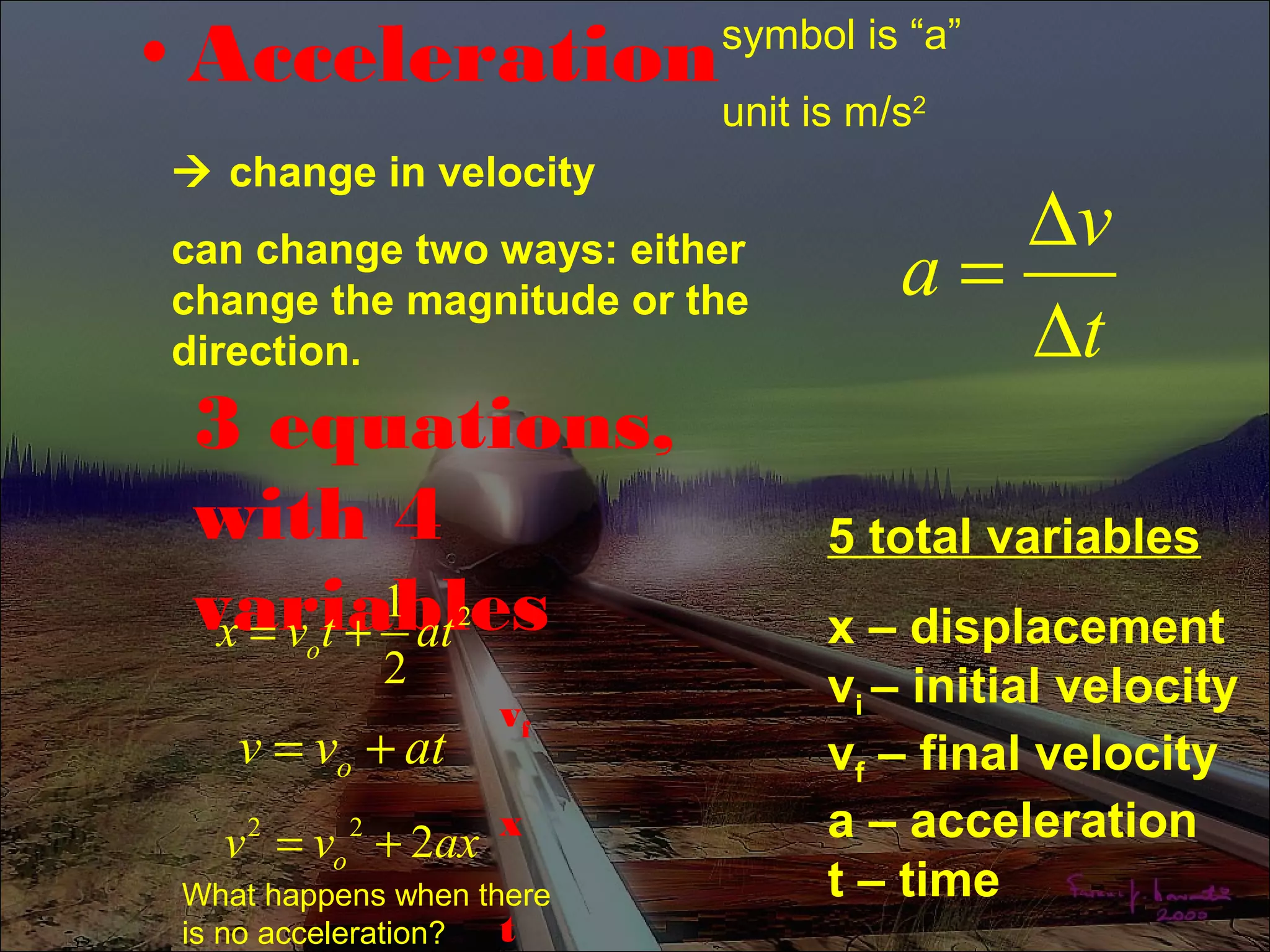
• Acceleration
 change in velocity
  How fast you change how fast you’re going
can change two ways: either change the symbol is “a”
magnitude or the direction.
                                       unit is m/s2
 3 equations,
 with 4                            5 total variables
 variables 1
  x = v t + at
       i
                   2               x – displacement
               2                   vi – initial velocity
                       vf
  v f = vi + at                    vf – final velocity
                       x           a – acceleration
 v f = vi + 2ax
   2       2
                                   t – time
                       t
A sailboat starts from rest and
accelerates at a rate of 0.21 m/s2 over
a distance of 280 m.
a. find the magnitude of       b. find the time it takes
   the boat’s final velocity      the boat to travel
                                  this distance.

1D Kinematics Notes

  • 1.
    An airplane isflying 160 m/s at 76°. If the wind is blowing 43.6 m/s at 136°, find the velocity the plane will actually fly in. (In other words…find the resultant of the following vectors:) G = 160 m/s @ 76° Gx = 160 cos 76 = 38.7 m/s Gy = 160 sin 76 = 155 m/s H = 43.6 m/s @ 136° Hx = 43.6 cos 136 = -31.4 m/s Hy = 43.6 sin 136 = 30.3 m/s xtot = 7.3 m/s ytot = 185.3 m/s R = 7.3 + 185.3 = 185m / s 2 2  185.3  θ = tan  −1 ÷ = 87.7°  7.3 
  • 3.
    • Distance vs.Displacement Distance  the total path traveled. no direction (scalar) d=A+B+C+D+E C B D symbol for distance E A x = resultant R symbol for displacement (sometimes y) Displacement  from the very beginning to the very end. includes direction so it is a vector
  • 4.
    • Speed vs.Velocity Speed (s or v)  distance divided by time (no direction, scalar) Velocity (v)  displacement divided by time (vector) equation measured in x meters m v= = = t second s
  • 5.
    Heather and Mattwalk with an average velocity of 0.98 m/s eastward. If it takes them 34 min to walk to the store, what is their displacement? Step 1: Draw a picture. Step 2: Write out givens. Givens: v = 0.98 m/s 60 s t = 34 min x = 2040 s 1min Step 3: Convert units if necessary Step 4: Write out equation. x = v t Step 5: Substitute. x = (0.98)(2040) Step 6: Solve. x = 2000 m
  • 7.
    • Acceleration  changein velocity How fast you change how fast you’re going can change two ways: either change the symbol is “a” magnitude or the direction. unit is m/s2 3 equations, with 4 5 total variables variables 1 x = v t + at i 2 x – displacement 2 vi – initial velocity vf v f = vi + at vf – final velocity x a – acceleration v f = vi + 2ax 2 2 t – time t
  • 8.
    A sailboat startsfrom rest and accelerates at a rate of 0.21 m/s2 over a distance of 280 m. a. find the magnitude of b. find the time it takes the boat’s final velocity the boat to travel this distance.