Physics
 Study of Matter and Energy
• The goal of physics is to use a
small number of basic concepts,
equations, and assumptions to
describe the physical world.
• These physics principles can then be
used to make predictions about a
broad range of phenomena.
Physics discoveries often turn out to
have unexpected practical
applications, and advances in
technology can in turn lead to new
physics discoveries.
The Branches of Physics
The Scientific Method
• There is no single
procedure that
scientists follow in their
work. However, there
are certain steps
common to all good
scientific investigations.
• These steps are called
the scientific method.
Numbers as Measurements
• In SI, the standard measurement system for
science, there are seven base units.
• Each base unit describes a single dimension,
such as length, mass, or time.
• Derived units are formed by combining the
seven base units with multiplication or division.
For example, speeds are typically expressed in
units of meters per second (m/s).
Other Units/Definitions You
Should Know
Volume (liter, l, cm3
) How much space an object
takes up
Weight (Newton’s, N)  How gravity affects your
mass
Density (g/cm3
)  Mass per unit volume D = M/V
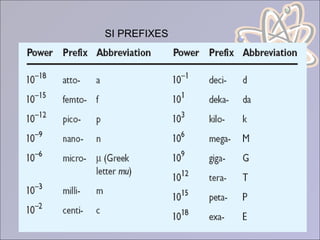
SI PREFIXES
Common Conversions you
should know
1in = 2.54 cm
5280 ft = 1 mile
3ft = 1 yd
.621 mi = 1 km
1 hour = 3600 seconds
Sample Problem
A typical bacterium has a mass of about 2.0 fg.
Express this measurement in terms of grams
and kilograms.
Given:
mass = 2.0 fg
Unknown:
mass = ? g mass = ? kg
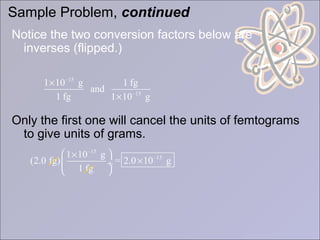
Sample Problem, continued
Notice the two conversion factors below are
inverses (flipped.)
Only the first one will cancel the units of femtograms
to give units of grams.
–15
–15
1 10 g 1 fg
and
1 fg 1 10 g
×
×
–15
–151 10 g
(2.0 fg) = 2.0 10 g
1 fg
 ×
× ÷
 
Sample Problem, continued
Take the previous answer, and use a
similar process to cancel the units of
grams to give units of kilograms.
–15 –18
3
1 kg
(2.0 10 g) = 2.0 10 kg
1 10 g
 
× × ÷
× 
Graphing
• Independent variable  you control (x-axis)
• Dependent variable  depends on the ind. (y-axis)
10 points on graphs
1. Title y vs x (dependent vs independent)
2/3 Label both axis correctly
4/5 Units on axis
6/7 Scale for both axis even
8 Dots with circle in correct place
9 Best fit line
10 Ruler
Inertia Balance Lab
• Inertia  the property of matter that opposes
any change in its state of motion
(mass is a measure of inertia)
• Amplitude  the distance the object travels
away from the equilibrium
• Period  The time for one complete back and
forth swing. (T=# of s/# of vibrations)

Ch1 - review notes

  • 1.
    Physics  Study ofMatter and Energy • The goal of physics is to use a small number of basic concepts, equations, and assumptions to describe the physical world. • These physics principles can then be used to make predictions about a broad range of phenomena. Physics discoveries often turn out to have unexpected practical applications, and advances in technology can in turn lead to new physics discoveries.
  • 2.
  • 3.
  • 4.
    The Scientific Method •There is no single procedure that scientists follow in their work. However, there are certain steps common to all good scientific investigations. • These steps are called the scientific method.
  • 5.
    Numbers as Measurements •In SI, the standard measurement system for science, there are seven base units. • Each base unit describes a single dimension, such as length, mass, or time. • Derived units are formed by combining the seven base units with multiplication or division. For example, speeds are typically expressed in units of meters per second (m/s).
  • 6.
    Other Units/Definitions You ShouldKnow Volume (liter, l, cm3 ) How much space an object takes up Weight (Newton’s, N)  How gravity affects your mass Density (g/cm3 )  Mass per unit volume D = M/V
  • 7.
  • 8.
    Common Conversions you shouldknow 1in = 2.54 cm 5280 ft = 1 mile 3ft = 1 yd .621 mi = 1 km 1 hour = 3600 seconds
  • 9.
    Sample Problem A typicalbacterium has a mass of about 2.0 fg. Express this measurement in terms of grams and kilograms. Given: mass = 2.0 fg Unknown: mass = ? g mass = ? kg
  • 10.
    Sample Problem, continued Noticethe two conversion factors below are inverses (flipped.) Only the first one will cancel the units of femtograms to give units of grams. –15 –15 1 10 g 1 fg and 1 fg 1 10 g × × –15 –151 10 g (2.0 fg) = 2.0 10 g 1 fg  × × ÷  
  • 11.
    Sample Problem, continued Takethe previous answer, and use a similar process to cancel the units of grams to give units of kilograms. –15 –18 3 1 kg (2.0 10 g) = 2.0 10 kg 1 10 g   × × ÷ × 
  • 12.
    Graphing • Independent variable you control (x-axis) • Dependent variable  depends on the ind. (y-axis) 10 points on graphs 1. Title y vs x (dependent vs independent) 2/3 Label both axis correctly 4/5 Units on axis 6/7 Scale for both axis even 8 Dots with circle in correct place 9 Best fit line 10 Ruler
  • 13.
    Inertia Balance Lab •Inertia  the property of matter that opposes any change in its state of motion (mass is a measure of inertia) • Amplitude  the distance the object travels away from the equilibrium • Period  The time for one complete back and forth swing. (T=# of s/# of vibrations)