A
Brief
History
of
Light
Since the dawn of time…
Up until Sir Isaac Newton, two theories
existed as to the nature of light.
1. Objects emitted “corpuscles” of light
that entered the eye.
2. The eye emitted rays that reflected
off of objects and allowed us to see.
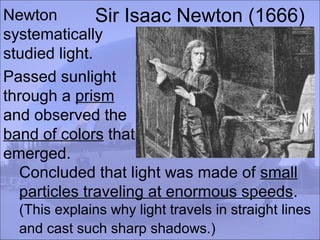
Sir Isaac Newton (1666)Newton
systematically
studied light.
Passed sunlight
through a prism
and observed the
band of colors that
emerged.
Concluded that light was made of small
particles traveling at enormous speeds.
(This explains why light travels in straight lines
and cast such sharp shadows.)
But why don’t the particles collide and
interact when two beams of light
crossed each other?
And, why would one color particle be
bent more than another?
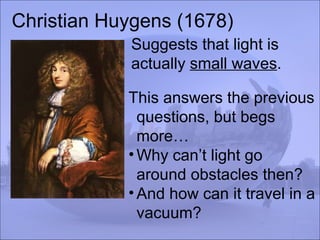
Christian Huygens (1678)
Suggests that light is
actually small waves.
This answers the previous
questions, but begs
more…
•Why can’t light go
around obstacles then?
•And how can it travel in a
vacuum?
Thomas Young, 1801
Passed a beam of
light through two
closely spaced holes.
The light diffracted
demonstrating light is
more wavelike.
Newton vs. Huygens
For 100 Years the argument went on…
Particle vs. Wave
So they had to come up with some
explanations!
Since space is “empty”, there had to be
something else called “ether”.
Properties of ether:
– Has to be everywhere
– More dense than steel
– Anything can move through it with great
ease.
• Ether
– If Earth has ether around it, then Earth would
cause “ether waves” as it travels through it.
(Like a beach ball in a tub.)
– Light going with the ether waves would be
faster. Light going across the waves would
have the same velocity.
– Michelson and Morley, 1887
• Developed interferometer:
– Measures wave speeds.
• What did it show?!?!?!?!
• The speed of light is unchanging!
• Does ether exist then?
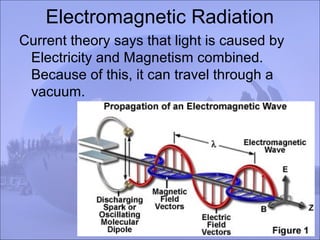
Electromagnetic Radiation
Current theory says that light is caused by
Electricity and Magnetism combined.
Because of this, it can travel through a
vacuum.
Wave - Particle Duality
Light exists as both a wave and a particle at
the same time. It shows itself however
you are looking for it.
If your experiment looks at it like a particle, it
behaves like a particle… and vice versa.
Ch15  - light history

Ch15 - light history

  • 1.
  • 2.
    Since the dawnof time… Up until Sir Isaac Newton, two theories existed as to the nature of light. 1. Objects emitted “corpuscles” of light that entered the eye. 2. The eye emitted rays that reflected off of objects and allowed us to see.
  • 3.
    Sir Isaac Newton(1666)Newton systematically studied light. Passed sunlight through a prism and observed the band of colors that emerged. Concluded that light was made of small particles traveling at enormous speeds. (This explains why light travels in straight lines and cast such sharp shadows.)
  • 4.
    But why don’tthe particles collide and interact when two beams of light crossed each other? And, why would one color particle be bent more than another?
  • 5.
    Christian Huygens (1678) Suggeststhat light is actually small waves. This answers the previous questions, but begs more… •Why can’t light go around obstacles then? •And how can it travel in a vacuum?
  • 6.
    Thomas Young, 1801 Passeda beam of light through two closely spaced holes. The light diffracted demonstrating light is more wavelike. Newton vs. Huygens For 100 Years the argument went on… Particle vs. Wave
  • 7.
    So they hadto come up with some explanations! Since space is “empty”, there had to be something else called “ether”. Properties of ether: – Has to be everywhere – More dense than steel – Anything can move through it with great ease.
  • 8.
    • Ether – IfEarth has ether around it, then Earth would cause “ether waves” as it travels through it. (Like a beach ball in a tub.) – Light going with the ether waves would be faster. Light going across the waves would have the same velocity. – Michelson and Morley, 1887 • Developed interferometer: – Measures wave speeds. • What did it show?!?!?!?! • The speed of light is unchanging! • Does ether exist then?
  • 9.
    Electromagnetic Radiation Current theorysays that light is caused by Electricity and Magnetism combined. Because of this, it can travel through a vacuum.
  • 10.
    Wave - ParticleDuality Light exists as both a wave and a particle at the same time. It shows itself however you are looking for it. If your experiment looks at it like a particle, it behaves like a particle… and vice versa.