General Physics 1/2
Science, Technology, Engineering, and Mathematics
General Physics 2
Science, Technology, Engineering, and Mathematics
Lesson 10.4
Law of Refraction
2
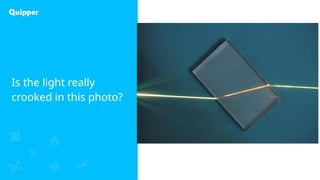
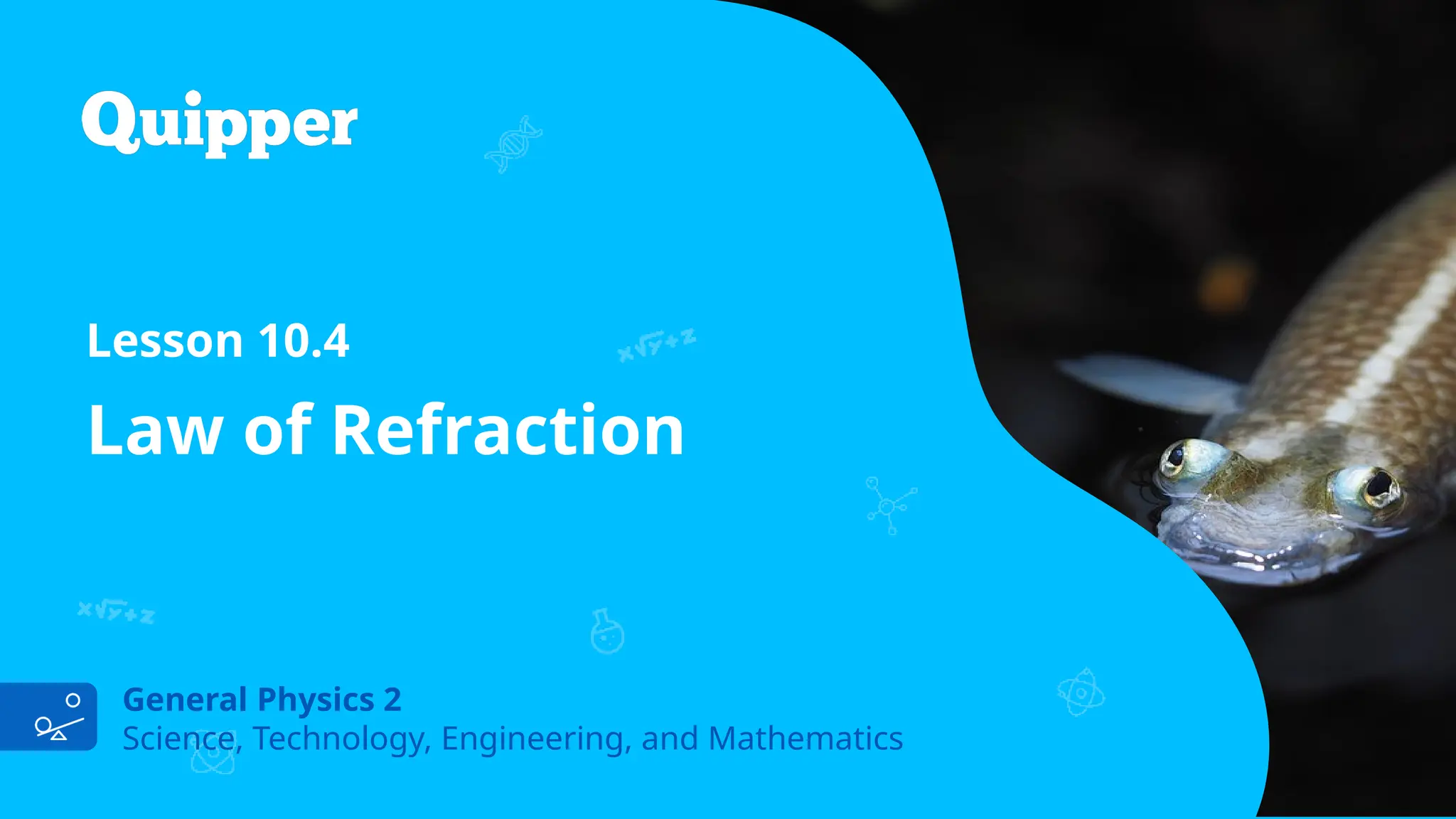
Is the light really
crooked in this photo?
3
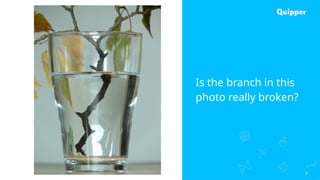
Is the branch in this
photo really broken?
4
Do not let your eyes deceive you. Those are just the
applications of refraction.
In this lesson, we will discuss how light refract.
5
Why does light refract?
Learning Competencies
At the end of the lesson, you should be able to do the
following:
6
● Apply Snell’s Law (STEM-GP12OPTIVb-15).
● Explain the conditions for total internal
reflection (STEM-GP12OPTIVb-14).
Learning Competencies
At the end of the lesson, you should be able to do the
following:
7
● Solve problems involving reflection and
refraction in contexts such as, but not
limited to (polarizing) sunglasses,
atmospheric rainbows, and haloes. (STEM-
GP12OPTIVb-21).
Learning Objectives
At the end of the lesson, you should be able to do the
following:
8
● Infer how the refractive index affects the optical
density of a material.
● Explain how light refracts.
● State Snell’s law.
Learning Objectives
At the end of the lesson, you should be able to do the
following:
9
● Determine the conditions of total internal
reflection.
● Solve problems related to the refraction and total
internal reflection of light.
● Identify applications of refraction and total
internal reflection in daily life.
10
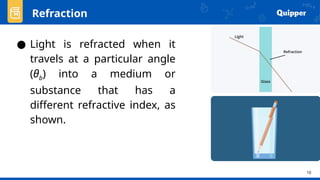
● Light is refracted when it
travels at a particular angle
(θb) into a medium or
substance that has a
different refractive index, as
shown.
Refraction
11
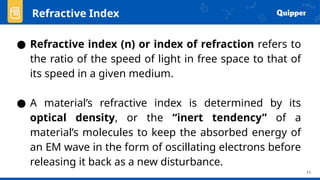
● Refractive index (n) or index of refraction refers to
the ratio of the speed of light in free space to that of
its speed in a given medium.
● A material’s refractive index is determined by its
optical density, or the “inert tendency” of a
material’s molecules to keep the absorbed energy of
an EM wave in the form of oscillating electrons before
releasing it back as a new disturbance.
Refractive Index
12
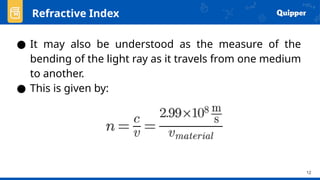
● It may also be understood as the measure of the
bending of the light ray as it travels from one medium
to another.
● This is given by:
Refractive Index
13
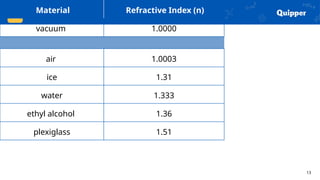
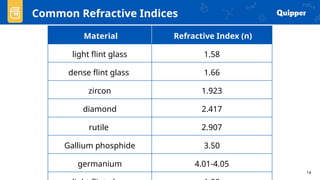
Common Refractive Indices
Material Refractive Index (n)
vacuum 1.0000
air 1.0003
ice 1.31
water 1.333
ethyl alcohol 1.36
plexiglass 1.51
14
Material Refractive Index (n)
light flint glass 1.58
dense flint glass 1.66
zircon 1.923
diamond 2.417
rutile 2.907
Gallium phosphide 3.50
germanium 4.01-4.05
Common Refractive Indices
15
How does a material’s refractive
index affect its optical density?
Remember
16
Optical density must not be confused
with mass density (mass per unit
volume). The more optically dense an
object is, the slower that a wave will
travel through that material.
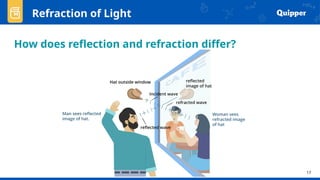
17
How does reflection and refraction differ?
Refraction of Light
18
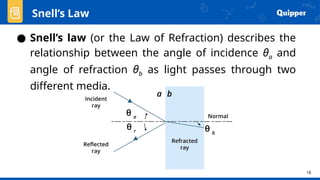
● Snell’s law (or the Law of Refraction) describes the
relationship between the angle of incidence θa and
angle of refraction θb as light passes through two
different media.
Snell’s Law
19
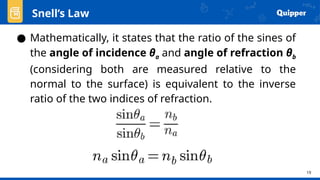
● Mathematically, it states that the ratio of the sines of
the angle of incidence θa and angle of refraction θb
(considering both are measured relative to the
normal to the surface) is equivalent to the inverse
ratio of the two indices of refraction.
Snell’s Law
20
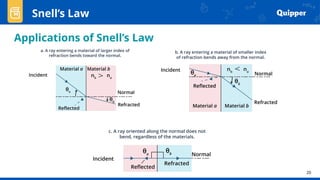
Applications of Snell’s Law
Snell’s Law
21
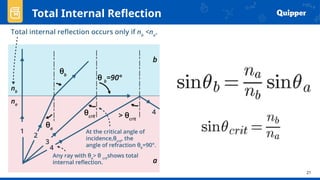
Total Internal Reflection
Remember
22
Total internal reflection happens
when a light ray from a material (a) is
incident (or forms an angle of
incidence) on a second material (b) with
a refractive index smaller than that of a,
such that nb> na.
23
Under what conditions does
total internal reflection occurs?
Let’s Practice!
24
The speed of light as it passes through an unknown
material is measured at 2.13 10
✕ 8
m/s. Determine
the material’s index of refraction.
Let’s Practice!
25
The speed of light as it passes through an unknown
material is measured at 2.13 10
✕ 8
m/s. Determine
the material’s index of refraction.
The refractive index of the unknown material is 1.40.
This is the refractive index of a fluoropolymer.
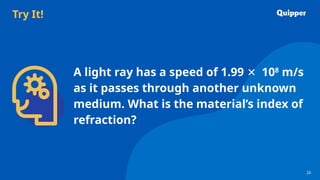
Try It!
26
26
A light ray has a speed of 1.99 ✕ 108
m/s
as it passes through another unknown
medium. What is the material’s index of
refraction?
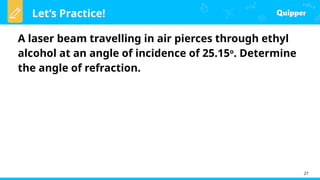
Let’s Practice!
27
A laser beam travelling in air pierces through ethyl
alcohol at an angle of incidence of 25.15o
. Determine
the angle of refraction.
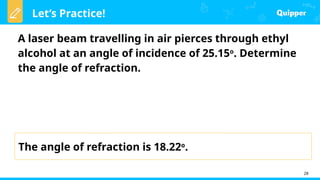
Let’s Practice!
28
A laser beam travelling in air pierces through ethyl
alcohol at an angle of incidence of 25.15o
. Determine
the angle of refraction.
The angle of refraction is 18.22o
.
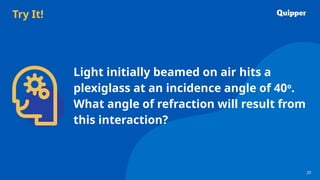
Try It!
29
29
Light initially beamed on air hits a
plexiglass at an incidence angle of 40o
.
What angle of refraction will result from
this interaction?
Let’s Practice!
30
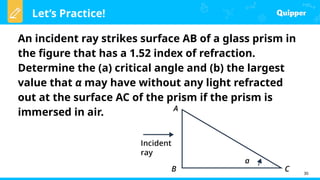
An incident ray strikes surface AB of a glass prism in
the figure that has a 1.52 index of refraction.
Determine the (a) critical angle and (b) the largest
value that α may have without any light refracted
out at the surface AC of the prism if the prism is
immersed in air.
Let’s Practice!
31
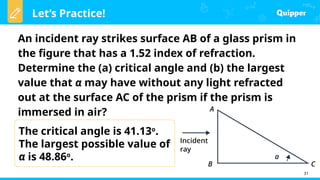
An incident ray strikes surface AB of a glass prism in
the figure that has a 1.52 index of refraction.
Determine the (a) critical angle and (b) the largest
value that α may have without any light refracted
out at the surface AC of the prism if the prism is
immersed in air?
The critical angle is 41.13o
.
The largest possible value of
α is 48.86o
.
Try It!
32
32
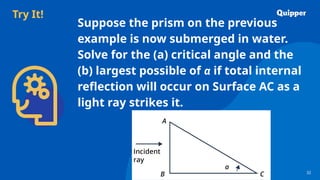
Suppose the prism on the previous
example is now submerged in water.
Solve for the (a) critical angle and the
(b) largest possible of α if total internal
reflection will occur on Surface AC as a
light ray strikes it.
Check Your
Understanding
33
Identify what is being referred to in each of the
following statements.
1. Light is refracted when it travels at a particular angle
into a material that has a ____________________ refractive
index.
2. The refractive index refers to the ratio of the speed of
light in ____________________ to that of its speed in
____________________.
3. Free space has a refractive index of ____________________.
Check Your
Understanding
34
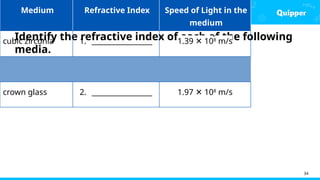
Identify the refractive index of each of the following
media.
Medium Refractive Index Speed of Light in the
medium
cubic zirconia 1. _________________ 1.39 10
✕ 8
m/s
crown glass 2. _________________ 1.97 ✕ 108
m/s
Let’s Sum It Up!
35
● Refraction refers to the bending of light at a
certain angle θb when it passes through a
different medium.
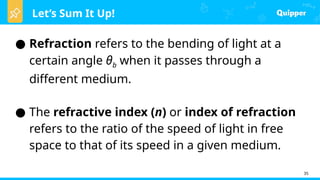
● The refractive index (n) or index of refraction
refers to the ratio of the speed of light in free
space to that of its speed in a given medium.
Let’s Sum It Up!
● A material’s refractive index is determined by its
optical density, or the “sluggish tendency” of a
material’s molecules to keep the absorbed
energy of an EM wave in the form of oscillating
electrons before releasing it back as a new
disturbance.
● Snell’s law (or the Law of Refraction) describes
the relationship between the angle of incidence
θa and angle of refraction θb as light passes 36
Let’s Sum It Up!
● A light ray passing through a material with a
larger refractive index bends toward the normal
to the surface. The opposite holds true. A ray
oriented along the normal will not bend,
regardless of the composition of the medium.
37
Let’s Sum It Up!
● Total internal reflection happens when a light
ray from a material (a) is incident (or forms an
angle of incidence) on a second material (b) with
a refractive index smaller than that of a, such that
nb> na.
38
Key Formulas
39
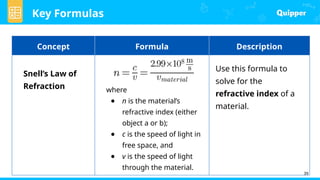
Concept Formula Description
Snell’s Law of
Refraction where
● n is the material’s
refractive index (either
object a or b);
● c is the speed of light in
free space, and
● v is the speed of light
through the material.
Use this formula to
solve for the
refractive index of a
material.
Key Formulas
40
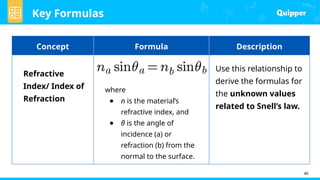
Concept Formula Description
Refractive
Index/ Index of
Refraction
where
● n is the material’s
refractive index, and
● θ is the angle of
incidence (a) or
refraction (b) from the
normal to the surface.
Use this relationship to
derive the formulas for
the unknown values
related to Snell’s law.
Key Formulas
41
Concept Formula Description
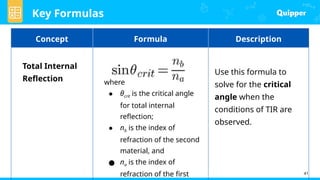
Total Internal
Reflection where
● θcrit is the critical angle
for total internal
reflection;
● nb is the index of
refraction of the second
material, and
● na is the index of
refraction of the first
Use this formula to
solve for the critical
angle when the
conditions of TIR are
observed.
Challenge Yourself
42
42
Can reflection and refraction occur at
the same time from a single
interface? Justify your answer.
Bibliography
43
Faughn, Jerry S. and Raymond A. Serway. Serway’s College Physics (7th ed). Singapore: Brooks/Cole,
2006.
Giancoli, Douglas C. Physics Principles with Applications (7th ed). USA: Pearson Education, 2014.
Halliday, David, Robert Resnick and Kenneth Krane. Fundamentals of Physics (5th ed). USA: Wiley,
2002.
Knight, Randall D. Physics for Scientists and Engineers: A Strategic Approach (4th ed). USA: Pearson
Education, 2017.
Serway, Raymond A. and John W. Jewett, Jr. Physics for Scientists and Engineers with Modern Physics (9th
ed). USA: Brooks/Cole, 2014.
Walker, James S. Physics (5th ed). USA: Pearson Education, 2017.
Young, Hugh D., Roger A. Freedman, and A. Lewis Ford. Sears and Zemansky’s University Physics with
Modern Physics (13th ed). USA: Pearson Education, 2012.

PHYSICS02-11_12-Quarter4-1004-PF-FD.pptx

  • 1.
    General Physics 1/2 Science,Technology, Engineering, and Mathematics General Physics 2 Science, Technology, Engineering, and Mathematics Lesson 10.4 Law of Refraction
  • 2.
    2 Is the lightreally crooked in this photo?
  • 3.
    3 Is the branchin this photo really broken?
  • 4.
    4 Do not letyour eyes deceive you. Those are just the applications of refraction. In this lesson, we will discuss how light refract.
  • 5.
  • 6.
    Learning Competencies At theend of the lesson, you should be able to do the following: 6 ● Apply Snell’s Law (STEM-GP12OPTIVb-15). ● Explain the conditions for total internal reflection (STEM-GP12OPTIVb-14).
  • 7.
    Learning Competencies At theend of the lesson, you should be able to do the following: 7 ● Solve problems involving reflection and refraction in contexts such as, but not limited to (polarizing) sunglasses, atmospheric rainbows, and haloes. (STEM- GP12OPTIVb-21).
  • 8.
    Learning Objectives At theend of the lesson, you should be able to do the following: 8 ● Infer how the refractive index affects the optical density of a material. ● Explain how light refracts. ● State Snell’s law.
  • 9.
    Learning Objectives At theend of the lesson, you should be able to do the following: 9 ● Determine the conditions of total internal reflection. ● Solve problems related to the refraction and total internal reflection of light. ● Identify applications of refraction and total internal reflection in daily life.
  • 10.
    10 ● Light isrefracted when it travels at a particular angle (θb) into a medium or substance that has a different refractive index, as shown. Refraction
  • 11.
    11 ● Refractive index(n) or index of refraction refers to the ratio of the speed of light in free space to that of its speed in a given medium. ● A material’s refractive index is determined by its optical density, or the “inert tendency” of a material’s molecules to keep the absorbed energy of an EM wave in the form of oscillating electrons before releasing it back as a new disturbance. Refractive Index
  • 12.
    12 ● It mayalso be understood as the measure of the bending of the light ray as it travels from one medium to another. ● This is given by: Refractive Index
  • 13.
    13 Common Refractive Indices MaterialRefractive Index (n) vacuum 1.0000 air 1.0003 ice 1.31 water 1.333 ethyl alcohol 1.36 plexiglass 1.51
  • 14.
    14 Material Refractive Index(n) light flint glass 1.58 dense flint glass 1.66 zircon 1.923 diamond 2.417 rutile 2.907 Gallium phosphide 3.50 germanium 4.01-4.05 Common Refractive Indices
  • 15.
    15 How does amaterial’s refractive index affect its optical density?
  • 16.
    Remember 16 Optical density mustnot be confused with mass density (mass per unit volume). The more optically dense an object is, the slower that a wave will travel through that material.
  • 17.
    17 How does reflectionand refraction differ? Refraction of Light
  • 18.
    18 ● Snell’s law(or the Law of Refraction) describes the relationship between the angle of incidence θa and angle of refraction θb as light passes through two different media. Snell’s Law
  • 19.
    19 ● Mathematically, itstates that the ratio of the sines of the angle of incidence θa and angle of refraction θb (considering both are measured relative to the normal to the surface) is equivalent to the inverse ratio of the two indices of refraction. Snell’s Law
  • 20.
  • 21.
  • 22.
    Remember 22 Total internal reflectionhappens when a light ray from a material (a) is incident (or forms an angle of incidence) on a second material (b) with a refractive index smaller than that of a, such that nb> na.
  • 23.
    23 Under what conditionsdoes total internal reflection occurs?
  • 24.
    Let’s Practice! 24 The speedof light as it passes through an unknown material is measured at 2.13 10 ✕ 8 m/s. Determine the material’s index of refraction.
  • 25.
    Let’s Practice! 25 The speedof light as it passes through an unknown material is measured at 2.13 10 ✕ 8 m/s. Determine the material’s index of refraction. The refractive index of the unknown material is 1.40. This is the refractive index of a fluoropolymer.
  • 26.
    Try It! 26 26 A lightray has a speed of 1.99 ✕ 108 m/s as it passes through another unknown medium. What is the material’s index of refraction?
  • 27.
    Let’s Practice! 27 A laserbeam travelling in air pierces through ethyl alcohol at an angle of incidence of 25.15o . Determine the angle of refraction.
  • 28.
    Let’s Practice! 28 A laserbeam travelling in air pierces through ethyl alcohol at an angle of incidence of 25.15o . Determine the angle of refraction. The angle of refraction is 18.22o .
  • 29.
    Try It! 29 29 Light initiallybeamed on air hits a plexiglass at an incidence angle of 40o . What angle of refraction will result from this interaction?
  • 30.
    Let’s Practice! 30 An incidentray strikes surface AB of a glass prism in the figure that has a 1.52 index of refraction. Determine the (a) critical angle and (b) the largest value that α may have without any light refracted out at the surface AC of the prism if the prism is immersed in air.
  • 31.
    Let’s Practice! 31 An incidentray strikes surface AB of a glass prism in the figure that has a 1.52 index of refraction. Determine the (a) critical angle and (b) the largest value that α may have without any light refracted out at the surface AC of the prism if the prism is immersed in air? The critical angle is 41.13o . The largest possible value of α is 48.86o .
  • 32.
    Try It! 32 32 Suppose theprism on the previous example is now submerged in water. Solve for the (a) critical angle and the (b) largest possible of α if total internal reflection will occur on Surface AC as a light ray strikes it.
  • 33.
    Check Your Understanding 33 Identify whatis being referred to in each of the following statements. 1. Light is refracted when it travels at a particular angle into a material that has a ____________________ refractive index. 2. The refractive index refers to the ratio of the speed of light in ____________________ to that of its speed in ____________________. 3. Free space has a refractive index of ____________________.
  • 34.
    Check Your Understanding 34 Identify therefractive index of each of the following media. Medium Refractive Index Speed of Light in the medium cubic zirconia 1. _________________ 1.39 10 ✕ 8 m/s crown glass 2. _________________ 1.97 ✕ 108 m/s
  • 35.
    Let’s Sum ItUp! 35 ● Refraction refers to the bending of light at a certain angle θb when it passes through a different medium. ● The refractive index (n) or index of refraction refers to the ratio of the speed of light in free space to that of its speed in a given medium.
  • 36.
    Let’s Sum ItUp! ● A material’s refractive index is determined by its optical density, or the “sluggish tendency” of a material’s molecules to keep the absorbed energy of an EM wave in the form of oscillating electrons before releasing it back as a new disturbance. ● Snell’s law (or the Law of Refraction) describes the relationship between the angle of incidence θa and angle of refraction θb as light passes 36
  • 37.
    Let’s Sum ItUp! ● A light ray passing through a material with a larger refractive index bends toward the normal to the surface. The opposite holds true. A ray oriented along the normal will not bend, regardless of the composition of the medium. 37
  • 38.
    Let’s Sum ItUp! ● Total internal reflection happens when a light ray from a material (a) is incident (or forms an angle of incidence) on a second material (b) with a refractive index smaller than that of a, such that nb> na. 38
  • 39.
    Key Formulas 39 Concept FormulaDescription Snell’s Law of Refraction where ● n is the material’s refractive index (either object a or b); ● c is the speed of light in free space, and ● v is the speed of light through the material. Use this formula to solve for the refractive index of a material.
  • 40.
    Key Formulas 40 Concept FormulaDescription Refractive Index/ Index of Refraction where ● n is the material’s refractive index, and ● θ is the angle of incidence (a) or refraction (b) from the normal to the surface. Use this relationship to derive the formulas for the unknown values related to Snell’s law.
  • 41.
    Key Formulas 41 Concept FormulaDescription Total Internal Reflection where ● θcrit is the critical angle for total internal reflection; ● nb is the index of refraction of the second material, and ● na is the index of refraction of the first Use this formula to solve for the critical angle when the conditions of TIR are observed.
  • 42.
    Challenge Yourself 42 42 Can reflectionand refraction occur at the same time from a single interface? Justify your answer.
  • 43.
    Bibliography 43 Faughn, Jerry S.and Raymond A. Serway. Serway’s College Physics (7th ed). Singapore: Brooks/Cole, 2006. Giancoli, Douglas C. Physics Principles with Applications (7th ed). USA: Pearson Education, 2014. Halliday, David, Robert Resnick and Kenneth Krane. Fundamentals of Physics (5th ed). USA: Wiley, 2002. Knight, Randall D. Physics for Scientists and Engineers: A Strategic Approach (4th ed). USA: Pearson Education, 2017. Serway, Raymond A. and John W. Jewett, Jr. Physics for Scientists and Engineers with Modern Physics (9th ed). USA: Brooks/Cole, 2014. Walker, James S. Physics (5th ed). USA: Pearson Education, 2017. Young, Hugh D., Roger A. Freedman, and A. Lewis Ford. Sears and Zemansky’s University Physics with Modern Physics (13th ed). USA: Pearson Education, 2012.