Huygens' principle states that each point on a wavefront can be seen as a source of secondary wavelets. The interference of these wavelets determines the shape of subsequent wavefronts as the wave propagates. Interference occurs when two waves superimpose, resulting in areas of constructive and destructive interference where wave amplitudes add or cancel. Constructive interference occurs when the path difference between waves is an integer multiple of the wavelength, while destructive interference requires an odd integer multiple. Beats are heard when tones of similar frequencies interfere, with the beat frequency equal to the difference between the frequencies.
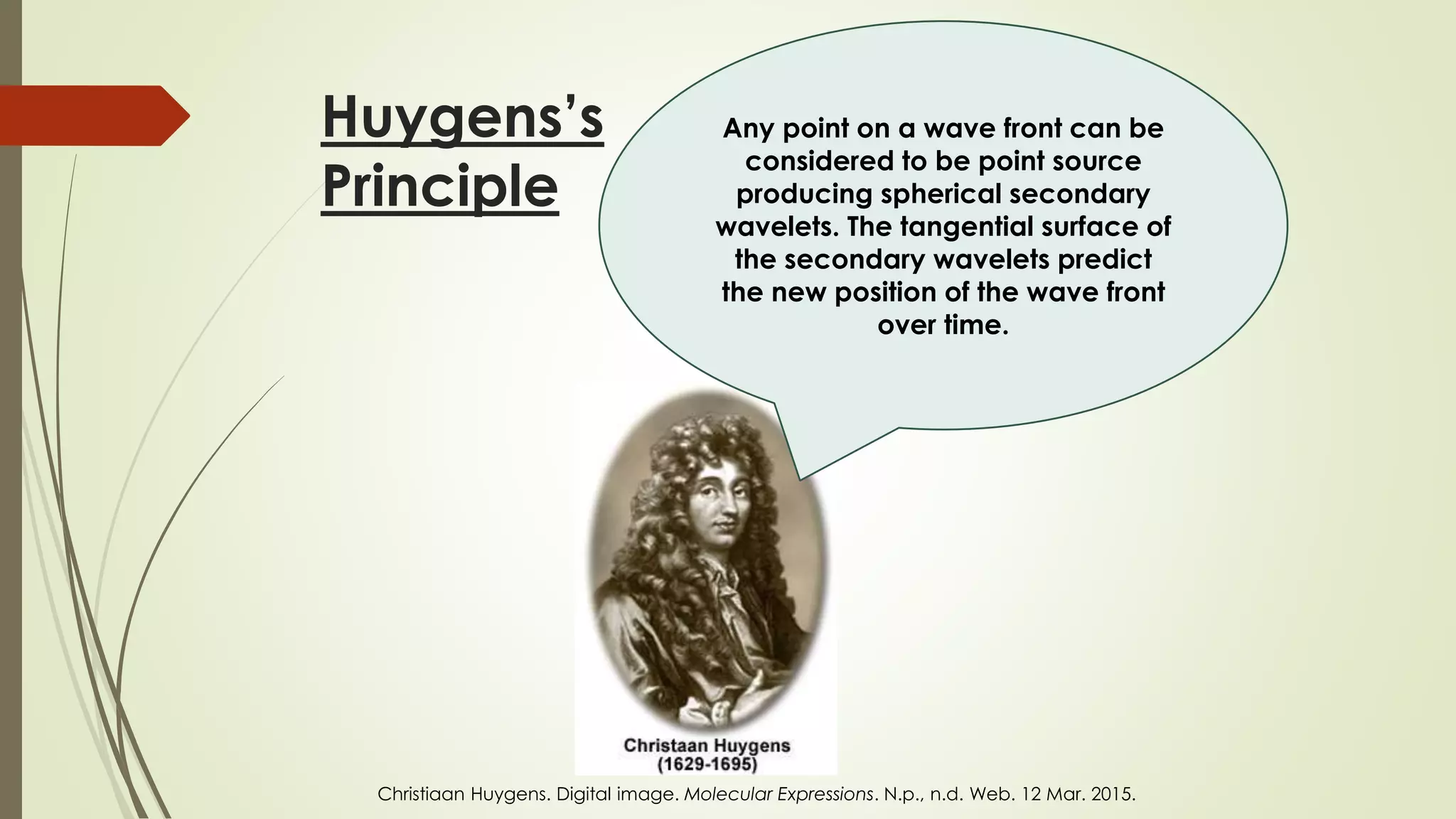
Huygens’s
Principle
Any point ona wave front can be
considered to be point source
producing spherical secondary
wavelets. The tangential surface of
the secondary wavelets predict
the new position of the wave front
over time.
Christiaan Huygens. Digital image. Molecular Expressions. N.p., n.d. Web. 12 Mar. 2015.
3.
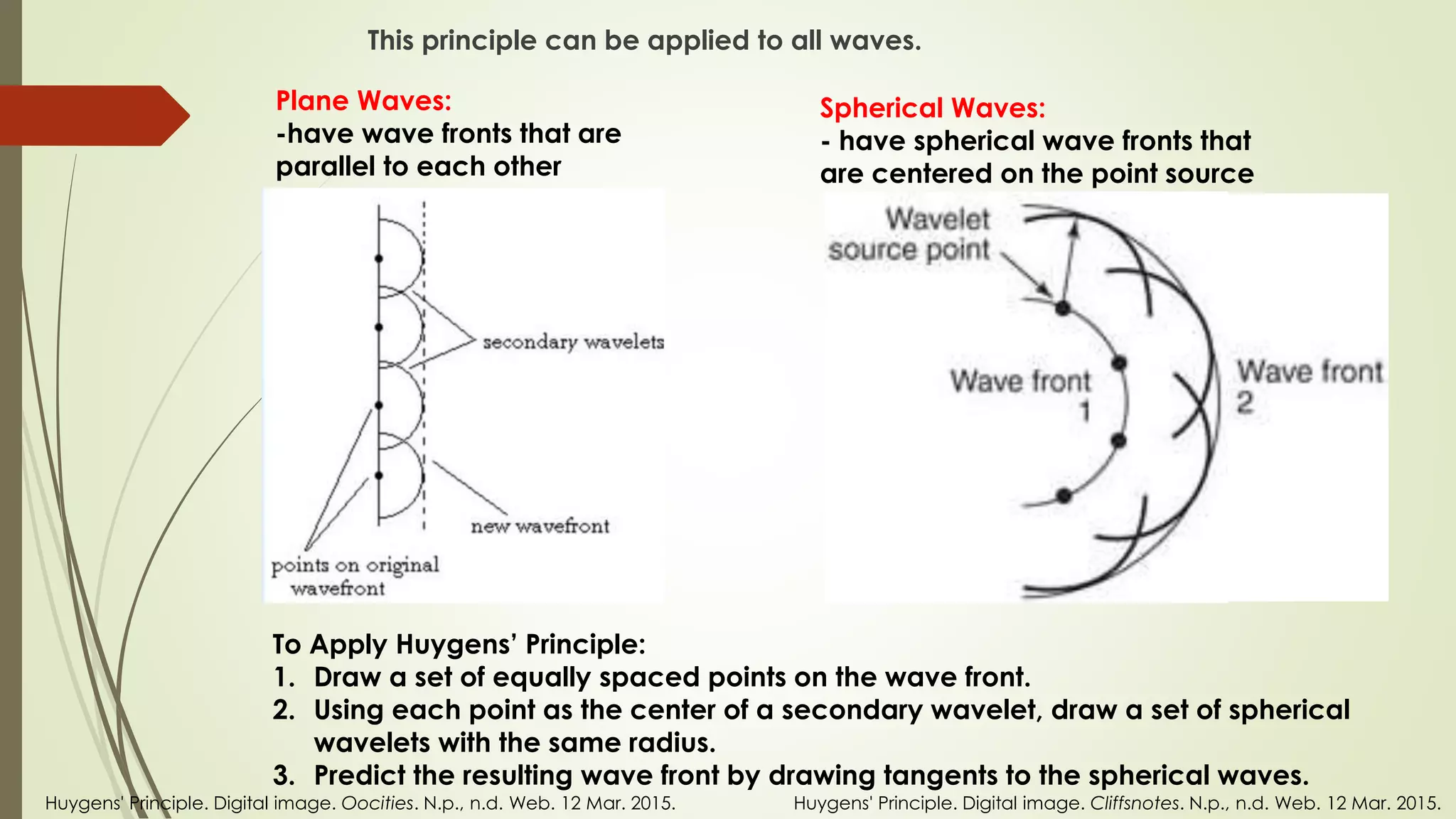
This principle canbe applied to all waves.
Plane Waves:
-have wave fronts that are
parallel to each other
Spherical Waves:
- have spherical wave fronts that
are centered on the point source
To Apply Huygens’ Principle:
1. Draw a set of equally spaced points on the wave front.
2. Using each point as the center of a secondary wavelet, draw a set of spherical
wavelets with the same radius.
3. Predict the resulting wave front by drawing tangents to the spherical waves.
Huygens' Principle. Digital image. Oocities. N.p., n.d. Web. 12 Mar. 2015. Huygens' Principle. Digital image. Cliffsnotes. N.p., n.d. Web. 12 Mar. 2015.
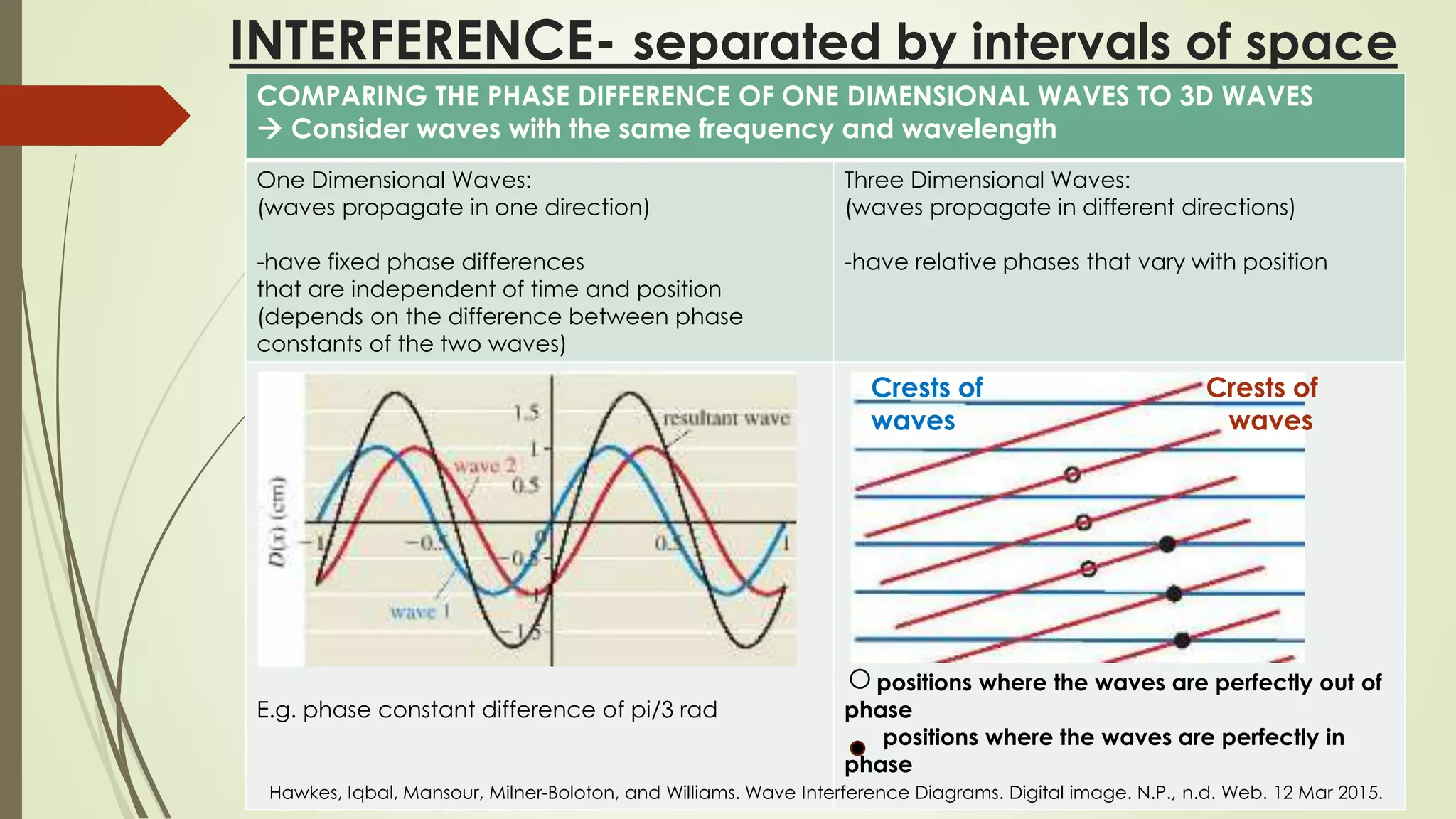
INTERFERENCE- separated byintervals of space
COMPARING THE PHASE DIFFERENCE OF ONE DIMENSIONAL WAVES TO 3D WAVES
Consider waves with the same frequency and wavelength
One Dimensional Waves:
(waves propagate in one direction)
-have fixed phase differences
that are independent of time and position
(depends on the difference between phase
constants of the two waves)
Three Dimensional Waves:
(waves propagate in different directions)
-have relative phases that vary with position
E.g. phase constant difference of pi/3 rad
positions where the waves are perfectly out of
phase
positions where the waves are perfectly in
phase
Crests of
waves
Crests of
waves
Hawkes, Iqbal, Mansour, Milner-Boloton, and Williams. Wave Interference Diagrams. Digital image. N.P., n.d. Web. 12 Mar 2015.
6.
Interference is aphenomenon in which two
waves superimpose to form a resultant
wave of greater or lower amplitude
7.
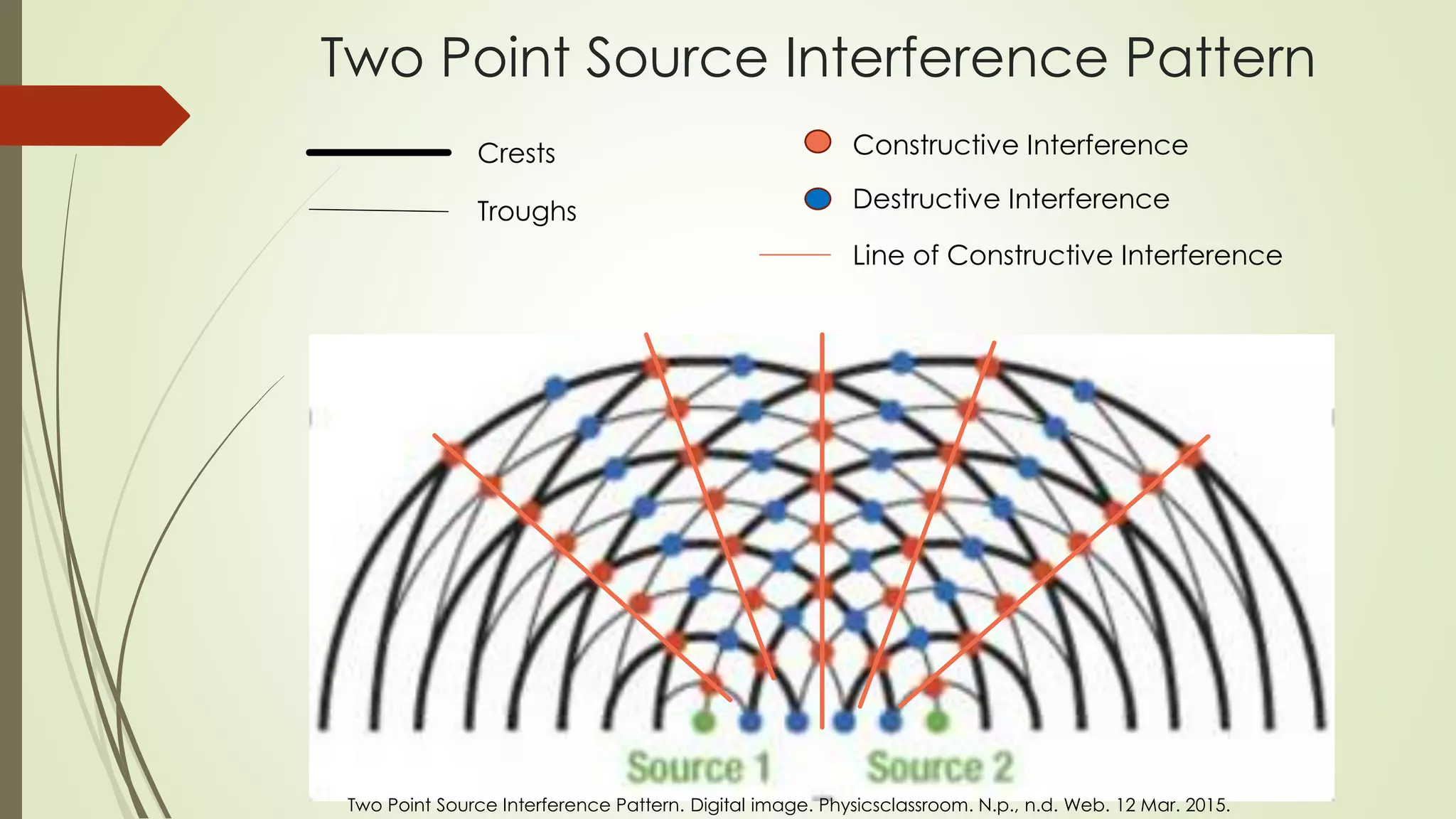
Two Point SourceInterference Pattern
Crests
Troughs
Constructive Interference
Destructive Interference
Line of Constructive Interference
Two Point Source Interference Pattern. Digital image. Physicsclassroom. N.p., n.d. Web. 12 Mar. 2015.
8.
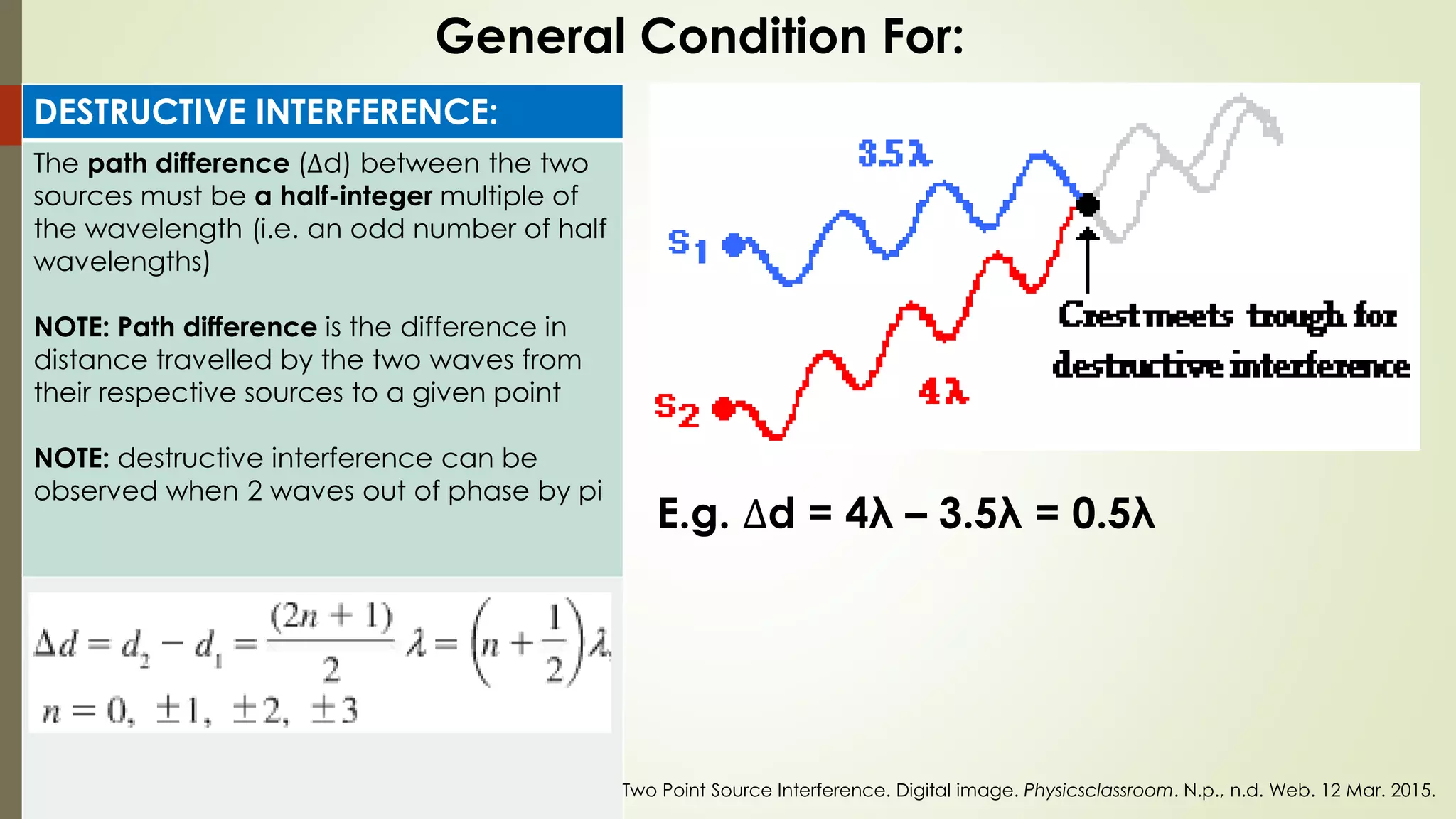
DESTRUCTIVE INTERFERENCE:
The pathdifference (∆d) between the two
sources must be a half-integer multiple of
the wavelength (i.e. an odd number of half
wavelengths)
NOTE: Path difference is the difference in
distance travelled by the two waves from
their respective sources to a given point
NOTE: destructive interference can be
observed when 2 waves out of phase by pi
General Condition For:
E.g. ∆d = 4λ – 3.5λ = 0.5λ
Two Point Source Interference. Digital image. Physicsclassroom. N.p., n.d. Web. 12 Mar. 2015.
9.
General Condition For:
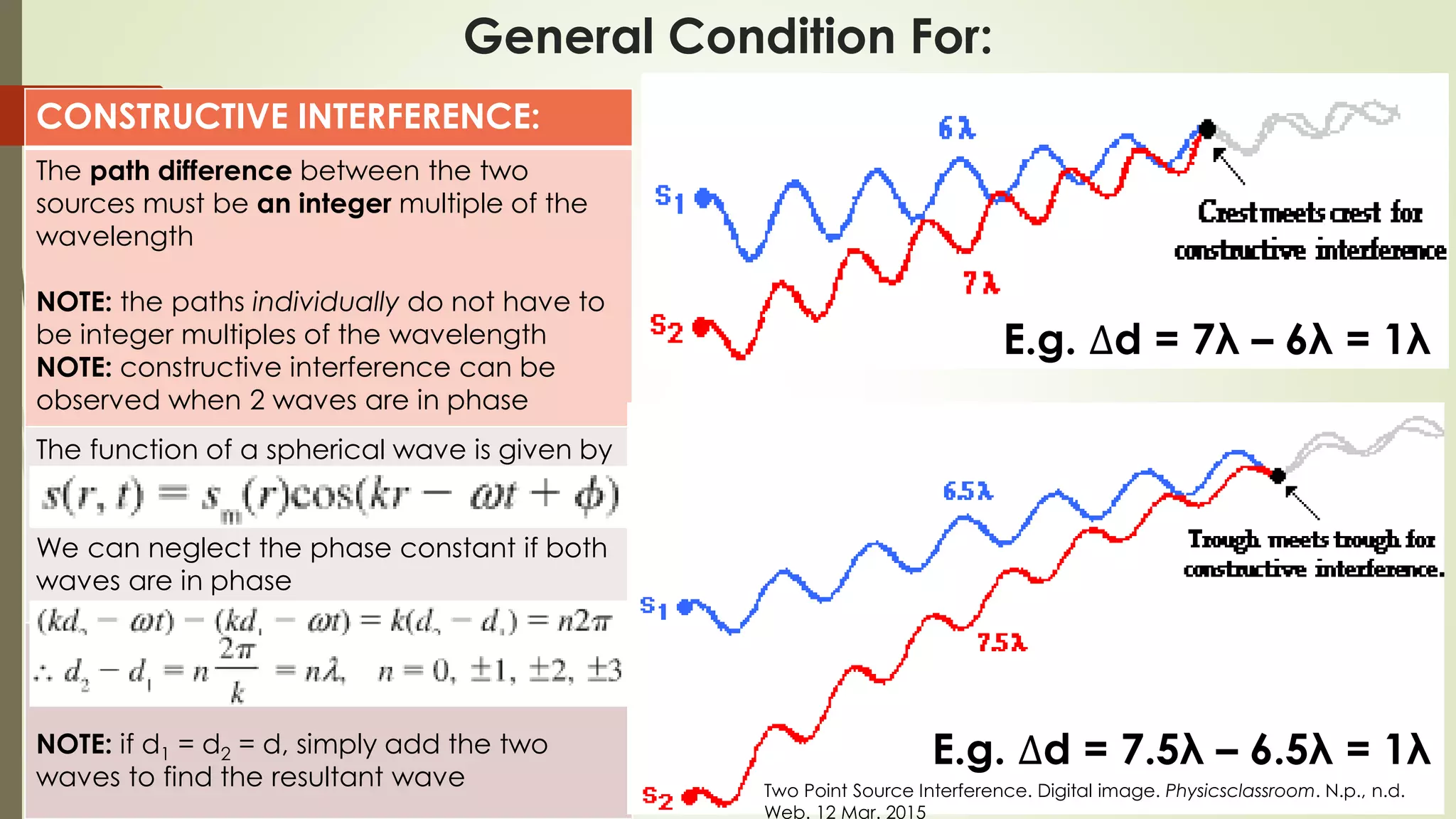
CONSTRUCTIVEINTERFERENCE:
The path difference between the two
sources must be an integer multiple of the
wavelength
NOTE: the paths individually do not have to
be integer multiples of the wavelength
NOTE: constructive interference can be
observed when 2 waves are in phase
The function of a spherical wave is given by
We can neglect the phase constant if both
waves are in phase
NOTE: if d1 = d2 = d, simply add the two
waves to find the resultant wave
E.g. ∆d = 7λ – 6λ = 1λ
E.g. ∆d = 7.5λ – 6.5λ = 1λ
Two Point Source Interference. Digital image. Physicsclassroom. N.p., n.d.
Web. 12 Mar. 2015
10.
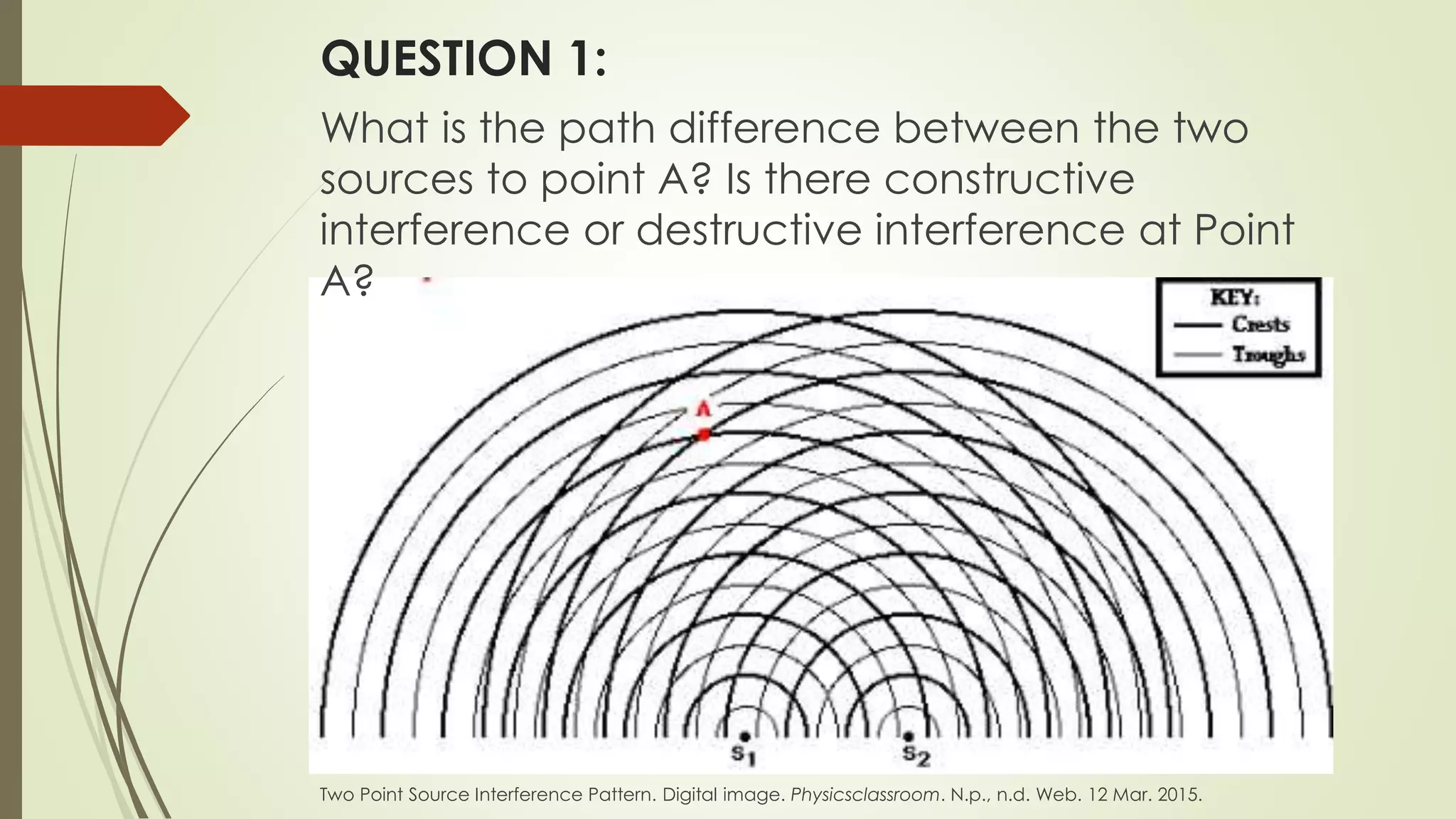
QUESTION 1:
What isthe path difference between the two
sources to point A? Is there constructive
interference or destructive interference at Point
A?
Two Point Source Interference Pattern. Digital image. Physicsclassroom. N.p., n.d. Web. 12 Mar. 2015.
11.
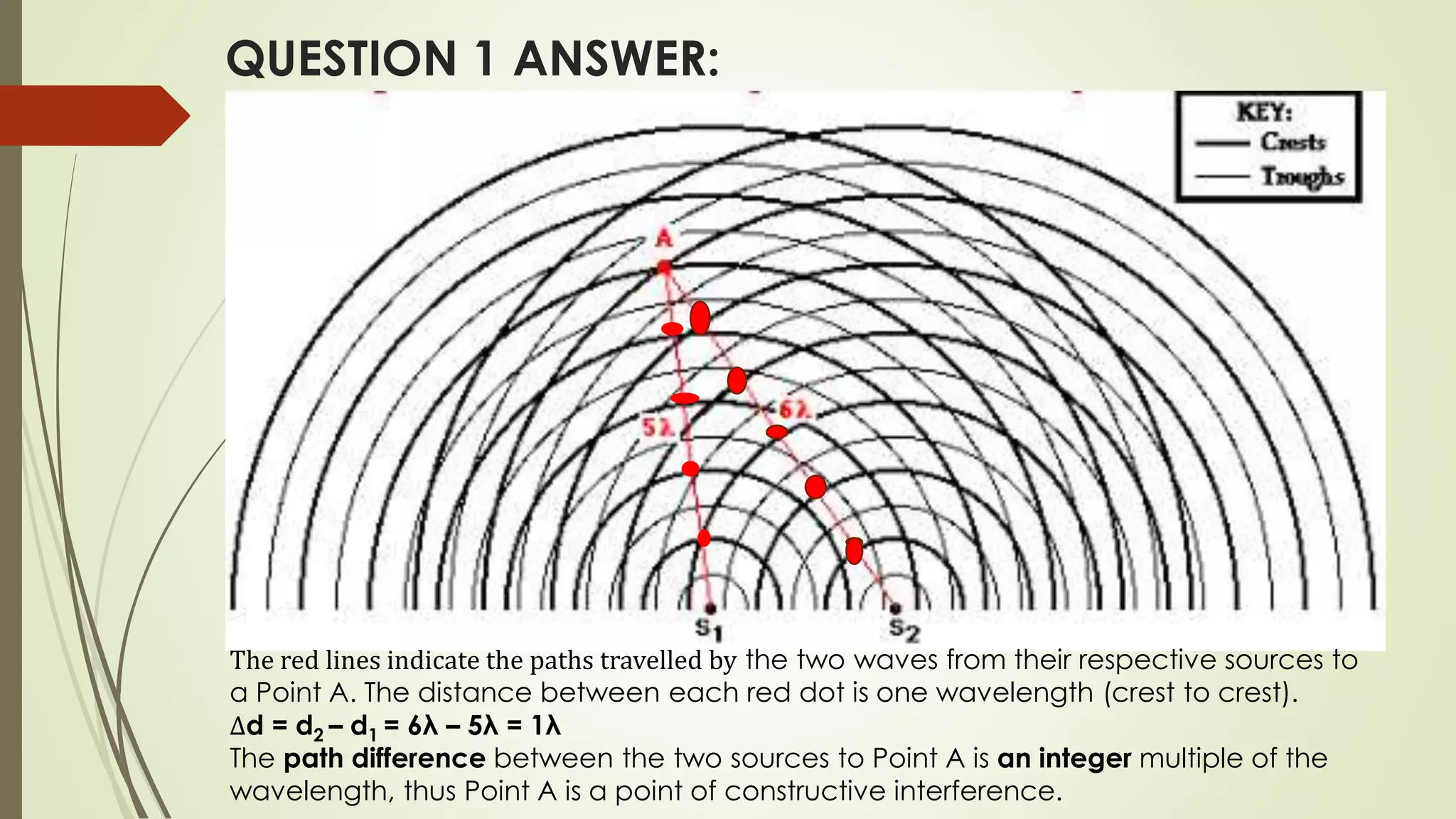
QUESTION 1 ANSWER:
Thered lines indicate the paths travelled by the two waves from their respective sources to
a Point A. The distance between each red dot is one wavelength (crest to crest).
∆d = d2 – d1 = 6λ – 5λ = 1λ
The path difference between the two sources to Point A is an integer multiple of the
wavelength, thus Point A is a point of constructive interference.
12.
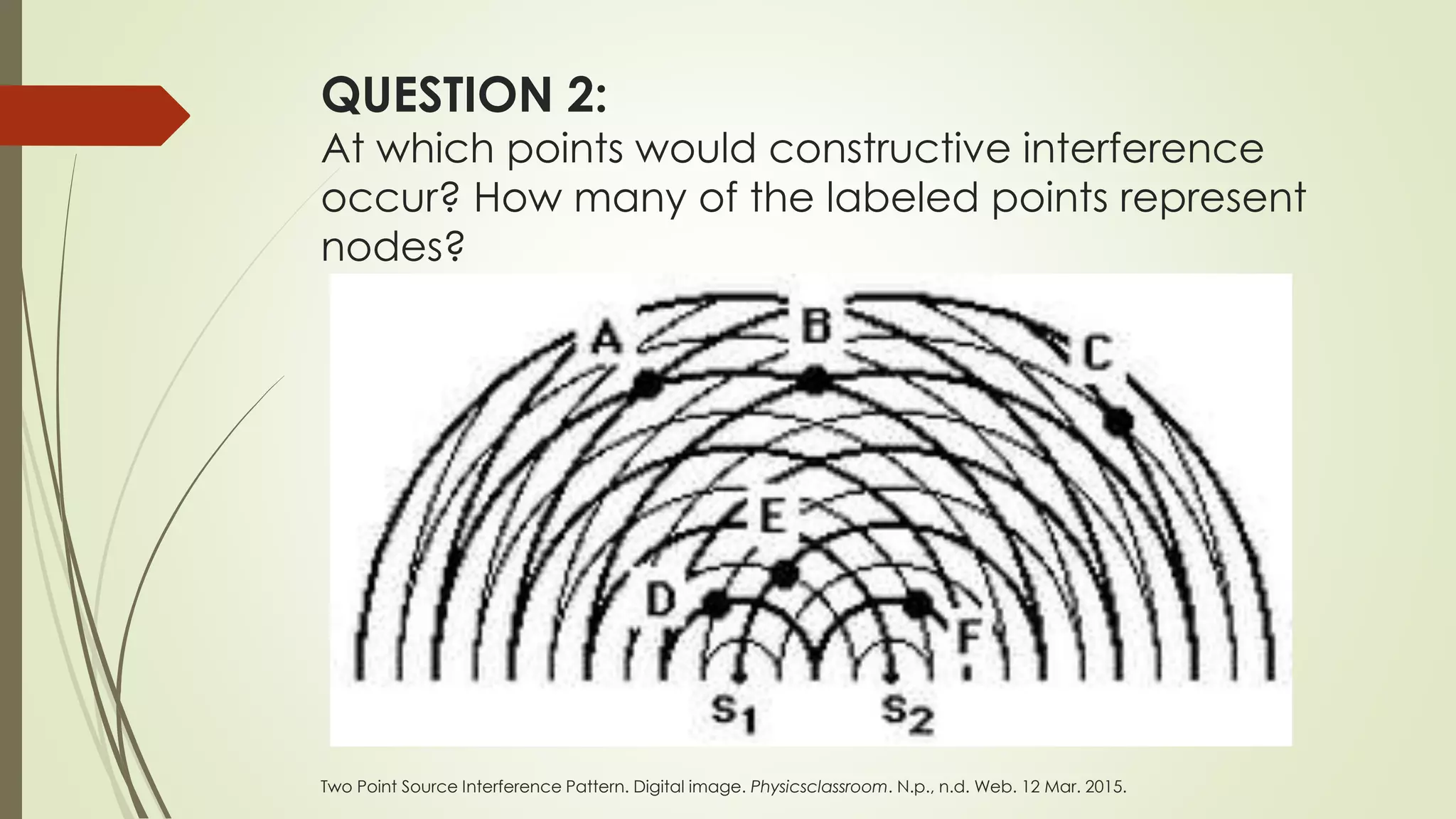
QUESTION 2:
At whichpoints would constructive interference
occur? How many of the labeled points represent
nodes?
Two Point Source Interference Pattern. Digital image. Physicsclassroom. N.p., n.d. Web. 12 Mar. 2015.
13.
QUESTION 2 ANSWER:
Constructiveinterference would occur at
Point A and Point B because both points are
at locations where a crest meets a crest.
Four out of the six points represent nodes.
Points C, D, E and F are points where crests
and troughs meet.
14.
Interference- separated byintervals of time
Beats are periodic fluctuations heard in the
intensity of a sound when two sound waves of
very similar frequencies interfere with one
another
The rate at which amplitude increases and
decreases as a function of time is proportional to
the frequency difference
15.
Beat Frequency:
the rateat which the volume is heard to be
oscillating from high to low volume
E.g. If three complete cycles of high and low
volumes are heard every second, the beat
frequency is 3 Hz.
The beat frequency is equal to the difference in
frequency of the two tones that interfere to
produce beats.
16.
QUESTION 3:
A guitaristplays a 110 Hz tone while his
friend simultaneously plays a tone with a
frequency of 115 Hz. How many beats will
be heard over a period of 15 seconds?
17.
QUESTION 3 ANSWER:
Thebeat frequency is equal to the difference
in frequency of the two tones that interfere to
produce beats.
The beat frequency will be 5 Hz.
( 115 Hz – 110 Hz = 5 Hz )
Thus, in 15 seconds, there should be 75 beats.
( 5 Hz x 15s = 75 beats)


![The Heisenberg Uncertainty Principle[1]](https://cdn.slidesharecdn.com/ss_thumbnails/theheisenberguncertaintyprinciple1-091020215730-phpapp01-thumbnail.jpg?width=640&height=640&fit=bounds)


