SUBMITTED TO:-
Prof.Syed Tazan
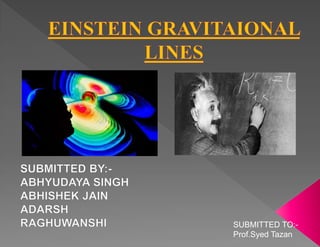
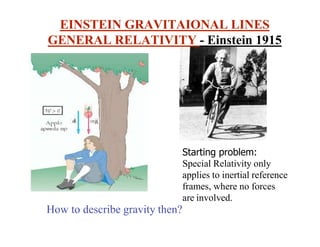
EINSTEIN GRAVITAIONAL LINES
GENERAL RELATIVITY - Einstein 1915
Starting problem:
Special Relativity only
applies to inertial reference
frames, where no forces
are involved.
How to describe gravity then?
Einstein's gravitational waves
‘seen' from black holes
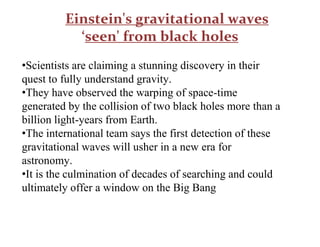
•Scientists are claiming a stunning discovery in their
quest to fully understand gravity.
•They have observed the warping of space-time
generated by the collision of two black holes more than a
billion light-years from Earth.
•The international team says the first detection of these
gravitational waves will usher in a new era for
astronomy.
•It is the culmination of decades of searching and could
ultimately offer a window on the Big Bang
Discovery(By whom & where)
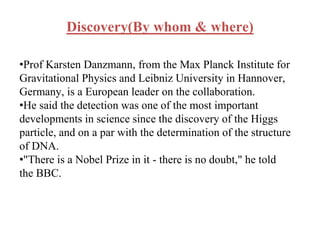
•Prof Karsten Danzmann, from the Max Planck Institute for
Gravitational Physics and Leibniz University in Hannover,
Germany, is a European leader on the collaboration.
•He said the detection was one of the most important
developments in science since the discovery of the Higgs
particle, and on a par with the determination of the structure
of DNA.
•"There is a Nobel Prize in it - there is no doubt," he told
the BBC.
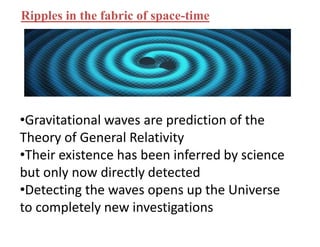
Ripples in the fabric of space-time
•Gravitational waves are prediction of the
Theory of General Relativity
•Their existence has been inferred by science
but only now directly detected
•Detecting the waves opens up the Universe
to completely new investigations
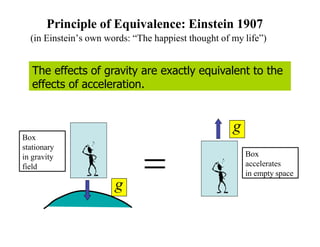
Box
stationary
in gravity
field
Box
accelerates
in empty space
Principle of Equivalence: Einstein 1907
(in Einstein’s own words: “The happiest thought of my life”)
The effects of gravity are exactly equivalent to the
effects of acceleration.
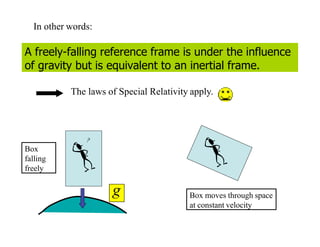
Box
falling
freely
Box moves through space
at constant velocity
In other words:
A freely-falling reference frame is under the influence
of gravity but is equivalent to an inertial frame.
The laws of Special Relativity apply.
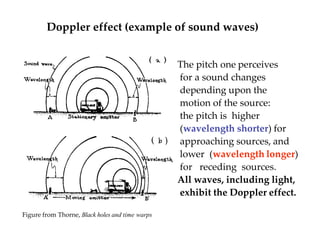
Figure from Thorne, Black holes and time warps
The pitch one perceives
for a sound changes
depending upon the
motion of the source:
the pitch is higher
(wavelength shorter) for
approaching sources, and
lower (wavelength longer)
for receding sources.
All waves, including light,
exhibit the Doppler effect.
Doppler effect (example of sound waves)
Time Dilation in a Gravitational LINES
A thought experiment with flashing
watches shows that time runs slower
at the back of an accelerating space-
ship. The yellow dots represent the
flashes from the watches, and the
spacing between the dots represent
the time between the flashes.
By the equivalence principle,
time must also run slower at
lower altitudes in a gravitational
field.
[Exampleandfiguresfrom“TheCosmicfterspective”,
byBennett et al.]
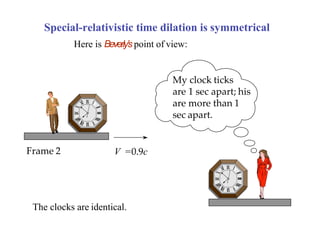
V =0.9cFrame 2
Special-relativistic time dilation is symmetrical
Here is Beverly’s point of view:
My clock ticks
are 1 sec apart; his
are more than 1
sec apart.
The clocks are identical.
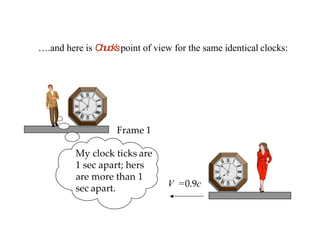
V =0.9c
Frame 1
My clock ticks are
1 sec apart; hers
are more than 1
sec apart.
….and here is Chuck’spoint of view for the same identical clocks:
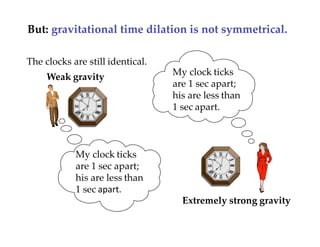
Extremely strong gravity
My clock ticks
are 1 sec apart;
his are less than
1 sec apart.
My clock ticks
are 1 sec apart;
his are less than
1 sec apart.
The clocks are still identical.
Weak gravity
But: gravitational time dilation is not symmetrical.
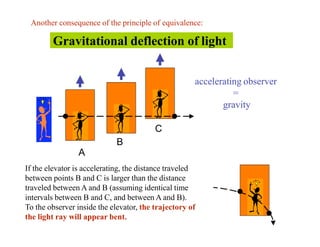
Another consequence of the principle of equivalence:
Gravitational deflection of light
accelerating observer
=
gravity
C
B
A
If the elevator is accelerating, the distance traveled
between points B and C is larger than the distance
traveled between A and B (assuming identical time
intervals between B and C, and between A and B).
To the observer inside the elevator, the trajectory of
the light ray will appear bent.
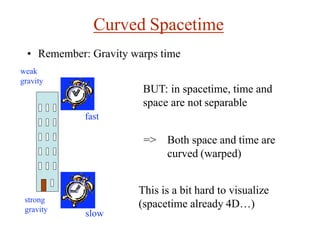
Curved Spacetime
slow
BUT: in spacetime, time and
space are not separable
fast
=> Both space and time are
curved (warped)
This is a bit hard to visualize
(spacetime already 4D…)
• Remember: Gravity warps time
weak
gravity
strong
gravity
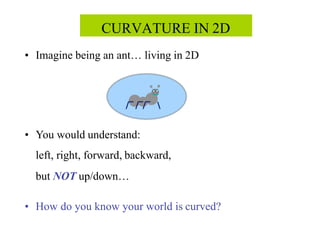
• Imagine being an ant… living in 2D
• You would understand:
left, right, forward, backward,
but NOT up/down…
• How do you know your world is curved?
CURVATURE IN 2D
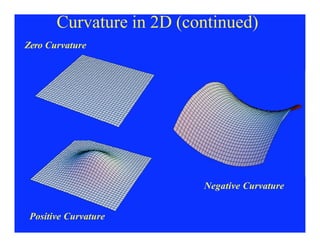
Curvature in 2D (continued)
Zero Curvature
Negative Curvature
Positive Curvature
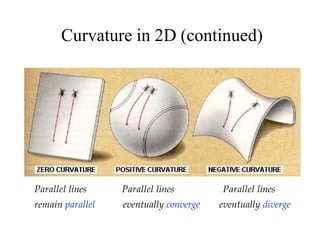
Curvature in 2D (continued)
Parallel lines
remain parallel
Parallel lines
eventually converge
Parallel lines
eventually diverge
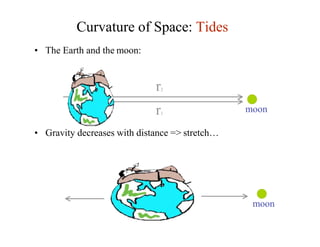
Curvature of Space: Tides
r1
• Gravity decreases with distance => stretch…
• The Earth and the moon:
r2
moon
moon
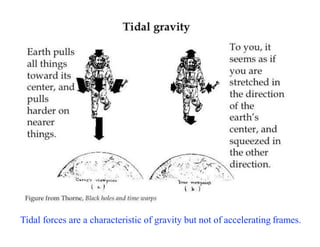
Tidal forces are a characteristic of gravity but not of accelerating frames.
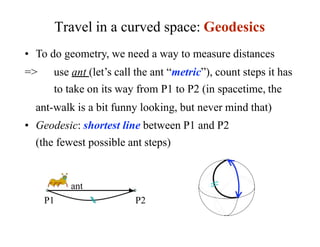
Travel in a curved space: Geodesics
P1 P2
• To do geometry, we need a way to measure distances
=> use ant (let’s call the ant “metric”), count steps it has
to take on its way from P1 to P2 (in spacetime, the
ant-walk is a bit funny looking, but never mind that)
• Geodesic: shortest line between P1 and P2
(the fewest possible ant steps)
ant
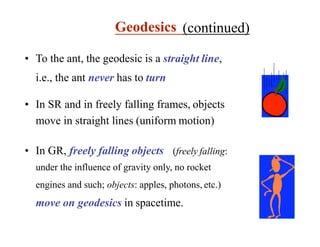
• To the ant, the geodesic is a straight line,
i.e., the ant never has to turn
• In SR and in freely falling frames, objects
move in straight lines (uniform motion)
• In GR, freely falling objects (freely falling:
under the influence of gravity only, no rocket
engines and such; objects: apples, photons, etc.)
move on geodesics in spacetime.
Geodesics (continued)
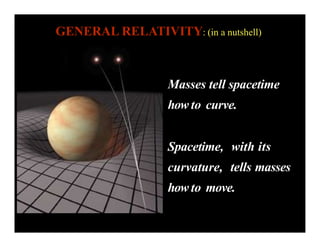
GENERAL RELATIVITY: (in a nutshell)
Masses tell spacetime
how to curve.
Spacetime, with its
curvature, tells masses
how to move.
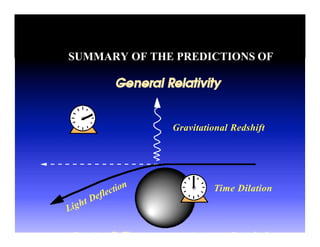
SUMMARY OF THE PREDICTIONS OF
Time Dilation
Gravitational Redshift
Einstein Prediction was Right?
 YES!
 Einstein predicted that if the gravity in an
area was changed suddenly - by an
exploding star, say - waves of gravitational
energy would ripple across the Universe at
light-speed, stretching and squeezing space
as they travelled.
 Although a fantastically small effect, modern
technology has now risen to the challenge.
EINSTEIN'S GRAVITATIONAL LINES

EINSTEIN'S GRAVITATIONAL LINES

  • 1.
  • 2.
    EINSTEIN GRAVITAIONAL LINES GENERALRELATIVITY - Einstein 1915 Starting problem: Special Relativity only applies to inertial reference frames, where no forces are involved. How to describe gravity then?
  • 3.
    Einstein's gravitational waves ‘seen'from black holes •Scientists are claiming a stunning discovery in their quest to fully understand gravity. •They have observed the warping of space-time generated by the collision of two black holes more than a billion light-years from Earth. •The international team says the first detection of these gravitational waves will usher in a new era for astronomy. •It is the culmination of decades of searching and could ultimately offer a window on the Big Bang
  • 4.
    Discovery(By whom &where) •Prof Karsten Danzmann, from the Max Planck Institute for Gravitational Physics and Leibniz University in Hannover, Germany, is a European leader on the collaboration. •He said the detection was one of the most important developments in science since the discovery of the Higgs particle, and on a par with the determination of the structure of DNA. •"There is a Nobel Prize in it - there is no doubt," he told the BBC.
  • 5.
    Ripples in thefabric of space-time •Gravitational waves are prediction of the Theory of General Relativity •Their existence has been inferred by science but only now directly detected •Detecting the waves opens up the Universe to completely new investigations
  • 6.
    Box stationary in gravity field Box accelerates in emptyspace Principle of Equivalence: Einstein 1907 (in Einstein’s own words: “The happiest thought of my life”) The effects of gravity are exactly equivalent to the effects of acceleration.
  • 7.
    Box falling freely Box moves throughspace at constant velocity In other words: A freely-falling reference frame is under the influence of gravity but is equivalent to an inertial frame. The laws of Special Relativity apply.
  • 8.
    Figure from Thorne,Black holes and time warps The pitch one perceives for a sound changes depending upon the motion of the source: the pitch is higher (wavelength shorter) for approaching sources, and lower (wavelength longer) for receding sources. All waves, including light, exhibit the Doppler effect. Doppler effect (example of sound waves)
  • 9.
    Time Dilation ina Gravitational LINES A thought experiment with flashing watches shows that time runs slower at the back of an accelerating space- ship. The yellow dots represent the flashes from the watches, and the spacing between the dots represent the time between the flashes. By the equivalence principle, time must also run slower at lower altitudes in a gravitational field. [Exampleandfiguresfrom“TheCosmicfterspective”, byBennett et al.]
  • 10.
    V =0.9cFrame 2 Special-relativistictime dilation is symmetrical Here is Beverly’s point of view: My clock ticks are 1 sec apart; his are more than 1 sec apart. The clocks are identical.
  • 11.
    V =0.9c Frame 1 Myclock ticks are 1 sec apart; hers are more than 1 sec apart. ….and here is Chuck’spoint of view for the same identical clocks:
  • 12.
    Extremely strong gravity Myclock ticks are 1 sec apart; his are less than 1 sec apart. My clock ticks are 1 sec apart; his are less than 1 sec apart. The clocks are still identical. Weak gravity But: gravitational time dilation is not symmetrical.
  • 13.
    Another consequence ofthe principle of equivalence: Gravitational deflection of light accelerating observer = gravity C B A If the elevator is accelerating, the distance traveled between points B and C is larger than the distance traveled between A and B (assuming identical time intervals between B and C, and between A and B). To the observer inside the elevator, the trajectory of the light ray will appear bent.
  • 14.
    Curved Spacetime slow BUT: inspacetime, time and space are not separable fast => Both space and time are curved (warped) This is a bit hard to visualize (spacetime already 4D…) • Remember: Gravity warps time weak gravity strong gravity
  • 15.
    • Imagine beingan ant… living in 2D • You would understand: left, right, forward, backward, but NOT up/down… • How do you know your world is curved? CURVATURE IN 2D
  • 16.
    Curvature in 2D(continued) Zero Curvature Negative Curvature Positive Curvature
  • 17.
    Curvature in 2D(continued) Parallel lines remain parallel Parallel lines eventually converge Parallel lines eventually diverge
  • 18.
    Curvature of Space:Tides r1 • Gravity decreases with distance => stretch… • The Earth and the moon: r2 moon moon
  • 19.
    Tidal forces area characteristic of gravity but not of accelerating frames.
  • 20.
    Travel in acurved space: Geodesics P1 P2 • To do geometry, we need a way to measure distances => use ant (let’s call the ant “metric”), count steps it has to take on its way from P1 to P2 (in spacetime, the ant-walk is a bit funny looking, but never mind that) • Geodesic: shortest line between P1 and P2 (the fewest possible ant steps) ant
  • 21.
    • To theant, the geodesic is a straight line, i.e., the ant never has to turn • In SR and in freely falling frames, objects move in straight lines (uniform motion) • In GR, freely falling objects (freely falling: under the influence of gravity only, no rocket engines and such; objects: apples, photons, etc.) move on geodesics in spacetime. Geodesics (continued)
  • 22.
    GENERAL RELATIVITY: (ina nutshell) Masses tell spacetime how to curve. Spacetime, with its curvature, tells masses how to move.
  • 23.
    SUMMARY OF THEPREDICTIONS OF Time Dilation Gravitational Redshift
  • 24.
    Einstein Prediction wasRight?  YES!  Einstein predicted that if the gravity in an area was changed suddenly - by an exploding star, say - waves of gravitational energy would ripple across the Universe at light-speed, stretching and squeezing space as they travelled.  Although a fantastically small effect, modern technology has now risen to the challenge.