Dr M.Ranjanee
MD,DM, SCE(Neph),FIMSA,CHS
Sr. Consultant Nephrologist
Apollo Hospitals , Greams Road , Chennai
Anticoagulation for CRRT
Outline
• Why do we change filters? Is everything related to
clotted filters?
• Why do filters/circuits clot?
• Various Anticoagulants available – Actions,
advantages,disadvantages
• Is there a single best anticoagulant?
• Available evidence
• In practice
3
Circuit lifespan: “Host-circuit” determinants
“circuit” factors
• flow rate
• Filtration fraction
• pre-dilution
• catheter size
• anticoagulation
“patient” factors
• primary condition !!
• PT/INR
• platelet count
• haemoglobin
• venous access issues
• blood products use.
Effects of circuit/filter clotting
• Decreased treatment efficacy -(esp. in ALF patients)
• Increased blood loss especially in newborns
• Propensity to increased haemodynamic instability during re-
connection
• Increased costs
• Staff dissatisfaction
6
The Impact of Down- Time and Filter Efficacy on
Delivered Dose of CRRT
Ronco et al. Lancet 356:26-30, 2000
Mehta et al. Kidney Int 60:1154-1163, 2001
Uchino et al. Intensive Care Med 29:575-578, 2000
Kumar et al. IJAO 27:371-379, 2004
J Am Soc Nephrol 21: F-FC172, 2010
- Factors related to premature clotting
patient related
access related
circuit related – FF, De-aeration chamber ,connections
treatment related
where does thrombus form ?
Circuit Connections UCSD
T
o CRRT
machine
qB 100
Patient fluid
replacement
Closed
Normal
Saline
Pt access
Venous Side Connections
From
CRRT
machine
Arterial Side Connections
Circuit –De-aeration Chamber
•Manages air in the return line, works like a vortex to propel all
air out of the blood.
•Post-filter replacement solution is added into the deaeration
chamber on top of the blood.
•Using a minimum of 200 to 500 ml/hr of post filter replacement
will prevent air/blood interface.
•This minimizes clotting and foaming into deaeration chamber.
Maintaining the CRRTcircuitiscrucial for
delivering CRRT effectively
= Qb(1-Hct)
< 0.2
Hemofilter –Prismaflex Specifications
Sets Surface
Area
(m2)
BFR
(ml/min)
DFR
(ml/hr)
Priming
Volume
(ml)
Blood
Volume
(ml)
Max Filtration
Capacity
(ml/hr)
M60* 0.6 50-180 0-4000 1000 93 4000-pre
3000-post
2000-pbp
M100 0.9
75-400 0-8000 1000 152 8000-pre
6000-post
4000-pbp
HF1000 1.15
75-400 0-8000 1000 165
HF1400 1.4 75-400 0-8000 2000 186
*Indicated for patients >11kg
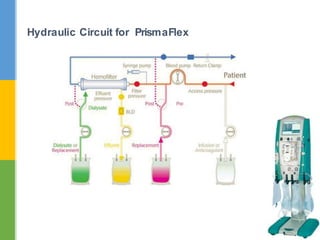
Hydraulic Circuit for PrismaFlex
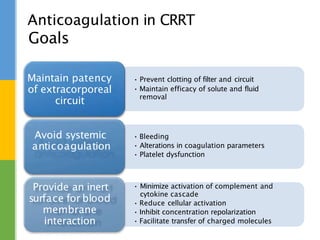
Anticoagulation in CRRT
Goals
• Prevent clotting of filter and circuit
• Maintain efficacy of solute and fluid
removal
• Bleeding
• Alterations in coagulation parameters
• Platelet dysfunction
• Minimize activation of complement and
cytokine cascade
• Reduce cellular activation
• Inhibit concentration repolarization
• Facilitate transfer of charged molecules
Maintain patency
of extracorporeal
circuit
Avoid systemic
anticoagulation
Provide an inert
surface for blood
membrane
interaction
Ideal Anticoagulation
• Readily available
• Safe -Selectively active in the circuit – minimal effects on patient
hemostasis
• Prolonged filter life ideally > 48 hours
• Monitoring – Rapid and Simple
• Rapidly reversible in case of complications
• Uncomplicated ,easy to follow consistently delivered protocols-
Staff training
• Cost Effective
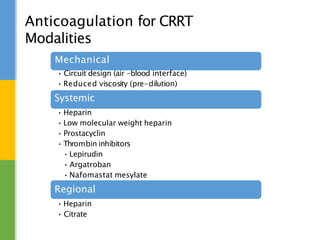
Anticoagulation for CRRT
Modalities
Mechanical
• Circuit design (air -blood interface)
• Reduced viscosity (pre-dilution)
Systemic
• Heparin
• Low molecular weight heparin
• Prostacyclin
• Thrombin inhibitors
• Lepirudin
• Argatroban
• Nafomastat mesylate
Regional
• Heparin
• Citrate
Usually used in patients with intrinsic coagulopathies
such as hepatic failure or low platelet counts
Methods:
•Prime circuit: Saline or Heparin prime
•Intermittent 0.9% NS flush 50-200 ml q 30-
60 mins
Results:
•Rates of filter clotting vary widely
•Mean filter life between 16 -70 hrsif coagulopathic
•Shorter filter life 6 -18 hrs unless severe coagulopathy
No Anticoagulation
Unfractionated Heparin (UFH)
XII -> XIIa = Hagemann
Factor
XI -> XIa
+ Ca
IX -> IXa
+ VIIIa, Ca
X -> Xa = Prothrombin
activator
+ Va, Ca
Prothrombin -> Thrombin
Fibrinogen -> Fibrin + XIIIa -> cross-linked Fibrin
VII -> VIIa
+ Ca
Intrinsic system Extrinsic system
Antithrombin III
• 4.5-6 kDa
• t1/2 2-4 hrs (increased in renal failure)
• Affected by antithrombin deficiency
Unfractionated Heparin
Advantages
• Effective
• Widely available
• Simple monitoring (aPTT)
• Reversedwith Protamine
• Inexpensive
• Short halflife
Disadvantages
• Systemic bleeding( 10-50%)
• Unpredictablekinetics
• PT
Tnotreliable bleeding
predictor
• Heparinresistance due to low
patient antithrombin levels
• Heparin induced
thrombocytopenia (HIT)
(1-5%)
Heparin
UFH Protocol
Dialysate
Effluent
Patient aPTT
<40 sec
Circuit aPT
T, >150 sec
Arterial line
Venous line
Prime with Saline containing heparin 5-10,000 IU
Bolus 2000-5000 IU (25-30 IU/kg)
Continuous infusion 400-700IU/hr
(5-20 IU/kg/hr)
aPTT 34-45 seconds (1.5-2.0 X normal)
Reported circuit patency 20-40 hrs
ACT180-240 sec
Risk Initial Continu Target Platelets PTT Heparin PTT Filter
group loading ous PTT (sec) Require-
ment
(sec) life
dose dose before before during time
IU/kg IU/kg/h CRRT CRRT (IU/h) CRRT (h)
Low risk 50 10 - 20 1.5 – 2x
normal
> 200000 42 > 700 40 23
Moder
a te
risk
15 - 25 10 10 – 15
sec
>
50-
200000
46 100 -
700
45 25
normal
High risk 10 5 - 8 < upper
limit of
< 50000 61 none 50 22
normal
P
Recommended Unfractionated Heparin dose
Heparin
Dialysate
Effluent
Patient aPTT
<40 sec
Circuit aPT
T, >150 sec
Arterial line
Venous line
Reported circuit patency 20-40 hrs
UFH – Protamine Sulfate Regional
Anticoagulation
Advantages
 Anticoagulation effects restricted to
extracorporeal circuit
Disadvantages
 Rebound (instable heparin-
protamine complex)
 Hypotension
 Hypersensitivity
Protamine
ACT180-240 sec
KaplanAA et al. TransAm SocArtif Organs 1987
Van der Voort PH et al. Blood Purif 2005
100 u Heparin = 1 mg Protamine
UFH 1000-1500 U/hr
Protamine 10-12 mg/hr
Heparin Induced Thrombocytopenia (HIT)
Low molecular weight heparin (LMWH)
XII -> XIIa = Hagemann
Factor
XI -> XIa
+ Ca
IX -> IXa
+ VIIIa,
Ca
X -> Xa = Prothrombin
activator
+ Va, Ca
Prothrombin -> Thrombin
Fibrinogen -> Fibrin + XIIIa -> cross-linked Fibrin
VII ->
VIIa
+ Ca
Intrinsic system Extrinsic system
Antithrombin III
more active in inhibiting factor Xa, less with factor IIa
half-life up to 10 hours
monitoring: Measurement of anti-Xa activity (0.3 – 0.5 IU/ml)
LMWH Protocols
Fixed dose vs. dose based on anti- Xa
T
arget anti-
Xa level0.25-0.35U/ml
Nadroparin, Dalteparin
• Loading dose 15-
25IU/kg
• Maintenance dose 5 -10
IU/kg/hr
• Median filterlife 18-
50hrs
Disadvantages
Enoxaparin
• Loading dose 0.15mg/kg
• Maintenance dose 0.05mg/kg/hr
• Mean filterlife 31hrs
Advantages
• Effective
• Predictable pharmacokinetics
• Lower incidence of HIT,lesslipideffect
•Systemic bleeding
• Only partially reversed with protamine
• anti Xa activity not everywhere available
• Expensive
• Pont AC de et al. Crit Care Med 2000
Reeves JH et al. Crit Care Med 1999
Journois D et al.Ann Fr Anesth Reanim 1990
Citrate
XII -> XIIa = Hagemann
Factor
XI -> XIa
+ Ca
IX -> IXa
+ VIIIa,
Ca
X -> Xa = Prothrombin
activator
+ Va, Ca
Prothrombin -> Thrombin
Fibrinogen -> Fibrin + XIIIa -> cross-linked Fibrin
VII ->
VIIa
+ Ca
Intrinsic system Extrinsic system
 Chelates free Ca +2in extracorporeal circuit
 Prevents activation of Ca +2-dependent procoagulants
 Anticoagulant effect measured by iCa +2
 Anticoagulation reversed by Ca +2infusion
Citrate
Normal blood levels of citrate:
0.05 mmol/L
Bleeding time prolonged at
citrate levels of 4 to 6 mmol/L
(iCa 2+ < 0.35 mmol/L)
Levels of 12 to 15 mmol/L
required for stored blood
products for transfusion therapy
Extracorpore al clearance:
•Clearance same asurea
•Sieving coefficient 0.87- 1.0
•CVVH =CVVHD clearance
•Dependson citrate
concentration in the filter and
filtration fraction
Citric acid has plasma half life
of 5 mins
Rapidly metabolized by liver,
kidney and muscle cells
Na3Citrate
+ 3H2CO3
Citric Acid +
3NaHCO3
3H2CO3 + H2O + 3NaHCO3
4H2O + 6CO2
Citrate
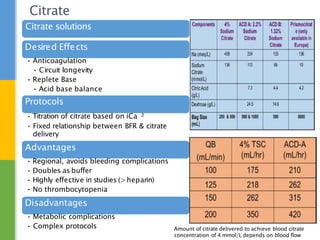
Citrate solutions
Desired Effects
• Anticoagulation
• Circuit longevity
• Replete Base
• Acid base balance
Protocols
• Titration of citrate based on iCa 2
• Fixed relationship between BFR & citrate
delivery
Advantages
• Regional, avoids bleeding complications
• Doubles as buffer
• Highly effective in studies (>heparin)
• No thrombocytopenia
Disadvantages
• Metabolic complications
• Complex protocols Amount of citrate delivered to achieve blood citrate
concentration of 4 mmol/L depends on blood flow
The Citrate-Calcium Complex
Anticoagulation with citrate utilises a process called ‘chelation’
Ca
–
+
+
–
–
Citrate forms a complex with the Ca2+ ions, making them
unavailable as a co-factor within the clotting cascade
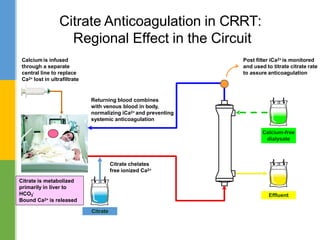
Calcium-free
dialysate
Citrate chelates
free ionized Ca2+
Citrate
Effluent
Post filter iCa2+ is monitored
and used to titrate citrate rate
to assure anticoagulation
Citrate is metabolized
primarily in liver to
HCO -
3
Bound Ca2+ is released
Calcium is infused
through a separate
central line to replace
Ca2+ lost in ultrafiltrate
Returning blood combines
with venous blood in body,
normalizing iCa2+ and preventing
systemic anticoagulation
Citrate Anticoagulation in CRRT:
Regional Effect in the Circuit
Circuit Options for CVVH
Post-
dilution
Citrate
Ca
RF
Pre-
dilution
Citrate-
Based
RF
Ca
Ca
Citrate
Blood flow 120-
200 ml/min
UF 1200-
4000 ml/min
Citrate 15-
40 mmol/L
Targets Systemic Ca 1.12- 1.25mmol/L
Post Filter Ca <0.4 mmol/L
RF
Palsson and Niles, KI, 1999, 55: 1991-1997
Munjal and Ejaz. Nephrology 2006; 11: 405-409
Morabito et al Critical Care 2012.
V
V
QB
Circuit Options for CVVHDF
RF +
Citrate
QR
QD
V
QB
QR
QD
RF
Citrate
RF
Ca
Ca
Mehta et al, KI, 1990 38(5): 976-981.
Tolwani et al. CJASN 2006
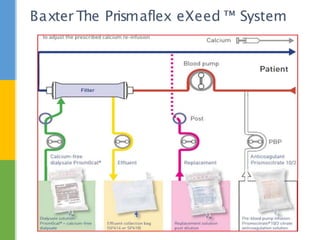
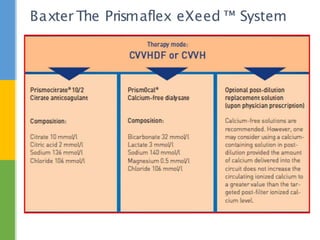
Baxter The Prismaflex eXeed ™ System
Fresenius Ci-Ca system
2
3
4
5
Fluids for Fresenius Ci-Ca®
Therapy
Ci-Ca Dialysates
calcium free, 4 types
4% Sodium Citrate
Contains 136 mmol/L citrate
Calcium Chloride
100 mmol/L
Dialysate solutions for Citrate
Therapy
• Sodium and bicarbonate are reduced to compensate for the systemic
infusion of sodium citrate
• Calcium-free to minimise the citrate requirement
• Slightly increased magnesium as citrate also chelates with
magnesium
Prismocal 140 0 0 0.5 106 32
Fully Integrated Citrate & Calcium Pumps
to Safeguard
Integrated Citrate & Calcium Lines to Safeguard
Page 16
Mechanically Different Citrate & Calcium
Connectors to Safeguard
Colour Coded Connectors to Safeguard
4% TSC 3.2% TSC
(ACD-A)
2%TSC
(ACD-B)
PRISMOCITRATE
18/0
PRISMOCITRATE
10/2
(only Europe)
Na 408 224 135 140 136
K 0 0 0 0
Citrate
(mmol/L)
136 74.8 68 18 10
Citric acid
mmol/L
0 38.1 4.4 0 2
Dextrose
mmol/L
124 14.7 0 0
Chloride 86 106
citrate dose
mmol/L
4 3 3.5
Bag size (ml) 250&500 500&1000 500&1000 5000 5000
Infusion rate 140-220 350 ml/h 1000-2000 1000-2000
Citrate solutions
• Amount of citrate required to anticoagulate one liter of blood.
• Citrate dose is determined by:
 Blood flow rate (in mL/min)
 Citrate solution flow rate (in mL/h)
 Concentration of citrate in the solution (in mmol/L)
Citrate dose for fixed BFR to Citrate
Citrate Dose
Qcitrate x Ccitrate
BFR x60
=
Qcitrate in mL/h
Ccitrate in mmol/L
BFR in mL/min (150 ml/min)
Citrate Dose in mmol/L of blood
3 mmol/L
2250 x12
150 x60
=
2250 mL/h
12 mmol/L
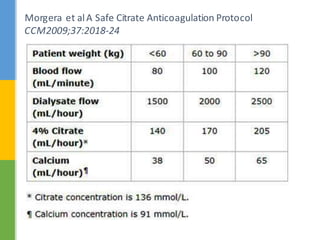
Morgera et alA Safe Citrate Anticoagulation Protocol
CCM2009;37:2018-24
Calcium
solutions for
replacement
1 gm Calcium Gluconate 10 % / 10 ml =4.6 Meq
of calcium
50 ml = 23 Meq of calcium
1 gm Calcium Chloride dihydrate 10% 10 ml
=13.6 meq of calcium
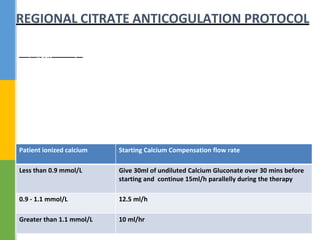
REGIONAL CITRATE ANTICOGULATION PROTOCOL
Pre-requisites:
1.Effluent dose :always below 35 ml / kg / hr (reduce dialysate
and RF acc.)
2.FF: Target Less Than 25%
3.Citrate Dose: 3 mmol/L (Regiocit, Citrate concentration
18mmol/l)
4.Calcium Dilution: 50ml of Calcium Gluconate undiluted in
50ml Syringe
5.Calcium compensation : It’s by Calcium Gluconate
depending on initial patient ionized calcium – see table 1
below.
Initial Calcium Compensation (Manual/External Pump)
Patient ionized calcium Starting Calcium Compensation flow rate
Less than 0.9 mmol/L Give 30ml of undiluted Calcium Gluconate over 30 mins before
starting and continue 15ml/h parallelly during the therapy
0.9 - 1.1 mmol/L 12.5 ml/h
Greater than 1.1 mmol/L 10 ml/hr
Monitoring
Maintaining Dialysis and Blood Flow Rates
• The dialysate to blood flow ratio should be 20:1 (corresponding to a
physical flow ratio of 1.3)
• Ratio adjustment based on acid base disorder
Display During Citrate Anticoagulation
Monitoring Patient
& Post Filter Ca2+
level
High Post Filter Ca
2+
-
>0.50 mmol/l
Normal Post Filter
Ca
2+
-
0.25 - 0.50mmol/l
Low Post Filter Ca
2+
-
<0.25 mmol/l
Low Patient Ca
2+
-
<1.0 mmol/l
Increase Citrate
dose by
0.5 mmol/l
& Increase Calcium
infusion by 5-10%
Increase Calcium
infusion by 5-10%
Decrease Citrate
dose by 0.5 mmol/l
Normal Patient Ca2+
- 1.0-1.2 mmol/l
Increase Citrate
dose by
0.5 mmol/l
NO CHANGE Decrease Citrate
dose by 0.5 mmol/l
High Patient Ca
2+
-
>1.2 mmol/l
Decrease Calcium
infusion by 5-10%
Decrease Calcium
infusion by 5-10%
Decrease Citrate
dose by 0.5 mmol/l
& Decrease Calcium
infusion by 5-10 %
Citrate modification
Calcium
infusion
modification
Calcium Infusion Adjustment
Target patient serum ionized calcium -1.1-1.2
mmol/l
Patient Ionized Ca2+ 10% Calcium Chloride/ Gluconate
0.85-0.94 mmol/L ↑↑ by 10mL/hour+2g Ca Gluconate
0.95-1.04 ↑↑ by 5 mL/hour+1g Ca Gluconate
1.05-1.09 ↑↑ by 5 mL/hour
1.10-1.2 No Change
1.21-1.3 ↓↓ by 5mL/hour
1.31-1.45 ↓↓ by 10mL/hour
>1.45 ↓↓ by 15ml/hour
28
Total calcium to ionized calcium ratio monitoring
High ratio surrogate marker for citrate toxicity
PATIENT TOTAL CALCIUM ÷ PATIENT IONIZED CALCIUM
(Ca mmol/l = Ca (mg/dl) x 0.2495)
Ratio Action
<2.5 Check Ratio Daily
>2.5 Stop Citrate for 20 minutes and restart afterwards with 0.5 mmol/l less
than the previous citrate dose
•Leave Calcium compensation unchanged. This would result in a slightly
higher filter ionized calcium. (0.35 to 0.45 acceptable)
If ratio remains above 2.4 despite post filter iCa of 0.35 – 0.45 mmol/L then consider:
 Doubling baseline dialysate flow (will increase citrate clearance)
 Reducing blood pump speed (will reduce total administered citrate dose)
 Stopping citrate and using an alternative anticoagulant (or no anticoagulant)
Citrate Metabolic Consequences
Metabolic alkalosis
• Citrate overdose/toxicity
Metabolic acidosis
• Citrate toxicity in setting of severe liver disease or
hypoperfusion
Hypernatremia
• Hyperosmolar citrate solutions
Hypocalcemia and hypercalcemia
• Inappropriate calcium supplementation
Hypomagnesemia
Managing an Metabolic Acidosis
• First review the patient, treat any underlying condition and ensure
dialysate dose is appropriate
• Check that the dialysate and blood flow rates are set according to
the protocol
To correct an acidosis either:
• Decrease the dialysate flow (a decrease of 20% will increase
the serum bicarbonate level by approximately 4mmol/L)
or
• Increase the blood flow rate (an increase of 20% to the blood
flow rate will increase the serum bicarbonate level by
approximately 4mmol/L)
• Increase bicarbonate in post filter replacement fluid
Patient Selection
All patients .. but especially
• Patient’s pre- or postoperatively where systemic anticoagulation
may be contraindicated
• Patients with significant coagulopathy – related to sepsis, large
volume transfusion etc.
• Trauma patients with potentially undiagnosed bleeding points
• Patients where surgical wound healing may be
compromised by systemic anticoagulation
• Uremic pericarditis ,severe DM retinopathy
• Patients with profound cardiovascular instability – for whom
highblood flows would be detrimental
Intensive Care Med. 2004 Feb;30(2):260-5. Epub 2003 Nov 5.
Citrate vs. heparin for anticoagulation in continuous venovenous
hemofiltration: a prospective randomized study.
Monchi M1, Berghmans D, Ledoux D, Canivet JL, Dubois B, Damas P.
Regional citrate anticoagulation was
superior to heparin for the filter lifetime
and transfusion requirements in ICU
patients treated with CRRT
• Median filter life : Citrate - 70 hr; Heparin - 40 hr
• Spontaneous circuit failure : Heparin -87%;Citrate- 57%
• Median time to spontaneous circuit failure: Heparin 45 hrs; Citrate -140 hrs
• Transfusion requirement :Citrate- 0.2 units/day of CVVH ; Heparin- 1 units/day
Final Decision – Citrate vs Heparin
Citrate
Heparin
Prostacyclin –PGI2
Vasodilator
Inhibits platelet aggregation and adhesion
Short acting
• Vasodilatorhalflife 2min
• Antiplatelet effect 2hrs
Protocol
• 2-
8 ng/kg/min infused pre-
filter
Disadvantages
• Hypotension, raised ICP, Hyperthermia
• Expensive
Median filter life
• 15-
19hrs
• 20-
22hrswith low dose heparin
Langenecker et al. Crit Care Med 1994
Kozek-Langenecker et al. Crit Care Med 1998
Fiaccadori et al. Int Care Med 2002
Balik et al. Blood Purif 2005
Nafomostat
Synthetic Serine Protease inhibitor prostacyclin analogue
Inhibits platelet aggregation and adhesion
Short acting
•Vasodilatorhalf life 2 min
•Antiplatelet effect 2 hrs
Protocol
•0.1 mg⁄kg⁄hour Infused pre-
filter
Disadvantages
•studies have demonstrated that levels of thrombin –antithrombin III complex and
prothrombin activation fragment 1 +2 increase, while protein C activity decreases,
leading to circuit clotting
•Several side effects (anaphylaxis, agranulocytosis, hyperkalemia)
Median filter life
•15-
19 hrs
•20-
22 hrs with low dose heparin
Platlet sparing effect !
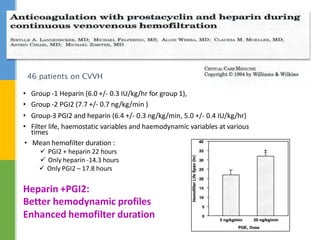
46 patients on CVVH
• Group -1 Heparin (6.0 +/- 0.3 IU/kg/hr for group 1),
• Group -2 PGI2 (7.7 +/- 0.7 ng/kg/min )
• Group-3 PGI2 and heparin (6.4 +/- 0.3 ng/kg/min, 5.0 +/- 0.4 IU/kg/hr)
• Filter life, haemostatic variables and haemodynamic variables at various
times
• Mean hemofilter duration :
 PGI2 + heparin 22 hours
 Only heparin -14.3 hours
 Only PGI2 – 17.8 hours
Heparin +PGI2:
Better hemodynamic profiles
Enhanced hemofilter duration
Acknowledge to A. Deep, KCH, London
Fibrinogen Fibrin
Thrombin
Prothrombin
Xa + Va
X
Tissue Factor-VIIa
Fondiparinux
Idraparinux
Hirudin
Bivalirudin
Argatroban
Ximelagatran
IX IXa
VIIIa
TFPI
NAPc2
FVIIai
APC
Thrombin Inhibitors
Lepirudin (r-Hirudin)
6980 Da
Irreversibly inhibits thrombin
Eliminated by the kidneys
Half life of 1-2 hrs prolonged in renal failure
Monitoring: Ecarin clotting time (ECT)
Protocols
•Continuousinfusion 0.005-0.01 mg/kg/hr
•Or bolusdose 0.002 g/kg
•ECT target 80-100 seconds
Disadvantages
•No antidote!
•ECTnot easily available
Fischer KG et al. Kidney Int 1999
Vargas O et al. Int Care Med 2001
Bivalirudin
Reversibly inhibitsthrombin
80% eliminated by nonorgan- dependent proteolysis
20% excreted unchanged by the kidneys
Half life of 25 min
•Clearance reduced approximately 20% in patients with severe renal impairment
and by 80% in dialysis -dependent patients
•Bivalirudin is hemodialyzable and approximately 25% is cleared by hemodialysis
Protocols
•Continuousinfusion 1 mg/hr (0.009 mg/kg/h)
•aPT
Ttarget 1-1.4 timesbaseline
Disadvantages
•Limited studies
•1 RCT2010:
•10 pts randomized to bivalirudin ( 2 mg/hr) vs. heparin (400 u/hr)
•Hemofilter survival time was significantly increased in patients receiving bivalirudin
vs. those receiving heparin (29.6 ±20.7 vs. 16.5 ±13.6 hrs, p=0.045)
Kiser et al. Pharmacotherapy. 2010
Mueller et al. Annals of Pharm. 2009
Kisere et al. Annals of Pharm. 2008
Argatroban
Second generation direct thrombin inhibitor
526 Da
54% protein bound
½-
life 35-
51 min
Metabolized by the liver
Dose
• Loading dose 100-
250 µg/kg
• Maintenance dose 0.1 -
2 µg/kg/min
• Adjusted to achieve aPT
T1.5 -
3.0 times baseline
No antidote
Mean circuit life 44 hrs
Reddy et al. Ann Pharmacother 2005
Tang IY et al. Ann Pharmacother 2005
Summary
Anticoagulation remains the Achilles' heelfor CRRT
Importantfactoraffecting delivered dialysisdose
 Heparin and citrate anticoagulation most commonly used
methods
Heparin: bleeding risk
Citrate: alkalosis, citrate lock !!!
Evidence favors the use of citrate ( not universally used)
Prostacyclin: platelets sparing effect, a good alternative in
patients with liver disease / bleeding diathesis, but cost
implications
Anticoagulation in Special
Circumstances
• advanced liver disease?
• post arrest / cardiac failure?
• ECMO?
• septic shock?
• heparin induced thrombocytopenia?
• Neonates?
Anticoagulation in Special
Circumstances
• advanced liver disease: No (or PGI2 ?)
• post arrest / cardiac failure: Heparin
• ECMO: Heparin, Citrate (PGI2?)
• septic shock: No, heparin
• heparin induced thrombocytopenia: Hirudin
• neonates : Heparin (PGI2?)
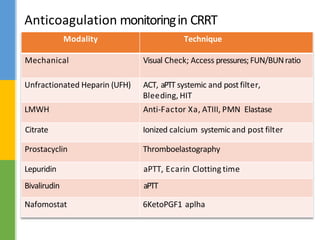
Anticoagulation monitoringin CRRT
Modality Technique
Mechanical Visual Check; Access pressures; FUN/BUNratio
Unfractionated Heparin (UFH) ACT, aPTT systemic and post filter,
Bleeding, HIT
LMWH Anti-Factor Xa, ATIII, PMN Elastase
Citrate Ionized calcium systemic and post filter
Prostacyclin Thromboelastography
Lepuridin aPTT, Ecarin Clotting time
Bivalirudin aPTT
Nafomostat 6KetoPGF1 aplha

anticoagulation CRRT .pptx

  • 1.
    Dr M.Ranjanee MD,DM, SCE(Neph),FIMSA,CHS Sr.Consultant Nephrologist Apollo Hospitals , Greams Road , Chennai Anticoagulation for CRRT
  • 2.
    Outline • Why dowe change filters? Is everything related to clotted filters? • Why do filters/circuits clot? • Various Anticoagulants available – Actions, advantages,disadvantages • Is there a single best anticoagulant? • Available evidence • In practice 3
  • 3.
    Circuit lifespan: “Host-circuit”determinants “circuit” factors • flow rate • Filtration fraction • pre-dilution • catheter size • anticoagulation “patient” factors • primary condition !! • PT/INR • platelet count • haemoglobin • venous access issues • blood products use.
  • 4.
    Effects of circuit/filterclotting • Decreased treatment efficacy -(esp. in ALF patients) • Increased blood loss especially in newborns • Propensity to increased haemodynamic instability during re- connection • Increased costs • Staff dissatisfaction 6
  • 5.
    The Impact ofDown- Time and Filter Efficacy on Delivered Dose of CRRT Ronco et al. Lancet 356:26-30, 2000 Mehta et al. Kidney Int 60:1154-1163, 2001 Uchino et al. Intensive Care Med 29:575-578, 2000 Kumar et al. IJAO 27:371-379, 2004 J Am Soc Nephrol 21: F-FC172, 2010
  • 6.
    - Factors relatedto premature clotting patient related access related circuit related – FF, De-aeration chamber ,connections treatment related where does thrombus form ?
  • 7.
    Circuit Connections UCSD T oCRRT machine qB 100 Patient fluid replacement Closed Normal Saline Pt access Venous Side Connections From CRRT machine Arterial Side Connections
  • 8.
    Circuit –De-aeration Chamber •Managesair in the return line, works like a vortex to propel all air out of the blood. •Post-filter replacement solution is added into the deaeration chamber on top of the blood. •Using a minimum of 200 to 500 ml/hr of post filter replacement will prevent air/blood interface. •This minimizes clotting and foaming into deaeration chamber. Maintaining the CRRTcircuitiscrucial for delivering CRRT effectively
  • 9.
  • 10.
    Hemofilter –Prismaflex Specifications SetsSurface Area (m2) BFR (ml/min) DFR (ml/hr) Priming Volume (ml) Blood Volume (ml) Max Filtration Capacity (ml/hr) M60* 0.6 50-180 0-4000 1000 93 4000-pre 3000-post 2000-pbp M100 0.9 75-400 0-8000 1000 152 8000-pre 6000-post 4000-pbp HF1000 1.15 75-400 0-8000 1000 165 HF1400 1.4 75-400 0-8000 2000 186 *Indicated for patients >11kg
  • 11.
  • 12.
    Anticoagulation in CRRT Goals •Prevent clotting of filter and circuit • Maintain efficacy of solute and fluid removal • Bleeding • Alterations in coagulation parameters • Platelet dysfunction • Minimize activation of complement and cytokine cascade • Reduce cellular activation • Inhibit concentration repolarization • Facilitate transfer of charged molecules Maintain patency of extracorporeal circuit Avoid systemic anticoagulation Provide an inert surface for blood membrane interaction
  • 13.
    Ideal Anticoagulation • Readilyavailable • Safe -Selectively active in the circuit – minimal effects on patient hemostasis • Prolonged filter life ideally > 48 hours • Monitoring – Rapid and Simple • Rapidly reversible in case of complications • Uncomplicated ,easy to follow consistently delivered protocols- Staff training • Cost Effective
  • 14.
    Anticoagulation for CRRT Modalities Mechanical •Circuit design (air -blood interface) • Reduced viscosity (pre-dilution) Systemic • Heparin • Low molecular weight heparin • Prostacyclin • Thrombin inhibitors • Lepirudin • Argatroban • Nafomastat mesylate Regional • Heparin • Citrate
  • 15.
    Usually used inpatients with intrinsic coagulopathies such as hepatic failure or low platelet counts Methods: •Prime circuit: Saline or Heparin prime •Intermittent 0.9% NS flush 50-200 ml q 30- 60 mins Results: •Rates of filter clotting vary widely •Mean filter life between 16 -70 hrsif coagulopathic •Shorter filter life 6 -18 hrs unless severe coagulopathy No Anticoagulation
  • 16.
    Unfractionated Heparin (UFH) XII-> XIIa = Hagemann Factor XI -> XIa + Ca IX -> IXa + VIIIa, Ca X -> Xa = Prothrombin activator + Va, Ca Prothrombin -> Thrombin Fibrinogen -> Fibrin + XIIIa -> cross-linked Fibrin VII -> VIIa + Ca Intrinsic system Extrinsic system Antithrombin III • 4.5-6 kDa • t1/2 2-4 hrs (increased in renal failure) • Affected by antithrombin deficiency
  • 17.
    Unfractionated Heparin Advantages • Effective •Widely available • Simple monitoring (aPTT) • Reversedwith Protamine • Inexpensive • Short halflife Disadvantages • Systemic bleeding( 10-50%) • Unpredictablekinetics • PT Tnotreliable bleeding predictor • Heparinresistance due to low patient antithrombin levels • Heparin induced thrombocytopenia (HIT) (1-5%)
  • 18.
    Heparin UFH Protocol Dialysate Effluent Patient aPTT <40sec Circuit aPT T, >150 sec Arterial line Venous line Prime with Saline containing heparin 5-10,000 IU Bolus 2000-5000 IU (25-30 IU/kg) Continuous infusion 400-700IU/hr (5-20 IU/kg/hr) aPTT 34-45 seconds (1.5-2.0 X normal) Reported circuit patency 20-40 hrs ACT180-240 sec
  • 19.
    Risk Initial ContinuTarget Platelets PTT Heparin PTT Filter group loading ous PTT (sec) Require- ment (sec) life dose dose before before during time IU/kg IU/kg/h CRRT CRRT (IU/h) CRRT (h) Low risk 50 10 - 20 1.5 – 2x normal > 200000 42 > 700 40 23 Moder a te risk 15 - 25 10 10 – 15 sec > 50- 200000 46 100 - 700 45 25 normal High risk 10 5 - 8 < upper limit of < 50000 61 none 50 22 normal P Recommended Unfractionated Heparin dose
  • 20.
    Heparin Dialysate Effluent Patient aPTT <40 sec CircuitaPT T, >150 sec Arterial line Venous line Reported circuit patency 20-40 hrs UFH – Protamine Sulfate Regional Anticoagulation Advantages  Anticoagulation effects restricted to extracorporeal circuit Disadvantages  Rebound (instable heparin- protamine complex)  Hypotension  Hypersensitivity Protamine ACT180-240 sec KaplanAA et al. TransAm SocArtif Organs 1987 Van der Voort PH et al. Blood Purif 2005 100 u Heparin = 1 mg Protamine UFH 1000-1500 U/hr Protamine 10-12 mg/hr
  • 21.
  • 22.
    Low molecular weightheparin (LMWH) XII -> XIIa = Hagemann Factor XI -> XIa + Ca IX -> IXa + VIIIa, Ca X -> Xa = Prothrombin activator + Va, Ca Prothrombin -> Thrombin Fibrinogen -> Fibrin + XIIIa -> cross-linked Fibrin VII -> VIIa + Ca Intrinsic system Extrinsic system Antithrombin III more active in inhibiting factor Xa, less with factor IIa half-life up to 10 hours monitoring: Measurement of anti-Xa activity (0.3 – 0.5 IU/ml)
  • 23.
    LMWH Protocols Fixed dosevs. dose based on anti- Xa T arget anti- Xa level0.25-0.35U/ml Nadroparin, Dalteparin • Loading dose 15- 25IU/kg • Maintenance dose 5 -10 IU/kg/hr • Median filterlife 18- 50hrs Disadvantages Enoxaparin • Loading dose 0.15mg/kg • Maintenance dose 0.05mg/kg/hr • Mean filterlife 31hrs Advantages • Effective • Predictable pharmacokinetics • Lower incidence of HIT,lesslipideffect •Systemic bleeding • Only partially reversed with protamine • anti Xa activity not everywhere available • Expensive • Pont AC de et al. Crit Care Med 2000 Reeves JH et al. Crit Care Med 1999 Journois D et al.Ann Fr Anesth Reanim 1990
  • 24.
    Citrate XII -> XIIa= Hagemann Factor XI -> XIa + Ca IX -> IXa + VIIIa, Ca X -> Xa = Prothrombin activator + Va, Ca Prothrombin -> Thrombin Fibrinogen -> Fibrin + XIIIa -> cross-linked Fibrin VII -> VIIa + Ca Intrinsic system Extrinsic system  Chelates free Ca +2in extracorporeal circuit  Prevents activation of Ca +2-dependent procoagulants  Anticoagulant effect measured by iCa +2  Anticoagulation reversed by Ca +2infusion
  • 25.
    Citrate Normal blood levelsof citrate: 0.05 mmol/L Bleeding time prolonged at citrate levels of 4 to 6 mmol/L (iCa 2+ < 0.35 mmol/L) Levels of 12 to 15 mmol/L required for stored blood products for transfusion therapy Extracorpore al clearance: •Clearance same asurea •Sieving coefficient 0.87- 1.0 •CVVH =CVVHD clearance •Dependson citrate concentration in the filter and filtration fraction Citric acid has plasma half life of 5 mins Rapidly metabolized by liver, kidney and muscle cells Na3Citrate + 3H2CO3 Citric Acid + 3NaHCO3 3H2CO3 + H2O + 3NaHCO3 4H2O + 6CO2
  • 26.
    Citrate Citrate solutions Desired Effects •Anticoagulation • Circuit longevity • Replete Base • Acid base balance Protocols • Titration of citrate based on iCa 2 • Fixed relationship between BFR & citrate delivery Advantages • Regional, avoids bleeding complications • Doubles as buffer • Highly effective in studies (>heparin) • No thrombocytopenia Disadvantages • Metabolic complications • Complex protocols Amount of citrate delivered to achieve blood citrate concentration of 4 mmol/L depends on blood flow
  • 27.
    The Citrate-Calcium Complex Anticoagulationwith citrate utilises a process called ‘chelation’ Ca – + + – – Citrate forms a complex with the Ca2+ ions, making them unavailable as a co-factor within the clotting cascade
  • 28.
    Calcium-free dialysate Citrate chelates free ionizedCa2+ Citrate Effluent Post filter iCa2+ is monitored and used to titrate citrate rate to assure anticoagulation Citrate is metabolized primarily in liver to HCO - 3 Bound Ca2+ is released Calcium is infused through a separate central line to replace Ca2+ lost in ultrafiltrate Returning blood combines with venous blood in body, normalizing iCa2+ and preventing systemic anticoagulation Citrate Anticoagulation in CRRT: Regional Effect in the Circuit
  • 29.
    Circuit Options forCVVH Post- dilution Citrate Ca RF Pre- dilution Citrate- Based RF Ca Ca Citrate Blood flow 120- 200 ml/min UF 1200- 4000 ml/min Citrate 15- 40 mmol/L Targets Systemic Ca 1.12- 1.25mmol/L Post Filter Ca <0.4 mmol/L RF Palsson and Niles, KI, 1999, 55: 1991-1997 Munjal and Ejaz. Nephrology 2006; 11: 405-409 Morabito et al Critical Care 2012.
  • 30.
    V V QB Circuit Options forCVVHDF RF + Citrate QR QD V QB QR QD RF Citrate RF Ca Ca Mehta et al, KI, 1990 38(5): 976-981. Tolwani et al. CJASN 2006
  • 32.
    Baxter The PrismaflexeXeed ™ System
  • 33.
    Baxter The PrismaflexeXeed ™ System
  • 34.
  • 35.
    Fluids for FreseniusCi-Ca® Therapy Ci-Ca Dialysates calcium free, 4 types 4% Sodium Citrate Contains 136 mmol/L citrate Calcium Chloride 100 mmol/L
  • 36.
    Dialysate solutions forCitrate Therapy • Sodium and bicarbonate are reduced to compensate for the systemic infusion of sodium citrate • Calcium-free to minimise the citrate requirement • Slightly increased magnesium as citrate also chelates with magnesium Prismocal 140 0 0 0.5 106 32
  • 37.
    Fully Integrated Citrate& Calcium Pumps to Safeguard
  • 38.
    Integrated Citrate &Calcium Lines to Safeguard Page 16
  • 39.
    Mechanically Different Citrate& Calcium Connectors to Safeguard
  • 40.
  • 41.
    4% TSC 3.2%TSC (ACD-A) 2%TSC (ACD-B) PRISMOCITRATE 18/0 PRISMOCITRATE 10/2 (only Europe) Na 408 224 135 140 136 K 0 0 0 0 Citrate (mmol/L) 136 74.8 68 18 10 Citric acid mmol/L 0 38.1 4.4 0 2 Dextrose mmol/L 124 14.7 0 0 Chloride 86 106 citrate dose mmol/L 4 3 3.5 Bag size (ml) 250&500 500&1000 500&1000 5000 5000 Infusion rate 140-220 350 ml/h 1000-2000 1000-2000 Citrate solutions
  • 42.
    • Amount ofcitrate required to anticoagulate one liter of blood. • Citrate dose is determined by:  Blood flow rate (in mL/min)  Citrate solution flow rate (in mL/h)  Concentration of citrate in the solution (in mmol/L) Citrate dose for fixed BFR to Citrate Citrate Dose Qcitrate x Ccitrate BFR x60 = Qcitrate in mL/h Ccitrate in mmol/L BFR in mL/min (150 ml/min) Citrate Dose in mmol/L of blood 3 mmol/L 2250 x12 150 x60 = 2250 mL/h 12 mmol/L
  • 43.
    Morgera et alASafe Citrate Anticoagulation Protocol CCM2009;37:2018-24
  • 44.
    Calcium solutions for replacement 1 gmCalcium Gluconate 10 % / 10 ml =4.6 Meq of calcium 50 ml = 23 Meq of calcium 1 gm Calcium Chloride dihydrate 10% 10 ml =13.6 meq of calcium
  • 45.
    REGIONAL CITRATE ANTICOGULATIONPROTOCOL Pre-requisites: 1.Effluent dose :always below 35 ml / kg / hr (reduce dialysate and RF acc.) 2.FF: Target Less Than 25% 3.Citrate Dose: 3 mmol/L (Regiocit, Citrate concentration 18mmol/l) 4.Calcium Dilution: 50ml of Calcium Gluconate undiluted in 50ml Syringe 5.Calcium compensation : It’s by Calcium Gluconate depending on initial patient ionized calcium – see table 1 below. Initial Calcium Compensation (Manual/External Pump) Patient ionized calcium Starting Calcium Compensation flow rate Less than 0.9 mmol/L Give 30ml of undiluted Calcium Gluconate over 30 mins before starting and continue 15ml/h parallelly during the therapy 0.9 - 1.1 mmol/L 12.5 ml/h Greater than 1.1 mmol/L 10 ml/hr
  • 46.
  • 47.
    Maintaining Dialysis andBlood Flow Rates • The dialysate to blood flow ratio should be 20:1 (corresponding to a physical flow ratio of 1.3) • Ratio adjustment based on acid base disorder
  • 48.
    Display During CitrateAnticoagulation
  • 49.
    Monitoring Patient & PostFilter Ca2+ level High Post Filter Ca 2+ - >0.50 mmol/l Normal Post Filter Ca 2+ - 0.25 - 0.50mmol/l Low Post Filter Ca 2+ - <0.25 mmol/l Low Patient Ca 2+ - <1.0 mmol/l Increase Citrate dose by 0.5 mmol/l & Increase Calcium infusion by 5-10% Increase Calcium infusion by 5-10% Decrease Citrate dose by 0.5 mmol/l Normal Patient Ca2+ - 1.0-1.2 mmol/l Increase Citrate dose by 0.5 mmol/l NO CHANGE Decrease Citrate dose by 0.5 mmol/l High Patient Ca 2+ - >1.2 mmol/l Decrease Calcium infusion by 5-10% Decrease Calcium infusion by 5-10% Decrease Citrate dose by 0.5 mmol/l & Decrease Calcium infusion by 5-10 % Citrate modification Calcium infusion modification
  • 50.
    Calcium Infusion Adjustment Targetpatient serum ionized calcium -1.1-1.2 mmol/l Patient Ionized Ca2+ 10% Calcium Chloride/ Gluconate 0.85-0.94 mmol/L ↑↑ by 10mL/hour+2g Ca Gluconate 0.95-1.04 ↑↑ by 5 mL/hour+1g Ca Gluconate 1.05-1.09 ↑↑ by 5 mL/hour 1.10-1.2 No Change 1.21-1.3 ↓↓ by 5mL/hour 1.31-1.45 ↓↓ by 10mL/hour >1.45 ↓↓ by 15ml/hour
  • 51.
  • 52.
    Total calcium toionized calcium ratio monitoring High ratio surrogate marker for citrate toxicity PATIENT TOTAL CALCIUM ÷ PATIENT IONIZED CALCIUM (Ca mmol/l = Ca (mg/dl) x 0.2495) Ratio Action <2.5 Check Ratio Daily >2.5 Stop Citrate for 20 minutes and restart afterwards with 0.5 mmol/l less than the previous citrate dose •Leave Calcium compensation unchanged. This would result in a slightly higher filter ionized calcium. (0.35 to 0.45 acceptable) If ratio remains above 2.4 despite post filter iCa of 0.35 – 0.45 mmol/L then consider:  Doubling baseline dialysate flow (will increase citrate clearance)  Reducing blood pump speed (will reduce total administered citrate dose)  Stopping citrate and using an alternative anticoagulant (or no anticoagulant)
  • 53.
    Citrate Metabolic Consequences Metabolicalkalosis • Citrate overdose/toxicity Metabolic acidosis • Citrate toxicity in setting of severe liver disease or hypoperfusion Hypernatremia • Hyperosmolar citrate solutions Hypocalcemia and hypercalcemia • Inappropriate calcium supplementation Hypomagnesemia
  • 54.
    Managing an MetabolicAcidosis • First review the patient, treat any underlying condition and ensure dialysate dose is appropriate • Check that the dialysate and blood flow rates are set according to the protocol To correct an acidosis either: • Decrease the dialysate flow (a decrease of 20% will increase the serum bicarbonate level by approximately 4mmol/L) or • Increase the blood flow rate (an increase of 20% to the blood flow rate will increase the serum bicarbonate level by approximately 4mmol/L) • Increase bicarbonate in post filter replacement fluid
  • 55.
    Patient Selection All patients.. but especially • Patient’s pre- or postoperatively where systemic anticoagulation may be contraindicated • Patients with significant coagulopathy – related to sepsis, large volume transfusion etc. • Trauma patients with potentially undiagnosed bleeding points • Patients where surgical wound healing may be compromised by systemic anticoagulation • Uremic pericarditis ,severe DM retinopathy • Patients with profound cardiovascular instability – for whom highblood flows would be detrimental
  • 56.
    Intensive Care Med.2004 Feb;30(2):260-5. Epub 2003 Nov 5. Citrate vs. heparin for anticoagulation in continuous venovenous hemofiltration: a prospective randomized study. Monchi M1, Berghmans D, Ledoux D, Canivet JL, Dubois B, Damas P. Regional citrate anticoagulation was superior to heparin for the filter lifetime and transfusion requirements in ICU patients treated with CRRT • Median filter life : Citrate - 70 hr; Heparin - 40 hr • Spontaneous circuit failure : Heparin -87%;Citrate- 57% • Median time to spontaneous circuit failure: Heparin 45 hrs; Citrate -140 hrs • Transfusion requirement :Citrate- 0.2 units/day of CVVH ; Heparin- 1 units/day
  • 57.
    Final Decision –Citrate vs Heparin Citrate Heparin
  • 58.
    Prostacyclin –PGI2 Vasodilator Inhibits plateletaggregation and adhesion Short acting • Vasodilatorhalflife 2min • Antiplatelet effect 2hrs Protocol • 2- 8 ng/kg/min infused pre- filter Disadvantages • Hypotension, raised ICP, Hyperthermia • Expensive Median filter life • 15- 19hrs • 20- 22hrswith low dose heparin Langenecker et al. Crit Care Med 1994 Kozek-Langenecker et al. Crit Care Med 1998 Fiaccadori et al. Int Care Med 2002 Balik et al. Blood Purif 2005
  • 59.
    Nafomostat Synthetic Serine Proteaseinhibitor prostacyclin analogue Inhibits platelet aggregation and adhesion Short acting •Vasodilatorhalf life 2 min •Antiplatelet effect 2 hrs Protocol •0.1 mg⁄kg⁄hour Infused pre- filter Disadvantages •studies have demonstrated that levels of thrombin –antithrombin III complex and prothrombin activation fragment 1 +2 increase, while protein C activity decreases, leading to circuit clotting •Several side effects (anaphylaxis, agranulocytosis, hyperkalemia) Median filter life •15- 19 hrs •20- 22 hrs with low dose heparin
  • 60.
  • 61.
    46 patients onCVVH • Group -1 Heparin (6.0 +/- 0.3 IU/kg/hr for group 1), • Group -2 PGI2 (7.7 +/- 0.7 ng/kg/min ) • Group-3 PGI2 and heparin (6.4 +/- 0.3 ng/kg/min, 5.0 +/- 0.4 IU/kg/hr) • Filter life, haemostatic variables and haemodynamic variables at various times • Mean hemofilter duration :  PGI2 + heparin 22 hours  Only heparin -14.3 hours  Only PGI2 – 17.8 hours Heparin +PGI2: Better hemodynamic profiles Enhanced hemofilter duration
  • 62.
    Acknowledge to A.Deep, KCH, London
  • 63.
    Fibrinogen Fibrin Thrombin Prothrombin Xa +Va X Tissue Factor-VIIa Fondiparinux Idraparinux Hirudin Bivalirudin Argatroban Ximelagatran IX IXa VIIIa TFPI NAPc2 FVIIai APC Thrombin Inhibitors
  • 64.
    Lepirudin (r-Hirudin) 6980 Da Irreversiblyinhibits thrombin Eliminated by the kidneys Half life of 1-2 hrs prolonged in renal failure Monitoring: Ecarin clotting time (ECT) Protocols •Continuousinfusion 0.005-0.01 mg/kg/hr •Or bolusdose 0.002 g/kg •ECT target 80-100 seconds Disadvantages •No antidote! •ECTnot easily available Fischer KG et al. Kidney Int 1999 Vargas O et al. Int Care Med 2001
  • 65.
    Bivalirudin Reversibly inhibitsthrombin 80% eliminatedby nonorgan- dependent proteolysis 20% excreted unchanged by the kidneys Half life of 25 min •Clearance reduced approximately 20% in patients with severe renal impairment and by 80% in dialysis -dependent patients •Bivalirudin is hemodialyzable and approximately 25% is cleared by hemodialysis Protocols •Continuousinfusion 1 mg/hr (0.009 mg/kg/h) •aPT Ttarget 1-1.4 timesbaseline Disadvantages •Limited studies •1 RCT2010: •10 pts randomized to bivalirudin ( 2 mg/hr) vs. heparin (400 u/hr) •Hemofilter survival time was significantly increased in patients receiving bivalirudin vs. those receiving heparin (29.6 ±20.7 vs. 16.5 ±13.6 hrs, p=0.045) Kiser et al. Pharmacotherapy. 2010 Mueller et al. Annals of Pharm. 2009 Kisere et al. Annals of Pharm. 2008
  • 66.
    Argatroban Second generation directthrombin inhibitor 526 Da 54% protein bound ½- life 35- 51 min Metabolized by the liver Dose • Loading dose 100- 250 µg/kg • Maintenance dose 0.1 - 2 µg/kg/min • Adjusted to achieve aPT T1.5 - 3.0 times baseline No antidote Mean circuit life 44 hrs Reddy et al. Ann Pharmacother 2005 Tang IY et al. Ann Pharmacother 2005
  • 68.
    Summary Anticoagulation remains theAchilles' heelfor CRRT Importantfactoraffecting delivered dialysisdose  Heparin and citrate anticoagulation most commonly used methods Heparin: bleeding risk Citrate: alkalosis, citrate lock !!! Evidence favors the use of citrate ( not universally used) Prostacyclin: platelets sparing effect, a good alternative in patients with liver disease / bleeding diathesis, but cost implications
  • 69.
    Anticoagulation in Special Circumstances •advanced liver disease? • post arrest / cardiac failure? • ECMO? • septic shock? • heparin induced thrombocytopenia? • Neonates?
  • 70.
    Anticoagulation in Special Circumstances •advanced liver disease: No (or PGI2 ?) • post arrest / cardiac failure: Heparin • ECMO: Heparin, Citrate (PGI2?) • septic shock: No, heparin • heparin induced thrombocytopenia: Hirudin • neonates : Heparin (PGI2?)
  • 71.
    Anticoagulation monitoringin CRRT ModalityTechnique Mechanical Visual Check; Access pressures; FUN/BUNratio Unfractionated Heparin (UFH) ACT, aPTT systemic and post filter, Bleeding, HIT LMWH Anti-Factor Xa, ATIII, PMN Elastase Citrate Ionized calcium systemic and post filter Prostacyclin Thromboelastography Lepuridin aPTT, Ecarin Clotting time Bivalirudin aPTT Nafomostat 6KetoPGF1 aplha

Editor's Notes

  • #58 Local familiarity with protocol, patient population Heparin common as vast experience, easy to monitor, good circuit life Problems – Systemic anticoagulation, bleeding (sometimes life-threatening), HIT, resistance Citrate – comparable filter life( uninterrupted run ,effective dose delivery ), no risk of bleeding, lesser transfusions Why is citrate not the standard of care ? Physician’s perception- use of citrate complex, Citrate module not in every machine Metabolic complications with regular monitoring, metabolism in liver disease complex Huge training resource Cost
  • #65 Ecarin clotting time –ct prolongation due to thrombin inhibition alone