Code Sepsis  Nursing Review
WHO  is involved? eLink monitoring team CCM Medical Team ICU/ED/Floor nurses Pharmacy Lab Other medical professionals
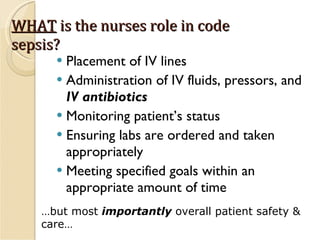
WHAT  is the nurses role in code sepsis? Placement of IV lines Administration of IV fluids, pressors, and  IV antibiotics Monitoring patient’s status Ensuring labs are ordered and taken appropriately Meeting specified goals within an appropriate amount of time … but most  importantly  overall patient safety & care…
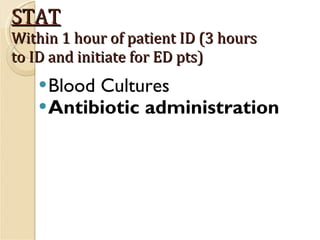
STAT Within 1 hour of patient ID (3 hours to ID and initiate for ED pts) Blood Cultures Antibiotic administration
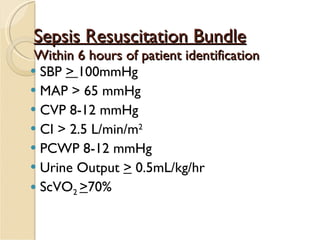
Sepsis Resuscitation Bundle Within 6 hours of patient identification SBP  >  100mmHg MAP > 65 mmHg CVP 8-12 mmHg CI > 2.5 L/min/m 2 PCWP 8-12 mmHg Urine Output  >  0.5mL/kg/hr ScVO 2  > 70%
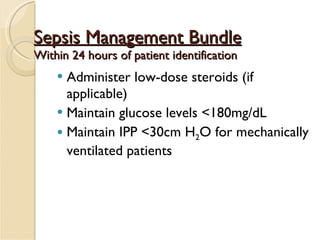
Sepsis Management Bundle Within 24 hours of patient identification Administer low-dose steroids (if applicable) Maintain glucose levels <180mg/dL Maintain IPP <30cm H 2 O for mechanically ventilated patients
HOW  should antibiotics be administered? Within 1 hour of patient identification for non-ED patients and 3 hours to identify septic patients and administer antibiotics in the ED setting Compatibilities should be checked – more antibiotics are compatible than you may realize A broad spectrum of antibiotic should  always  be administered first
Spectrum of Activity for Selected Antimicrobial Agents Gram (+) Antibiotics (+/- Anaerobes) Vancomycin (Vancocin®), Linezolid (Zyvox®), Daptomycin (Cubicin®), Clindamycin (Cleocin®) Gram (-) Antibiotics (+/- Anaerobes ) Gentamicin, Tobramycin, Aztreonam (Azactam®) Antifungal Fluconazole (Diflucan®), Caspofungin (Cancidas®), Micafungin (Mycamine®), Amphotericin B
Broad Spectrum Antibiotics Penicillins Piperacillin/Tazobactam (Zosyn®), Ampicillin/Sublactam (Unasyn®) Cephalosporins Ceftriazone (Rocephin®), Ceftazidine (Fortaz®), Cefipime (Maxipime®) Fluoroquinolones Ciprofloxin (Cipro®), Moxifloxacin (Avelox®), Levofloxacin (Levaquin®) Carbapenem Imipenem/Cilastin (Primaxin®), Meropenem (Merrem®)
WHY  does this matter? Sepsis is a range of clinical conditions caused by the body’s systemic response to an infection, which can be accompanied by single or multiple organ dysfunction or failure, leading to death Sepsis kills approximately 1,400 people worldwide every day and is a leading cause of death in ICU patients Patients who do not receive prompt antibiotic therapy have a 10-15% increased risk of mortality – therefore early administration of antibiotics have proven to improve mortality Nurses play a huge role in patient care and ensuring that antibiotics are given correctly and in a timely manner
That’s all for now! Now you can take the post test and see what you have learned. Information provided by Elizabeth Jennings Martin, PharmD Email:  [email_address]  with any questions or comments

Code sepsis nursing review

  • 1.
    Code Sepsis Nursing Review
  • 2.
    WHO isinvolved? eLink monitoring team CCM Medical Team ICU/ED/Floor nurses Pharmacy Lab Other medical professionals
  • 3.
    WHAT isthe nurses role in code sepsis? Placement of IV lines Administration of IV fluids, pressors, and IV antibiotics Monitoring patient’s status Ensuring labs are ordered and taken appropriately Meeting specified goals within an appropriate amount of time … but most importantly overall patient safety & care…
  • 4.
    STAT Within 1hour of patient ID (3 hours to ID and initiate for ED pts) Blood Cultures Antibiotic administration
  • 5.
    Sepsis Resuscitation BundleWithin 6 hours of patient identification SBP > 100mmHg MAP > 65 mmHg CVP 8-12 mmHg CI > 2.5 L/min/m 2 PCWP 8-12 mmHg Urine Output > 0.5mL/kg/hr ScVO 2 > 70%
  • 6.
    Sepsis Management BundleWithin 24 hours of patient identification Administer low-dose steroids (if applicable) Maintain glucose levels <180mg/dL Maintain IPP <30cm H 2 O for mechanically ventilated patients
  • 7.
    HOW shouldantibiotics be administered? Within 1 hour of patient identification for non-ED patients and 3 hours to identify septic patients and administer antibiotics in the ED setting Compatibilities should be checked – more antibiotics are compatible than you may realize A broad spectrum of antibiotic should always be administered first
  • 8.
    Spectrum of Activityfor Selected Antimicrobial Agents Gram (+) Antibiotics (+/- Anaerobes) Vancomycin (Vancocin®), Linezolid (Zyvox®), Daptomycin (Cubicin®), Clindamycin (Cleocin®) Gram (-) Antibiotics (+/- Anaerobes ) Gentamicin, Tobramycin, Aztreonam (Azactam®) Antifungal Fluconazole (Diflucan®), Caspofungin (Cancidas®), Micafungin (Mycamine®), Amphotericin B
  • 9.
    Broad Spectrum AntibioticsPenicillins Piperacillin/Tazobactam (Zosyn®), Ampicillin/Sublactam (Unasyn®) Cephalosporins Ceftriazone (Rocephin®), Ceftazidine (Fortaz®), Cefipime (Maxipime®) Fluoroquinolones Ciprofloxin (Cipro®), Moxifloxacin (Avelox®), Levofloxacin (Levaquin®) Carbapenem Imipenem/Cilastin (Primaxin®), Meropenem (Merrem®)
  • 10.
    WHY doesthis matter? Sepsis is a range of clinical conditions caused by the body’s systemic response to an infection, which can be accompanied by single or multiple organ dysfunction or failure, leading to death Sepsis kills approximately 1,400 people worldwide every day and is a leading cause of death in ICU patients Patients who do not receive prompt antibiotic therapy have a 10-15% increased risk of mortality – therefore early administration of antibiotics have proven to improve mortality Nurses play a huge role in patient care and ensuring that antibiotics are given correctly and in a timely manner
  • 11.
    That’s all fornow! Now you can take the post test and see what you have learned. Information provided by Elizabeth Jennings Martin, PharmD Email: [email_address] with any questions or comments