Vaccines and
Anti-viral Drugs
Presented to: Ms.Iffra Nadeem
Group members:
 Jaweria Sultan (052)
 Rabia Azam (001)
 Zohra jabeen (040)
 Arooba Ishaq (025)
 Tazim Yousaf (054)
 M.Subhan Khalid (087)
BS.Biotechnology (A)
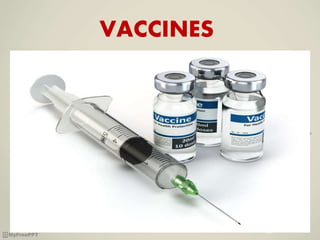
VACCINES
Vaccines
A vaccine is a biological prepration that improve
immunity to a particular disease.
Vaccine is a substance introduce into the body to
prevent the disease produced by certain pathogen
It Consist of dead pathogens or live but attenuated
(artificially weakened) organism.
• Vaccine induce immunity against the pathogen.
• By production of antibodies or by activation of T
lymphocytes.
History
The tradition of vaccination may have originated in
india in AD 1000.
Powdered scabs from people infected with smallpox
was used to protect against the disease.
Smallpox was responsible for 8 to 20%of all death in
several Euorpean countries in the 18th century.
Two to three percent of the smallpox vaccine
however died from the vaccination itself.
History
Edward Jenner could show that vaccination with the
less dangerous cowpox could protect against infection
with smallpox.
Word vaccination which is derived from vacca, the
latin word for cow.
In 1885Pasture developed a vaccine against rabies
based on a live attenuated virus.
Over the next 20 years killed typhoid and plague
vaccines were developed.
Edwad jenner(1749- 1823)
 Pioneer of smallpox vaccine.
 Father of immunology
 From the age of 14years trained as apprentice to
Daniel ludlow a surgeon.
 In 1770 worked under surgeon john hunter at St.
George”s hospital.
Jenner VS pox
• Initial theory:
• “ the initial source of infection was a disease of
horses called “the greases” and that this was
transferred to cows by farm workers transformed
and then manifested as cowpox”
• He noted that milkmaids don’t generally get small
pox.
• He theorized that:
• Pus in the blisters which milkmaids received from
cowpox(a disease similar to smallpox but much less
virulent ) protected the milkmaids from smallpox.
• On 14 may 1796:
• Inoculated James Phipps, a young boy of 8 years(the
son of Jenner’s ) with material from the cowpox
blisters of the hand of Sarah Neilmes, a milkmaid
who had caught cowpox from a cow called blossom.
Produced a fever and some uneasiness but now great
illness.
Injected phipps with variolous material-No disease
followed.
Again challenged with variolous material-but no sign
of infection.
Why jenner was
successful?????
 Not only inoculated cowpox but proved that they
are immune to small pox.
 Demonstrated that the protective cowpox could be
effectively inoculated from person to person not
just directly from cattle,
 He tested his theory on a series of 23 subjects.
 This aspect of his research method increased the
validity of his evidence.
 He continued his research and reported it to the royal
society, who did not publish the initial report
 After improvement and further work, he published a
report of 23 cases
 In 1803 in London he became involved with the
jennerim institution, society concerned with
promoting vaccination eradicate smallpox.
Vaccine preparation
 Vaccines are produced in large scale as they need
to be administered to large populations of children
and adults to be effective as a public health tool.
 This large scale production is often a challenge.
 Vaccine production has several stages. Process of
vaccine manufacture has the following steps:
Inactivation
Purification
Formulation
1. Generating the antigen from the
microbe
 The initial production involves generation of the
antigen from the microbe.
 For this the virus or microbe is grown
 on primary cells such as chicken eggs (e.g. in
influenza)
 or on cell lines or cultured human cells (e.g.
Hepatitis A).
 Bacteria against which the vaccines are
developed may be grown in bioreactors (e.g.
Haemophilus influenzae type b).
Conti……
 The antigen may also be
 a toxin or toxoid from the organism (e.g.
Diphtheria or tetanus).
 or it may be part of the microorganism as well.
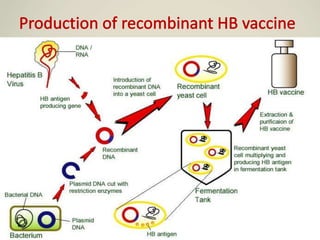
 Proteins or parts from the organism can be
generated in yeast, bacteria, or cell cultures.
 Bacteria or viruses may be weakened using
chemicals or heat to make the vaccine (e.g. polio
vaccine).
2. Isolation of the antigens
 After the antigen is generated, it is isolated from
the cells used to generate it.
 For weakened or attenuated viruses no further
purification may be required.
 Recombinant proteins need many operations
involving ultra filtration and column chromatography
for purification before they are ready for
administration.
3. Adjuvants, stabilizers and preservatives
 Once the antigen is developed the vaccine is
formulated by adding adjuvants, stabilizers, and
preservatives.
 The role of the adjuvant is to enhance the immune
response of the antigen.
 The stabilizers increase the storage life.
 Preservatives allow the use of multi dose vials.
It is difficult to develop and produce combination
vaccines due to the possibility of incompatibilities and
interactions among the antigens and other
ingredients of the vaccines.
4. Vaccine Production Requirements
 The product needs to be protected from
Air
Water and
Human contamination
 The environment needs to be protected from
spillage of the antigens.
The main types of vaccines are:
 Live, attenuated vaccines
 Inactivated vaccines/killed vaccines
 Subunit vaccines
 Toxoid vaccines
 Conjugate vaccines
 DNA vaccines
 Recombinant vector vaccines
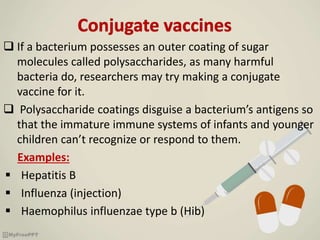
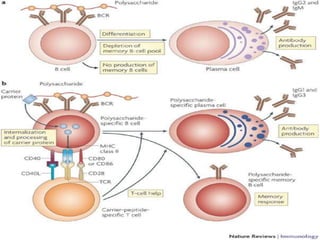
 If a bacterium possesses an outer coating of sugar
molecules called polysaccharides, as many harmful
bacteria do, researchers may try making a conjugate
vaccine for it.
 Polysaccharide coatings disguise a bacterium’s antigens so
that the immature immune systems of infants and younger
children can’t recognize or respond to them.
Examples:
 Hepatitis B
 Influenza (injection)
 Haemophilus influenzae type b (Hib)
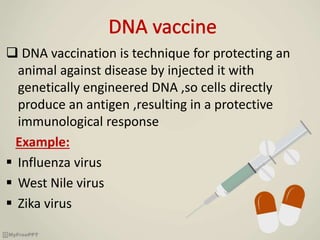
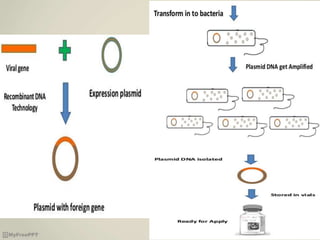
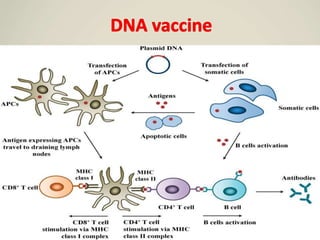
 DNA vaccination is technique for protecting an
animal against disease by injected it with
genetically engineered DNA ,so cells directly
produce an antigen ,resulting in a protective
immunological response
Example:
 Influenza virus
 West Nile virus
 Zika virus
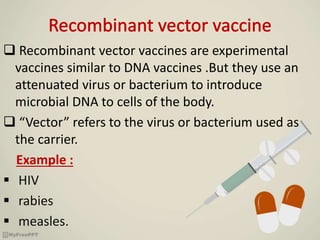
 Recombinant vector vaccines are experimental
vaccines similar to DNA vaccines .But they use an
attenuated virus or bacterium to introduce
microbial DNA to cells of the body.
 “Vector” refers to the virus or bacterium used as
the carrier.
Example :
 HIV
 rabies
 measles.
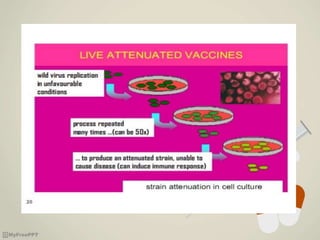
 Live attenuated vaccines are made by weakening the
natural virus or bacteria (uncommon).
 Natural viruses need to reproduce thousands of times
during infection to cause disease.
 These weakened viruses are only able to reproduce fewer
than twenty times. With such little reproduction, attenuated
viruses are not able to create nearly enough copies of
themselves to cause disease.
Examples:
 Vaccines against
 Measles
 Mumps
 Chicken pox
Advantages
 Good (teachers) of immune system
 They only require one to two doses for life-long
immunity.
 These vaccines are relatively easy to create for
certain viruses.
 Oral preparations are less expensive than giving
injections.
Disadvantages
These vaccines cannot be administered to people with
weakened immune systems due to cancer, HIV, or other
immune system depressing disease.
Live, attenuated vaccines usually must be refrigerated
and protected from light.
This technique doesn’t work as well with bacteria,
therefore there are very few live bacterial vaccines.
Toxoid Vaccines
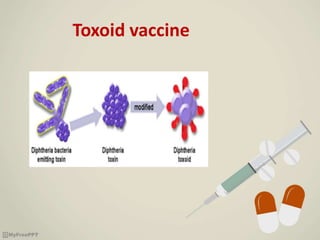
Toxoid vaccines are vaccines that are made from the
toxins (harmful chemicals) from bacteria.
There are some bacteria that cause disease through
releasing a protein called a toxin.
 Scientists can inactivate these toxins in the lab using a
chemical called formalin (a solution of formaldehyde)
and sterilized water, which are completely safe to use in
small quantities in the human body.
Once the toxin is inactivated, it’s called a toxoid, and it
can no longer cause harm. The body learns how to
fight off the bacteria’s natural toxin once exposed to
the toxoid through producing antibodies that bind into
the toxin like keys into a lock.
Examples:
 Bacterial:
 Tetanus Vaccine
 Diphtheria Vaccine
 Pertussis Vaccine
Toxoid vaccine
Advantages
• Highly immunogenic
• Sterile
• Safe
Side Effects of Toxoid Vaccines
Less common
• Fever
• general feeling of discomfort or illness
• unusual tiredness or weakness
• Headache
More common
• Hard lumps, redness, tenderness, or warmth at the injection site
• Difficulty with moving
• joint pain
• lack or loss of strength
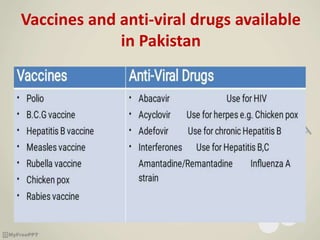
Vaccines and anti-viral drugs available
in Pakistan
Antiviral Drugs
Antiviral Drug
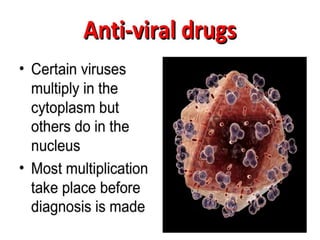
 Antiviral drug, any agent that is used in
the treatment of an infectious disease caused
by a virus.
 Viruses are responsible for illnesses such as
HIV/AIDS, influenza, Herps simplex type I
(cold sores of the mouth) and type II (genital
herpes), herpes zoster (shingles),
viral hepatitis, encephalitis,
infectious mononucleosis, and the common
cold.
Useable Drugs…
• Abacavir
Use for HIV
• Acyclovir (Aciclovir)
Use for herpes e.g. Chicken pox
• Adefovir
Use for chronic Hepatitis B
• Amantadine
Use for influenza
• Amprenavir
(Agenerase) Use for inhibition of HIV
History….
The first modest search for antiviral drugs
occurred in early 1950’ s.
Chemists looked at derivatives of sulfonamide
antibiotics.
Idoxuridine : the first useful antiviral .The
Decreption of 5-iodo-2-deoxyuridine by Dr Bill
prusoff in 1959 and the realization of its antiviral
properties.
 In the 1960 and 1970 ‘s drug companies
launched huge “ blind –Screening” programs to
find chemicals with antiviral activity.
 In 1995 –first protease inhibitor sequinavir FDA
Approved
 In 1996 first NNRTI Nevirapine approved by
FAD
 March 2003- first fusion inhibitor Enfuvirtide
approved by FAD
Some Facts…….
 Most drug Affect host cell – Unacceptable
Toxicity
 Most Drug Inhibitor viral replication
 Replication start again when drug is
discontinued
 Good host immunity is essential
 Current drugs do not affect dormate virus
ANTIVIRAL DRUGS FOR INFLUENZA
There are four types of flu antiviral are:
• Amantadine
• Rimantadine
• Oseltamivir
• zanamivir
 Amantadine and rimantadine these drugs
work against influenza type A viruses, but not
influenza type B viruses.
 They are thought to inhibit the activity of an
influenza A viral protein, which prevents the
virus from replicating after it enters a cell.
 Zanamivir (an inhaled powder) and oseltamivir
(oral drug) are medications known as
neuraminidase inhibitors.
 Block the active site of the influenza viral enzyme
neuraminidase, which is found in both influenza
A and influenza B viruses.
 This enzyme normally breaks the bonds that hold
new virus particles to the outside of an infected
cell.
 This frees new viruses to infect other cells and
spread infection.
 Neuraminidase inhibitors' ability to block this
enzyme's activity prevents new virus particles
from being released. This limits the spread of
infection.
Effects of oseltamivir:
• nausea
• vomiting
• diarrhea
• abdominal pain
• insomnia
ANTI-HERPES DRUGS
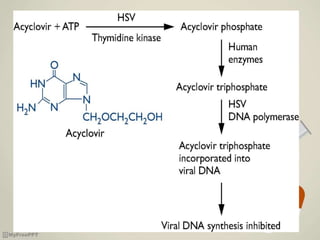
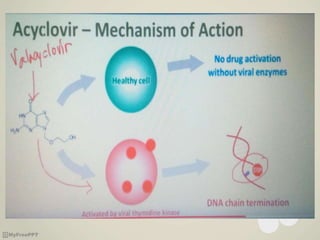
Acyclovir
• It has greater specificity than Vidarabine against
herpes viruses.
• Use in the treatment of choice in HSV encephalitis
and increase rate of survival.
• It is given prophylactically to sero +ve patients
before bone marrow & after heart transplants
ANTIVIRAL DRUGS FOR HEPATITIS
Interferon:
• Naturally occurring inducible glycoprotein
• Interfere with ability of viruses to infect cells
• Synthetically prepared by Recombinant DNA
• technology
• Three types Exist ▪ Alpha ▪ Beta ▪ Gamma
• Interferon alpha-2b has been approver for the
treatment of Hepatitis B & C, Condylomata
acuminata and Cancer
• Interferon Beta has some effectiveness in treatment
of
• Multiple sclerosis
Mode of Action
• Induction of host cell enzymes
• Inhibit Viral RNA translation leading to
• degradation of Viral mRNA & tRNA
• The Exact mechanism is incompletely understood
Adverse Effects
• Fatigue
• Mental Depression
• Bone marrow suppression
including
• Neurotoxicity
• Hypersensitivity reaction and
Hepatic failure are rare

vaccines and anti-viral drugs

  • 1.
  • 2.
    Presented to: Ms.IffraNadeem Group members:  Jaweria Sultan (052)  Rabia Azam (001)  Zohra jabeen (040)  Arooba Ishaq (025)  Tazim Yousaf (054)  M.Subhan Khalid (087) BS.Biotechnology (A)
  • 3.
  • 4.
    Vaccines A vaccine isa biological prepration that improve immunity to a particular disease. Vaccine is a substance introduce into the body to prevent the disease produced by certain pathogen It Consist of dead pathogens or live but attenuated (artificially weakened) organism.
  • 5.
    • Vaccine induceimmunity against the pathogen. • By production of antibodies or by activation of T lymphocytes.
  • 6.
    History The tradition ofvaccination may have originated in india in AD 1000. Powdered scabs from people infected with smallpox was used to protect against the disease. Smallpox was responsible for 8 to 20%of all death in several Euorpean countries in the 18th century. Two to three percent of the smallpox vaccine however died from the vaccination itself.
  • 7.
    History Edward Jenner couldshow that vaccination with the less dangerous cowpox could protect against infection with smallpox. Word vaccination which is derived from vacca, the latin word for cow. In 1885Pasture developed a vaccine against rabies based on a live attenuated virus. Over the next 20 years killed typhoid and plague vaccines were developed.
  • 8.
    Edwad jenner(1749- 1823) Pioneer of smallpox vaccine.  Father of immunology  From the age of 14years trained as apprentice to Daniel ludlow a surgeon.  In 1770 worked under surgeon john hunter at St. George”s hospital.
  • 9.
    Jenner VS pox •Initial theory: • “ the initial source of infection was a disease of horses called “the greases” and that this was transferred to cows by farm workers transformed and then manifested as cowpox” • He noted that milkmaids don’t generally get small pox.
  • 10.
    • He theorizedthat: • Pus in the blisters which milkmaids received from cowpox(a disease similar to smallpox but much less virulent ) protected the milkmaids from smallpox. • On 14 may 1796: • Inoculated James Phipps, a young boy of 8 years(the son of Jenner’s ) with material from the cowpox blisters of the hand of Sarah Neilmes, a milkmaid who had caught cowpox from a cow called blossom.
  • 11.
    Produced a feverand some uneasiness but now great illness. Injected phipps with variolous material-No disease followed. Again challenged with variolous material-but no sign of infection.
  • 12.
    Why jenner was successful????? Not only inoculated cowpox but proved that they are immune to small pox.  Demonstrated that the protective cowpox could be effectively inoculated from person to person not just directly from cattle,  He tested his theory on a series of 23 subjects.  This aspect of his research method increased the validity of his evidence.
  • 13.
     He continuedhis research and reported it to the royal society, who did not publish the initial report  After improvement and further work, he published a report of 23 cases  In 1803 in London he became involved with the jennerim institution, society concerned with promoting vaccination eradicate smallpox.
  • 14.
    Vaccine preparation  Vaccinesare produced in large scale as they need to be administered to large populations of children and adults to be effective as a public health tool.  This large scale production is often a challenge.  Vaccine production has several stages. Process of vaccine manufacture has the following steps: Inactivation Purification Formulation
  • 15.
    1. Generating theantigen from the microbe  The initial production involves generation of the antigen from the microbe.  For this the virus or microbe is grown  on primary cells such as chicken eggs (e.g. in influenza)  or on cell lines or cultured human cells (e.g. Hepatitis A).  Bacteria against which the vaccines are developed may be grown in bioreactors (e.g. Haemophilus influenzae type b).
  • 16.
    Conti……  The antigenmay also be  a toxin or toxoid from the organism (e.g. Diphtheria or tetanus).  or it may be part of the microorganism as well.  Proteins or parts from the organism can be generated in yeast, bacteria, or cell cultures.  Bacteria or viruses may be weakened using chemicals or heat to make the vaccine (e.g. polio vaccine).
  • 17.
    2. Isolation ofthe antigens  After the antigen is generated, it is isolated from the cells used to generate it.  For weakened or attenuated viruses no further purification may be required.  Recombinant proteins need many operations involving ultra filtration and column chromatography for purification before they are ready for administration.
  • 18.
    3. Adjuvants, stabilizersand preservatives  Once the antigen is developed the vaccine is formulated by adding adjuvants, stabilizers, and preservatives.  The role of the adjuvant is to enhance the immune response of the antigen.  The stabilizers increase the storage life.  Preservatives allow the use of multi dose vials. It is difficult to develop and produce combination vaccines due to the possibility of incompatibilities and interactions among the antigens and other ingredients of the vaccines.
  • 19.
    4. Vaccine ProductionRequirements  The product needs to be protected from Air Water and Human contamination  The environment needs to be protected from spillage of the antigens.
  • 20.
    The main typesof vaccines are:  Live, attenuated vaccines  Inactivated vaccines/killed vaccines  Subunit vaccines  Toxoid vaccines  Conjugate vaccines  DNA vaccines  Recombinant vector vaccines
  • 21.
     If abacterium possesses an outer coating of sugar molecules called polysaccharides, as many harmful bacteria do, researchers may try making a conjugate vaccine for it.  Polysaccharide coatings disguise a bacterium’s antigens so that the immature immune systems of infants and younger children can’t recognize or respond to them. Examples:  Hepatitis B  Influenza (injection)  Haemophilus influenzae type b (Hib)
  • 23.
     DNA vaccinationis technique for protecting an animal against disease by injected it with genetically engineered DNA ,so cells directly produce an antigen ,resulting in a protective immunological response Example:  Influenza virus  West Nile virus  Zika virus
  • 26.
     Recombinant vectorvaccines are experimental vaccines similar to DNA vaccines .But they use an attenuated virus or bacterium to introduce microbial DNA to cells of the body.  “Vector” refers to the virus or bacterium used as the carrier. Example :  HIV  rabies  measles.
  • 28.
     Live attenuatedvaccines are made by weakening the natural virus or bacteria (uncommon).  Natural viruses need to reproduce thousands of times during infection to cause disease.  These weakened viruses are only able to reproduce fewer than twenty times. With such little reproduction, attenuated viruses are not able to create nearly enough copies of themselves to cause disease. Examples:  Vaccines against  Measles  Mumps  Chicken pox
  • 30.
    Advantages  Good (teachers)of immune system  They only require one to two doses for life-long immunity.  These vaccines are relatively easy to create for certain viruses.  Oral preparations are less expensive than giving injections.
  • 31.
    Disadvantages These vaccines cannotbe administered to people with weakened immune systems due to cancer, HIV, or other immune system depressing disease. Live, attenuated vaccines usually must be refrigerated and protected from light. This technique doesn’t work as well with bacteria, therefore there are very few live bacterial vaccines.
  • 32.
    Toxoid Vaccines Toxoid vaccinesare vaccines that are made from the toxins (harmful chemicals) from bacteria. There are some bacteria that cause disease through releasing a protein called a toxin.  Scientists can inactivate these toxins in the lab using a chemical called formalin (a solution of formaldehyde) and sterilized water, which are completely safe to use in small quantities in the human body.
  • 33.
    Once the toxinis inactivated, it’s called a toxoid, and it can no longer cause harm. The body learns how to fight off the bacteria’s natural toxin once exposed to the toxoid through producing antibodies that bind into the toxin like keys into a lock. Examples:  Bacterial:  Tetanus Vaccine  Diphtheria Vaccine  Pertussis Vaccine
  • 34.
  • 35.
    Advantages • Highly immunogenic •Sterile • Safe Side Effects of Toxoid Vaccines Less common • Fever • general feeling of discomfort or illness • unusual tiredness or weakness • Headache More common • Hard lumps, redness, tenderness, or warmth at the injection site • Difficulty with moving • joint pain • lack or loss of strength
  • 36.
    Vaccines and anti-viraldrugs available in Pakistan
  • 37.
  • 38.
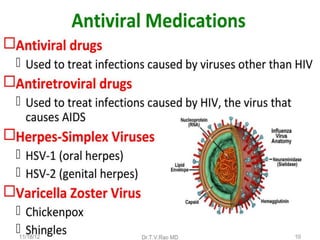
    Antiviral Drug  Antiviraldrug, any agent that is used in the treatment of an infectious disease caused by a virus.  Viruses are responsible for illnesses such as HIV/AIDS, influenza, Herps simplex type I (cold sores of the mouth) and type II (genital herpes), herpes zoster (shingles), viral hepatitis, encephalitis, infectious mononucleosis, and the common cold.
  • 47.
    Useable Drugs… • Abacavir Usefor HIV • Acyclovir (Aciclovir) Use for herpes e.g. Chicken pox • Adefovir Use for chronic Hepatitis B • Amantadine Use for influenza • Amprenavir (Agenerase) Use for inhibition of HIV
  • 48.
    History…. The first modestsearch for antiviral drugs occurred in early 1950’ s. Chemists looked at derivatives of sulfonamide antibiotics. Idoxuridine : the first useful antiviral .The Decreption of 5-iodo-2-deoxyuridine by Dr Bill prusoff in 1959 and the realization of its antiviral properties.
  • 49.
     In the1960 and 1970 ‘s drug companies launched huge “ blind –Screening” programs to find chemicals with antiviral activity.  In 1995 –first protease inhibitor sequinavir FDA Approved  In 1996 first NNRTI Nevirapine approved by FAD  March 2003- first fusion inhibitor Enfuvirtide approved by FAD
  • 50.
    Some Facts…….  Mostdrug Affect host cell – Unacceptable Toxicity  Most Drug Inhibitor viral replication  Replication start again when drug is discontinued  Good host immunity is essential  Current drugs do not affect dormate virus
  • 51.
    ANTIVIRAL DRUGS FORINFLUENZA There are four types of flu antiviral are: • Amantadine • Rimantadine • Oseltamivir • zanamivir  Amantadine and rimantadine these drugs work against influenza type A viruses, but not influenza type B viruses.  They are thought to inhibit the activity of an influenza A viral protein, which prevents the virus from replicating after it enters a cell.
  • 52.
     Zanamivir (aninhaled powder) and oseltamivir (oral drug) are medications known as neuraminidase inhibitors.  Block the active site of the influenza viral enzyme neuraminidase, which is found in both influenza A and influenza B viruses.  This enzyme normally breaks the bonds that hold new virus particles to the outside of an infected cell.  This frees new viruses to infect other cells and spread infection.
  • 53.
     Neuraminidase inhibitors'ability to block this enzyme's activity prevents new virus particles from being released. This limits the spread of infection. Effects of oseltamivir: • nausea • vomiting • diarrhea • abdominal pain • insomnia
  • 54.
    ANTI-HERPES DRUGS Acyclovir • Ithas greater specificity than Vidarabine against herpes viruses. • Use in the treatment of choice in HSV encephalitis and increase rate of survival. • It is given prophylactically to sero +ve patients before bone marrow & after heart transplants
  • 57.
    ANTIVIRAL DRUGS FORHEPATITIS Interferon: • Naturally occurring inducible glycoprotein • Interfere with ability of viruses to infect cells • Synthetically prepared by Recombinant DNA • technology • Three types Exist ▪ Alpha ▪ Beta ▪ Gamma • Interferon alpha-2b has been approver for the treatment of Hepatitis B & C, Condylomata acuminata and Cancer • Interferon Beta has some effectiveness in treatment of • Multiple sclerosis
  • 58.
    Mode of Action •Induction of host cell enzymes • Inhibit Viral RNA translation leading to • degradation of Viral mRNA & tRNA • The Exact mechanism is incompletely understood
  • 59.
    Adverse Effects • Fatigue •Mental Depression • Bone marrow suppression including • Neurotoxicity • Hypersensitivity reaction and Hepatic failure are rare