HIV/AIDS in Sudan

Geneva Foundation for Medical Education
            and Research
          GFMER Sudan 2012
            Forum No: (2)
Name of presenter
Name              Position            Institution
Mishkat Shehata   Junior Doctor       Ministry of Health


        Name of contributors
Name              Position            Institution
Osman Abass       Head of STIs Unit   Ministry of Health
Content of the presentation
•   Overview
•   Social and behavioural impact
•   Overview of National Response
•   SNAP
•   Mother-to-Child Transmission
•   Prevention through skin piercing & surgical instruments
•   Prevention through blood transfusions
•   Access to Treatment
•   HIV Testing
•   Surveillance
•   Challenges & Gaps
•   Conclusion
•   References
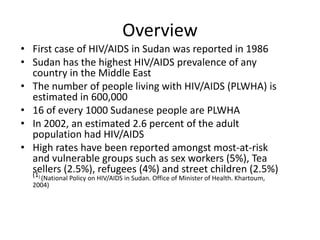
Overview
• First case of HIV/AIDS in Sudan was reported in 1986
• Sudan has the highest HIV/AIDS prevalence of any
  country in the Middle East
• The number of people living with HIV/AIDS (PLWHA) is
  estimated in 600,000
• 16 of every 1000 Sudanese people are PLWHA
• In 2002, an estimated 2.6 percent of the adult
  population had HIV/AIDS
• High rates have been reported amongst most-at-risk
  and vulnerable groups such as sex workers (5%), Tea
  sellers (2.5%), refugees (4%) and street children (2.5%)
  (1) (National   Policy on HIV/AIDS in Sudan. Office of Minister of Health. Khartoum,
  2004)
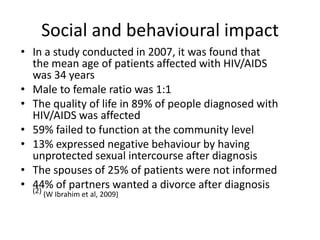
Social and behavioural impact
• In a study conducted in 2007, it was found that
  the mean age of patients affected with HIV/AIDS
  was 34 years
• Male to female ratio was 1:1
• The quality of life in 89% of people diagnosed with
  HIV/AIDS was affected
• 59% failed to function at the community level
• 13% expressed negative behaviour by having
  unprotected sexual intercourse after diagnosis
• The spouses of 25% of patients were not informed
• 44% of partners wanted a divorce after diagnosis
  (2)
    (W Ibrahim et al, 2009)
Overview of National Response

• The National AIDS Council (NAC) is the
  highest level of policy and is headed by the
  governor

• The National Executive Council on HIV/AIDS
  (NECHA) is chaired by the Undersecretary of
  the Federal Ministry of Health. It is
  responsible for execution, coordination and
  overall management of the national response
  (NR) (1)
SNAP
•    The Sudan National AIDS Control Programme (SNAP) was established since
    1987 and is a program within the Communicable Disease Control in the
    Federal Ministry of Health (FMOH) (1)
•   It is the technical department responsible for policy, planning and
    coordination at a national level. It liaises with different sectors such as the
    ministries of defense, interior, education, higher education, information and
    communication, labour, culture, youth and sports, social welfare and women
    and child affairs (3) (UNGASS Report, 2010)
•    SNAP acts within the framework of NAC and NECHA and is mandated to
    develop the health sector plan to ensure the availability and accessibility to
    quality standards of HIV/AIDS services (1)
General Objectives
•   The main objective of Sudan National Strategy for Reproductive Health was aimed at
    keeping HIV/AIDS prevalence less than 2% by 2010
•   In addition, it aimed to limit the transmission of HIV/AIDS infection through appropriate
    strategies and proper interventions
•   It also aimed to reduce morbidity and mortality due to HIV/AIDS and to improve the
    quality of live of People Living with HIV/AIDS (PLWHA)
•   It identified the need to build the competence of the different partners involved in the
    prevention and control of HIV/AIDS
•   It aimed to organise national & international resources for the prevention and control
    of HIV/AIDS (1)
Budget
• The cost of the initiative was 200 million USD;
  only one million out of the 200 that is needed
  to implement the National Strategic Plan of
  2003-2004 was available at that time (1)

• For 2004-2009, the budget set for
  achievement of objectives was 19, 119, 391,
  10 USD (4) (Sudan National Strategic Plan and Sectoral Plans on HIV/AIDS. Sudan
   National AIDS Council. 2004-2009)
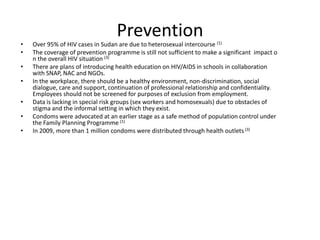
Prevention
•   Over 95% of HIV cases in Sudan are due to heterosexual intercourse (1)
•   The coverage of prevention programme is still not sufficient to make a significant impact o
    n the overall HIV situation (3)
•   There are plans of introducing health education on HIV/AIDS in schools in collaboration
    with SNAP, NAC and NGOs.
•   In the workplace, there should be a healthy environment, non-discrimination, social
    dialogue, care and support, continuation of professional relationship and confidentiality.
    Employees should not be screened for purposes of exclusion from employment.
•   Data is lacking in special risk groups (sex workers and homosexuals) due to obstacles of
    stigma and the informal setting in which they exist.
•   Condoms were advocated at an earlier stage as a safe method of population control under
    the Family Planning Programme (1)
•   In 2009, more than 1 million condoms were distributed through health outlets (3)
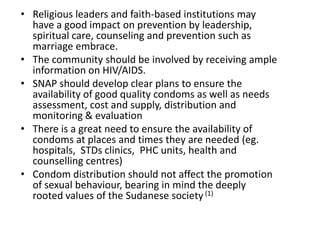
• Religious leaders and faith-based institutions may
  have a good impact on prevention by leadership,
  spiritual care, counseling and prevention such as
  marriage embrace.
• The community should be involved by receiving ample
  information on HIV/AIDS.
• SNAP should develop clear plans to ensure the
  availability of good quality condoms as well as needs
  assessment, cost and supply, distribution and
  monitoring & evaluation
• There is a great need to ensure the availability of
  condoms at places and times they are needed (eg.
  hospitals, STDs clinics, PHC units, health and
  counselling centres)
• Condom distribution should not affect the promotion
  of sexual behaviour, bearing in mind the deeply
  rooted values of the Sudanese society (1)
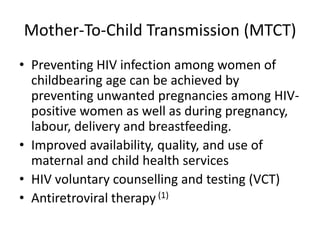
Mother-To-Child Transmission (MTCT)
• Preventing HIV infection among women of
  childbearing age can be achieved by
  preventing unwanted pregnancies among HIV-
  positive women as well as during pregnancy,
  labour, delivery and breastfeeding.
• Improved availability, quality, and use of
  maternal and child health services
• HIV voluntary counselling and testing (VCT)
• Antiretroviral therapy (1)
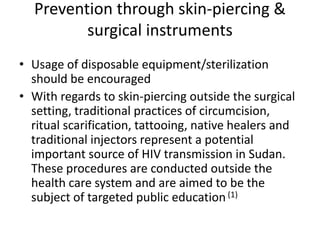
Prevention through skin-piercing &
         surgical instruments
• Usage of disposable equipment/sterilization
  should be encouraged
• With regards to skin-piercing outside the surgical
  setting, traditional practices of circumcision,
  ritual scarification, tattooing, native healers and
  traditional injectors represent a potential
  important source of HIV transmission in Sudan.
  These procedures are conducted outside the
  health care system and are aimed to be the
  subject of targeted public education (1)
Prevention through blood transfusions


• Mandatory screening for blood and blood
  products before transfusion should be
  introduced in all hospitals/blood banks in
  private and public sectors at a national level

• Decisions on tests to be adopted and kits to
  be used are taken by the National Health
  Laboratory (NHL) and SNAP (1)
Access to Treatment
• Treatment consists of anti-retroviral therapy
  (ART) and co-management of Tuberculosis (1)
• There is an urgent need to improve access to
  treatment. There is a considerable gap in the
  number of patients started on ART and those
  currently on treatment. Retention and patient
  tracking are issues at hand
• Links between HIV services are weak and need
  clear-cut referral systems
• Integration of health services is a priority (3)
•   Total numbers of ART centers have increased from 21 in 2007 to
    32 in 2009
•   About 5,710 patients were provided with cotrimoxazole prophylaxis.
•   CD4 monitoring coverage was improved by providing
    at least one machine per state.
•   A nutrition programme targeting PLWHA was initiated
•   The TB/HIV services expanded to all states with a minimum of
    one centre per state.
•   In Sudan, the overall coverage of TV/HIV is estimated at 8 percent.
•   VCT centres have increased from 55 in 2007 to 132 in 2009
•   The number of MTCT facilities increased from seven in 2007 to 27
    in 2009, resulting in an increased number of pregnant women with
    access to HIV testing and counselling (3)
HIV Testing
• Promotion of early diagnosis of HIV infection
  through voluntary testing with pre- and post-
  test counselling
• Reassure HIV-negative persons to take
  precautionary measures to not get infected
• Counsel and support HIV-positive persons
• Integration of Primary Health Care (PHC) and
  Voluntary Counselling and Testing (VCT)
  centres is needed (1)
• The current reach of HIV testing services remains
  poor. The reality is that stigma and discrimination
  continue to stop people from having an HIV test
• ‘3 Cs’: Confidentiality, Counselling and Consent
• The standards of HIV testing will be determined
  and monitored by the virology department in
  liaison with SNAP
• NHL is responsible for quality control for all
  institutions running HIV testing and confirmatory
  tests
• It should be offered free of charge or at the
  lowest possible and affordable price to the general
  population (1)
Types of HIV Testing
• Voluntary Counselling and Testing (VCT): Test
  providers should conform to the UNAIDS/WHO
  new guidelines to encourage the use of rapid
  tests so that results are provided in a timely
  fashion and can be followed up immediately with
  a first post-test counselling session for both HIV-
  negative and HIV-positive individuals.
• Diagnostic HIV Testing: When there are signs and
  symptoms consistent with HIV/AIDS
• Mandatory Testing: Blood and blood product
  transfusions
Surveillance
• Monitoring and evaluation of the response and
  the assessment of outcomes need a reliable
  surveillance system
• HIV Sentinel Surveillance
• AIDS Case Surveillance: To assess the incidence of
  AIDS cases in the country, data is collected from
  hospitals
• Behavioural Surveillance surveys
• Special survey of sero-prevalence: High-risk and
  vulnerable groups (1)
Challenges & Gaps
•   The need to understand the profile and sizes of most-at-risk groups
•   More focus is required on community mobilization to access and
    utilization of services
•   The need to strengthen current health system to achieve Universal
    Access targets
•   Strengthen current surveillance system to improve knowledge on
    trends and extent of epidemic
•   Give support to capacity building and leadership of government, NGOs
    and people living with HIV groups.
•   Re-enforce government coordination and decentralization efforts (5)
    (UNAIDS Country Situation. Sudan. 2009)
Conclusion
• Strategies and Plans of the NR are sound,
  however there is lack of funding from the
  government and participating international
  bodies to help control the HIV/AIDS situation
  in Sudan
• Poor surveillance system
• Access to treatment for high-risk groups and
  the community is lagging behind
• Not enough effort is put in prevention
  strategies in terms of condom distribution
  and health education
• Stigma and discrimination are a hindering
  factor as they are still major issues
• The new strategic plan for 2010‐2014
  has prioritized to address most-at-risk
  populations (MARPs) and
  vulnerable populations (3)
• There is improvement of TB/HIV services
  and nutritional support programmes
References
1. National Policy on HIV/AIDS in Sudan. Office of
   Minister of Health. Khartoum, 2004
2. W Ibrahim, K Elmusharaf, M Ali. Social and
   behavioural impact of HIV/AIDS on Sudanese patients
   after the diagnosis. Contraception 01/2009; 80:221
3. United Nations General Assembly Special Session on
   HIV/AIDS (UNGASS Report) 2008-2009. Sudan
   National AIDS Program. 2010
4. Sudan National Strategic Plan and Sectoral Plans on
   HIV/AIDS. Sudan National AIDS Council. 2004-2009
5. UNAIDS Country Situation. Sudan. 2009

HIV/AIDS in sudan

  • 1.
    HIV/AIDS in Sudan GenevaFoundation for Medical Education and Research GFMER Sudan 2012 Forum No: (2)
  • 2.
    Name of presenter Name Position Institution Mishkat Shehata Junior Doctor Ministry of Health Name of contributors Name Position Institution Osman Abass Head of STIs Unit Ministry of Health
  • 3.
    Content of thepresentation • Overview • Social and behavioural impact • Overview of National Response • SNAP • Mother-to-Child Transmission • Prevention through skin piercing & surgical instruments • Prevention through blood transfusions • Access to Treatment • HIV Testing • Surveillance • Challenges & Gaps • Conclusion • References
  • 4.
    Overview • First caseof HIV/AIDS in Sudan was reported in 1986 • Sudan has the highest HIV/AIDS prevalence of any country in the Middle East • The number of people living with HIV/AIDS (PLWHA) is estimated in 600,000 • 16 of every 1000 Sudanese people are PLWHA • In 2002, an estimated 2.6 percent of the adult population had HIV/AIDS • High rates have been reported amongst most-at-risk and vulnerable groups such as sex workers (5%), Tea sellers (2.5%), refugees (4%) and street children (2.5%) (1) (National Policy on HIV/AIDS in Sudan. Office of Minister of Health. Khartoum, 2004)
  • 7.
    Social and behaviouralimpact • In a study conducted in 2007, it was found that the mean age of patients affected with HIV/AIDS was 34 years • Male to female ratio was 1:1 • The quality of life in 89% of people diagnosed with HIV/AIDS was affected • 59% failed to function at the community level • 13% expressed negative behaviour by having unprotected sexual intercourse after diagnosis • The spouses of 25% of patients were not informed • 44% of partners wanted a divorce after diagnosis (2) (W Ibrahim et al, 2009)
  • 8.
    Overview of NationalResponse • The National AIDS Council (NAC) is the highest level of policy and is headed by the governor • The National Executive Council on HIV/AIDS (NECHA) is chaired by the Undersecretary of the Federal Ministry of Health. It is responsible for execution, coordination and overall management of the national response (NR) (1)
  • 9.
    SNAP • The Sudan National AIDS Control Programme (SNAP) was established since 1987 and is a program within the Communicable Disease Control in the Federal Ministry of Health (FMOH) (1) • It is the technical department responsible for policy, planning and coordination at a national level. It liaises with different sectors such as the ministries of defense, interior, education, higher education, information and communication, labour, culture, youth and sports, social welfare and women and child affairs (3) (UNGASS Report, 2010) • SNAP acts within the framework of NAC and NECHA and is mandated to develop the health sector plan to ensure the availability and accessibility to quality standards of HIV/AIDS services (1)
  • 10.
    General Objectives • The main objective of Sudan National Strategy for Reproductive Health was aimed at keeping HIV/AIDS prevalence less than 2% by 2010 • In addition, it aimed to limit the transmission of HIV/AIDS infection through appropriate strategies and proper interventions • It also aimed to reduce morbidity and mortality due to HIV/AIDS and to improve the quality of live of People Living with HIV/AIDS (PLWHA) • It identified the need to build the competence of the different partners involved in the prevention and control of HIV/AIDS • It aimed to organise national & international resources for the prevention and control of HIV/AIDS (1)
  • 11.
    Budget • The costof the initiative was 200 million USD; only one million out of the 200 that is needed to implement the National Strategic Plan of 2003-2004 was available at that time (1) • For 2004-2009, the budget set for achievement of objectives was 19, 119, 391, 10 USD (4) (Sudan National Strategic Plan and Sectoral Plans on HIV/AIDS. Sudan National AIDS Council. 2004-2009)
  • 12.
    Prevention • Over 95% of HIV cases in Sudan are due to heterosexual intercourse (1) • The coverage of prevention programme is still not sufficient to make a significant impact o n the overall HIV situation (3) • There are plans of introducing health education on HIV/AIDS in schools in collaboration with SNAP, NAC and NGOs. • In the workplace, there should be a healthy environment, non-discrimination, social dialogue, care and support, continuation of professional relationship and confidentiality. Employees should not be screened for purposes of exclusion from employment. • Data is lacking in special risk groups (sex workers and homosexuals) due to obstacles of stigma and the informal setting in which they exist. • Condoms were advocated at an earlier stage as a safe method of population control under the Family Planning Programme (1) • In 2009, more than 1 million condoms were distributed through health outlets (3)
  • 13.
    • Religious leadersand faith-based institutions may have a good impact on prevention by leadership, spiritual care, counseling and prevention such as marriage embrace. • The community should be involved by receiving ample information on HIV/AIDS. • SNAP should develop clear plans to ensure the availability of good quality condoms as well as needs assessment, cost and supply, distribution and monitoring & evaluation • There is a great need to ensure the availability of condoms at places and times they are needed (eg. hospitals, STDs clinics, PHC units, health and counselling centres) • Condom distribution should not affect the promotion of sexual behaviour, bearing in mind the deeply rooted values of the Sudanese society (1)
  • 14.
    Mother-To-Child Transmission (MTCT) •Preventing HIV infection among women of childbearing age can be achieved by preventing unwanted pregnancies among HIV- positive women as well as during pregnancy, labour, delivery and breastfeeding. • Improved availability, quality, and use of maternal and child health services • HIV voluntary counselling and testing (VCT) • Antiretroviral therapy (1)
  • 15.
    Prevention through skin-piercing& surgical instruments • Usage of disposable equipment/sterilization should be encouraged • With regards to skin-piercing outside the surgical setting, traditional practices of circumcision, ritual scarification, tattooing, native healers and traditional injectors represent a potential important source of HIV transmission in Sudan. These procedures are conducted outside the health care system and are aimed to be the subject of targeted public education (1)
  • 16.
    Prevention through bloodtransfusions • Mandatory screening for blood and blood products before transfusion should be introduced in all hospitals/blood banks in private and public sectors at a national level • Decisions on tests to be adopted and kits to be used are taken by the National Health Laboratory (NHL) and SNAP (1)
  • 17.
    Access to Treatment •Treatment consists of anti-retroviral therapy (ART) and co-management of Tuberculosis (1) • There is an urgent need to improve access to treatment. There is a considerable gap in the number of patients started on ART and those currently on treatment. Retention and patient tracking are issues at hand • Links between HIV services are weak and need clear-cut referral systems • Integration of health services is a priority (3)
  • 18.
    Total numbers of ART centers have increased from 21 in 2007 to 32 in 2009 • About 5,710 patients were provided with cotrimoxazole prophylaxis. • CD4 monitoring coverage was improved by providing at least one machine per state. • A nutrition programme targeting PLWHA was initiated • The TB/HIV services expanded to all states with a minimum of one centre per state. • In Sudan, the overall coverage of TV/HIV is estimated at 8 percent. • VCT centres have increased from 55 in 2007 to 132 in 2009 • The number of MTCT facilities increased from seven in 2007 to 27 in 2009, resulting in an increased number of pregnant women with access to HIV testing and counselling (3)
  • 19.
    HIV Testing • Promotionof early diagnosis of HIV infection through voluntary testing with pre- and post- test counselling • Reassure HIV-negative persons to take precautionary measures to not get infected • Counsel and support HIV-positive persons • Integration of Primary Health Care (PHC) and Voluntary Counselling and Testing (VCT) centres is needed (1)
  • 20.
    • The currentreach of HIV testing services remains poor. The reality is that stigma and discrimination continue to stop people from having an HIV test • ‘3 Cs’: Confidentiality, Counselling and Consent • The standards of HIV testing will be determined and monitored by the virology department in liaison with SNAP • NHL is responsible for quality control for all institutions running HIV testing and confirmatory tests • It should be offered free of charge or at the lowest possible and affordable price to the general population (1)
  • 21.
    Types of HIVTesting • Voluntary Counselling and Testing (VCT): Test providers should conform to the UNAIDS/WHO new guidelines to encourage the use of rapid tests so that results are provided in a timely fashion and can be followed up immediately with a first post-test counselling session for both HIV- negative and HIV-positive individuals. • Diagnostic HIV Testing: When there are signs and symptoms consistent with HIV/AIDS • Mandatory Testing: Blood and blood product transfusions
  • 22.
    Surveillance • Monitoring andevaluation of the response and the assessment of outcomes need a reliable surveillance system • HIV Sentinel Surveillance • AIDS Case Surveillance: To assess the incidence of AIDS cases in the country, data is collected from hospitals • Behavioural Surveillance surveys • Special survey of sero-prevalence: High-risk and vulnerable groups (1)
  • 23.
    Challenges & Gaps • The need to understand the profile and sizes of most-at-risk groups • More focus is required on community mobilization to access and utilization of services • The need to strengthen current health system to achieve Universal Access targets • Strengthen current surveillance system to improve knowledge on trends and extent of epidemic • Give support to capacity building and leadership of government, NGOs and people living with HIV groups. • Re-enforce government coordination and decentralization efforts (5) (UNAIDS Country Situation. Sudan. 2009)
  • 24.
    Conclusion • Strategies andPlans of the NR are sound, however there is lack of funding from the government and participating international bodies to help control the HIV/AIDS situation in Sudan • Poor surveillance system • Access to treatment for high-risk groups and the community is lagging behind • Not enough effort is put in prevention strategies in terms of condom distribution and health education
  • 25.
    • Stigma anddiscrimination are a hindering factor as they are still major issues • The new strategic plan for 2010‐2014 has prioritized to address most-at-risk populations (MARPs) and vulnerable populations (3) • There is improvement of TB/HIV services and nutritional support programmes
  • 26.
    References 1. National Policyon HIV/AIDS in Sudan. Office of Minister of Health. Khartoum, 2004 2. W Ibrahim, K Elmusharaf, M Ali. Social and behavioural impact of HIV/AIDS on Sudanese patients after the diagnosis. Contraception 01/2009; 80:221 3. United Nations General Assembly Special Session on HIV/AIDS (UNGASS Report) 2008-2009. Sudan National AIDS Program. 2010 4. Sudan National Strategic Plan and Sectoral Plans on HIV/AIDS. Sudan National AIDS Council. 2004-2009 5. UNAIDS Country Situation. Sudan. 2009